



Choosing the Right Storage Drawer Trolley for Your Workspace
At its heart, a storage drawer trolley is a simple concept: a mobile, wheeled unit with multiple drawers. But to call it just that would be an understatement. It's a portable powerhouse of organisation, designed to keep your essential supplies sorted and always within arm's reach, whether you're a sewing professional, a visual merchandiser, or a passionate hobbyist.
Beyond Clutter: The Power of Mobile Organisation
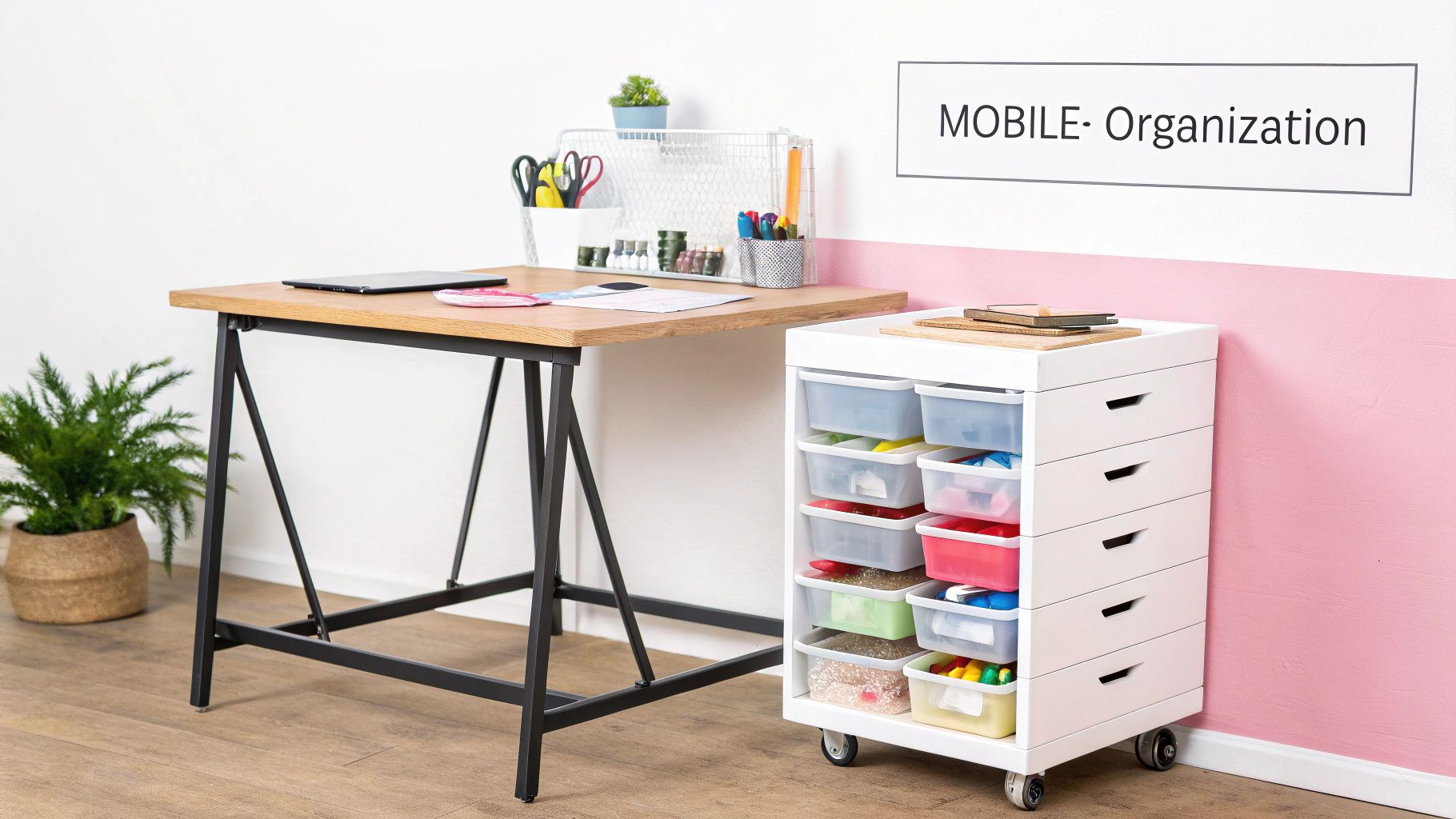
In any creative space, from a bustling sewing studio to a dynamic shop floor, disorganisation is the enemy of productivity. We’ve all been there—time spent hunting for a specific thread, a pricing gun, or the right art supply is time you’ll never get back. This is where a storage drawer trolley stops being just a piece of furniture and becomes a vital part of your workflow.
Think of it as your mobile command centre. Instead of constantly walking over to your supplies, your supplies come to you. It's a simple shift, but one that fundamentally changes how you work, saving precious minutes and clearing the mental fog that comes with clutter. A well-ordered trolley brings a sense of calm and clarity, letting you focus completely on the task at hand.
Transforming Your Workflow with Mobile Storage
The real magic of a storage drawer trolley lies in its sheer adaptability. It's a dynamic system you can reconfigure and relocate to meet the ever-changing demands of your day. This flexibility is a game-changer for professionals who need solutions that can grow with their business or projects.
What does this mean for you?
- Enhanced Efficiency: When everything has a designated home, finding what you need—and putting it away—becomes second nature.
- Smarter Space Management: A vertical trolley makes the most of your floor space, offering a surprising amount of storage on a small footprint.
- True Portability: Move your entire toolkit from one station to another without missing a beat.
This growing need for smart, mobile storage isn't just a hunch. Across the UK, the self-storage sector has swelled to over 50 million square feet, with an annual turnover now topping £1.2 billion. This boom points to a wider demand for effective organisation, especially as e-commerce pushes small businesses to find nimble ways to manage their stock.
For anyone trying to make the most of limited space, looking into tiny house interior design ideas can spark some brilliant insights into clever storage. Mastering mobile organisation is a crucial step towards a more fluid and productive creative process. For more tailored advice, our complete guide to https://www.displayguru.co.uk/blogs/news/sewing-room-organization is a great place to start.
Anatomy of a Storage Drawer Trolley
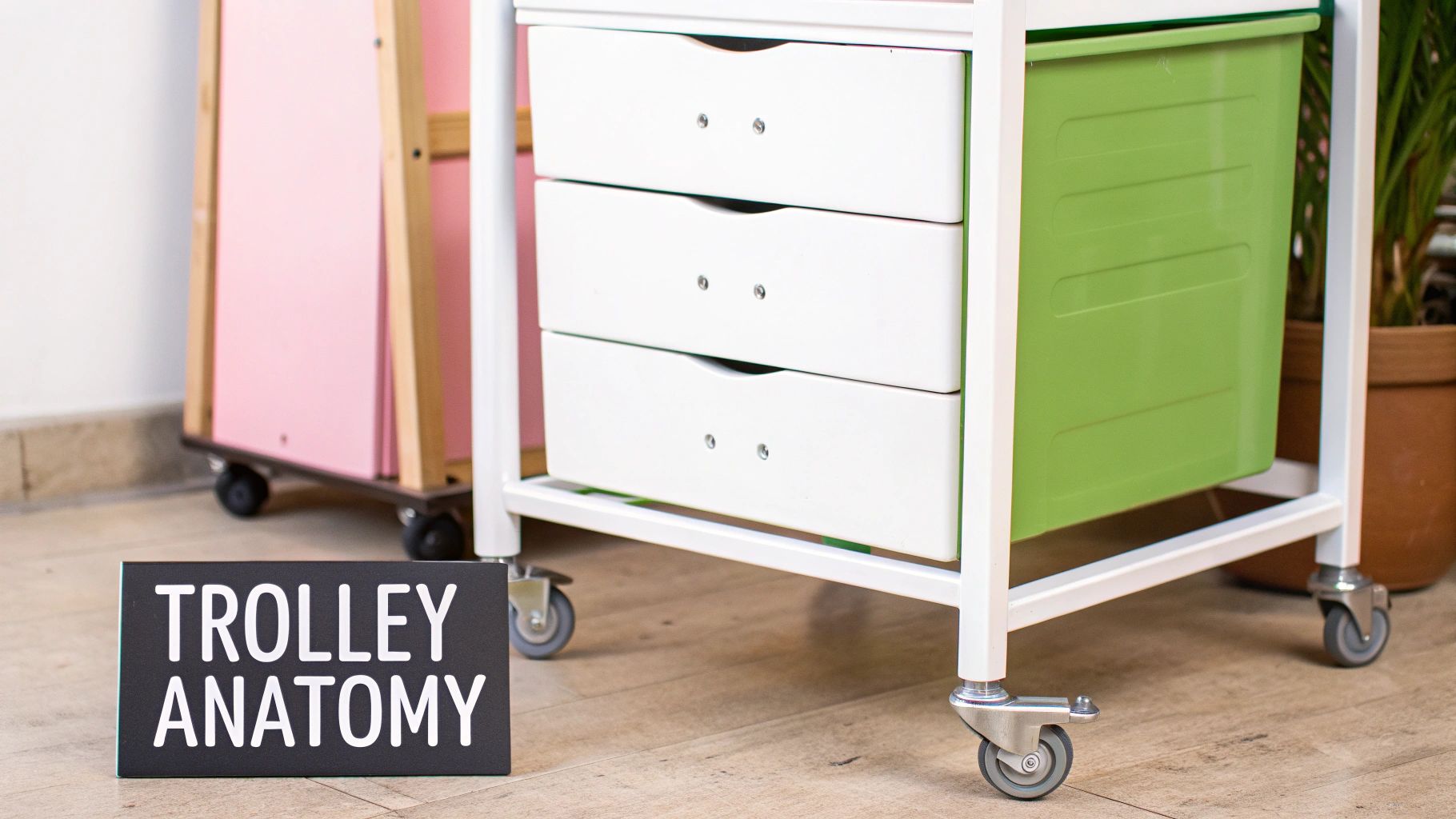
Before you can pick the right storage trolley, you need to know what makes one tick. Think of it less like a piece of furniture and more like a simple machine. Every part has a job to do, and understanding how they work together is the key to finding a unit that won't let you down.
At its core, a storage trolley is made up of three main components: the frame, the drawers, and the casters (the wheels). The frame is the skeleton, giving it strength. The drawers are the heart of the operation, holding all your materials. And the casters are the feet, giving it the freedom to move where you need it most. Let's break down each part.
The Frame: The Structural Skeleton
The frame is the backbone of the entire unit. It’s what provides stability and determines just how much of a workhorse your trolley can be. The material it's made from is the single most important factor, directly impacting its strength and longevity.
Here's a look at what you'll typically find:
- Steel Frames: When you need pure strength, steel is the answer. Often finished with chrome or a powder coating, these frames are built to last and can handle serious weight. If you're storing bolts of fabric, heavy retail stock, or chunky tools, a steel frame is non-negotiable. It resists bending and won't buckle under pressure.
- Plastic Frames: Don't dismiss plastic. Modern, high-quality plastic frames are surprisingly sturdy, lightweight, and have the bonus of being rust-proof. This makes them a brilliant choice for art studios or craft rooms where spills are a part of life. They're generally more budget-friendly and perfect for lighter hobbyist use.
- Wood Frames: For a trolley that needs to blend into a home studio or office, wood or MDF (medium-density fibreboard) offers a warmer, more traditional look. They strike a good balance between style and sturdiness, though they are often heavier and less forgiving of moisture than their plastic or metal counterparts.
Ultimately, the frame dictates the trolley's purpose. Steel is for heavy-duty work; plastic and wood are fantastic for lighter tasks and blending in with your décor.
The Drawers: The Functional Heart
The drawers are where the magic happens. They are the primary reason for buying a trolley in the first place, and their material, size, and style will define how you organise your workflow.
Plastic drawers are by far the most common, and for good reason. They're light, a breeze to clean, and often see-through, which is a massive time-saver. On the other hand, fabric drawers are a great choice for delicate materials like yarn or fine textiles, as they are collapsible and gentle. Just be aware they don't offer the same rigid support for heavier items.
A smart drawer system is about more than just tidiness; it's about pure efficiency. In a busy studio or retail space, transparent drawers can cut down the time you spend searching for an item by up to 30%. You can see what you need at a glance without pulling everything out.
Drawer Types and Configurations
The combination of drawer sizes is just as crucial as the material. Most trolleys come with a mix of shallow and deep drawers to give you more flexibility.
- Shallow Drawers: These are your go-to for small, fiddly bits. For a seamstress, that means buttons, needles, and thread. For a visual merchandiser, it's perfect for pricing tags, clips, and display hooks.
- Deep Drawers: When you need to store bulkier items, you'll be thankful for deep drawers. They easily handle fabric offcuts, paint bottles, skeins of wool, or even small power tools.
- Transparent vs Opaque: The choice is a classic head vs heart dilemma. Transparent drawers are practical, giving you an instant visual inventory. Opaque drawers, however, create a much cleaner, more uniform look and can protect contents that are sensitive to light.
If you’re keen on maximising your storage, taking a look at different ways to organise crafts storage drawers can spark some brilliant ideas for custom layouts.
The Casters: The Foundation of Mobility
Finally, let’s talk about the wheels. The casters might seem like a small detail, but they are what transform a static shelving unit into a dynamic, go-anywhere workstation. The quality of your casters will make or break the user experience.
Always look for casters with a full 360-degree swivel. This lets you glide the trolley smoothly in any direction, even in tight spaces. Crucially, at least two of the four wheels should have a locking mechanism. This is a vital safety feature that keeps the trolley firmly in place while you work.
The wheel material matters, too. Hard plastic wheels are fine for smooth, hard floors, but rubberised casters will give you a much quieter ride, navigate uneven surfaces better, and won't scratch delicate wood flooring.
Finding the Perfect Fit: Size and Load Capacity
Picking the right storage trolley is about more than just the colour or how many drawers it has. It’s a bit of a balancing act between the space you have and the stuff you need to store. Get this wrong, and your brilliant organisational solution quickly becomes a new source of frustration – either it’s too big for the room or too flimsy for your gear.
You really have to think about two things: the physical footprint of the trolley itself, and the weight of what you're going to put in it. A seamstress dealing with hefty bolts of fabric has completely different needs to a makeup artist who needs something slim and nimble to get around a busy studio.
Measuring Your Workspace for a Perfect Match
Before you even think about clicking 'buy', grab a tape measure. Seriously, this is the most important first step. You need to measure not just where the trolley will live, but the entire space it needs to function properly.
Start with the spot you plan to park it. Get the width, depth, and height, especially if you want to slide it under a workbench or desk. But don't stop there. This is where most people trip up.
You have to account for clearance. Think about the room you'll need to:
- Open drawers fully: Can you pull a drawer all the way out and still get to what's inside without smacking into a wall or another bit of furniture?
- Move around it comfortably: A good rule of thumb is to leave at least 60-90 cm (2-3 feet) of clear walkway around the trolley.
- Wheel it about: If you plan on moving it a lot, make sure you have enough of a turning circle to get around corners and through doorways without a three-point turn.
Think of it like parking a car in a garage. You don't just measure the car; you have to account for the space to open the doors. It’s the same with your trolley—it needs "door space" for its drawers and "walking space" for you.
Forgetting to factor in this clearance is the quickest way to turn a mobile storage unit into a permanent, awkward obstacle.
Understanding Trolley Load Capacity
Once you've got your dimensions sorted, the next vital number to consider is load capacity. This is just the total weight a trolley can safely hold without the frame bending, the drawers bowing, or the whole thing becoming dangerously wobbly. It’s a crucial detail for both safety and durability, but it's one that often gets overlooked in favour of looks.
Manufacturers usually list a total load capacity for the whole unit, and sometimes a separate weight limit for each drawer. Pushing past these limits won't just damage the trolley; it creates a serious tipping hazard, especially when you're moving it.
To work out what you need, just do a quick mental inventory of what you plan to store.
- Light-Duty Use (up to 15 kg): This is plenty for hobbyists with lightweight supplies – think yarn, paper, stationery, or small sewing notions.
- Medium-Duty Use (15-30 kg): Great for professionals storing heavier tools, lots of paint bottles, or smaller fabric remnants.
- Heavy-Duty Use (30 kg+): Absolutely essential if you're storing dense, heavy items like full fabric bolts, power tools, or back-of-house retail stock. These models have much tougher frames and casters for a reason.
If you’re managing a serious amount of stock for a retail space or a busy workshop, these principles apply on a much larger scale. When a trolley just isn't enough, understanding how to choose the right heavy-duty rails for a stockroom gives you great insight into managing weight safely and efficiently.
In the end, it’s not about buying the biggest or strongest trolley you can find. It’s about finding the one that slots perfectly into your workspace and handles your day-to-day workflow without a fuss. A few minutes spent measuring your space and estimating your weight needs will make sure your new trolley is an asset from the moment it arrives.
The Small Details That Make a Big Difference
At first glance, a storage drawer trolley seems pretty straightforward. But it's the little details—the features beyond the basic frame and drawers—that separate a simple container from a truly indispensable piece of kit. These are the elements that let you mould the trolley to your exact workflow, whether you're zipping across a busy shop floor or setting up in a cosy sewing studio.
Think of it this way: the right features transform your trolley from a passive box into an active assistant. A good set of locking wheels, for example, stops it from drifting away just as you reach for something. Drawer dividers can mean the difference between a jumble of threads and a perfectly organised palette of colour. Let's dig into the key features that really make a trolley work for you.
Getting Around: Why Quality Casters Are a Must
The wheels, or casters, are hands-down one of the most important parts of any mobile unit. We’ve all wrestled with a wonky shopping trolley, and a storage unit with bad wheels is just as frustrating. What you're looking for is a set of four 360-degree swivel casters. They let you glide the trolley in any direction, making it a breeze to navigate tight corners in a stockroom or manoeuvre around a dressmaker's dummy.
But all that freedom of movement needs a bit of control. That’s where a solid locking mechanism comes in.
A storage drawer trolley without locking casters is like a workbench on ice. It will shift, slide, and drift precisely when you need it to be still, creating not just an annoyance but a potential safety hazard.
Ideally, at least two of the four wheels should have locks that are easy to flick on and off with your foot. This gives you the stability to work directly from the trolley without it rolling away every time you open a drawer. This isn't just a convenience; in a professional setting, it's a matter of safety. UK workplace standards often call for features like reliable locking casters and clear load ratings to keep things secure.
Keeping Your Supplies Safe and Sound
For many of us, a trolley holds more than just odd bits and bobs. It might contain valuable tools, confidential paperwork, or high-value retail supplies. If you’re in a shared studio or need to protect your stock, security features are non-negotiable.
You'll generally find two types of locking systems:
- Single-Key Lock: A central lock secures all the drawers at once with a single turn of a key. It’s a wonderfully efficient way to lock everything down at the end of the day.
- Individual Drawer Locks: For a bit more control, some higher-spec models have separate locks on each drawer. This is perfect if you need to organise supplies by who can access them or simply want to keep your personal tools separate from shared ones.
Making It Your Own: Customising the Layout
An empty drawer is a blank slate. To really get the most out of your trolley, you need options that let you adapt the space to fit what you’re storing. This is how you turn a generic unit into a perfectly organised hub for your work. As many crafters and retailers know, clever internal organisation is one of the most important parts of using storage units for crafts effectively.
Here are a few customisation features to look out for:
- Drawer Dividers: These simple inserts are an absolute game-changer for anyone working with small items. Adjustable dividers let you create perfectly sized compartments for bobbins, beads, buttons, or price tags, stopping them from sliding into one big messy pile at the back.
- Attachable Bins and Hooks: Some systems let you expand your storage outwards. Look for models with side-mounted pegboards, clip-on bins, or simple S-hooks. They give you a handy place to hang the tools you grab most often—scissors, tape measures, pricing guns—without even needing to open a drawer.
Smart Organisation Strategies for Your Workflow
A storage drawer trolley is more than just a place to stash your things; it's a dynamic tool that should bend to your specific workflow. But let's be honest, without a solid plan, even the most promising trolley can quickly become a rolling junk drawer. The real magic happens when you move beyond simple tidying and create an intuitive system that turns your trolley into a command centre for your craft or profession.
Think of it as transforming a simple cupboard into a well-oiled machine. For a sewing pro, this might mean dedicating drawers to different stages of a project. A visual merchandiser could group tools by task—pricing, display building, and so on. The goal is to make your trolley an extension of your own process, cutting down on wasted time and frustration.
Designing a Layout for Sewing Professionals
For any busy tailor or seamstress, time is money. A 10-drawer trolley can be organised to mirror the entire garment-making journey, from the first cut to the final stitch. When everything has its place, you can grab what you need in a heartbeat without breaking your focus.
Here’s a practical layout to get you started:
- Top Drawers (1-2): Your everyday essentials. This is for your scissors, rotary cutters, seam rippers, and measuring tapes—the tools you reach for constantly.
- Middle Drawers (3-5): A home for threads and bobbins. Organising these by colour makes finding the perfect match a quick visual scan.
- Mid-to-Lower Drawers (6-8): All your fastenings and hardware. Give zips, buttons, hooks, and snaps their own separate drawers to avoid a jumbled mess.
- Bottom Drawers (9-10): Reserved for project-specific items like fabric offcuts, interfacing, or your current works-in-progress.
For more ideas on making the most of every square inch, have a look at these tips for optimizing the contents of your drawers, which can easily be adapted for craft supplies.
A System for Retail and Visual Merchandising
On a bustling shop floor, a storage trolley is your mobile workstation for setting up displays and handling daily maintenance. The aim here is to have everything you need for a task in one place, which means fewer trips back and forth to the stockroom. A well-sorted trolley is a serious productivity booster.
In the UK, professional buyers are increasingly choosing storage trolleys based on their impact on labour efficiency. With rising operational costs, ergonomic and mobile systems that speed up tasks are seen as a smart investment.
A logical setup for a visual merchandiser might look like this:
- Top Level: Your pricing gun, spare label rolls, and a scanner.
- Upper Drawers: All things signage. This includes different sizes of sign holders, clips, and promotional cards.
- Middle Drawers: Fastening tools like cable ties, pins, tape, and a trusty staple gun.
- Lower Drawers: Bulkier items like seasonal props, cleaning supplies, or neatly folded display fabrics.
This kind of hierarchy ensures your most-used items are always within easy reach.

As the chart above shows, features like casters, security, and the ability to customise are the foundations of a great trolley. Keeping these in mind helps you choose a model that truly supports your day-to-day work.
Sample Drawer Layouts by Profession
To give you a clearer picture, here’s how a standard 10-drawer trolley could be set up for different professions. This is just a starting point—feel free to adapt it to your own unique needs!
| Drawer Number | Sewing Professional Layout | Visual Merchandiser Layout | Art Hobbyist Layout |
|---|---|---|---|
| 1-2 | Cutting tools, measuring tapes | Pricing gun, labels, scanner | Pencils, charcoals, erasers |
| 3 | Threads by colour | Sign holders & clips | Inks, pens, nibs |
| 4 | Bobbins & needles | Promotional cards & tags | Watercolour paints |
| 5 | Zips & closures | Cable ties, tape, pins | Acrylic or oil paints |
| 6 | Buttons & snaps | Staple gun & staples | Brushes & palette knives |
| 7 | Interfacing & elastic | Cleaning cloths & sprays | Mediums & varnishes |
| 8 | Fabric scraps & offcuts | Small seasonal props | Sketchbooks & paper pads |
| 9-10 | Current project pieces | Folded display fabrics | Spare canvases, palettes |
These layouts show how a bit of planning can turn your trolley into an incredibly efficient and specialised tool, no matter your field.
Organising for Artists and Hobbyists
For artists and crafters, a trolley is your best friend for keeping a creative space organised and ready for action. The best strategy here is usually to categorise your supplies by medium, colour, or project type. This isn't just about being tidy; it's about making sure your creative flow is never interrupted by a frantic search for the right tool.
An artist could arrange their trolley something like this:
- Drawer 1: All your drawing tools—pencils, charcoal, and erasers.
- Drawer 2: Inking supplies, from pens and nibs to ink pots.
- Drawers 3-5: Paints, neatly sorted by type (watercolours, acrylics, oils) and then by colour.
- Drawer 6: Brushes and palette knives.
- Drawer 7: Mediums, varnishes, and solvents.
- Bottom Drawers: Larger items like canvases, paper pads, and mixing palettes.
We dive deeper into this topic in our guide on the https://www.displayguru.co.uk/blogs/news/craft-storage-drawer.
Ultimately, by creating a system that’s built around you, your storage trolley becomes less of a piece of furniture and more of an indispensable partner, ensuring your tools are always ready when inspiration strikes.
Putting It Together and Keeping It Rolling: Assembly and Long-Term Care
Think of your new storage trolley as a long-term investment in your workspace. Like any good tool, a little care at the beginning and some simple maintenance along the way will keep it performing at its best for years to come. Getting the assembly right from day one is the secret to a sturdy, reliable trolley you can count on.
Protecting that investment starts the moment you open the box. Most trolleys are designed for straightforward assembly, but a few common missteps can lead to a wobbly unit that just doesn’t feel right. A little patience now will pay off massively down the line.
Getting the Build Right First Time
When you unbox your new trolley, resist the temptation to jump straight into building it. Take a moment to lay out all the parts and compare them against the inventory list in the manual. This simple check saves you the headache of realising a crucial screw is missing halfway through.
Here are a few tips from experience to ensure a rock-solid build:
- Don't tighten everything at once. Hand-tighten all the screws first to get the frame together. Once you’re happy that everything is square and aligned, go back and give them a final, firm tighten.
- Pay attention to the casters. Most trolleys come with two standard wheels and two with locks. For easy access, it’s best to put the locking casters on the front of the trolley so you can engage them with your foot.
- Check the drawer runners. Before you slide the drawers in, make sure the runners are level and securely attached to the frame. This is the key to preventing drawers that stick or sag.
A classic mistake is putting the locking casters on backwards, with the brake lever facing inwards. It makes them almost impossible to use, which completely defeats the point of having a secure, stationary workstation when you need one.
A correctly assembled trolley is about safety, not just stability. In a busy sewing studio or a bustling shop floor, a wobbly frame or poorly installed wheels can be a genuine hazard, especially when it’s fully loaded.
A Simple Maintenance Checklist
Once your trolley is built and in service, a little bit of upkeep makes a huge difference. Regular checks stop small issues—like a loose screw or a stiff wheel—from becoming bigger problems. Just a few minutes every month is all it takes.
Keep your trolley in prime condition with this quick checklist:
- Clean with Care: Wipe down the frame and drawers with a damp cloth to keep them looking professional. Steer clear of harsh, abrasive cleaners on metal frames, as they can scratch the finish.
- Inspect the Hardware: Every couple of months, give all the screws and bolts a quick check to make sure they’re still tight. The small vibrations from rolling the trolley around can sometimes loosen them over time.
- Lubricate the Casters: If the wheels start to squeak or feel stiff, a quick spray of household lubricant will get them spinning freely again.
- Check the Drawer Runners: Make sure the runners are clear of any dust or debris that might cause the drawers to jam or stick.
This kind of proactive care ensures your trolley remains a dependable and functional part of your workflow for the long haul.
Frequently Asked Questions
Even after you've done your homework, a few last-minute questions can crop up before you decide on the perfect storage trolley. Let’s tackle some of the most common ones we hear, giving you that final bit of clarity to make your choice.
Can I Add More Drawers Later On?
For the vast majority of trolleys, the short answer is no. The frame is a fixed structure, designed and built to hold a specific number of drawers securely. Trying to force in an extra drawer isn't just difficult—it can throw the whole unit off balance, making it wobbly and unsafe to move around.
It's always better to plan for the future. If you suspect your fabric stash or art supplies will grow, go for a trolley with a bit more capacity than you need right now. It saves you from having to buy a whole new unit later on.
Think of the trolley's frame like a purpose-built chest of drawers. You can't just slide another drawer into the top. It pays to buy for the space you'll need tomorrow, not just the stuff you have today.
Are the Drawers Removable?
Yes, they almost always are. This is one of the best features of a drawer trolley and what makes them so incredibly useful. Being able to pull a drawer right out means you can take just what you need—say, all your embroidery threads or beading supplies—and pop it on your desk.
This also makes cleaning a breeze. A quick wipe-down is simple when you can remove the drawer completely. And when you want to switch things up and reorganise, you can just shuffle the drawers around without having to empty them first. It’s a huge time-saver.
Can I Replace the Wheels with Better Ones?
Definitely, and it’s a brilliant upgrade to consider. The casters that come as standard are usually fine, but upgrading them can make a world of difference, especially if you’re constantly wheeling your trolley across different surfaces like from a carpeted room to a hard floor.
When you're shopping for new wheels, keep an eye out for:
- 360-degree swivel: This gives you that smooth, effortless glide in any direction.
- Locking brakes: You'll want at least two locking wheels to keep the trolley firmly in place when you need it to stay put.
- Rubberised material: These are quieter, roll more smoothly, and are much kinder to your floors.
Just make sure to double-check the size of the original caster stems before you buy, so you know the new ones will fit. It's a small change that can seriously improve how you use your storage drawer trolley every day.
At Display Guru, we specialise in the kind of high-quality, durable storage that helps professionals and creatives keep their spaces tidy and productive. Find the right trolley to get your workflow in order by exploring our collection at https://www.displayguru.co.uk.