



Your Guide to the Perfect Dressmaker Form Adjustable
At its heart, an adjustable dressmaker form is a life-sized torso mannequin designed to be your perfect stand-in. With dials or keys that let you change the bust, waist, and hip measurements, it becomes a customisable replica of a specific body, making it an indispensable tool for anyone serious about creating clothes that fit beautifully.
Your Essential Partner for Precision Sewing
Imagine having a model available 24/7 who holds their pose perfectly and never complains about being poked with pins. That’s what an adjustable dressmaker form is—the crucial link between a flat paper pattern and a garment that truly comes to life on a three-dimensional body. This guide will show you how this form isn't just equipment; it's the very foundation of successful sewing projects.
A sewer uses an adjustable form in much the same way a sculptor uses an armature to support a clay masterpiece. It provides the underlying structure needed to achieve professional results. This is what separates a garment that just hangs on a body from one that fits with precision, flattering the wearer's shape and moving with them. With a form, you can see exactly how a fabric will drape, check the line of a seam, and tweak the fit in real-time—all without having to constantly try it on yourself.
From Hobbyist to Professional
Whether you're a professional tailor juggling fittings for multiple clients or a home sewing enthusiast dedicated to perfecting your own wardrobe, the core benefit is the same. The power to dial in exact measurements means a single form can stand in for countless different body shapes and sizes, making it an incredibly efficient and versatile investment.
For anyone truly passionate about garment construction, an adjustable dress form isn't a luxury. It's a fundamental tool for getting that professional finish, eliminating guesswork, and saving precious time and fabric.
Professionals rely on these forms to ensure every single stitch contributes to a flawless silhouette. To build the perfect drape and structure into your work, the form acts as a partner to high-quality materials like Pellon Tailors Elite Interfacing. This is why top creative professionals across the UK turn to suppliers like Display Guru for durable, versatile forms that help them bring their visions to life with accuracy and confidence.
So, How Do These Adjustable Forms Actually Work?
Forget thinking of a dressmaker form as just a static mannequin. The best way to picture it is as a highly specialised instrument. A guitarist tightens a string to hit the perfect note; a seamstress turns a dial on a form to capture the unique combination of curves that define a real human body. Let's get into the mechanics of how that happens.
At its heart, an adjustable form uses a clever system of internal mechanisms that let you expand or shrink key areas of the torso. These are usually controlled by dials or keys on the front, back, and sides. The beauty of it is that each dial is linked to a specific measurement, so you can tweak one area without throwing all the others out of sync.
This is all about moving from a flat, 2D pattern to a living, 3D garment. This concept map shows how the form acts as the bridge between precise measurements and a professional-quality fit.
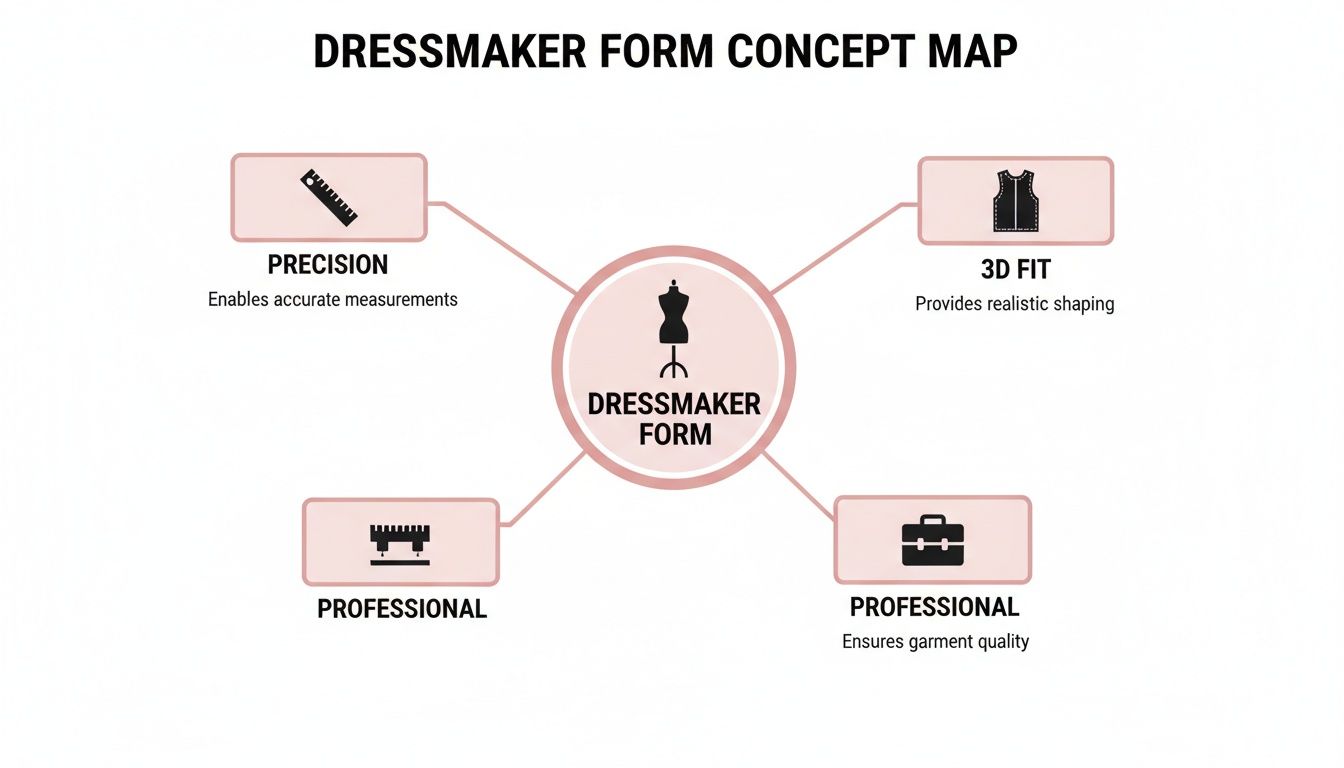
As you can see, the form is the central hub, connecting the dots between accurate measurements and the final, three-dimensional piece.
The Different Ways They Adjust
While there are lots of models out there, most professional forms use one of a few tried-and-true systems. Getting to know them will make it much easier to choose the right tool for the job.
- Dial-Based Systems: This is the most popular setup you'll find. There are typically between eight and twelve dials located across the bust, waist, and hips. Giving a dial a twist moves a panel inside the form, changing the circumference right where you need it.
- Key-Operated Systems: These work a lot like dial systems, but you use a special key to turn an internal worm gear. The action is incredibly smooth and controlled, making it perfect for those tiny, precise adjustments.
- Torso Length Adjustment: This is a game-changer for getting a truly accurate fit. A separate mechanism lets you lengthen or shorten the torso, so you can perfectly match the back-waist length of anyone, from petite to tall.
The real magic happens when you start combining these adjustments. By carefully tuning the bust, waist, hips, and torso length, you can build a near-perfect replica of a client's body. That’s something a standard, fixed-size mannequin could never do.
Comparing Adjustment Mechanisms on Dressmaker Forms
Not all adjustment systems are created equal, and the best one for you really depends on what you’ll be doing. A bespoke tailor making a one-off wedding dress will have different needs from a designer quickly prototyping a new collection. This table breaks down the main types.
| Mechanism Type | How It Works | Level of Precision | Ideal For |
|---|---|---|---|
| Dial Adjustments | Multiple dials expand or contract internal panels at key points. | High | All-purpose use, from bespoke tailoring to general dressmaking. |
| Key Adjustments | A single key turns internal gears for smooth expansion. | Very High | Precision work where tiny, incremental changes are essential. |
| Auto-Set Dials | Dials that click into pre-set size increments. | Medium | Rapidly switching between standard UK dress sizes for retail or classes. |
| Height/Length | A central pole or locking mechanism adjusts torso length. | High | Achieving accurate fit for clients with varying body proportions. |
Ultimately, these systems are all designed to work in harmony, giving you a customisable canvas to work on. They take the guesswork out of pattern making, letting you see exactly how a fabric will hang and drape on a real body.
If you want to dive deeper into what the pros use, our guide on tailor’s adjustable dummies is a great next step. This kind of versatility is precisely why a quality adjustable form is one of the most valuable tools you can have in your sewing studio.
Here is the rewritten section, designed to sound like it was written by an experienced human expert.
What You Really Gain from an Adjustable Form
Let's be honest, an adjustable dressmaker’s form is more than just a piece of kit; it's a game-changer for anyone serious about garment making. When you get one, you’re not just buying a mannequin, you're investing in your entire process. The benefits aren't just theoretical – they show up in three very real ways: pinpoint accuracy, incredible versatility, and a healthier bottom line.
The first thing you'll notice is the jump in precision. An adjustable form becomes your client's (or your own) perfect stand-in, killing the guesswork that so often leads to endless, frustrating fitting sessions. You can drape, pin, and build your garment right on a shape that truly reflects the body it’s meant for, getting the fit right from the very first stitch. This accuracy doesn't just save fabric; it saves your most valuable asset: your time.
One Form, Endless Possibilities
Think about a freelance designer working from a small home studio. With a single adjustable dummy, they can craft custom garments for a whole roster of clients, all with completely different body shapes. A few simple turns of the dials and the form can morph from a petite frame to a fuller figure. Suddenly, the need to own a clutter of fixed-size forms just vanishes, freeing up both precious studio space and a chunk of your budget.
This adaptability is what makes it such a smart long-term investment. Instead of buying a new form every time a new size range walks through your door, one quality model can serve you for years to come. For any professional trying to make their mark in the UK’s dynamic clothing industry, this isn't just a nicety – it's a necessity.
Being able to replicate diverse body types with a single tool gives designers and tailors the power to offer genuinely bespoke clothing. That's a growing slice of the market where precision and a personal touch are everything.
This kind of efficiency is crucial right now. The UK's mannequin market, which includes these vital dressmaker's forms, was valued at a hefty USD 278.2 million in 2023 and is only set to grow. With all the pressures facing the industry, a good dressmaker form adjustable is a powerful tool for maintaining high standards of craft while keeping your operations lean. If you’re interested in the numbers, you can dig deeper into the UK mannequin market outlook in this full research report.
The Smart Money is on a Single Form
Let’s break down the savings a bit more. Imagine you’re setting up a small studio and need to cover a standard range of sizes with traditional, static forms. The cost adds up fast.
- Slash Your Initial Outlay: One adjustable form easily takes the place of at least three or four fixed-size ones.
- Cut Down on Clutter: A single stand has a tiny footprint compared to a collection of mannequins that eat up your floor space.
- Future-Proof Your Studio: As your client list expands and their shapes vary, your form simply adapts along with your business.
At the end of the day, this one piece of equipment allows you to create higher-quality, better-fitting garments, faster. It’s a genuine investment in your craft, and it pays you back on every single project you tackle.
How to Choose the Right Size and Fit
Picking the right size for your dressmaker form adjustable is hands-down the most critical decision you'll make. It’s tempting to think a single adjustable form can cover every possibility, but getting this first step wrong can completely undermine the precision you're trying to achieve. It’s like buying a suit off the rack; you have to start with the closest possible size before you even think about making alterations.
This is about more than just a standard dress size, like a 10 or 14. When looking at an adjustable form, you need to focus on two key numbers: its base size and its expansion range. The base size is the mannequin's smallest possible set of measurements, while the expansion range shows you just how far the bust, waist, and hips can be dialled out.
Taking Your Key Measurements
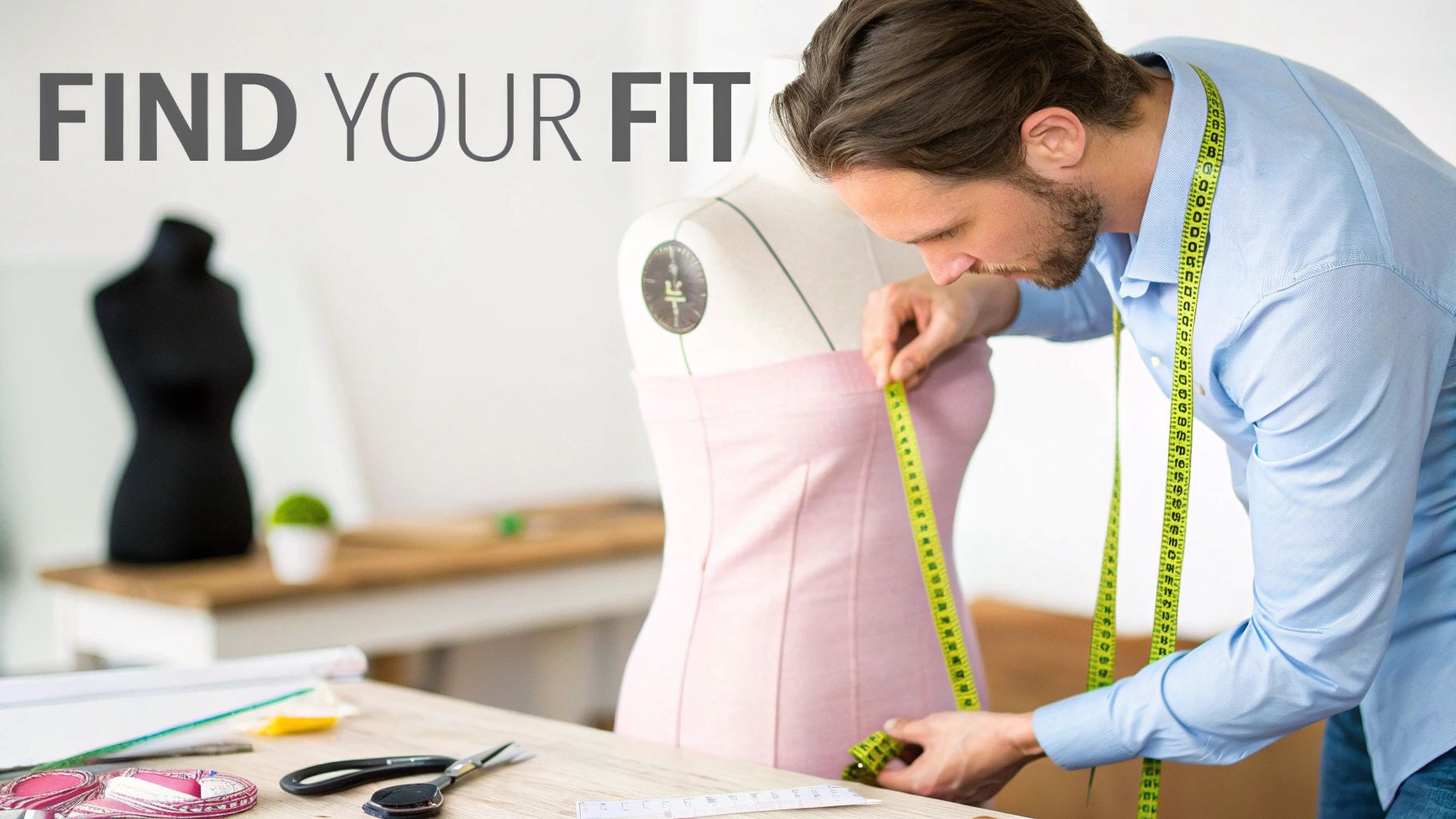
Before you even start browsing, you need a set of accurate measurements for the body you'll be fitting most often, whether that’s your own or a core client's. Grab a soft tape measure and jot down these three essential figures:
- Bust: Measure around the fullest part of the chest, making sure the tape stays level and parallel to the floor.
- Waist: Find the natural waistline—this is usually the narrowest part of the torso—and measure all the way around.
- Hips: Measure around the widest point of the hips and seat.
These numbers are your starting point. To make sure you're measuring properly every time, take a look at our detailed guide on taking accurate mannequin measurements, as the same principles apply here.
Finding the Sweet Spot
Now for the golden rule of choosing your form: Your measurements should fall somewhere in the middle of the form’s adjustment range, not at the extreme ends.
For example, if your waist is 30 inches, you don't want a form with a range of 30-36 inches. Why is that a problem? When a form is expanded to its absolute maximum, the gaps between the panels can become quite wide. This makes the entire structure less stable and creates an uneven surface that's a nightmare to pin into. On the flip side, if you're at the minimum setting, you have zero wiggle room to adjust downwards for other projects.
A professional form is at its most stable and accurate when the dials are only partially extended. By aiming for the middle of the range, you give yourself the maximum flexibility to adjust both up and down—which is the entire reason for buying an adjustable model in the first place.
Real World Sizing Scenarios
Let's look at how this plays out for two different professionals.
-
The Bridal Tailor: A tailor who specialises in bespoke gowns for petite clients (say, UK sizes 6-10) needs a smaller form. A model with a base bust of 33 inches and an expansion range up to 41 inches would be perfect. It allows them to precisely replicate smaller frames while still having enough range to accommodate a slightly larger client without issue.
-
The Theatre Costumer: A costumer working with a diverse cast of actors needs true versatility. They would likely choose a "medium-to-large" form. If the actors typically range from a UK size 12 to 16, a form with a waist range of 28-35 inches would be a very smart buy, placing the majority of their cast squarely in that ideal mid-range.
By matching your most frequent measurement needs to the form’s operational sweet spot, you ensure your dressmaker form adjustable becomes a reliable, stable, and genuinely versatile partner for all your creative work.
Key Features of a Quality Adjustable Form
When you're ready to invest in an adjustable dressmaker form, it’s tempting to focus solely on the fact that it adjusts. But that’s just the starting point. The real difference between a professional tool and a frustrating hobbyist gadget lies in the details.
Think of it like buying a chef's knife. Any knife can cut, but a professional looks for the weight, the balance, and the quality of the steel. It's the same with a dress form; you need to look beyond the basic function to find something that will truly support your work.
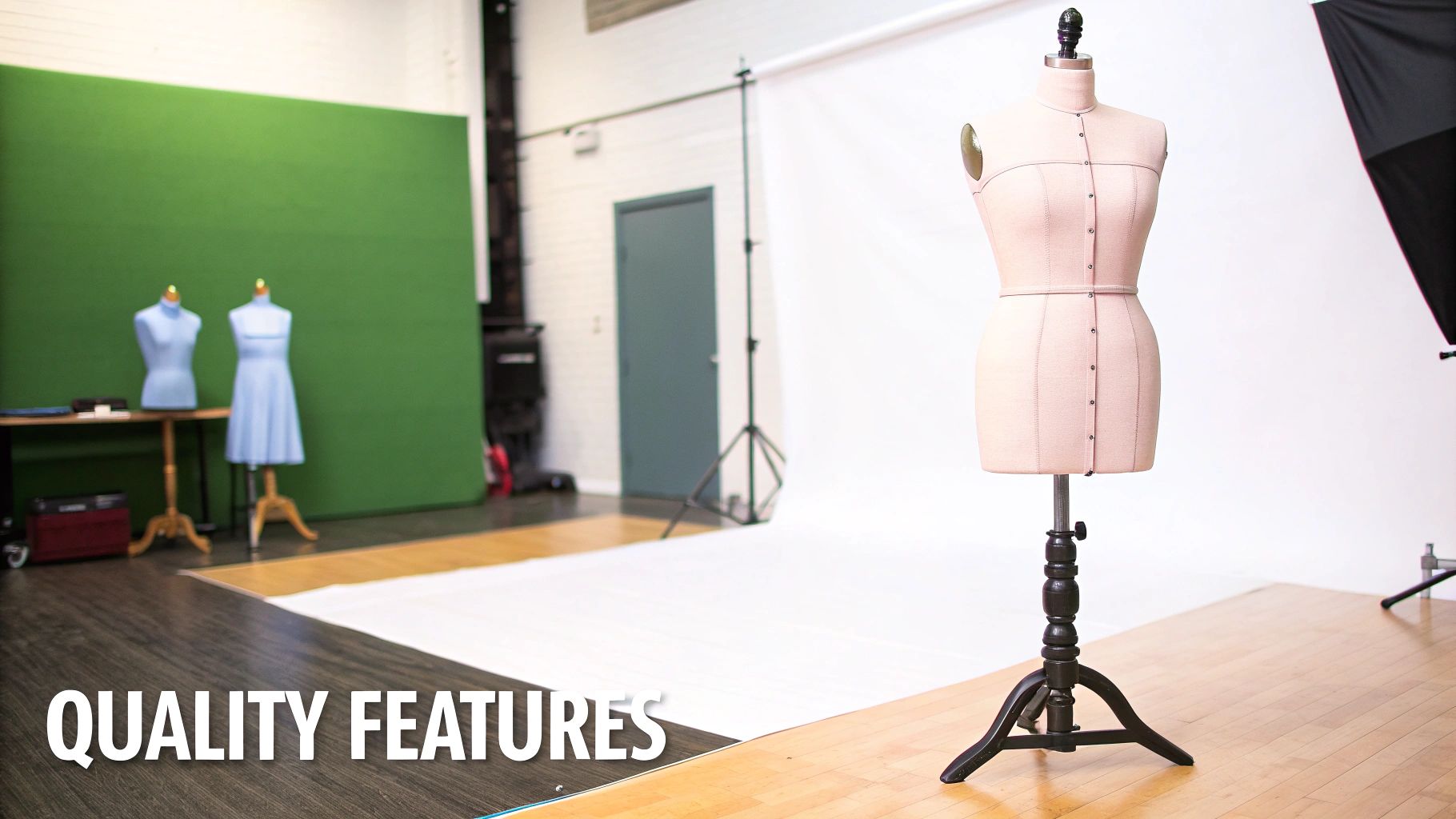
A fully pinnable torso is absolutely non-negotiable for serious draping and pattern-making. This means the body isn't just a hard plastic shell; it's made from a material like high-density foam that lets you push pins straight in, not just sideways. Without that, you can forget about securely holding fabric in place for complex designs.
Stability and Durability
The stand and the internal dials are the unsung heroes of a great dress form. The adjustment mechanisms should feel solid and turn smoothly, allowing for small, precise changes without jamming or slipping. Cheaper forms often use flimsy plastic gears that wear down and strip over time, which can quickly render the whole thing useless.
The base is just as crucial. A sturdy stand is what stops the form from wobbling or toppling over, especially when you're wrestling with heavy wool for a winter coat or metres of delicate silk for a wedding dress. Look for a solid metal construction, either with a tripod-style base or a heavy, weighted bottom for maximum stability.
A professional adjustable form is an investment in your craft's efficiency and accuracy. Its quality is defined by how well it performs under the real-world pressures of pinning, draping, and handling heavy garments day after day.
The demand for these specialised tools is clearly on the rise. The mannequin market, which includes these essential adjustable forms, was valued at USD 312.8 million and is projected to hit USD 1132.6 million by 2035. This huge growth shows just how vital they are becoming in the industry. For anyone interested in the numbers, you can explore more data on the United Kingdom mannequin market growth.
Essential Additions for Precision
Finally, keep an eye out for the thoughtful little extras that make a big difference to your workflow. An integrated hem marker, for instance, is a game-changer. It’s usually a chalk puffer or a simple pin guide that moves up and down a pole, helping you get a perfectly level hemline every single time without the guesswork.
Here's a quick checklist to keep in mind when you're shopping around:
- Fully Pinnable Torso: A must-have for proper draping and pattern work.
- Sturdy Metal Stand: Non-negotiable for stability, especially with heavier fabrics.
- Durable Adjustment Mechanisms: Look for smooth, reliable dials that feel built to last.
- Integrated Hem Marker: An invaluable tool for achieving a professional, even finish.
By prioritising these features, you can be confident that your new dressmaker form adjustable will be a reliable partner for many years and countless projects. To see how all these components work together in practice, take a look at our detailed overview of dress forms for sewing.
Getting the Most Out of Your Dressmaker Form: Setup and Care
Think of your adjustable dressmaker form as a silent partner in your creative process. Like any valuable tool, a little bit of care goes a long way in making sure it stays accurate and reliable for years to come.
It all starts with a solid foundation. When you first set it up, assemble the stand and make sure every screw is properly tightened. A wobbly base is more than just an annoyance; it’s a hazard, especially when you’re draping heavy or expensive fabrics.
When it comes to adjusting the form itself, the key is to be methodical. Instead of cranking one dial all the way to its limit, turn each one a little at a time, moving around the form in sequence. This balanced approach puts less stress on the internal gears and ensures the torso expands evenly, giving you a much more realistic silhouette to work with. It's a bit like tuning a guitar – small, careful tweaks get you the perfect result.
Keeping Your Form in Top Condition
Long-term care is surprisingly simple, but it's the little habits that really protect your investment and maintain the form's accuracy.
- A Quick Clean: Keep a lint roller or a soft brush handy to whisk away dust and stray threads from the fabric cover. If you get a small mark on it, a slightly damp cloth will usually do the trick.
- Sun and Dust Protection: Direct sunlight can cause the fabric to fade over time, so try to keep your form out of bright windows. A simple dust cover is also a brilliant idea for when it’s not in use.
- Smart Storage: Store your form in a dry room with a stable temperature. Keeping your entire sewing space tidy not only helps your workflow but also protects your tools. If you're looking for ideas, there are some great strategies to help you organise your craft supplies that can make a huge difference.
Looking after your dressmaker form isn’t a chore. It’s about safeguarding a key piece of equipment, ensuring it remains a precise and dependable partner for every single project you bring to life.
For a deeper dive into the world of adjustable mannequins, check out our complete guide on the adjustable dressmaking dummy.
Frequently Asked Questions
When you're thinking about investing in a dressmaker's form, a few practical questions always come up. Getting these sorted helps you choose the right model with confidence and get the most out of it from the very first stitch. Let's tackle some of the most common queries we hear.
Can I Pin Directly onto an Adjustable Form?
You certainly can. In fact, a pinnable torso is one of the most crucial features of any serious dressmaker's form. High-quality models, including those from Display Guru, have a body made of high-density polystyrene.
This material is perfect for the job—it’s firm enough to hold its shape but soft enough to let you push pins straight in when you're draping fabric or fitting a pattern. It’s what allows for that professional precision without damaging the form itself.
How Do I Know Which Size Form to Buy?
The best approach is to find a form where your own body measurements sit somewhere in the middle of its adjustment range. Start by taking your bust, waist, and hip measurements accurately.
Once you have those numbers, compare them to the size specifications for each form. Try to steer clear of a model where you're at the absolute smallest or largest end of the range. Choosing one that gives you a bit of wiggle room on either side ensures you have the flexibility for future projects and helps keep the form stable, as it won't be over-extended.
Is an Adjustable Form Stable Enough for Heavy Garments?
Yes, but this is where the quality of the base makes all the difference. A robust stand is what separates a professional tool from a flimsy hobbyist one.
Look for a sturdy metal stand, whether it's a classic tripod design or a weighted circular base. These are specifically designed to provide the balance and stability needed to support a dressmaker form adjustable, even when you’re working with heavy wool coats, thick denim, or the multiple layers of a wedding dress.
For more foundational knowledge, our guide on sewing for beginners can help build your confidence.
Ready to achieve the perfect fit on every project? Explore the professional range of adjustable dressmaker forms at Display Guru and find the ideal partner for your sewing studio. Visit us at https://www.displayguru.co.uk to see our collection.