



Clothes Rail Ends Explained for UK Retail Displays
You're usually looking at clothes rail ends only when something has already gone wrong. A rail starts to dip, hangers drag towards one side, or the bracket loosens even though the tube itself looks fine. Staff blame the rail. Buyers blame the installer. In practice, the problem often sits in the small end fitting that joins one to the other.
That's why I treat clothes rail ends as a structural part first and a finishing detail second. On a UK retail rail, the end is the handshake between tube, bracket and load. If that handshake is weak, the rest of the assembly never really stands a chance.
When the Rail Started Bowing Mid-Morning
It's a familiar shop-floor problem. The rail went up looking straight at opening. By late morning, after a few rounds of replenishment and customers sliding hangers hard against one side, the line has changed. You can see the tube starting to bow, and someone on the team is already redistributing heavier stock just to get through the day.
Look at the centre of the span first. Fair enough. That's where the sag shows. But the failure often starts at the ends, where the tube meets the bracket or upright. If the end fitting is shallow, poorly matched, or too light for the span, the load doesn't transfer cleanly. The tube starts to rack, twist, or creep at the fixing point.
That's why I never think of clothes rail ends as cosmetic caps. They're the parts that locate the tube, hold it in line, and pass the merchandising load into the support system. If you're already dealing with deflection, bracket movement or hanger drag, it's worth checking the clothes rail support options used in retail fittings before assuming the tube is the only weak link.
What the shop floor usually reveals
A rail rarely fails in a dramatic way first. It gives you warnings:
- The tube starts sitting off-centre in the bracket.
- One end shows witness marks from movement around the screw or pin.
- Hangers bunch at one side because the rail is no longer level.
- Staff compensate manually by spreading garments across nearby rails.
A bowed rail is often the visible symptom. The end fitting is often the actual fault line.
In busy retail, that matters more than people think. Once the end loses alignment, the whole run feels cheap and unstable, even when the finish still looks good from a distance.
What a Clothes Rail End Actually Does
A clothes rail end is the fitted piece that terminates the tube and connects it to the fixing system. Sometimes that means a simple stop. Sometimes it means an insert, socket, spigot or bracket-integrated fitting that takes real structural load.
The mistake is assuming all end pieces do the same job. They don't. A push-fit plastic stop and a bracket-mounted metal end can both sit at the end of a rail, but they behave very differently once garments are hung and staff start moving stock at pace.
The four jobs that matter
A good rail end usually handles four things at once:
-
It locates the tube properly
The end keeps the tube concentric with the bracket or support point. If the tube sits off line, the rail doesn't load evenly. -
It resists movement under use
Rails don't just hold static weight. Staff pull garments, push stock along the run, and wheel mobile fixtures across the floor. The end has to resist pull-out, twist and chatter. -
It transfers weight into the support
This is the work. The end takes load from the tube and passes it into the bracket without crushing, deforming or loosening the connection. -
It finishes the rail cleanly
This is the least important structural job, but it still matters. A clean termination improves safety, appearance and how the fixture reads at customer eye level.
The main designs you'll actually meet
Three setups turn up again and again:
-
Push-fit plastic stops
Fine for simple stopping duties and some lighter arrangements. They tidy the end and can stop hangers sliding off, but they aren't a substitute for a proper structural connection. -
Threaded or fixed inserts
Better where the end needs to lock into the bracket or accept a more secure fixing. -
Integrated bracket spigots
Common on stronger commercial systems. The bracket and end relationship is designed as one load path rather than two unrelated pieces.
If you're comparing hardware, it helps to understand the bracket side at the same time as the end side. This guide to clothes rail brackets and how they're used is useful because end performance is always tied to bracket geometry.
Practical rule: If the end only looks like a trim piece, check whether it's actually carrying load or only covering a cut tube.
That distinction saves a lot of ordering mistakes.
Common Types, Materials and Finishes
The UK market gives you a mix of utility hardware and more polished display fittings. Some are built for busy retail rails. Some are built mainly to neaten the finish. The problem comes when buyers mix those two categories without noticing.
The common end types
In day-to-day shopfitting, these are the styles you're most likely to see:
- Internal plastic push-fit caps for simple stop duty and basic finishing
- Zinc die-cast ends that engage more positively with the bracket
- Pressed steel end plates with a locating feature or pin
- Decorative stainless or brass ends used where the fixture is part of the visual scheme
Plastic has its place. It's tidy, cheap, and fast to replace. But on longer spans or heavier stock, it's usually not the answer if the end is doing structural work.
Pressed steel can work, but only where the geometry is right and the load case is modest. It's often the first option people overestimate.
Finish matters more than people admit
Finish isn't just about matching the rail. It affects wear, scratching, visible maintenance and how quickly a display starts looking tired.
- Bright chrome suits classic retail fittings but shows scratches and handling marks quickly.
- Satin chrome hides wear better and usually ages more gracefully.
- Powder-coated black works well in fashion retail and contemporary fit-outs, especially where rails need to visually recede.
- Raw zinc is practical in back-of-house or utility settings.
- Brushed stainless makes sense where corrosion resistance and a cleaner premium look both matter.
| End type | Material | Common finishes | Indicative cost | Best suited to |
|---|---|---|---|---|
| Push-fit cap | Plastic | Black, grey | Low | Light-duty stopping and visual finishing |
| Die-cast end | Zinc alloy | Chrome, satin, painted finishes | Medium | General retail rails where better location is needed |
| Pressed end plate | Steel | Chrome, zinc, powder-coated | Low to medium | Functional shop fittings with compatible brackets |
| Decorative structural end | Stainless steel or brass | Brushed, polished, plated | Medium to high | Premium display runs and customer-facing fittings |
What works and what usually doesn't
What works is matching the end material to the actual job.
- Utility rails respond well to metal ends with decent engagement.
- Premium displays need a finish that wears well under handling, not just one that looks good on day one.
- Light domestic parts usually disappoint when they're dropped into commercial retail use.
Cheap ends save money only if the rail stays straight, aligned and serviceable. If they loosen, mark, or twist, you pay for them twice.
Sizing, Tube Geometry and UK Load Ratings
A lot of bad buying starts here. People order by appearance, then try to make the parts fit on site. With rail ends, sizing has to begin with the tube and the span, not the catalogue photo.
UK retail garment rails are commonly produced in standard widths. One trade guide lists junior rails at 915mm and 1220mm, standard rails from 915mm to 1830mm, and reinforced or fishtail rails from 1220mm to 1830mm. The same guide describes 5ft (1524mm) and 6ft (1830mm) rails as the standard floor-retail sizes. It also notes that commercial rails are tested against BS EN 16121, with examples advertising 160kg and 200kg load capacities, which places the end fitting inside a regulated strength-and-stability system rather than treating it as decoration alone. Those details are set out in the Tradelines retail garment rail guide.
The tube tells you what the end must do
On commercial rails, 32 mm steel tube is a common standard. One UK supplier states that a heavy-duty rail built from 32 mm steel tube with 4 x 2-inch castors is tested to 160 kg spread weight and is compliant with BS EN 16121 clauses 6.1.1 and 6.1.16, which matters because the ends have to pass both static and movement load into the frame without letting it rack or bow. That specification appears on the Display Sense heavy-duty 6ft clothes rail.
If you're checking tube sizes across mixed systems, a quick refresher on scaffold pipe diameter and related sizing conventions helps avoid the usual metric versus nominal confusion.
End-piece compatibility starts with geometry
A rail end has to match more than diameter. You also need to look at:
- Bore depth, so the end engages enough of the tube
- Tube wall thickness, which affects clamping and deformation
- Fixing clearance, especially where grub screws or locating pins are involved
- Bracket alignment, so the load enters the support squarely
Lightweight ends are often fine on shorter spans. They become doubtful as span and stock weight rise.
| Rail Width | Typical Tube Diameter | Minimum End Bore Depth | Recommended BS EN 16121 Rating |
|---|---|---|---|
| 915mm | 32 mm commonly used on commercial rails | Match the rail system and support geometry | Use a commercial system tested to BS EN 16121 |
| 1220mm | 32 mm commonly used on commercial rails | Match the rail system and support geometry | Use a commercial system tested to BS EN 16121 |
| 1524mm | 32 mm commonly used on standard floor-retail rails | Deeper engagement is typically preferable | Use a commercial system tested to BS EN 16121 |
| 1830mm | 32 mm commonly used on standard floor-retail rails | Deep, secure engagement is typically required | Use a commercial system tested to BS EN 16121 |
The point is simple. Once you move into the longer UK retail widths, end selection stops being a tidying-up exercise and becomes part of the engineering of the run.
Why End Design Shapes Merchandising Capacity
Retailers usually talk about capacity in terms of how much stock can fit on a rail. That's only half the question. The other half is whether the end design can keep the load stable while people use the fixture.
The same UK rail guide notes that a 2ft rail typically holds 20 to 30 garments, a 4ft rail 40 to 60, and a 6ft rail 60 to 80. Those capacities are listed in the Tradelines garment rail guide, and they're a useful reminder that end design is tied directly to merchandising, not just finish.
Capacity on paper versus capacity in use
A rail loaded with light shirts behaves differently from the same rail loaded with denim, outerwear or mixed-weight stock. Add staff pulling hangers side to side all day and the load stops behaving like a neat static number.
That's where the end geometry matters. A shallow pressed cap on a longer run can start to creep or concentrate stress at the fixing point. A deeper cast or swaged end usually spreads that load better and keeps the tube truer under use.
| Rail Length | Typical Garment Capacity | End Design Required | Deflection Risk if Under-Specified |
|---|---|---|---|
| 2ft | 20 to 30 garments | Basic commercial end can be suitable if matched to the system | Lower, but still present if poorly fixed |
| 4ft | 40 to 60 garments | More secure engagement is usually advisable | Moderate if the end is shallow or loose |
| 6ft | 60 to 80 garments | Strong end connection with deeper engagement is typically needed | High if the end is too light for the span |
Why the rail twists before it drops
People expect vertical sag. What often happens first is torsion. Hangers are pushed along the tube, garments are pulled from one side, and the rail starts to twist slightly at the ends. Once that movement begins, the bracket sees forces it wasn't meant to absorb in that way.
That's why visual merchandising and fixture hardware can't be separated. Good display practice loads and spaces the rail sensibly, but the hardware still has to survive real handling. If you're planning fixture density, these visual merchandising guidelines for retail displays are useful alongside the hardware spec.
Under-specifying the end is a quiet way to reduce the usable capacity of the whole rail, even when the tube itself looks substantial.
Shop-Floor Rails Versus Wardrobe Rails
Retail rails and wardrobe rails get lumped together too often. They aren't the same job, and their end details shouldn't be selected the same way either.
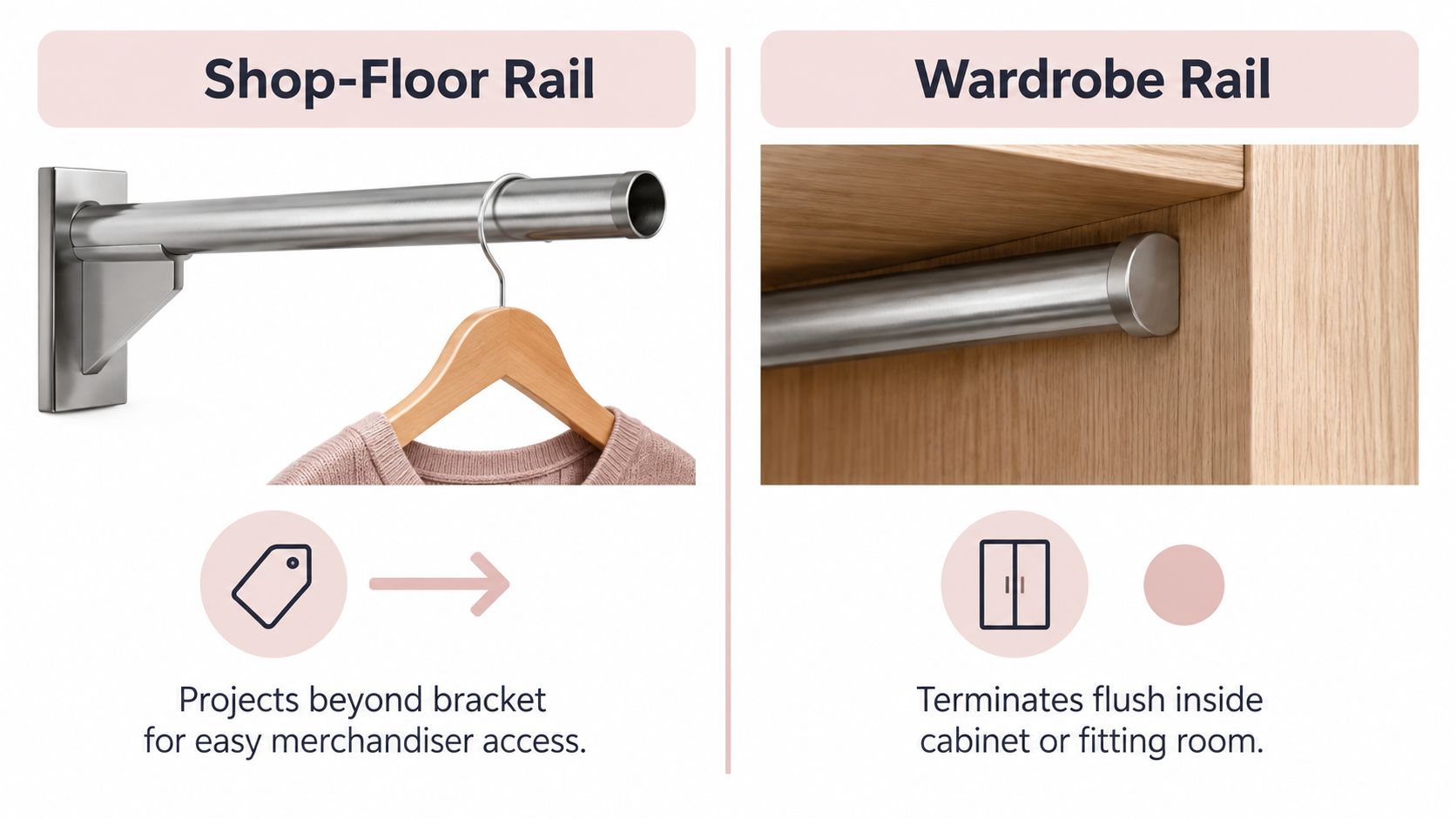
A shop-floor rail usually wants open access, fast rehanging and a cleaner visual line from a normal standing viewpoint. A wardrobe rail usually wants a contained finish inside joinery, with more emphasis on flush fitting, snag reduction and neat termination within a cabinet opening.
Open-ended retail rails
On the shop floor, open-ended systems are common because they help staff move quickly. The tube may project beyond the bracket, and the end may act mainly as a stop, a visual finish, or an accessory mounting point.
These setups suit:
- Wall-mounted display runs
- Gondola-mounted rails
- Freestanding retail fixtures
- Runs that may be extended or reworked later
The emphasis is access and speed. That's why a more exposed end detail is acceptable if it remains stable.
Closed-end wardrobe and fitting-room rails
Wardrobe rails are a different category. One UK hardware supplier lists a curved wardrobe rail using a 30 x 15 x 1.0 mm chrome-plated rail with 825 x 825 mm dimensions, while another UK supplier notes that standard 25 mm round end fittings can be swapped for alternatives for 40x40 cups, E-type tracks, vertical sliding, oval panel and keyhole track or panel systems. Those examples on the SCF Hardware wardrobe rail page show how much the end fitting controls compatibility and load path in fitted storage.
One UK-facing source also notes that end stoppers are needed for some bracket setups but optional for others, which is a useful corrective because many buying guides pretend every end cap is mandatory in every layout. That point appears on the Regalraum wardrobe rail end caps page.
Some rail ends are structural. Some are protective. Some are optional. Problems start when buyers assume they're all the same part with the same job.
End Accessories and the 2025 UK Pricing Shift
Rail ends now do more than finish the tube and carry load. In many shops, they also need to carry information. That changes the specification brief.
UK retail fixture pages already treat end-of-rail displays and sign holders as a normal accessory category. A second pressure point is regulatory. One UK retail-fixture source notes that the Marking of Retail Goods Regulations came into force on 1 July 2025, and that there's now a gap in practical guidance on how end-facing ticket holders, sign holders and related accessories can support clearer pricing and display compliance. That context is laid out on the UK POS garment rail accessories page.
The end cap is now part of communication
That means the end can no longer be chosen only for load and finish where customer-facing information sits at the rail tip. Buyers increasingly need an end piece that can also accept:
- Sign holders
- Ticket carriers
- Promotional message inserts
- Tamper-aware pricing attachments
A weak accessory-ready end is no improvement on a strong plain end. If the sign wobbles, obscures stock, or loosens the fitting, it creates a different operational problem.
Compliance and practicality have to sit together
The better approach is to specify from the start for both functions. Ask whether the end can carry the physical demands of the rail and the day-to-day demands of pricing updates, promo swaps and customer contact.
That usually means checking:
- whether the accessory mount is integrated or added on later
- whether changing tickets requires tools
- whether the sign orientation interferes with hanger travel
- whether the added attachment affects end stability
Retailers running frequent promotional changes feel this first. If the end fitting can take a sign neatly and stay put, staff spend less time improvising with clip-on accessories that were never designed for the rail.
Choosing the Right End Piece and Avoiding Costly Mistakes
The safest way to buy clothes rail ends is to work from the rail backwards. Measure first. Match second. Order last.
A lot of returns come from assumptions. Someone thinks the tube is standard, assumes the end is universal, and only discovers the mismatch when the fitting arrives on site.
A short selection checklist
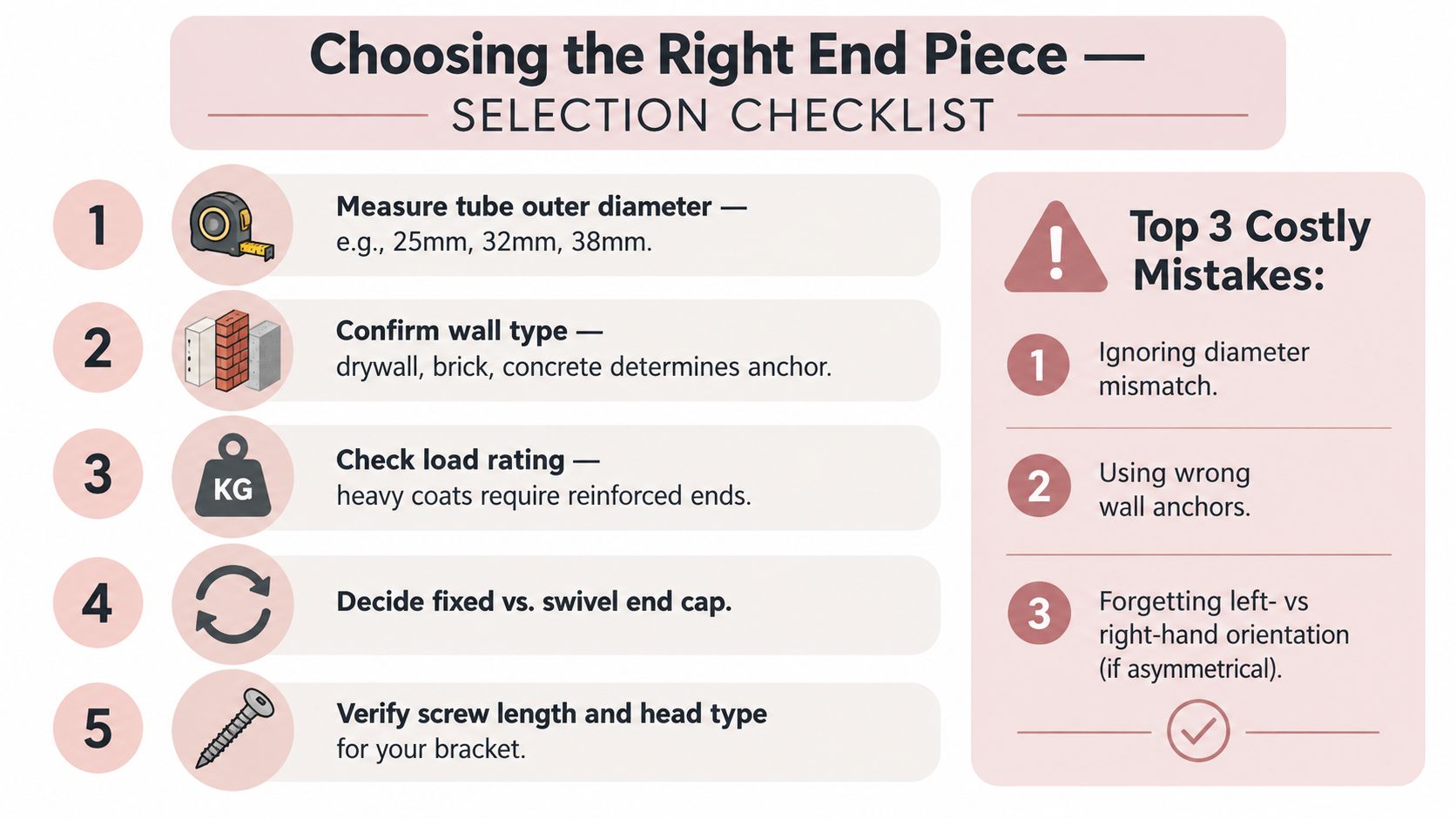
Run through these points before ordering:
-
Confirm the tube outer diameter
On commercial rails, 32 mm is common, but don't assume. Measure the actual tube. -
Check bracket-to-end compatibility
A correct diameter can still fail if the locating method, screw position or bore depth doesn't match the bracket. -
Match the finish to the setting
Bright chrome can mark quickly in heavy-contact areas. Satin or coated finishes often hold their appearance better. -
Verify commercial load suitability
If the rail is in retail use, the end shouldn't be chosen from domestic wardrobe hardware unless the system is appropriate. -
Plan for replacement parts
Ends are small, but they're often the first item you need in a hurry after damage or refits. Keep spares.
The mistakes I see most often
Some errors repeat across projects:
- Mixing domestic and commercial hardware for the same run
- Combining imperial and metric assumptions in one bay
- Choosing by finish only and ignoring fixing geometry
- Forgetting accessory needs until after installation
- Ignoring asymmetric parts where handed fittings apply
If you need a straightforward example of the category, Display Guru offers rail hardware including wardrobe rail end supports for wall-mounted clothes rails and discreet rail stoppers, alongside broader clothes rail and bracket options. The useful part isn't the product label. It's knowing whether you need a stopper, a support, or a load-bearing end connection, because those are not interchangeable.
Buy the end for the load path first. Then check finish, signage and appearance.
That order prevents most expensive mistakes before they reach the shop floor.
If you're sorting out a new rail run or replacing tired fittings, Display Guru supplies garment rails, accessories and support hardware that fit the practical realities covered here. If you need the small parts that keep a rail straight, stable and presentable under daily use, visit Display Guru and compare the fixture options against your tube size, bracket type and merchandising load.