



Mannequin Wig Heads A Guide to Styling Display and Care
We’ve all been there: staring at a tangled mess of a wig or a display that just looks… flat. It's a professional's worst nightmare. The humble mannequin wig head is what turns that chaos into a perfectly styled, professional presentation. It's far more than just a stand; it’s an essential partner for tailors, wig makers, and visual merchandisers.
Your Essential Partner for Wig Perfection
Picture a mannequin head as your silent, steady assistant. It’s the solid foundation you need for a precise cut, the perfect canvas for colouring, and the elegant model that makes your wigs shine in a retail setting. For anyone working with wigs or headwear, it's a non-negotiable piece of kit.
It provides the stability and human-like form you need to work efficiently, whether you're a seasoned hairstylist perfecting a look, a costume designer prepping for a production, or a shop owner who needs every product to look its absolute best.
Why Every Professional Needs One
The real value of a good wig head becomes obvious the moment you start using one. It’s not just about keeping a wig off the floor; it’s about expert preparation, styling, and flawless presentation.
Using one correctly helps you:
- Achieve Symmetrical Styles: A stable head is the only way to guarantee even cuts, consistent curls, and balanced colouring. Trying to do this on a flimsy surface is a recipe for disaster.
- Streamline Your Workflow: Having a dedicated station for wig prep saves an enormous amount of time and cuts out the frustration of fighting with a wig that won't stay put.
- Enhance Retail Displays: A beautifully presented wig on a smart, elegant head can dramatically increase its perceived value and catch a customer's eye.
- Preserve Wig Quality: Storing a wig properly on a head prevents tangles and maintains its shape, which ultimately extends its lifespan. You can find more details in our complete guide to wig mannequin heads.
This one tool can elevate your craft, simplify your projects, and ensure every wig or headpiece you touch looks flawless from every angle.
The growing demand for these tools is clear from market trends. In the UK, the broader mannequin market—which includes these vital heads—was valued at a staggering USD 312.8 million in 2024. Projections show this figure rocketing to USD 1132.6 million by 2035, a testament to the crucial role these heads play in the UK's bustling fashion and retail sectors. You can read more about this growth in the United Kingdom mannequin market report.
This guide will walk you through everything, from choosing the right material for your needs to mastering professional techniques.
Choosing the Right Mannequin Head Material
Not all mannequin heads are created equal. The material you choose is the very foundation of your work, and picking the right one is a bit like a chef choosing the right knife—the tool has to match the task to get the best results. A head for simple display is a world away from one needed for an intensive styling session.
This decision directly affects everything from durability and function to the final quality of your work. Let's break down the most common options to help you find the perfect match, whether you're styling, displaying, or storing valuable wigs and headpieces.
Polystyrene: The Lightweight Option
Polystyrene, which most of us know as Styrofoam, is the most common and budget-friendly choice out there. Think of these heads as the perfect entry point for basic tasks. They’re incredibly lightweight, which makes them a breeze to transport for mobile stylists or to set up in temporary retail displays.
Their main draw is their pinnability for light-duty work. You can easily secure a wig with T-pins for a simple comb-through, storage, or straightforward presentation. But their softness is also their biggest weakness. Repeated pinning will eventually cause the material to crumble and lose its grip, making them a poor choice for long-term, heavy-duty use.
This decision tree can help you quickly figure out which type of head best suits your immediate task, from cutting and colouring to a simple in-store display.
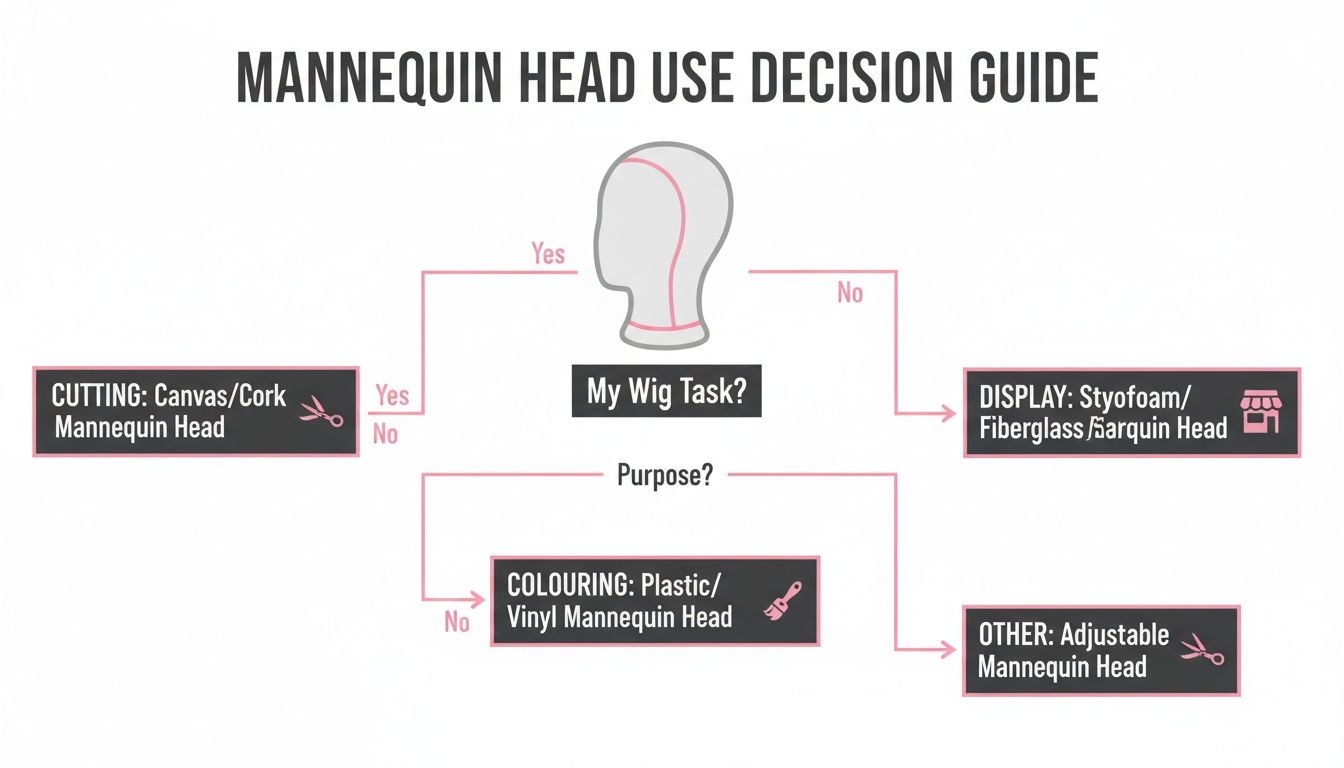
As the guide shows, more demanding jobs like cutting and colouring need a much more robust material, while simple display needs are easily met by lighter, more affordable options.
The popularity of polystyrene heads for display is clear from market trends. In 2024, Europe (with the UK as a key market) accounted for over 27.4% of global mannequin head revenue. Women's heads led the market with a 59.4% share, partly driven by merchandisers and dressmakers who rely on these forms for realistic wig fittings and shop displays.
Canvas Block Heads: The Professional Standard
When it comes to serious styling, the canvas block head is the undisputed industry champion. If a polystyrene head is for casual display, think of the canvas head as a professional tailor's dress form. It’s built for intensive, repeated use and offers stability and durability that other materials just can't match.
These heads have a dense cork or polyurethane foam interior, all wrapped in a sturdy canvas fabric. This construction gives you a few key advantages:
- Superior Pinning: The dense core grips T-pins tightly and securely. This means you can pull and style a wig with real tension without worrying about it slipping.
- Durability: They are designed to withstand thousands of pin insertions without falling apart. They also hold up well against the moisture from washing or colouring wigs.
- Heat Resistance: Unlike polystyrene, which can melt, a canvas head can easily handle the heat from blow dryers, straighteners, and curling tongs.
A canvas block head is a long-term investment in your craft. Its resilience and stability provide the professional-grade foundation needed for precise cutting, colouring, and intricate styling that other materials simply cannot support.
This is why they are the go-to choice for wig makers, theatrical designers, and salon professionals who demand absolute precision and reliability from their tools. For more information, you might find our guide to mannequin heads for wigs helpful.
Fibreglass and Plastic: Other Versatile Choices
Beyond the two main contenders, fibreglass and plastic heads serve more specific purposes, particularly in retail and commercial settings. They bring a different set of advantages to the table, focusing more on aesthetics and longevity in high-traffic environments.
Fibreglass heads are prized for their sleek, high-end look. They often come with realistic or abstract facial features, making them perfect for luxury boutiques displaying hats, scarves, or headphones. While they aren't pinnable, they offer exceptional durability and are very easy to clean, ensuring a polished presentation at all times.
Plastic heads, on the other hand, are a durable, low-cost alternative to polystyrene for display. They generally aren’t pinnable, but they’re far more resilient and won't flake or dent easily. They are a practical choice for basic wig storage or for displaying mass-market headwear where intensive styling isn't part of the brief.
To help you weigh your options, this table breaks down the key differences between the materials at a glance.
Mannequin Head Material Comparison Guide
| Material Type | Best For | Pin-Friendly? | Durability | Price Point |
|---|---|---|---|---|
| Polystyrene | Basic display, light styling, storage, hobbyists | Yes (light use only) | Low | £ |
| Canvas Block | Professional styling, cutting, colouring, wig making | Yes (heavy-duty) | High | £££ |
| Fibreglass | High-end retail display (hats, headphones), visual merchandising | No | Very High | ££££ |
| Plastic | General display, storage, high-traffic retail | No | Medium | ££ |
Ultimately, the best head is the one that fits your workflow. For quick, simple tasks, polystyrene gets the job done. But for anyone serious about their craft, a canvas block head is an essential investment that will pay for itself in reliability and quality of work.
Mastering Professional Wig Styling Techniques
Once you've chosen the right head, it's time to transform it from a simple stand into your most trusted styling partner. This is where your creative vision truly comes to life. Moving beyond basic display means getting hands-on, and mastering professional techniques starts with a solid, unshakeable foundation. It’s what ensures every cut is precise, every curl is perfect, and every colour is flawlessly applied.
A stable work surface is non-negotiable. Think of it like trying to paint a portrait on a canvas that keeps wobbling—the result would be a mess. The same principle applies here. A secure mannequin wig head is the secret to achieving the kind of symmetry and precision that separates amateur work from professional artistry.
This stability becomes absolutely critical when you're tackling intricate tasks. Whether you’re executing a razor-sharp bob, blending extensions, or applying delicate highlights, any slip or wobble can undo hours of painstaking work. This is precisely why seasoned professionals invest in quality heads and stands; they provide the unwavering support needed for those high-stakes projects.
Securing the Wig for Flawless Styling
Before you even think about picking up a comb or a pair of scissors, the first step is to mount the wig correctly. Getting this right ensures the wig stays firmly in place, mimicking how it would sit on a human head and giving you the freedom to work with confidence and proper tension.
For this job, your best friend is the T-pin. These sturdy, T-shaped pins are specifically designed to anchor the wig's foundation—whether it's lace, monofilament, or a wefted cap—directly into the mannequin head itself.
Here’s how to get a secure mount every time:
- Centre the Wig: Pop the wig onto the head, taking a moment to make sure the hairline and parting are aligned exactly where you want them.
- Pin the Perimeter: Start by inserting T-pins along the wig's outer edge. A good starting point is through the ear tabs, at the nape of the neck, and along the front hairline to create a secure border.
- Avoid Puncturing Lace: This is crucial. When working with delicate lace front wigs, be incredibly careful. Always insert the pins through the reinforced polyurethane tabs or the thicker seams of the cap. Never push them through the fine lace mesh itself, as this can cause tears that are impossible to repair.
- Check for Tension: Give the hair a gentle tug to make sure the wig is completely secure and doesn’t shift. If you feel any movement, simply add a few more pins at key anchor points until it’s rock-solid.
Advanced Cutting and Heat Styling
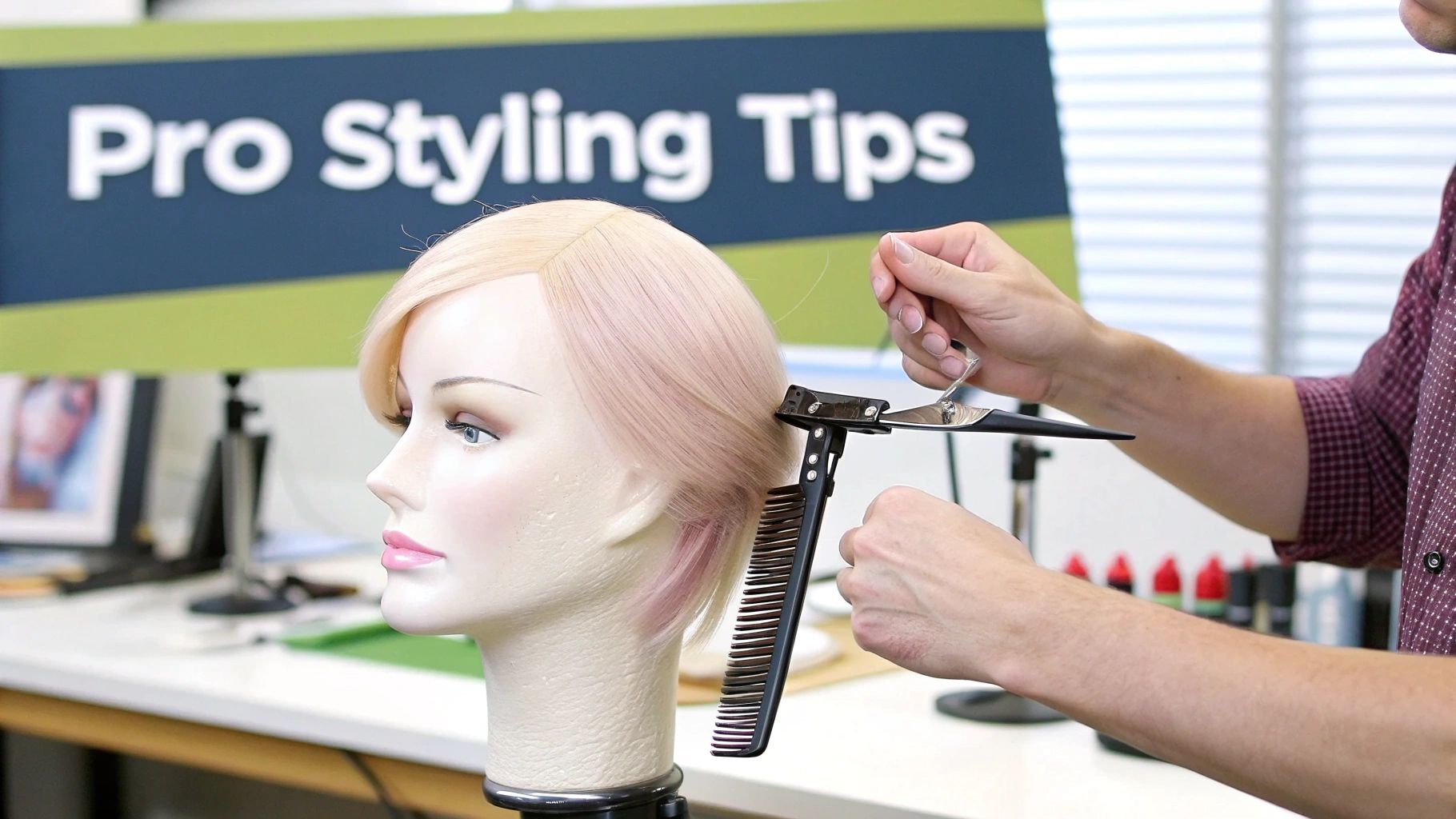
With the wig firmly secured, you're ready for the fun part. The stability of your setup allows you to see the entire wig from a 360-degree perspective, an absolute must for creating a balanced, symmetrical cut that looks great from every angle.
When it comes to heat styling, your mannequin head acts as a safe, heat-resistant base. This is a game-changer when you're working with human hair wigs that need high temperatures for curling or straightening. It lets you set curls with clips and leave them to cool completely on the head—a classic salon technique that drastically improves how long the style holds.
Pro Tip: Always use a lower heat setting on synthetic wigs and double-check if they are heat-friendly first. For human hair, a quality canvas block head won't be damaged by heat, but be warned: polystyrene heads can easily melt or deform under the direct, high heat from styling tools.
The wig and hairpiece design sector is a significant and fast-growing part of the UK's beauty and fashion industries. This growth is supported by the national mannequin market's impressive 12.41% CAGR trajectory. Globally, this niche was valued at USD 496.1 million in 2024, and the UK reflects this trend, with over 5,000 specialist salons relying on mannequin heads for styling practice that can reduce training time by an estimated 25%.
Washing and Maintaining Styled Wigs
Proper maintenance is the final piece of the professional puzzle. Trying to wash a wig in a sink is a recipe for tangles, but washing it on a mannequin head makes the process far more manageable and helps preserve the style you've worked so hard to create.
First, secure the wig to a waterproof plastic head or a canvas head you’ve protected well. Use a gentle, sulphate-free shampoo, and let the water run down the hair shaft from root to tip to prevent knots. After a thorough rinse, gently blot the wig with a towel, apply a leave-in conditioner, and then let it air dry completely on the head. This method keeps the style's integrity intact, ensuring the wig is pristine and ready for its next outing.
You can dive deeper into this topic in our complete guide on choosing a mannequin head for a wig.
Finding the Perfect Stand for a Stable Workspace
Even the best canvas block head is only as good as the stand it sits on. A wobbly, unstable base makes precision work nearly impossible, turning a simple task into a frustrating ordeal. The stand is your foundation, and choosing the right one transforms your mannequin wig head from a mere display piece into a proper professional workstation.
Think of it like an artist’s easel. Without a solid frame, the canvas shifts and moves, making every brushstroke a guess. A good stand gives you the stability you need to pin, cut, and style with confidence, so you can focus on your craft, not on fighting a swaying head.
This isn’t just about keeping things steady, though. It’s also about comfort and adaptability. The best stand works with you and your space, whether that’s a busy salon, a compact home studio, or a retail shop floor. Let’s break down the most common options.
Tripod Stands: The Gold Standard for Flexibility
For anyone doing serious styling work, a tripod stand is the industry go-to, and for good reason. These free-standing mounts give you complete 360-degree access to the head, which is non-negotiable for creating symmetrical cuts, getting even colour saturation, or nailing a complex updo.
The real game-changer is their adjustable height and angle. You can set the head at the perfect level whether you’re sitting or standing, saving your back and neck during long styling sessions. That ergonomic benefit alone is a huge plus for professionals.
Tripod stands are ideal for:
- Full-Length Styling: Essential for seeing how long wigs hang and move naturally.
- Intensive Cutting and Colouring: They provide the robust stability needed to apply tension without the whole setup tipping over.
- Training and Demonstrations: Their portability makes them perfect for classes and workshops.
The freedom of movement a tripod stand gives you is what separates good work from great work. It lets you step back, see your creation from every angle, and make those tiny tweaks that truly elevate the final look.
Table Clamps and Suction Bases: Compact Solutions
When floor space is tight, a tripod isn't always practical. That's where more compact mounts come in. Table clamps and suction bases anchor the head securely without the large footprint, making them a brilliant choice for smaller workspaces, retail counters, or on-the-go professionals.
Table clamps, often called C-clamps, screw directly onto the edge of a desk, counter, or workbench. They provide an incredibly firm grip, creating a fixed, ultra-stable station for styling. They’re an excellent permanent or semi-permanent fixture for a dedicated styling corner.
Suction bases, on the other hand, offer more flexibility. They use a powerful vacuum cup to stick to any smooth, non-porous surface like glass, polished stone, or laminate. While not quite as rock-solid as a clamp, they're perfect for quick touch-ups or for situations where you can't permanently attach anything. To explore this pairing further, check out our detailed guide to wig heads with stands.
Ultimately, the right choice comes down to your workflow. A costume designer fitting a piece needs the mobility of a tripod. A visual merchandiser setting up a counter display will find a discreet table clamp far more suitable. By matching the stand to the task, you create a workspace that’s both efficient and professional.
Thinking Beyond Basic Styling
A quality mannequin wig head is an absolute must-have for styling, but its real value shines when you look past the salon chair. For visual merchandisers, designers, and photographers, it's a secret weapon that can boost sales, lock in consistency, and bring a creative vision to life.
Thinking of a mannequin head as just a styling stand is like calling a tailor's dummy a simple coat rack—you're missing the whole point. Once you start seeing it as a multi-purpose tool, its potential in retail, performance, and e-commerce becomes just as vital as its role in cutting and colouring.

Driving Sales with Eye-Catching Retail Displays
In a busy shop, grabbing a customer's attention is half the battle. Mannequin heads are a simple but incredibly effective way to create compelling displays that help shoppers see themselves wearing your products.
A cleverly placed head can turn a flat hat, a pair of headphones, or a beautiful scarf into an irresistible accessory. It gives shape and context to items that can otherwise look a bit lifeless on a shelf.
Here’s how they can elevate your retail space:
- Create Themed Vignettes: Group several heads to tell a story. Think of a winter scene with matching hats, scarves, and jewellery.
- Showcase Product Use: Demonstrating how a headset actually fits or how a necklace drapes gives customers an instant understanding of the item.
- Maximise Impulse Buys: Place them on countertops or near the tills to encourage last-minute purchases of smaller accessories.
A mannequin head is your silent salesperson. By showing products in a relatable, 3D context, it boosts engagement and ultimately helps close the sale.
Nailing Consistency for Production and E-commerce
Away from the shop floor, mannequin heads are indispensable behind the scenes, especially in theatre, film, and e-commerce photography. In these worlds, consistency is everything, and a mannequin head is the perfect, reliable canvas.
For costume and wig departments, they are essential for maintaining character continuity. A lead actor's wig can be styled, stored, and moved on its own dedicated head, guaranteeing it looks exactly the same for every performance or take. No more guesswork, just a flawless look every single time.
This same principle is a game-changer for online retail. If you're selling hats or glasses online, photographing every product on the same mannequin head creates a clean, professional, and uniform look across your entire website. This polished feel builds brand trust and gives customers a clear sense of scale and fit, which can seriously cut down on returns.
The Foundation of Proper Wig Storage
Finally, let's not forget the most basic—but often overlooked—job of a mannequin head: proper storage. After you’ve invested time and money in a quality wig, just throwing it in a box is a sure-fire way to end up with a tangled, frizzy mess.
Keeping a wig on a head, even a simple polystyrene one, helps maintain its shape and keeps the fibres smooth and ready to go. This small step preserves the style you’ve worked so hard on and massively extends the life of the piece. It’s the cheapest and best insurance you can get for your investment.
Your Professional Mannequin Head Buying Checklist
Choosing the right professional tool can feel a bit daunting, but when you know what to look for, making a confident decision is straightforward. This final checklist pulls everything together into a clear, actionable guide. Think of it as your roadmap to finding the perfect mannequin wig heads for your craft—a tool that will truly be a worthwhile investment.
Before you finalise your purchase, just take a moment to run through these key points. Answering them honestly will guide you towards a head that doesn't just meet your needs, but genuinely improves your workflow.
Define Your Primary Use Case
First things first, what's the main job? Think about what you'll be using the head for 90% of the time. This simple question will instantly filter your options, stopping you from overpaying for features you’ll never use or, worse, buying a tool that can't handle the work.
- For Intensive Styling: If you're cutting, colouring, and heat styling daily, a canvas block head is a must-have. You simply can't beat its durability and pin-friendly grip for professional, precision work.
- For Retail Display: Need something to show off wigs, hats, or scarves in your shop? A sleek fibreglass or a tough plastic head looks professional and is built to last in a busy retail setting.
- For Light Use and Storage: If you just need a stand for basic storage or very occasional, simple styling, an affordable polystyrene model is a smart, budget-friendly pick.
Assess Your Technical Requirements
Once your main purpose is clear, it's time to get into the nitty-gritty. These are the details that will make a real difference to your day-to-day work and the final quality of your creations.
Don't compromise on the fundamentals. A head that's the wrong size or can't be secured properly will be a constant source of frustration and could even end up damaging the wigs you're working on.
Consider these non-negotiable points:
- Pin-Friendliness: Will you be using T-pins? For any serious styling, only a canvas head offers the robust grip you need. For simple display, a polystyrene head works, but just be aware that it won't hold up to repeated pinning over time.
- Correct Head Size: Get your tape measure out. Mannequin heads typically come in circumferences from 21-23 inches. For styling, choose a size slightly smaller than the wig to make it easy to slip on and off. For a realistic display fit, go for an exact match.
- Mounting Solution: Where and how will you be working? If you need to spin the head around and work from all angles, a tripod stand is essential for that 360-degree access. If you have a fixed workstation, a table clamp offers rock-solid stability in a smaller footprint.
By running through this checklist, you can confidently choose the right mannequin head for your specific needs. For a deeper dive into the options available, you might find our guide on different types of wig head mannequins helpful. Taking this deliberate approach ensures your new tool will be a valuable asset for years to come.
Frequently Asked Questions
When you're working with professional tools, a few questions are bound to pop up. To help you choose wisely and handle any common snags, we’ve put together some straightforward answers to the questions we hear most often about mannequin wig heads.
What's the Best Head for Cutting and Colouring Wigs?
When it comes to serious styling work like cutting, colouring, or any kind of chemical treatment, the canvas block head is the undisputed champion. There's a reason it's the professional standard. Its tough canvas skin and solid cork or polyurethane foam core are built to handle moisture and hold T-pins firmly, day in and day out, without falling apart.
Polystyrene heads just can't compete here; they can be damaged by chemicals and will quickly lose their grip after a few pinning sessions. A canvas head, firmly mounted on a good tripod stand, gives you that stable, reliable base you need to achieve professional results.
How Do I Choose the Right Size Mannequin Wig Head?
Getting the size right is crucial, whether you're styling or displaying a wig. The first step is to measure the circumference of the wig's inner cap or the head size the wig was made for. Mannequin heads are generally sold in standard sizes, typically from 21 to 23 inches.
Here's a solid rule of thumb: for styling, pick a head that's a touch smaller than the wig cap. This makes it much easier to get the wig on and off without stretching the delicate foundation. For display, you'll want a head that matches the wig's actual size to give it the most natural and flattering look.
Always double-check the product details before you buy to make sure you're getting the perfect fit.
Can I Use T-Pins on a Polystyrene Wig Head?
Yes, you certainly can. In fact, that's what makes polystyrene (or Styrofoam) heads so handy for lighter tasks. They're great for holding a wig in place for some simple brushing, storage, or putting it on show in a shop.
The thing to remember, though, is that polystyrene is soft. If you keep sticking pins in the same spots, the material will eventually crumble and won't hold the pins securely anymore. For any heavy-duty styling that needs the wig to be held tight under tension, you'll be far better off with a durable canvas block head.
What's the Best Way to Clean My Mannequin Head?
How you clean your head really depends on what it's made of. Keeping your tools in top shape not only helps them last longer but also ensures you have a clean, hygienic surface for your wigs.
- Plastic or Fibreglass Heads: A quick wipe with a damp cloth and a bit of mild soap is all you need.
- Polystyrene Heads: Use a damp cloth, but steer clear of harsh chemicals – they can actually dissolve the foam.
- Canvas Block Heads: You can spot-clean the canvas with a gentle fabric cleaner. A great pro tip for colouring is to wrap the head in cling film beforehand. It saves a lot of mess!
No matter the type, always let the head dry completely before you put a wig back on it. This simple step prevents any chance of mould or mildew from setting in.
At Display Guru, we stock a complete range of high-quality mannequin heads and stands for professionals in tailoring, design, and retail. Find the perfect tools to elevate your work at our official UK store.