




Craft Desk with Storage: Organize Your Creative Space in Style
Imagine a creative space where every tool, every spool of thread, and every bead has its own dedicated spot. The result? A clear work surface and an even clearer mind. This is the real magic of a proper craft desk with storage—it's so much more than just furniture. It’s the command centre for your passion.
Your Foundation for a More Creative Workflow
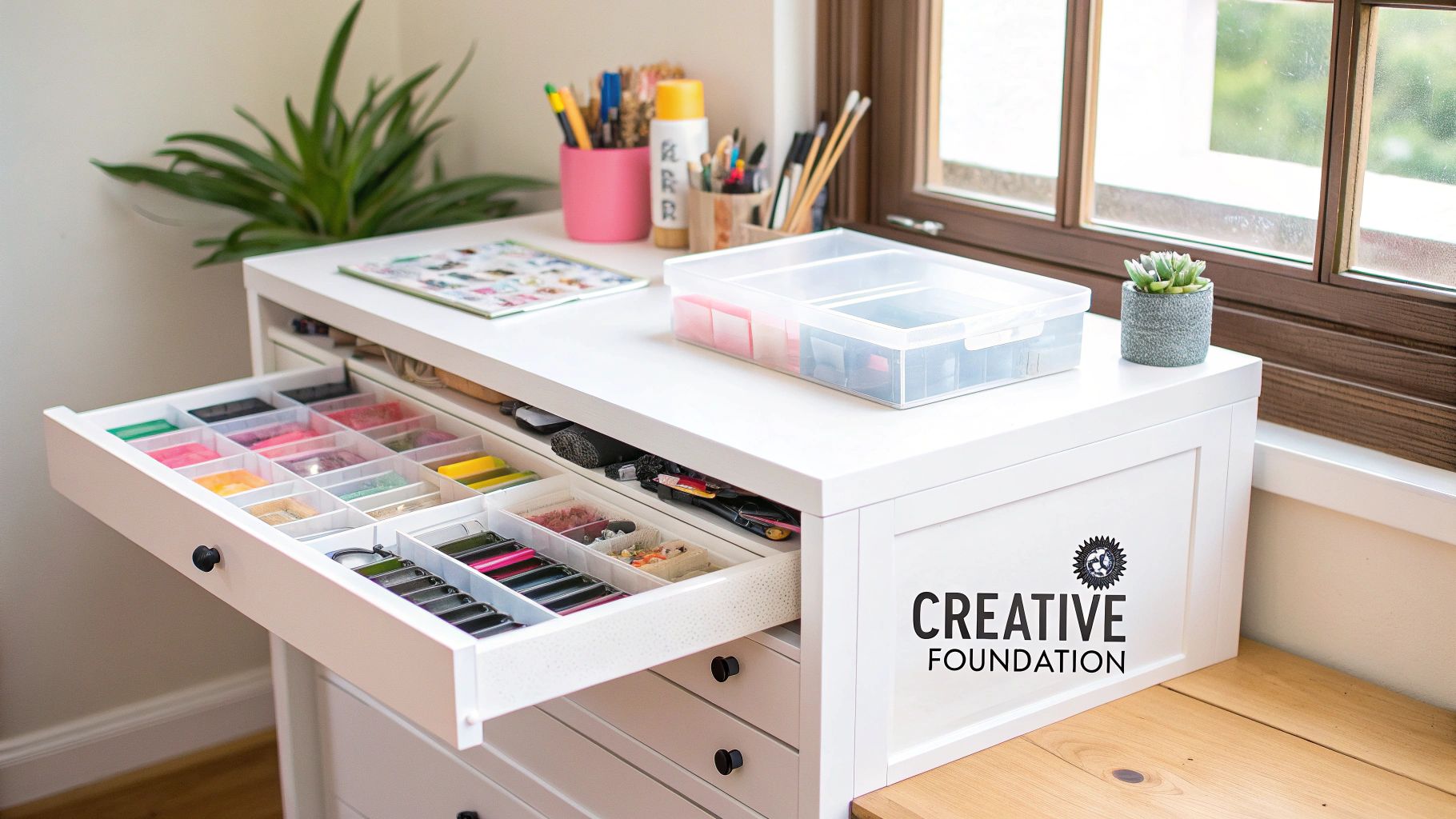
A thoughtfully chosen workspace truly becomes the bedrock of your creativity and efficiency. It marks the difference between a chaotic corner piled high with materials and a streamlined station that actually makes you want to get started. When your environment is organised, your creative process tends to follow, freeing you up to focus on bringing ideas to life instead of hunting for a misplaced pair of scissors.
This move towards dedicated creative spaces isn't just a fleeting trend. As more of us embrace hobbies and home-based businesses, the demand for functional, stylish furniture has shot up. The global craft table market was even projected to hit around $1.5 billion by 2025, with UK crafters showing a real appetite for multi-functional desks that blend a generous surface area with clever storage.
Moving Beyond a Simple Table
Start thinking of your craft desk as your personal command centre. That's the first step to a better workflow. The right desk should be built around your specific needs, whether you're a sewer who needs a huge cutting surface or a jeweller who requires dozens of tiny compartments.
An organised desk brings some immediate, tangible benefits:
- Improved Efficiency: With everything in its place, you spend less time searching and more time actually creating.
- Reduced Stress: A tidy space really does contribute to a calmer, more focused mindset, getting rid of that nagging frustration from clutter.
- Enhanced Creativity: When your tools are easy to grab and your surface is clear, your mind is free to wander and explore new ideas without distraction.
A well-organised craft desk doesn't just hold your supplies; it holds your potential. By creating a system where every single item has a home, you remove the barriers between your vision and your execution. It makes the whole creative process far more enjoyable and productive.
Ultimately, investing in a proper craft desk with storage is about setting yourself up for success before a project even begins. It's a non-negotiable part of any creative setup, providing the structure your imagination needs to flourish. For those looking to create a dedicated area, our complete guide to a functional sewing room setup can offer even more inspiration.
Anatomy of the Ideal Craft Desk
Choosing the right craft desk with storage feels a lot like a tailor fitting a bespoke suit. It’s not about grabbing the first table you see; it's about understanding the individual parts that come together to create a workspace that perfectly fits your creative process. Let's break down the anatomy of a great craft desk so you can spot the features that will actually make a difference to your projects.
The Worktop: Your Creative Stage
Think of the desk's surface as your stage. This is where the magic happens, so its size and material are absolutely crucial. If you're into pattern cutting, large-scale illustration, or assembling visual merchandising displays, a generous worktop isn't just a nice-to-have, it's a necessity. It gives you the freedom to spread out without constantly having to shift things around.
The material of this stage sets the tone for both durability and style. Laminate and melamine are the workhorses of the craft world – they’re tough, stand up to scratches, and are a breeze to clean. A rogue splash of paint or a bit of glue is no big deal. A solid wood top, on the other hand, brings a timeless, natural warmth to a room but will need a bit more looking after to keep it pristine.
Decoding Storage Styles: Drawers, Cubbies, and Shelves
Once you’ve sorted your stage, it’s time to think about the backstage area – the storage that keeps your tools and supplies organised and ready for their cue. The best craft desk with storage will usually offer a mix of options, because different tools need different homes.
- Drawers: These are your best friend for hiding away all those small, fiddly bits that love to go missing. We're talking needles, threads, beads, and delicate tools. Pro tip: look for shallow drawers. They stop everything from descending into a jumbled mess at the bottom.
- Cubbies: I love open-fronted cubbies for things you need to see and grab quickly. They’re fantastic for stashing yarn, neatly folded fabric fat quarters, or jars of pigment, keeping them visible and within arm's reach.
- Shelving: Whether they’re built-in below the worktop or part of a hutch above, shelves give you flexible space for bigger items. They’re perfect for reference books, pattern binders, or stacking clear storage boxes.
To help you weigh your options, here’s a quick breakdown of the most common storage features you'll find.
Comparing Craft Desk Storage Features
This table offers a quick-reference comparison of common storage types to help you decide which features best suit your crafting needs.
| Storage Type | Best For | Pros | Cons |
|---|---|---|---|
| Drawers | Small tools, loose items (beads, threads), paperwork | Keeps clutter hidden; protects items from dust; great for organising | Can become messy if too deep; items can be hard to find |
| Cubbies | Yarn, fabric bundles, jars, bulky supplies | Items are visible and easy to grab; adds a splash of colour | Can look untidy if not kept organised; items are exposed to dust |
| Shelves | Books, storage boxes, larger equipment, finished items | Highly versatile; can be adjusted; good for both storage and display | Can look cluttered; not ideal for very small or loose items |
| Pegboards | Frequently used tools (scissors, rulers, pliers) | Keeps tools off the desk surface; highly customisable layout | Not suitable for heavy or bulky items; requires hooks and accessories |
Ultimately, the right combination of storage is deeply personal and should reflect the rhythm of your work.
Your storage setup should be a mirror of your workflow. If you’re constantly reaching for the same five tools, having them in open cubbies or on a pegboard just makes sense. For supplies you only pull out for specific projects, deep drawers or closed cabinets are perfect for keeping your main workspace clear.
Advanced Storage: The Power of the Pegboard
Looking beyond the basics, many modern craft desks now come with smart features designed for serious organisation. And one of the most effective has to be the integrated pegboard.
A pegboard is like a vertical, customisable toolkit. It lets you hang your most-used tools—scissors, rotary cutters, rulers, pliers—right in your line of sight. This one simple addition can make you so much more efficient. It clears your worktop of clutter and frees up drawer space, all while keeping your essential gear just an arm’s length away. By understanding how each of these elements—the surface, the drawers, the cubbies, and the pegboard—works together, you can look at any desk and know instantly if its anatomy is the right fit for your creative soul.
Matching Your Desk to Your Crafting Passion
Think of it like this: a chef's kitchen is worlds apart from a baker's. In the same way, what a sewer needs from a desk is completely different from what a painter needs. Finding the perfect craft desk with storage isn't about a one-size-fits-all solution; it's about matching the desk's features to the real-world demands of your creative work. When you get this right, your desk becomes more than just storage – it becomes an active part of your workflow.
For instance, a paper crafter handling delicate cardstock needs shallow drawers to keep everything perfectly flat and prevent bent corners. A jeweller, on the other hand, would get far more use out of a desk with lots of small, sectioned compartments to keep countless beads, findings, and wires from becoming a tangled mess.
For Sewers and Fabric Artists
If your passion is sewing, quilting, or pattern making, your biggest need is space. A large, uninterrupted worktop is absolutely essential for laying out, measuring, and cutting long lengths of fabric. Desks with drop-leaf extensions are a brilliant solution here, giving you that extra surface area when you’re in the zone and folding away neatly when you're not.
Your storage needs to be practical, too. Look for options deep enough to hold bolts of fabric or bulky patterns without crushing them. For a deeper dive into setting up your sewing space, have a look at our guide on choosing the perfect sewing table with storage.
For Painters and Mixed-Media Artists
Painters and mixed-media artists have a whole different set of priorities, starting with the desk surface itself. A non-porous, stain-resistant material like laminate is a must-have. It means you can wipe away accidental paint or ink spills without a second thought.
When it comes to storage, your needs are quite varied.
- Deep Cabinets: These are fantastic for stashing bulky paint tubes, jars of medium, and canvases out of sight.
- Open Shelving: Keeps your most-used items, like brush holders and palettes, visible and within easy reach.
- Sturdy Drawers: Perfect for organising sketchbooks, pencils, and all your smaller tools.
This simple flowchart can help you visualise which type of storage will work best for the supplies you use most often.
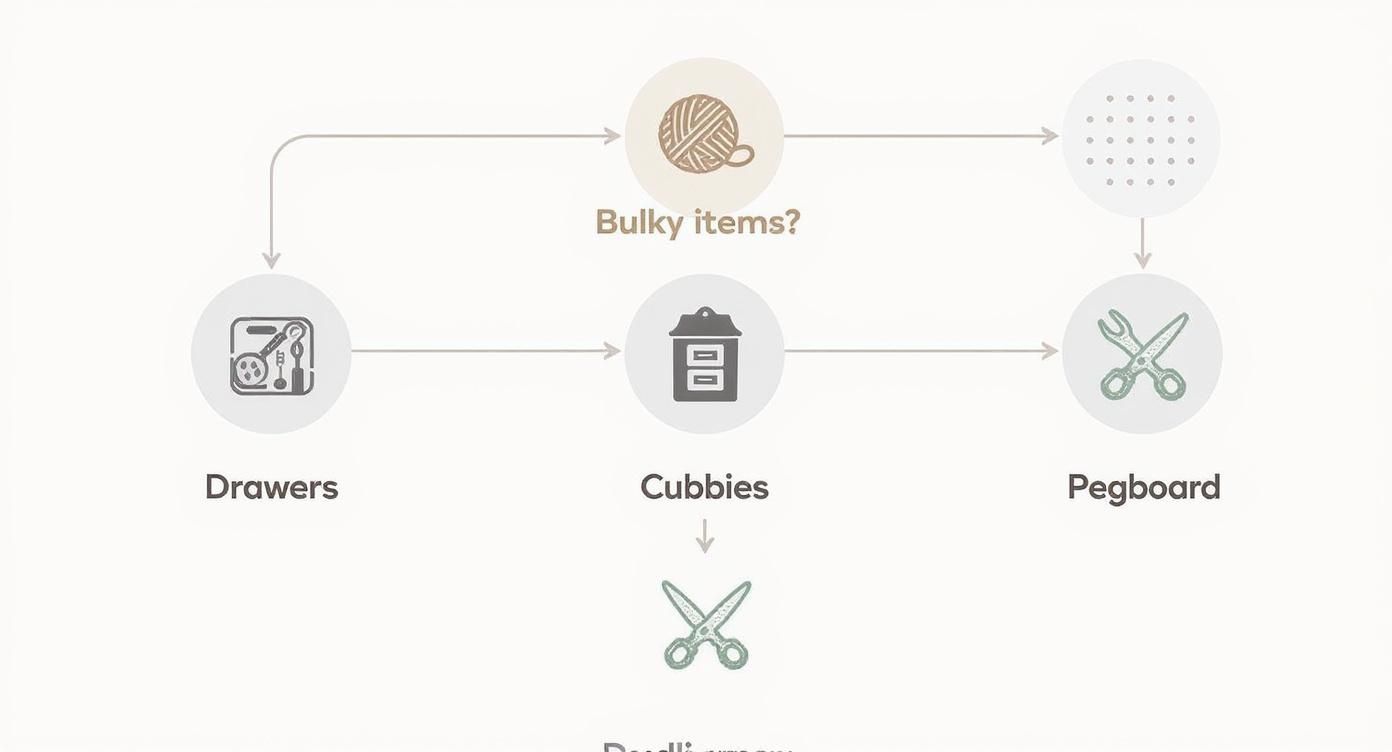
As you can see, the chart maps out how different storage solutions—drawers, cubbies, or pegboards—are best suited for small, bulky, or displayable items respectively.
This need for specialised furniture is part of a much bigger picture. The UK's arts and crafts market is set to grow at a compound annual growth rate of around 7.2% between 2025 and 2029, largely fuelled by a growing interest in DIY culture. As more of us get into textile, paper, and functional crafts, the demand for well-designed workspaces with smart storage is only getting stronger.
Choosing a desk is like casting a character in a play. Your craft is the star, and the desk is its essential supporting actor. It needs to complement the lead's every move, not get in the way.
By taking the time to think about the unique rhythm and requirements of your craft, you’ll find a desk that feels less like a piece of furniture and more like a true creative partner.
Planning Your Creative Space for a Perfect Fit
https://www.youtube.com/embed/FbToLPgu0N8
It’s easy to get swept away by a beautiful craft desk with storage you see online, but taking a moment to plan is the most important first step. One of the most common pitfalls is buying a desk that technically fits into a room but leaves absolutely no space for you to actually move and create. This is where getting out the tape measure and thinking strategically about your layout saves the day.
You have to think beyond the desk's simple footprint. Consider what interior designers call ‘working room’—that crucial bit of space you need to pull out your chair, open drawers all the way, and sidle around your workspace without bumping into things. As a solid rule of thumb, aim for at least 60-90 cm of clearance behind your chair.
Measuring for Your Workflow
Grab a tape measure and get the basic dimensions of your craft corner. Jot down the length and width, but don't stop there. Make a note of where windows and power sockets are. You’ll thank yourself later when your desk is bathed in natural light, which is a lifesaver for reducing eye strain and getting your colours just right. And, of course, being near a plug socket is essential for any sewing machine, glue gun, or cutting machine.
Once you've got the numbers, it's time to map out the flow of your space.
- Desk Placement: Pinpoint the best wall, keeping that natural light and power access top of mind.
- Chair Zone: Sketch out the space your chair needs, both when it's pushed in and when you're sitting in it.
- Access Paths: Check that you can open every drawer and cupboard door fully without them hitting a wall or another piece of furniture.
- Movement Space: Can you walk around the desk with ease to get to your shelves or other supplies?
A workspace should adapt to your creative process, not force you to adapt to it. A little layout planning ensures your new desk feels like a natural extension of your craft, not just a well-designed obstacle.
If you're working with a smaller room, don't despair. Exploring options like folding desk solutions for small creative spaces can be a real game-changer. These smart designs give you a generous work surface when you need it and then tuck away neatly to give you your floor space back.
Proper planning is the best way to avoid the frustration of a workspace that just doesn't work. For more inspiration on setting up your whole room, have a look at our detailed guide on effective sewing room layout ideas. A bit of prep work now guarantees your craft desk will be a perfect, practical fit for years to come.
Setting Up Your Workspace to Spark Creativity
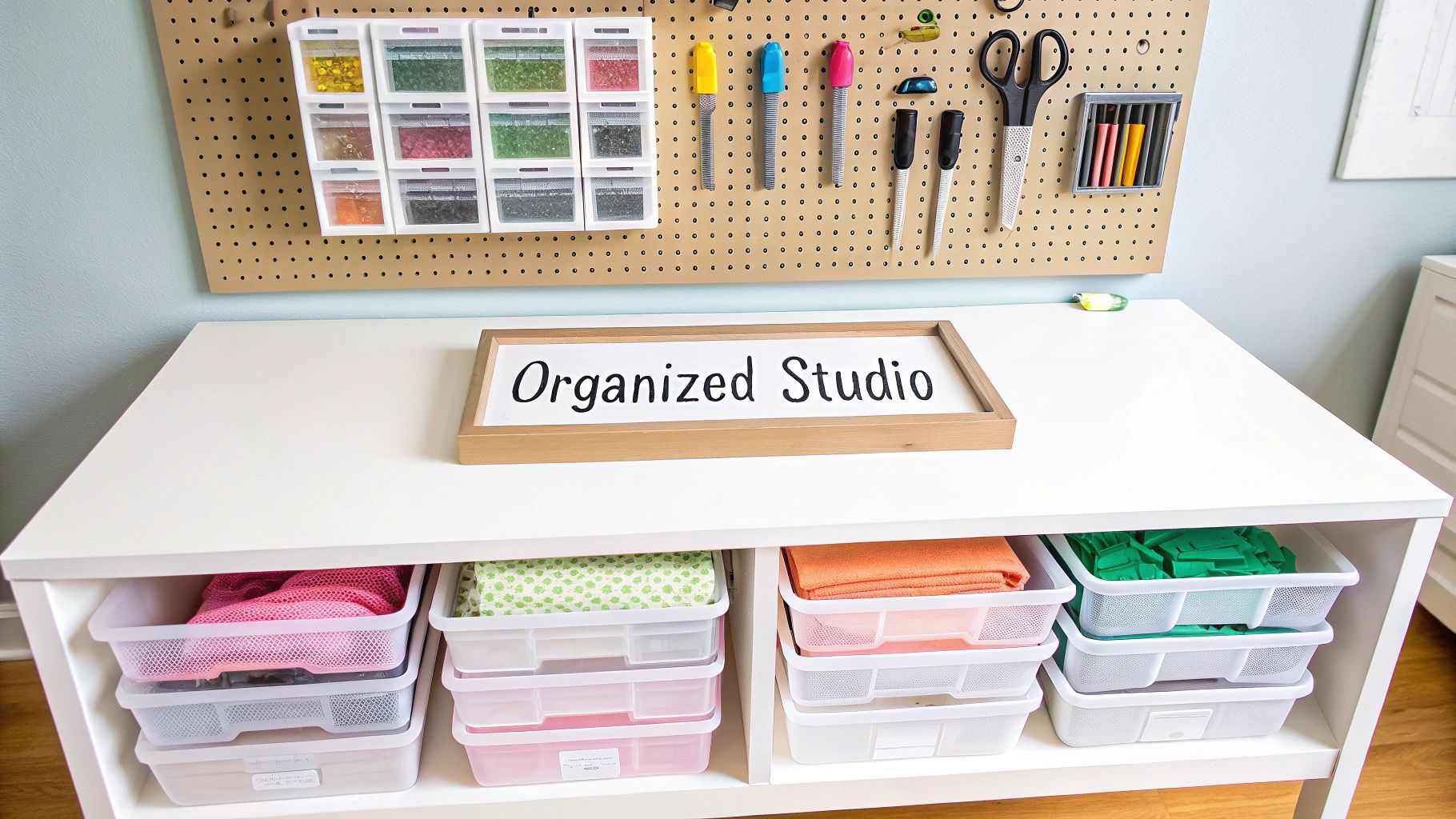
Getting a fantastic craft desk with storage is the perfect first step, but the real magic happens when you pair it with smart, consistent organisation. A tidy station isn’t just about appearances; it has a direct impact on your focus and efficiency. It turns your desk from a simple piece of furniture into a true creative command centre.
The aim is to build a system where everything has a designated place. This makes finding supplies second nature and tidying up a breeze, ensuring your space remains an inspiring hub long after the desk is assembled.
Group Your Supplies for a Better Workflow
Start by sorting all your supplies into logical groups. You can categorise them by how you use them, how often you need them, or by material type. This methodical approach lays the foundation for a workspace that genuinely works for you.
- High-Frequency Items: The tools you grab constantly—scissors, rulers, your favourite pens—need to be within arm's reach. Think top drawers, desk caddies, or a handy pegboard.
- Project-Specific Materials: Keep all the bits for a particular craft together. For example, beads for jewellery making or vinyl rolls for a cutting machine should have their own dedicated drawers or cubbies.
- Bulk Storage: Use larger cabinets or lower shelves for things you don't use every day, like bolts of fabric or backup paint tubes.
This kind of sorting turns your desk’s storage into a bespoke toolkit. For a deeper dive into making your space work harder, check out these tips for organizing your craft supplies effectively.
This need for well-organised creative spaces is a growing trend across the UK. In fact, the office supplies market—which includes creative furniture—is Europe's fastest-growing segment. It's forecasted to grow by around 1.6% each year between 2025 and 2033, driven by creative SMEs and startups who know the value of investing in quality furniture that supports an efficient workflow.
Thinking Beyond the Desk: Vertical and Mobile Storage
Your desk is the heart of your creative space, but don't forget to look up and around. Bringing in some clever external storage can massively boost your capacity and keep your main work surface clear and ready for action.
Think of your workspace in three dimensions. Your desk is the horizontal plane for creating, while vertical and mobile storage add the depth you need to keep everything flowing smoothly.
Consider placing a garment rail nearby to hang works-in-progress, keeping them safe, visible, and out of the way. Display Guru dump bins are another brilliant addition, perfect for stashing fabric remnants, yarn, or other bulky bits that might otherwise end up on the floor.
For those smaller items, you can explore more ideas for optimising your craft storage drawers in our dedicated guide.
Making Your Craft Desk Last a Lifetime
A good craft desk with storage isn’t just another piece of furniture; think of it as a long-term investment in your creative work. Making sure it stands up to years of projects comes down to two things: understanding what it’s made of and giving it a bit of regular care. This simple approach will protect your investment and keep your creative space in top shape.
The lifespan of your desk really begins with its core material. Solid wood has that classic appeal and can always be refinished down the line, but it does ask for a bit more attention. On the other hand, modern MDF is incredibly durable and holds its shape well, while metal frames offer rock-solid stability. Whatever you choose, the build quality is what truly matters.
Protecting Your Workspace
Let's be realistic—your desk's surface is going to see some action. Spills, cuts, and even a bit of heat are all part of the creative process. A little proactive protection goes a long way in keeping it looking and feeling new.
- Use a Self-Healing Cutting Mat: If you use rotary cutters or craft knives, this is absolutely essential. It’s the single best way to protect the surface from nicks and scratches.
- Invest in a Protective Cover: For those wonderfully messy projects with paint, glue, or resin, a silicone craft mat or even a simple oilcloth cover can save you from permanent stains.
- Wipe Spills Immediately: It sounds obvious, but cleaning up spills straight away stops liquids from seeping in and causing damage, which is especially important for wooden desks.
A desk's durability isn't just about the material it's made from; it's also about the quality of its construction. Sturdy joints and smooth, robust drawer runners are signs of a well-made piece that will withstand daily use without wobbling or sticking.
Inspecting Build Quality Before You Buy
When you're looking at potential desks, it's the small details that often reveal the true quality. Give the unit a gentle nudge; it shouldn’t wobble or feel flimsy. Open and close the drawers a few times. Do they glide smoothly, or do they feel cheap and sticky? These are the tell-tale signs of a desk built to last.
If you have heavy equipment to consider, it's worth looking into specialised furniture. Exploring options like a purpose-built sewing machine with cabinet can give you a better idea of what truly robust construction looks like. By focusing on both material care and solid build quality from the start, you’ll end up with a craft desk that serves as a reliable partner on your creative journey for years to come.
Common Questions About Craft Desks
Even with the best plan in the world, a few questions always seem to pop up when you're on the hunt for a craft desk with storage. Getting these final details sorted is the key to creating a space that's not just a pretty picture, but a truly functional hub for all your projects. Let's tackle some of the queries I hear most often.
What Is the Best Height for a Craft Desk?
Honestly, the perfect height comes down to how you work. If you spend most of your time sitting, a standard desk height of 73-76 cm is the gold standard. It lets you sit comfortably with your feet on the floor, keeping your arms at a natural angle for those intricate, detailed tasks.
But let's face it, a lot of crafting happens on your feet. Cutting huge swathes of fabric or assembling a big project can be a real back-breaker if you're constantly hunched over. For standing tasks, a counter-height desk, which sits around 90-96 cm, is a game-changer for your posture. The dream setup? An adjustable-height desk. It gives you the freedom to switch between sitting and standing, which is a lifesaver during those marathon making sessions.
How Do I Manage Cables and Cords?
Nothing ruins the vibe of a clean, creative space faster than a chaotic nest of wires from your sewing machine, Cricut, or glue gun. Good cable management isn't just about looks; it's about safety and sanity. Some desks are designed with this in mind, featuring built-in grommets or cut-outs to discreetly channel all those cords.
If the desk you've fallen for doesn't have these features, don't fret. There are plenty of easy, aftermarket fixes.
- Adhesive Cable Clips: These little things are brilliant. Just stick them to the underside or leg of your desk to keep wires tidy and out of the way.
- Cable Trays: A simple tray screwed underneath the desktop can hold your power strip and all the excess cable slack, keeping everything off the floor.
- Cable Spines: For a really polished look, these flexible tubes gather all your cords into a single, neat column.
Your workspace should be a place that fuels your creativity, not a source of frustration. A few simple cable management tricks can make a world of difference, keeping your surface clear and your mind on the project.
Can I Use a Regular Office Desk for Crafting?
You absolutely can, but a dedicated craft desk with storage is usually a much better investment in the long run. Think of it this way: craft desks are built for the job. They often have larger, more resilient surfaces designed to take a beating from sharp tools, glue spills, and paint.
More importantly, the storage is designed by people who get it. We’re talking shallow drawers for tiny tools, deep cubbies for bolts of fabric, and pegboards that put everything you need within arm's reach. A standard office desk just doesn't have that kind of specialised organisation, and it probably wasn't built to handle the unique wear and tear our creative hobbies inflict.
Ready to build a workspace that truly works for you? Having the right tools and storage is everything. Take a look at the full range of professional-quality garment rails, dump bins, and display forms from Display Guru to put the finishing touches on your creative studio. Find your ideal setup at https://www.displayguru.co.uk.