

How to Measure Bra Size at Home: A Step-by-Step Guide
What if the number you get from a tape measure is the least reliable part of the whole process?
Those measuring bra size at home treat the result as an answer. It isn't. The tape gives you two circumferences, and arithmetic turns those into a band and a cup, but the label on the bra is only a claim about a piece of fabric. Whether that claim holds depends on how the band sits on your ribs, where the wires land, and whether the cups contain what's in them.
Arguing with a tape for twenty minutes won't rescue a size that never had a chance. Measure carefully, calculate accurately, then let the fit check overrule the calculator when the two disagree. That order matters, and it's the part most home guides leave out.
How to Measure Your Underbust and Bust
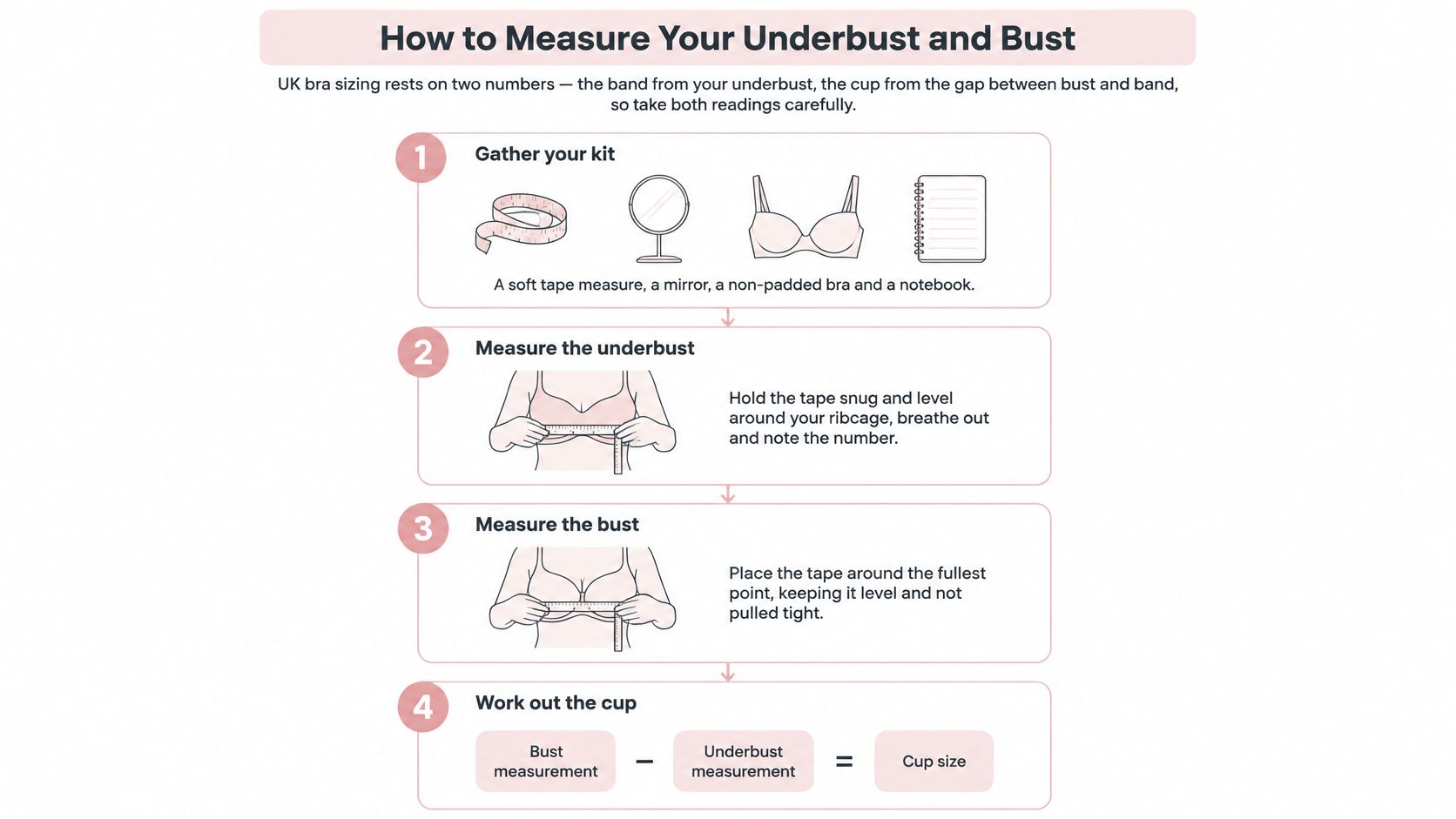
Two numbers run UK bra sizing. The band comes from the circumference of your ribcage directly under the breasts, and the cup comes from the gap between your fullest bust measurement and that band. Get either reading wrong and the error travels into every calculation afterwards, so this stage deserves the patience.
What You Need Before You Start
A soft flexible tape measure is the only tool that works. Metal building tapes don't follow a ribcage, and string stretches, so both hand you a number that's wrong in a direction you can't predict. Add a notepad, a mirror so you can see whether the tape is level at the back, and a second pair of hands if there's someone around.
Standing matters as much as the tape. Take off padded or lined bras and stand naturally with your arms relaxed, wearing a thin top or nothing over the torso. The same discipline you'd apply to taking body measurements for clothes applies here: one thin layer, tape level, every number written down.
Snug, not tight: the tape should leave a faint line on the skin, not an indentation. If you can slide two fingers under it at the back without it lifting away from the ribs, it's sitting about right.
The Two Readings, In Order
- Underbust first. Wrap the tape around the ribcage directly beneath the breasts, where the band will sit in a well-fitting bra. Keep it level at the back and snug, with no compression of the flesh beneath it.
- Breathe out and read. Let the ribcage settle into a normal exhale before you read the inch value. Sucking in or holding your breath changes the circumference, and the band you calculate from it comes out wrong.
- Move to the fullest point. Lift the tape to the fullest part of the bust, running it level across the front and parallel to the floor. Don't pull it tight; the tape should touch the tissue, not press into it.
- Read the bust number in inches and note it. If your tape only shows centimetres, record that figure too and convert once at the end rather than mid-calculation.
- Repeat both readings. Do the underbust and the bust a second time, and a third if the first two disagree. Frimley Health NHS Foundation Trust's step-by-step measurement guide advises repeating measurements because a tilted tape, a held breath, a padded bra or a bulky top all distort the result, and it treats the outcome as a starting guide rather than a settled answer.
- Write both numbers down before you go further. The next stage is arithmetic, and arithmetic on remembered numbers goes wrong.
Centimetres convert to inches at 2.54 to 1, so a 30-inch underbust is about 76 cm. If you recorded in both units, check one against the other before you calculate. A mismatch of more than a couple of centimetres means one reading was taken badly and should be redone.
Measuring Mistakes That Skew Your Size
The error that changes your result most isn't a bad tape, it's a held breath. Clinical fitting guidance warns against it because an expanding or contracting ribcage changes the circumference, and the band you calculate inherits that change. Everything else on this list is smaller, but each one is worth fixing before any arithmetic happens.
- Tape tilting up at the back or sagging at the front. It adds length to the reading, so you buy a band that feels loose within an hour of putting it on. Check the tape by eye against the floor line in a mirror, front and back, before you read.
- Holding your breath or pulling your stomach in. The ribcage shrinks, the band comes out too small, and the result is a band that digs in and a back that rides up. Breathe out normally and let the tape sit where it lands.
- Measuring over a padded, lined or thick knit top. Bulk adds to the bust reading and the cup you calculate ends up gapping at the top. Measure over bare skin or one thin layer.
- Measuring straight after a large meal or hard exercise. The torso changes size for a while afterwards, so pick a consistent time of day and stick to it.
- Accepting a single reading. One pass of the tape is a sample, not a measurement. Repeat both readings and proceed only when they agree within half an inch.
A stretched tape skews things too. Keep a soft tape in the sewing box rather than a drawer where it kinks, replace it when the metal end frays, and check what to look for in a guide to choosing and using sewing tape measures. Tape-based sizing carries a systematic bias of its own, documented by the University of Portsmouth's evaluation of professional bra fitting criteria, which is why no size should be bought or cut on the strength of a measurement alone.
Your UK Band Size from the Underbust
The traditional UK rule is short and slightly odd: if your underbust measures an even number of inches, add 4; if it's odd, add 5. Every result lands on an even band size, which is why UK labels skip the odd numbers entirely. The NHS bra measurement guide from Frimley Health NHS Foundation Trust sets the method out this way, with 28 inches giving a 32 band and 29 inches giving a 34 band.
Only the underbust has any say in the band. Your bust reading plays no part in this calculation, so resist the urge to average the two or split the difference.
| Underbust (in) | UK band size | Rule applied |
|---|---|---|
| 26 | 30 | Even: add 4 |
| 27 | 32 | Odd: add 5 |
| 28 | 32 | Even: add 4 |
| 29 | 34 | Odd: add 5 |
| 30 | 34 | Even: add 4 |
| 31 | 36 | Odd: add 5 |
| 32 | 36 | Even: add 4 |
| 33 | 38 | Odd: add 5 |
| 34 | 38 | Even: add 4 |
| 35 | 40 | Odd: add 5 |
| 36 | 40 | Even: add 4 |
The plus-four rule doesn't mean your ribcage is four inches wider than the tape says. It's a convention for landing on even band sizes, and UK brands build to the same convention.
Read your row, then write the band beside the bust reading so the cup calculation has both inputs in front of you. If you're fitting a garment rather than buying a bra, matching a mannequin to your own measurements before you pin anything saves a great deal of unpicking later.
Treat the band as a starting size, not a verdict. Brands cut their blocks differently, and a 34 in one label can measure very much like a 32 in another. The number only becomes a size once the band sits level, stays put when you raise your arms and doesn't need hauling down all day.
Your UK Cup Size from the Bust Difference
Subtract the band from the bust, both in inches, and read the difference off the UK cup chart. A bust of 38 inches on a 34 band gives a difference of 4, which is a C cup, so the full size is 34C. That's the whole calculation.
The slip nearly everyone makes is subtracting the underbust reading instead of the band. Do that with a 30-inch underbust and a 38-inch bust and you get 8, an F cup, on a 30 band that will never close at the back. The band already carries the plus-four adjustment; the cup is measured from the band, not from your ribs.
| Bust minus band (in) | UK cup |
|---|---|
| 1 | AA |
| 2 | A |
| 3 | B |
| 4 | C |
| 5 | D |
| 6 | DD |
| 7 | E |
| 8 | F |
| 9 | FF |
| 10 | G |
If your difference comes out at zero or less, one reading is wrong. A bust smaller than the band usually means the bust tape slipped down towards the underbust line, so re-measure before you start hunting for a cup that doesn't exist.
Cups above D are not exotic. In 2025, The Interline reported an analysis of 1,261 women's body scans from Manchester Metropolitan University that found 80.88% measured as a C cup or larger, with 27.31% measuring as a D cup. If the chart hands you a DD, that's an ordinary result, not a misprint.
Differences above 10 inches sit outside this chart. Check the brand's own size guide at that point, because ranges extend further and the letters don't always step up in the same order. Allow a cup of leeway between labels too, since cup depth is the least standardised part of the whole system.
Write the full size down, band first then cup. 34C is easier to work with, and easier to adjust, than a cup letter floating on its own.
Check the Fit Before You Trust the Numbers
The calculated size is a hypothesis. Put the bra on the loosest hook, bend forward and settle each breast into the cup with your hand, then stand up and check five things: the underband, the wires, the cups, the centre panel and the straps. Repeat the check with your arms raised, then again leaning forward, because a band that only behaves when you're still isn't doing its job.
Why the Tape Runs Biased
In a University of Portsmouth study reported in 2012, researchers measured 45 women with both the traditional method and a broader best-fit assessment covering the underband, cup, underwire, straps and front band. Traditional measurement overestimated band size in 76% of participants and underestimated cup size in 84%, producing on average a result one band size larger and one cup smaller, as Phys.org reported on the University of Portsmouth bra fitting study.
That bias has a practical shape. If the band rides up at the back, the tape has probably handed you a band that's too big. Going down one band and up one cup keeps roughly the same cup volume while tightening the fit around the ribs, which is where the support comes from.
Even a professional fitting isn't a guarantee, because the bra's design matters as much as the measurement. The University of Lancashire's 2024 fit assessment study reported that 100% of participants failed the fit assessment in their usual bras, against 87.5% in professionally fitted standard bras and 4.2% in the alternative bras tested. The lesson for home measuring is that the fit check, not the tape, is the deciding instrument.
| Symptom | Likely cause | Adjustment to try |
|---|---|---|
| Band rides up at the back | Band too large | Go down one band and up one cup |
| Cups spill over the top or sides | Cup too small | Try the next cup size up in the same band |
| Cups gape or wrinkle at the top | Cup too large or different cup shape | Try one cup size down or a different style |
| Wires sit on breast tissue, not the ribcage | Cup too small or band too loose | Try a larger cup, then recheck the band |
| Straps dig in and band rides up | Band too small or straps too tight | Go up one band and loosen the straps |
One change at a time: adjust the band or the cup, never both, then put the bra back on and re-run the whole check. Two simultaneous changes tell you nothing about which one worked.
A bra that passes every check is the right size in that style, whatever the label says. Where a garment has to sit over a bra, an adjustable dress form for sewing lets you pin the toile over shaped volume rather than a flat chest, which is the only way to see where the neckline will fall.
Fitting Breasts That Differ in Size
Breast asymmetry is normal. It's an ordinary finding rather than a problem to be fixed, and a well-fitting bra makes a normal difference far less noticeable. Standard home instructions don't help here, because they take one bust reading across the fullest point and assume both sides match, which leaves you stuck when one cup fits and the other gaps or spills.
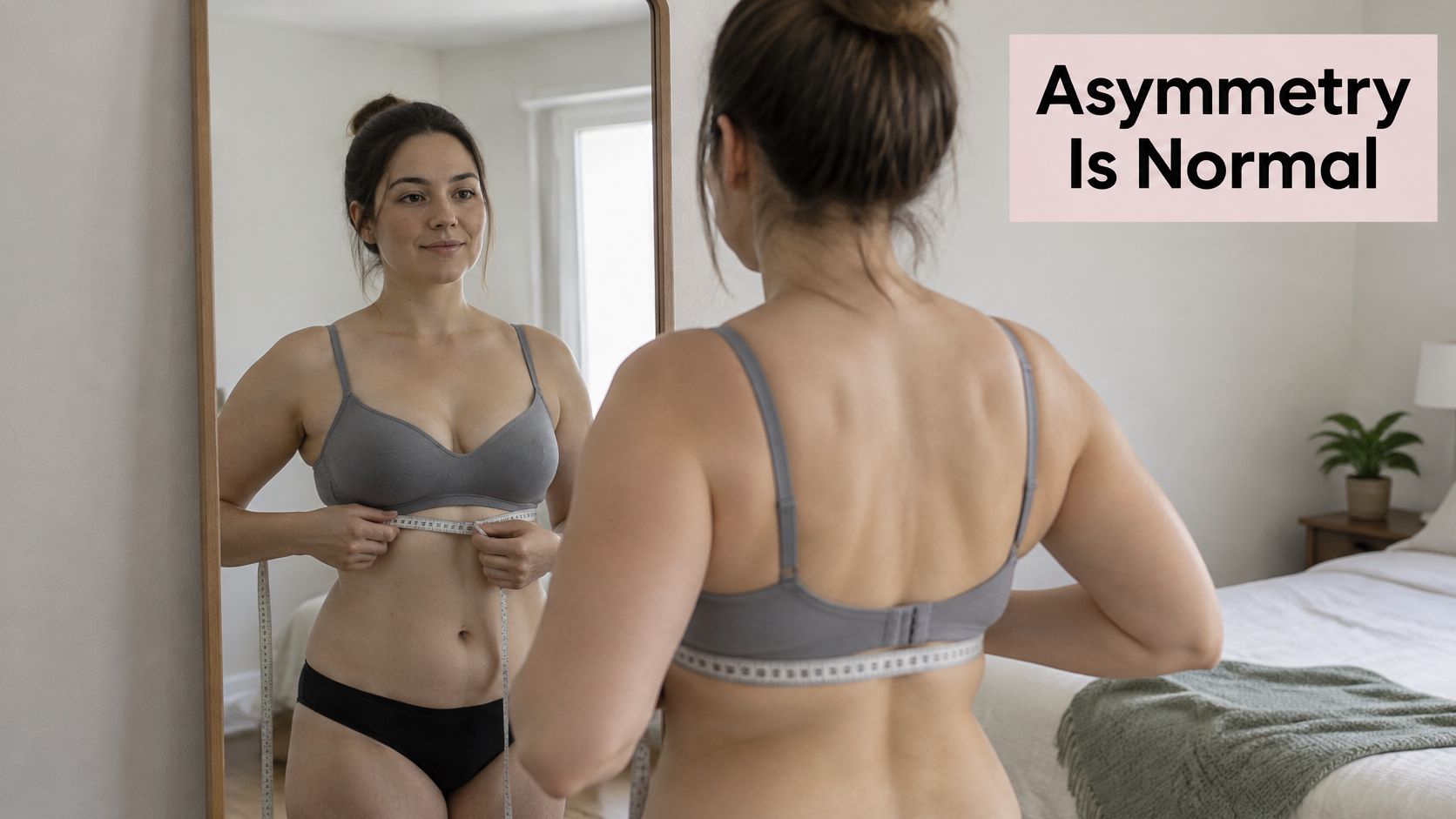
Measure each side separately. Run the tape around the fullest part of each breast on its own, using a fixed reference for both, such as the centre of your sternum, so you're comparing like with like. Two readings that differ by a cup or more tell you the size you calculated is an average of two different bodies.
Fit the larger breast. The band and cup have to contain all of that tissue, because anything left outside the cup ends up under the wire or over the top by mid-afternoon. Once that side is comfortable, close the gap on the smaller side with a strap shortened slightly, a removable pad, or a modest insert.
Record which side is larger alongside the band and cup, so the next fitting starts from knowledge rather than from scratch.
A short walkthrough of the same principle on the body is useful before you commit to a size.
A difference you've always had is a fitting matter. A difference that has appeared recently, is changing quickly, or comes with a lump, skin or nipple changes, or discharge from one breast is a reason to see a GP rather than to try another size. NHS guidance on breast problems in women sets out what should be examined, and none of it is solved by a different bra.
Confirm Your Size Before You Buy or Sew
You now have a band, a cup and a fit check to run, and a decision to make with them: buy in this size, cut a pattern in this size, or measure again. Work through this routine before you spend anything.
- Write the four numbers down. Underbust, bust, band and cup, in that order. A worked example: 30 inches underbust, 38 inches bust, a 34 band and a 34C.
- Pass the fit check on the loosest hook first. Try the style you intend to wear. A size that works in a full-cup bra can fail in a plunge cut, and the label isn't what you'll be living in.
- Read the returns policy before you buy. Even at the right size, a shape that doesn't suit your breast tissue is a return, not a fault. Retailers that accept unworn returns make the trial cheap.
- Re-measure every six to twelve months, and sooner after a significant weight change or a pregnancy. Band and bust both move, and a bra bought two years ago was sized for a different body.
Sewists get an extra check that buyers don't. Anyone cutting a bodice needs a tailor's dummy that matches the body being fitted, because a form a size out gives you a shoulder line and bust apex that won't match the wearer. Our female tailors dummies are listed from size 6/8 through 18/20, and the polystyrene torsos take pins securely enough for real fittings and alterations rather than display-only work. If you're finishing the garment afterwards, the guide to fixing bubbling and peeling fusible is worth reading before you press the interfacing, because a bubbling layer changes how the bodice sits over the bra you've just fitted.
Keep three numbers when you close the notebook: underbust, bust and the confirmed size. 30, 38 and 34C tells you more, and stays useful longer, than the size label on its own.
If you're fitting garments as well as buying bras, our female tailor dummies run from size 6/8 to 18/20 with pin-friendly polystyrene torsos and a choice of tripod or round base stands, with the Female UK Size 8/10 on a white wood tripod stand at £39.95. Browse the full range at Display Guru and measure once against a form that matches the body you're dressing. Free shipping applies to every order, and our team answers sizing questions by live chat and email before you buy.