



Bodysuits for Ladies: Styles, Fabrics and Fit Guide
You're fitting a black bodysuit beneath a fitted blazer. The bust looks right until the client sits down, then the neckline drops and the shoulder straps tighten. Letting out the side seams won't necessarily help, because the problem may be torso length rather than circumference. With bodysuits for ladies, the body panels, gusset and fabric recovery have to work as a fit system.
What Makes a Ladies' Bodysuit a Bodysuit
A ladies' bodysuit is a one-piece garment that covers the torso and continues through the crotch, usually with straps or sleeves. Most fashion styles have an opening at the crotch for dressing and bathroom access. The gusset is the fabric section between the legs; the snaps or hooks attached to it are the closure, not the gusset itself.
Think of the garment as a sealed envelope rather than separate sheets of fabric. Pull at the bottom and the top responds. Unlike a vest or camisole, a bodysuit can't slide upwards at its lower edge when the wearer reaches.
That connection produces a clean tucked-in appearance, but it also transfers tension between areas. A short body can pull down a neckline that would otherwise fit, while inadequate bust room can draw fabric away from the waist.
Check the components separately
- Body panels: Assess shaping, seam position and stretch direction. A stretch jersey front and a rigid decorative panel won't distribute tension equally.
- Gusset: Check width, length, lining and seam placement. It must sit against the body without twisting or dragging the leg openings inwards.
- Closure: Inspect the attachment, reinforcement and access. A comfortable fabric won't compensate for bulky snaps positioned against a pressure point.
A leotard shares the continuous construction but is usually developed around dance, exercise or performance movement, often without an opening gusset. A camisole ends at the waist or hip, while a bodice describes an upper-body garment or garment section rather than necessarily a closed one-piece.
A shapewear body adds deliberate control through firmer fabrics, engineered panels and sometimes boning. Not every shapewear body is boned, and a close-fitting fashion bodysuit shouldn't automatically be sold as supportive shapewear.
Practical rule: Identify what the garment must do before judging how tightly it fits. Smooth layering, bust support and compression are different requirements.
Choose the style for its intended outfit, then assess fabric, measurements, movement and care as separate approval decisions.
Bodysuit Styles Compared at a Glance
Common ladies' bodysuit styles and their uses
| Style | Construction | Typical use | Usual fastening |
|---|---|---|---|
| Thong bodysuit | High-cut leg, thong back, scoop or V neck | Fitted tops, dresses, low-back outfits when the back cut allows | Snap gusset |
| Full-brief bodysuit | Full seat coverage, higher leg line | Everyday wear under trousers and skirts | Snap or hook gusset |
| Long-sleeve bodysuit | Sleeves to the wrist, high or crew neck | Layering under knitwear and jackets | Snap gusset |
| Sleeveless bodysuit | Narrow or wide straps, fitted armhole | Under blazers, tailoring and sleeveless tops | Snap gusset |
| Backless bodysuit | Open or low back, configurable strap design | Under backless dresses and open-back tops | Snap gusset or back hooks |
| Sheer or mesh bodysuit | Sheer panels with opaque lining in key areas | Evening wear, statement styling | Snap gusset |
| Shapewear bodysuit | Firm compression, boning or panels, higher waist | Smoothing under tailored or fitted outfits | Hook-and-eye or back hooks |
These categories overlap. A sleeveless bodysuit can also have a thong base, and a backless design can incorporate shaping panels. Specify the neckline, sleeve, back, leg cut and fastening together rather than treating a style name as a complete construction specification.
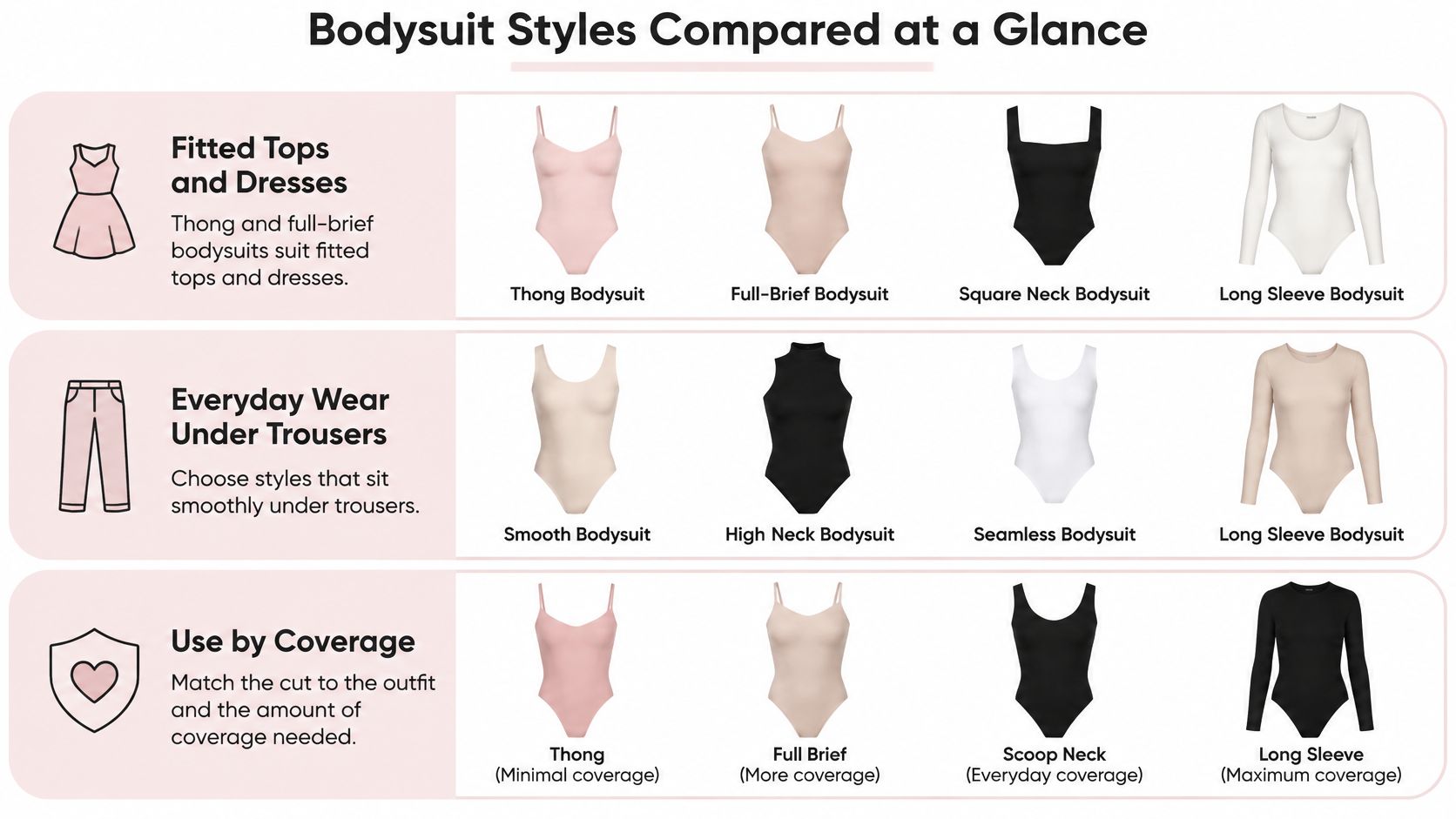
The grouping below is useful when comparing garments against an intended outfit.
Choose coverage by use
For fitted skirts and trousers, start with the base. A thong removes a full-brief seat edge but can concentrate tension if the gusset is narrow or the body is short. A full brief provides more coverage, although its leg elastic needs checking beneath close-fitting outer fabric.
For jackets and knitwear, consider armholes and sleeve bulk. Sleeveless cuts avoid doubled sleeves beneath a blazer; long sleeves provide coverage but can catch inside a narrow jacket arm.
Backless and mesh garments need a different assessment. Removing back coverage changes where the garment can obtain support, while sheer panels make seam quality and lining placement visible. Display them on a form that reveals the back and waist rather than concealing the construction.
Separate fashion from control
Maidstone Museum's account of British fashion in the 1980s describes skin-tight dresses, strapless bodices and lingerie-inspired clothing, useful context for the overlap between underwear and visible fashion. A lingerie-influenced appearance, however, doesn't prove that a garment provides firm control.
For a client seeking a smooth line beneath a specific outfit, start with a sleeveless style and snap gusset. Move to shapewear only when deliberate compression is needed, not as a remedy for an incorrectly proportioned fashion bodysuit.
Fabrics, Care and Long-Term Value
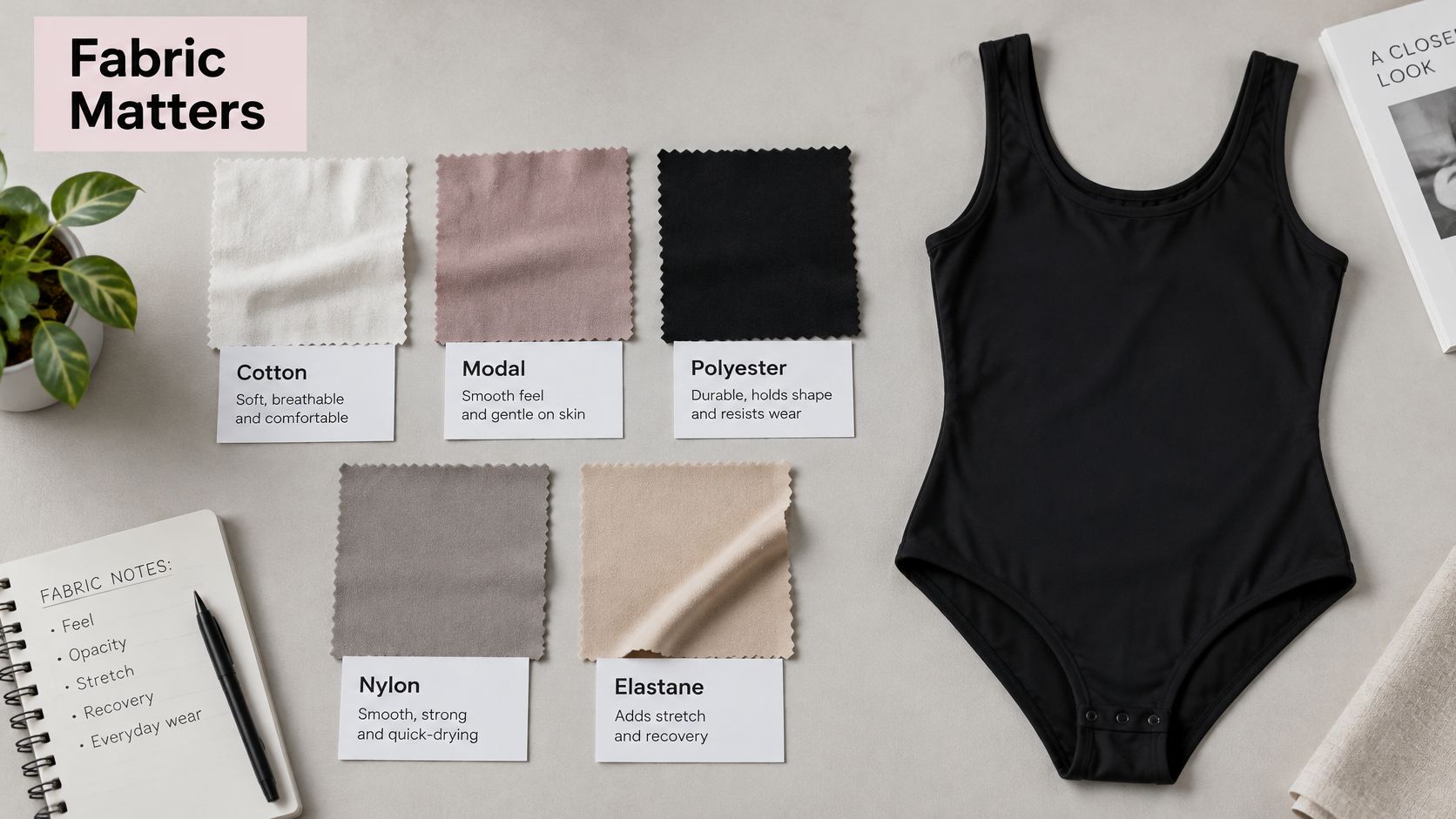
Common bodysuit fabrics and their trade-offs
| Fabric | Main strength | Watch for |
|---|---|---|
| Cotton-elastane jersey | Soft, breathable, natural feel | Bagging and slower recovery when the stretch system is inadequate |
| Nylon-elastane | Smooth finish, strong stretch recovery | Dense constructions can trap heat |
| Polyester-elastane | Colour retention, quick drying, shape retention | Static and odour retention |
| Modal-elastane | Soft handle, good drape | Recovery needs testing; gentle care is important |
| Recycled polyester blends | Recycled fibre input | Verify origin claims and test the finished blend's durability |
| Mesh | Ventilation and sheer styling | Snagging and seam stress near fastenings |
These are sourcing tendencies, not guarantees. Yarn, fabric weight, knit structure, finishing and garment tension can change the result substantially. A dense cotton blend isn't automatically cooler than an open synthetic knit.
Stretch percentage isn't a performance specification
Elastane provides extensibility and recovery, while the companion fibres contribute handle, moisture behaviour and surface appearance. Increasing elastane can improve recovery within a comparable construction, but it doesn't guarantee better support or comfort. Don't approve a fabric from its composition alone.
Stretch and recovery are different. A fabric may extend easily yet remain elongated after release; another may recover well but require too much force for comfortable movement. Check both the lengthwise and crosswise response because a bodysuit needs to accommodate circumference and torso movement.
Elastic trims need their own specification. Our guide to elastic for sewing is useful when choosing neckline and leg-opening finishes, where excessive trim tension can distort an otherwise suitable body fabric.
Inspect the fabric and finished garment together.
Composition is a compliance requirement
The UK government's textile-labelling guidance explains the fibre-composition requirements under the Textile Products (Labelling and Fibre Composition) Regulations 2012, including approved fibre names and percentages by weight in descending order. Identify the composition of materially different textile components, including relevant lining, mesh and gusset sections, rather than describing a multi-component garment with a misleading overall blend.
Obtain composition information from the manufacturer and reconcile the online description with the sewn-in label. Consumers need access to the required information before purchasing online. Keep the body fabric, gusset and lining distinct in the technical pack, even where the consumer-facing presentation can be simpler.
Judge value through wearable life
Affordability remains central: InternetRetailing reports that 61% of UK and US consumers ranked price above sustainability in fashion purchases. Retail buyers therefore need a clearer argument than a recycled-content label attached to an untested garment.
A recycled fibre claim describes an input, not the complete environmental performance of a bodysuit. Ask for documentation supporting recycled content or certification claims, and don't infer that viscose or elastane is sustainable from the fibre name alone. Nor should you claim a conventional blend has a lower environmental impact without evidence covering the comparison.
Cost per wear is a useful commercial measure, but it isn't a substitute for an environmental assessment. Include fastening repairability, seam durability and continued fit when judging likely service life.
A bodysuit that still stretches but no longer returns to shape has failed its fit specification.
Establish a sample-care test
Use a repeatable approval routine rather than stretching the sample once across a desk.
- Record the baseline: Lay the garment flat without tension and note body length, width, leg openings and fastening alignment.
- Launder consistently: Use a cool, gentle process within the care instructions, mild detergent and no bleach. Avoid softener during comparative testing so it doesn't introduce another variable.
- Dry without loading: Reshape and air-dry flat where appropriate. Don't suspend a wet garment from narrow straps or apply heat unless the care label permits it.
- Recheck performance: Compare dimensions, recovery, opacity, pilling and gusset seams after repeated wash-and-dry cycles.
Protect trims as well as fabric. Close the fastening before washing, use a wash bag for snag-prone mesh, and fold garments for storage rather than leaving the straps under prolonged tension.
Measuring and Sizing for a Reliable Fit
A bodysuit can match the bust and still pull at the gusset or ride up at the shoulders. Reliable sizing depends on the torso, gusset and fabric recovery working together, so compare body measurements with the brand's size chart and the garment's finished measurements before ordering.
Compare measurements, not size labels
Each brand sets its own bust, waist and hip bands for each size. Use the chosen brand's chart rather than treating UK labels as universal, and check finished garment measurements alongside body measurements. The two are not interchangeable, particularly when a pattern uses negative ease.
Take measurements consistently
Use a flexible dressmaker's tape over the underwear intended for the fitting. Keep it level for circumferences and snug without compressing the body. Follow a consistent method for taking body measurements for clothes.
- Bust: Measure around the fullest point, checking that the tape stays level across the back.
- Natural waist: Find the wearer's natural waist rather than using a trouser waistband as the reference.
- Hip: Measure around the fullest part of the seat, keeping the tape horizontal.
- Shoulder-to-crotch length: Measure from the shoulder reference point through the front torso to the crotch, following the supplier's stated method.
If the supplier specifies a complete torso loop instead, record that measurement separately. Do not compare it directly with shoulder-to-crotch length, since they describe different routes.
Assess the bodysuit as a fit system
A female-sizing study using body scans from 677 participants highlights why body shape is more complex than a single circumference. A bodysuit must align through several points: bust, waist, hip and torso length. Its fabric must stretch enough for movement and recover without leaving the gusset under constant strain.
A bust-only size choice can leave too little room at the hips or insufficient vertical length. If the lower-body fit is uncertain, guidance on fixing common underwear fit problems can help distinguish a brief-area fit issue from a mismatch through the upper body.
Between sizes, compare the garment's stretch direction and intended compression with how it will be worn, as an underlayer or a visible top. Choose the size that fits the full measurement set and intended use, rather than relying on the larger label as a safeguard.
Fit for Petite, Tall, Long-Torso and Short-Torso Wearers
Height and torso proportion aren't interchangeable. A tall wearer can have a relatively short torso, while a petite wearer can need more body length than the size label suggests. Compare the wearer's torso measurement with the garment's corresponding finished length before changing circumference.
Petite and short-torso fittings
For a petite wearer with a short torso, inspect where the waist shaping and leg openings sit. Excess vertical length can collect above the waist or allow the neckline to migrate, even when the bust circumference looks correct.
A shorter body pattern is usually cleaner than tightening straps to remove surplus length. Adjustable gusset positions can provide useful fine-tuning where the design includes them, but they can't relocate incorrectly positioned bust shaping.
Consider a scenario where the front waist bunches but the seat is smooth. Shortening the whole garment could create a new problem at the back; the pattern may need a local front-length adjustment instead.
Fitting judgement: Remove or add length where the mismatch occurs, not automatically at the shoulder or fastening.
Tall and long-torso fittings
A long-torso wearer needs enough vertical reach without using all the fabric's available stretch while standing still. If fastening the gusset immediately depresses the neckline or loads the shoulders, test a longer-body style.
Don't confuse overall garment length with a suitable rise. The front and back sections must distribute that length appropriately, especially over a fuller bust or seat.
- When circumference also feels tight: Trial the adjacent size and reassess the complete silhouette.
- When only length is wrong: Prefer a longer-rise pattern or dedicated length option over a generally larger garment.
- When coverage causes discomfort: Compare thong and full-brief bases, but don't expect either cut to correct inadequate torso length.
Size labels don't describe these proportions. Our discussion of whether size 16 is plus size provides context for avoiding assumptions based on a category name rather than measurements.
Approve the proportion on a suitable form, then confirm comfort seated and with the arms raised. A garment that fastens only when the wearer stands rigidly isn't an acceptable fit.
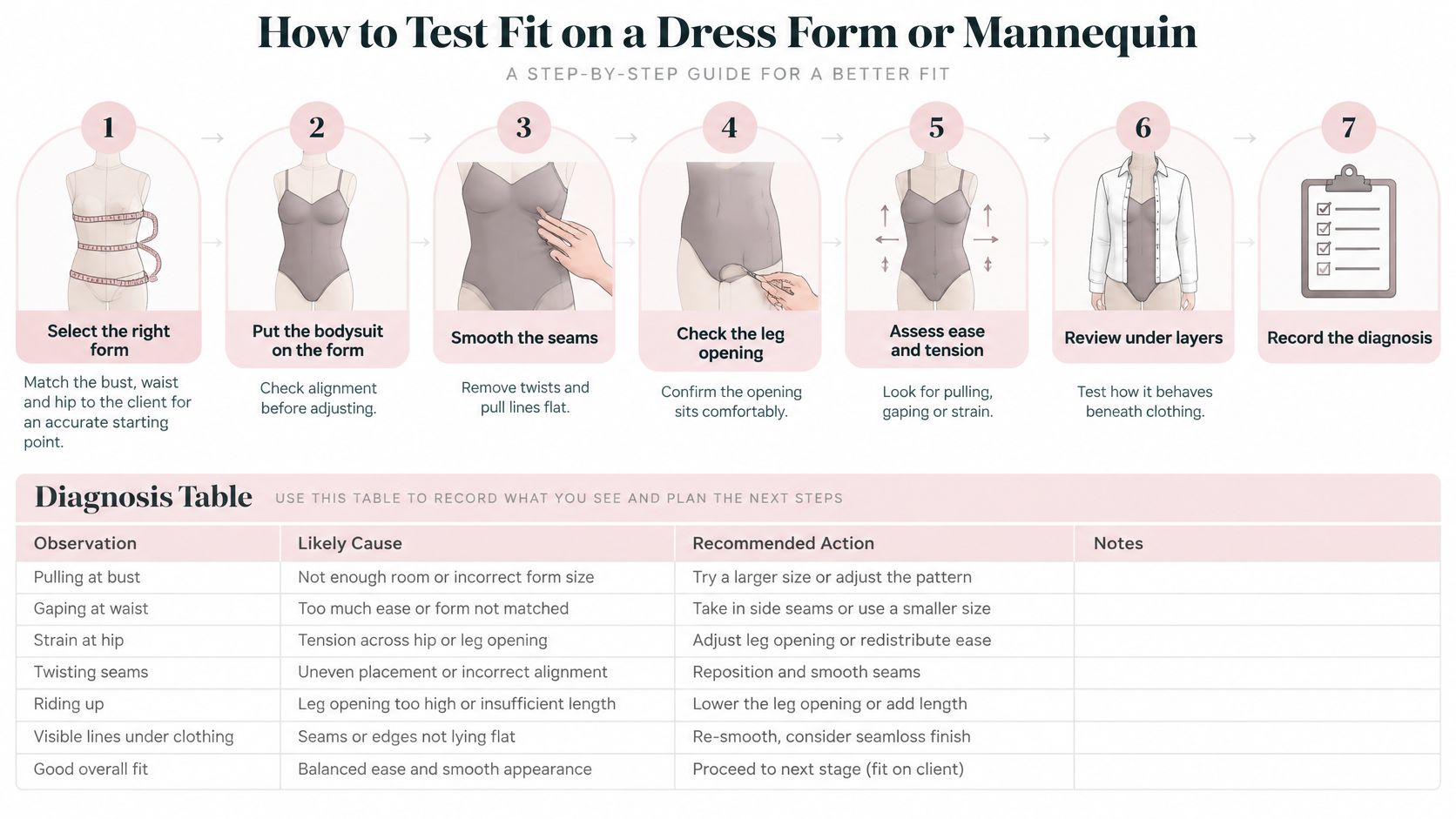
How to Test Fit on a Dress Form or Mannequin
- Select the right form. Match bust, waist and hip, then check torso proportions and whether the form has a usable crotch section. Raising the stand changes working height, not body length; our guide to an adjustable mannequin dress form helps distinguish the available adjustments.
- Dress and align the garment. Close the gusset without forcing it and align the centre front, centre back and side seams. A twisted starting position can produce misleading diagonal drag lines.
- Assess the bust. Look for horizontal strain and displaced seams rather than judging smoothness alone. Check fabric extension before deciding whether to add pattern width.
- Inspect the neckline. Note whether gaping is local or accompanies tension elsewhere. Excess neckline length, insufficient shaping and vertical drag require different corrections.
- Check the gusset and rise. Inspect leg-opening symmetry and fastening position on a compatible form. Don't pin a gusset beneath a flat-ended torso and treat that improvised anchor as evidence of fit.
- Review shoulder loading. Check whether straps dig into the form, slip outwards or pull the neckline off position. Establish whether the cause is strap geometry or insufficient body length before altering the strap.
- Complete a movement assessment. Use articulated features only as the manufacturer intends; never bend a rigid stand to imitate sitting. Finish with a live seated, reaching and bending check, or record movement approval as outstanding.
Fit problems on a form and their likely fixes
| Problem on the form | Likely cause | Adjustment |
|---|---|---|
| Horizontal pulling across the bust | Insufficient bust room or inadequate stretch | Add bust room or test fabric with suitable extension and recovery |
| Gaping at the neckline | Opening too wide or drop too deep | Reshape the neckline or apply correctly tensioned elastic |
| Gusset riding up | Garment torso too short or rise insufficient | Lengthen the relevant rise section or select a longer-body style |
| Shoulder straps digging in | Excess strap tension or shoulder-width mismatch | Correct body length first, then adjust strap length, position or width |
| Bagging at the seat or waist | Excess ease or poor recovery | Reduce local ease or select fabric with better recovery |
Record a diagnosis, not just a rejection
Just Style reports that around 30% of UK fashion purchases are returned and that 62% of surveyed UK shoppers have used bracketing. A return marked poor fit gives a patternmaker little to act on; a note identifying front-rise shortage or excess neckline length is actionable.
Photograph the front, side and back under consistent conditions. Record the sample size, form measurements, fabric specification and proposed alteration, then change one cause at a time.
Use the visual workflow as a reminder during sample reviews.
Styling and Layering Bodysuits Under Clothing
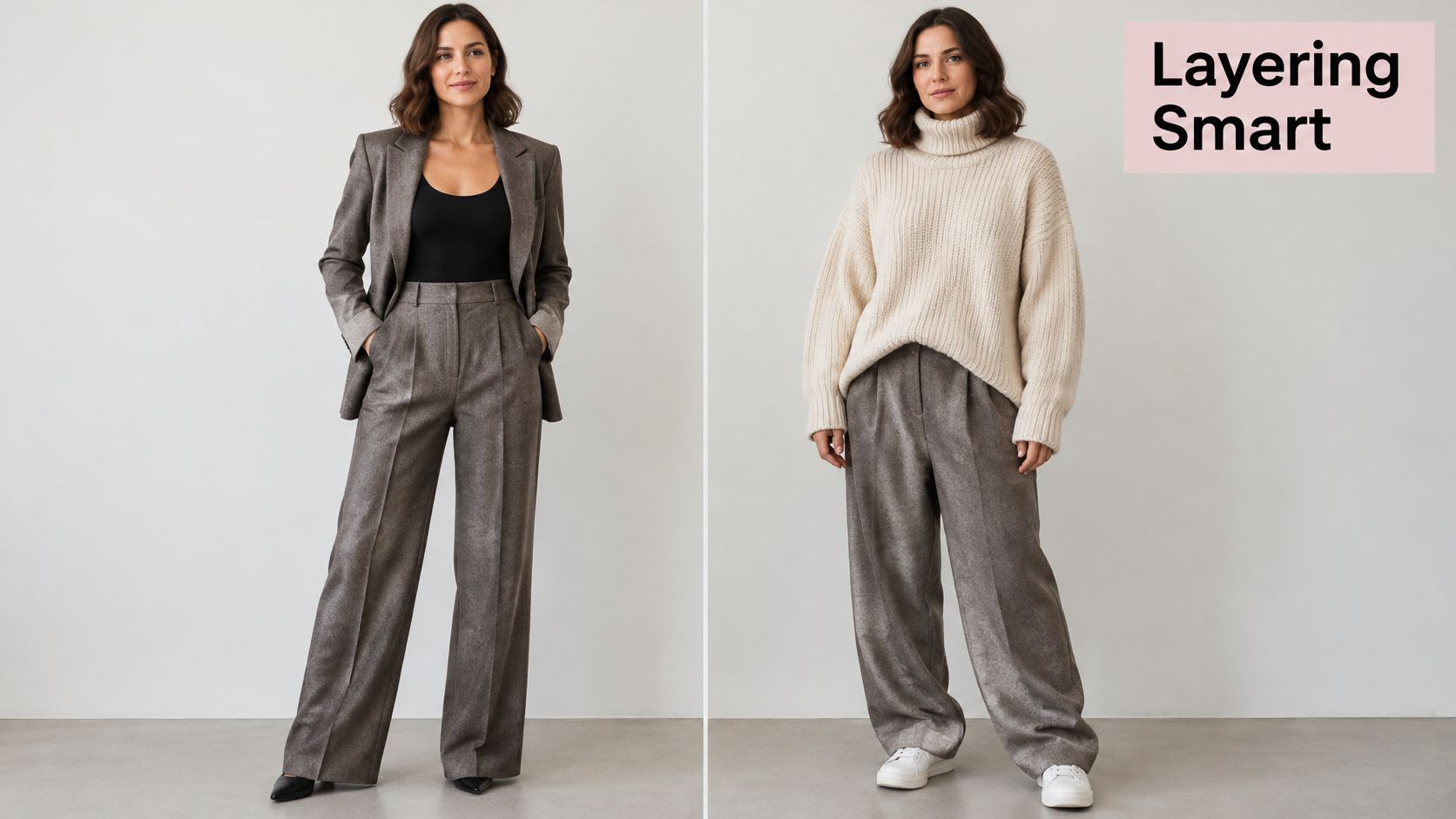
A bodysuit beneath high-waisted wool trousers can produce a continuous line through a trouser suit. Put the same garment beneath a loose knit and the result may be less tidy if the knit catches on raised seams or excess fabric. Assess the layers together rather than approving each garment in isolation.
This outfit example is useful for considering proportion and the relationship between a fitted upper layer and wide-leg trousers.
Match the garment edges to the outfit
Under tailoring, choose a neckline that clears the jacket collar and lapel roll. A close colour match can reduce visual interruption, but the armhole finish matters just as much when the jacket is removed.
Under skirts, position the leg opening away from the area where the skirt fits most closely. A full brief may work beneath an opaque A-line skirt, while a thin fitted skirt needs particular attention to seat-edge visibility.
For sheer or open-back garments, make the bodysuit's coverage intentional. A visible strap arrangement should look integrated, not like an ordinary back band exposed by accident.
A high-neck or long-sleeve bodysuit can also serve as the visible top with trousers or a skirt, with only its lower section concealed. When combining it with loose-fitting clothes, check contact points at the waistband and underarms rather than assuming the outer volume prevents interference.
Use the styling video to compare the finished outline with the garment's technical requirements.
Run an outfit-level check
- Check visible edges: Inspect leg elastic, lining boundaries and seam allowances through the trousers or skirt.
- Dress without dragging: Put on the outer layer and confirm that friction hasn't displaced the body or opened the fastening.
- Review the display: Confirm that the form reveals the intended back and waist, without clipping away genuine fit problems.
Choose the Right Bodysuit Before You Order
Choose the style by use, fabric by tested performance and size by the complete measurement set. Then approve a sample on an appropriate form and wearer. Reversing that sequence often produces a purchase that looks right on the specification sheet but needs avoidable alterations.
Create a sample approval record
A useful buying record separates what the supplier claims from what the sample demonstrates. Keep photographs, measurement sheets and laundering observations with the style reference so another fitter can reproduce the assessment.
- Outfit compatibility: Record the neckline, back exposure, sleeve requirement and intended lower-body coverage.
- Component identification: Confirm that body, gusset and lining descriptions are clear and consistent across the technical pack and sales information.
- Measurement agreement: Compare the wearer's dimensions with the brand's body chart and finished garment specification, using matching measurement definitions.
- Sample status: Mark static fit, movement, laundering and fastening checks as approved or unresolved.
- Care practicality: Reject a care regime that the customer, wardrobe department or retail proposition can't reasonably support.
For a tailor or dressmaker, a matching form provides a repeatable reference while cutting and altering. It doesn't replace the wearer, but it helps distinguish a pattern change from a change in posture between fittings.
For retail and costume teams, plan assessment across the size bands being stocked rather than approving a whole range from its smallest sample. Prioritise forms that represent the measurements being sold, with enough access to inspect the construction that matters.
Match the tool to the decision
At Display Guru, our female tailor dummies are available in sizes 6/8, 8/10, 10/12, 12/14, 16/18 and 18/20; our Female UK Size 8/10 tailors dummy torso bust is made from polystyrene for secure pinning during fittings and alterations. Choose a pin-friendly torso for marking and shaping work, but use a compatible lower-body form or live fitting when the decision concerns crotch geometry.
Keep display approval separate from technical approval. A garment can present neatly on a torso while its gusset, fastening access or seated comfort remains untested.
Pick one style and one target size band, obtain a sample, and document the outstanding checks before committing to quantity. Approve the order only when the garment performs in the intended outfit, not merely when it looks smooth standing still.
We offer tailor dummies and female three-quarter and full body forms to support garment fitting and presentation. Visit Display Guru to select a form suited to your target measurements and inspection needs, then test your bodysuit sample before ordering in quantity.