




Choosing Your Perfect Sewing Cutting Table
If you’re serious about sewing, your cutting table isn't just a piece of furniture—it’s the heart of your workspace. It’s the difference between an improvised corner and a proper, professional-grade prep station, designed to improve your workflow, protect your back, and ensure your cuts are dead-on accurate every time.
Your Most Important Sewing Tool
Imagine a professional chef’s kitchen. They don't prep their ingredients on the hob or a wobbly side table. They have a dedicated, sturdy prep station where everything is chopped and organised with precision. That’s exactly what a proper cutting table is for a sewist. It’s the clean, stable, and ergonomic surface where your creative ideas start to take real shape.
Moving your cutting process off the floor or the dining room table is one of the single biggest upgrades you can make to your craft. This isn't just about convenience; it’s about accuracy and comfort. A dedicated table, set to the right height, saves you from the back and shoulder pain that comes from hunching over, letting you work for hours without discomfort. More importantly, its large, flat surface ensures your fabric lies perfectly straight, without any of the subtle stretching or skewing that can ruin a project. Without that stability, even the most carefully measured patterns can lead to a garment that just doesn't fit right.
The Foundation of a Professional Workflow
A truly professional workflow starts with your setup. Having a dedicated cutting space means you’re not constantly clearing away clutter just to get started. It saves an incredible amount of time and mental energy. Everything—from your rotary cutter to your pattern weights—has its place, creating an organised and efficient environment where you can focus on the work itself. This is where your raw materials are transformed into the building blocks of your next creation.
Think of your cutting table as the cornerstone of your sewing studio. It provides the stability and space you need to ensure every single cut is precise, laying the groundwork for a flawless finished piece.
Here in the UK, the boom in sewing has changed how people think about their creative spaces. As the UK textiles manufacturing industry has grown, now projected to hit a market size of £158.6 billion in 2025, the line between making and showing off your work has blurred. Many studios now use their cutting tables as dual-purpose areas for client fittings or even displaying finished pieces, integrating them with mannequins and garment rails. This shift shows why a well-chosen table is a smart investment, not just another piece of furniture. You can discover more insights about the UK textiles market and its growth to see just how significant this trend is.
A Look at the Different Types of Sewing Cutting Tables
Choosing a sewing cutting table is a lot like picking out a good kitchen knife. You wouldn't use a tiny paring knife to carve a Sunday roast, and you wouldn't use a giant cleaver for delicate garnishes. The right tool depends entirely on the job at hand. In the same way, the best table for a professional tailor working in a bustling studio is worlds apart from what a home hobbyist needs in their spare bedroom.
Let's break down the main types to help you find your perfect match.
This little decision tree can help you figure out if a dedicated table is the right move for you right now.
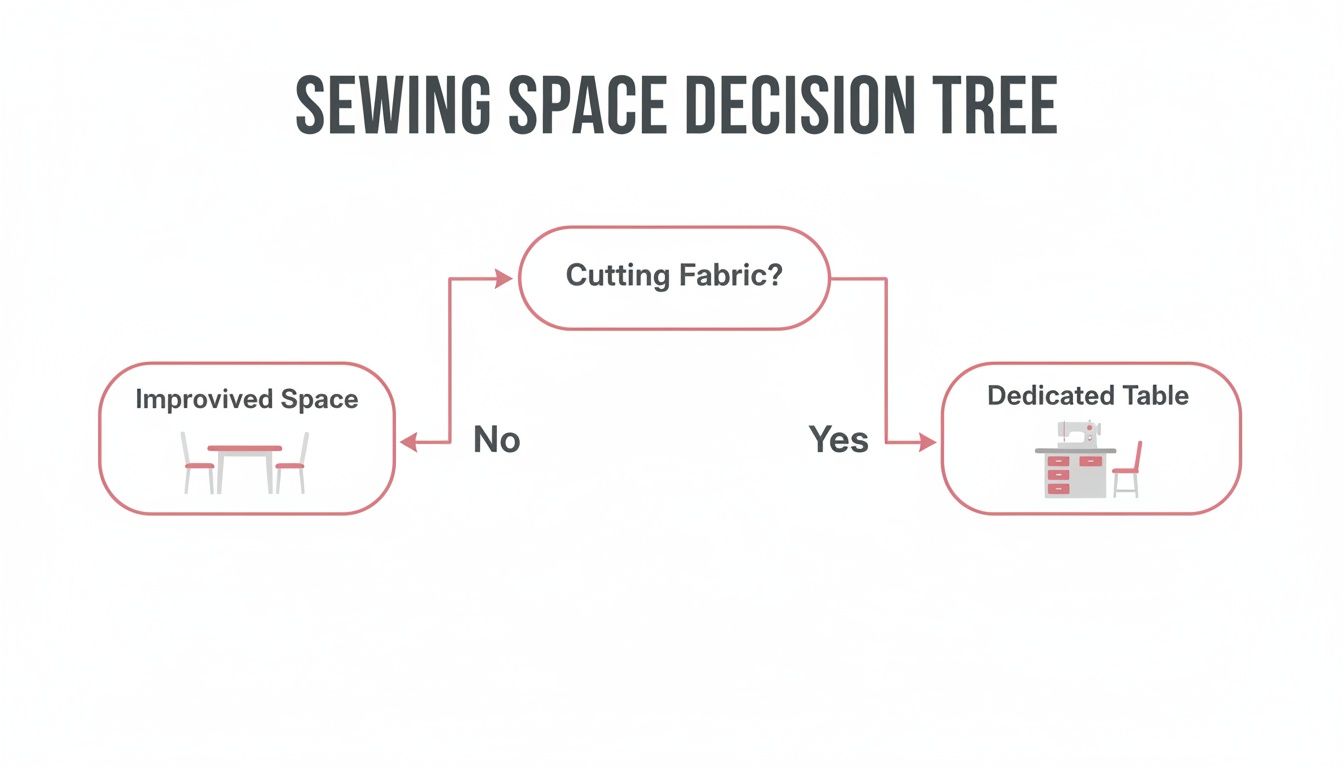
As you can see, the moment you find yourself regularly cutting fabric, it's time to graduate from the kitchen table or the floor to a proper, purpose-built surface.
Fixed-Height Tables: The Studio Workhorse
Think of fixed-height tables as the sturdy, reliable backbone of the sewing world. These are typically large, robust tables set at a standard counter height—usually around 36 inches—and built to take a beating in professional settings like tailoring shops, fashion schools, and production houses.
Their biggest selling point is unbeatable stability. With no moving parts for height adjustment, they provide a rock-solid surface that won't wobble or shift, even when you’re wrangling heavy bolts of denim or upholstery fabric. For any business where precision is everything, that stability is non-negotiable. The trade-off? Their one-size-fits-all design isn't very flexible, which can be an ergonomic headache if people of different heights are sharing the same workspace.
Adjustable-Height Tables: Built for Ergonomic Comfort
Adjustable-height tables are a complete game-changer when it comes to comfort. Whether you adjust them with a manual crank or an electric motor, these tables let you dial in the surface to your ideal height. This simple feature prevents the nagging back and shoulder strain that comes from hunching over a low table or stretching up to a high one.
This adaptability makes them perfect for shared spaces or for anyone who spends long hours cutting patterns. Some sewists even use them as a sit-stand desk, raising the table for cutting and then lowering it for work at the sewing machine. While the health benefits are fantastic, they can sometimes be a touch less stable than their fixed-height cousins and often come with a bigger price tag.
Folding Tables: The Space-Saving Solution
For the home sewist working with limited space, a folding cutting table is an absolutely brilliant solution. These tables are cleverly designed to give you a generous cutting surface when you need it, but then collapse down to a fraction of their size for easy storage in a cupboard or against a wall.
They’re ideal for multi-purpose rooms where a permanent setup just isn't an option. Picture a student in a small flat or a hobbyist who has claimed the guest room as their creative space. While they are incredibly convenient, the main compromise is often on stability and size. They might not be as robust as a fixed table, but for many, the space-saving perk is well worth it. You can learn more about how to choose the right pattern cutting table for your specific needs in our detailed guide.
The Bottom Line: The best type of table boils down to your priorities. Do you need maximum stability for professional use (fixed), ergonomic comfort for long hours (adjustable), or compact storage for a small room (folding)?
Modular Systems: The Future-Proof Choice
Modular systems offer the ultimate in customisation. These aren't just single tables; they're a collection of units—tabletops, leg frames, storage cabinets—that you can mix, match, and reconfigure as your needs change. You can start with a small, simple setup and then add more sections as your projects get bigger or your business grows.
This makes them a fantastic long-term investment for a growing studio or a serious crafter who knows their hobby is only going to expand. Their versatility lets you create L-shaped or U-shaped workstations that adapt perfectly to your room's layout. The main thing to bear in mind is that building a large, high-quality system can be a significant financial outlay compared to buying a single, all-in-one table.
Sewing Cutting Table Types Compared
To make the choice a bit clearer, here’s a side-by-side look at the most common types of sewing cutting tables.
| Table Type | Best For | Pros | Cons |
|---|---|---|---|
| Fixed-Height | Professional studios, workshops, and educational settings where stability is key. | Extremely sturdy and durable; often has a large, uninterrupted surface. | Not ergonomically friendly for multiple users; can't be adjusted for comfort. |
| Adjustable-Height | Shared workspaces, professional freelancers, and anyone prioritising comfort. | Excellent for ergonomics and preventing strain; versatile for sitting or standing. | Can be less stable than fixed tables; typically more expensive. |
| Folding | Home hobbyists, small apartments, and multi-purpose rooms. | Saves a huge amount of space; easy to store away when not in use. | Less stable; often smaller surface area; may not be as durable. |
| Modular | Growing businesses, dedicated crafters, and oddly shaped rooms. | Highly customisable and expandable; can be adapted to any space. | Can be a significant investment; assembly may be complex. |
Ultimately, weighing these pros and cons against your specific workspace, budget, and sewing habits will point you directly to the best table for your needs.
How to Choose the Right Tabletop Material and Surface
The surface of your sewing cutting table is where all the magic happens. It’s not just a slab of wood or laminate; it's the foundation for every cut you make, directly impacting your accuracy, the longevity of your tools, and the final quality of your work. Think of it as an active partner in your creative process.
Choosing the right material is a balancing act between durability, function, and the kind of work you do.
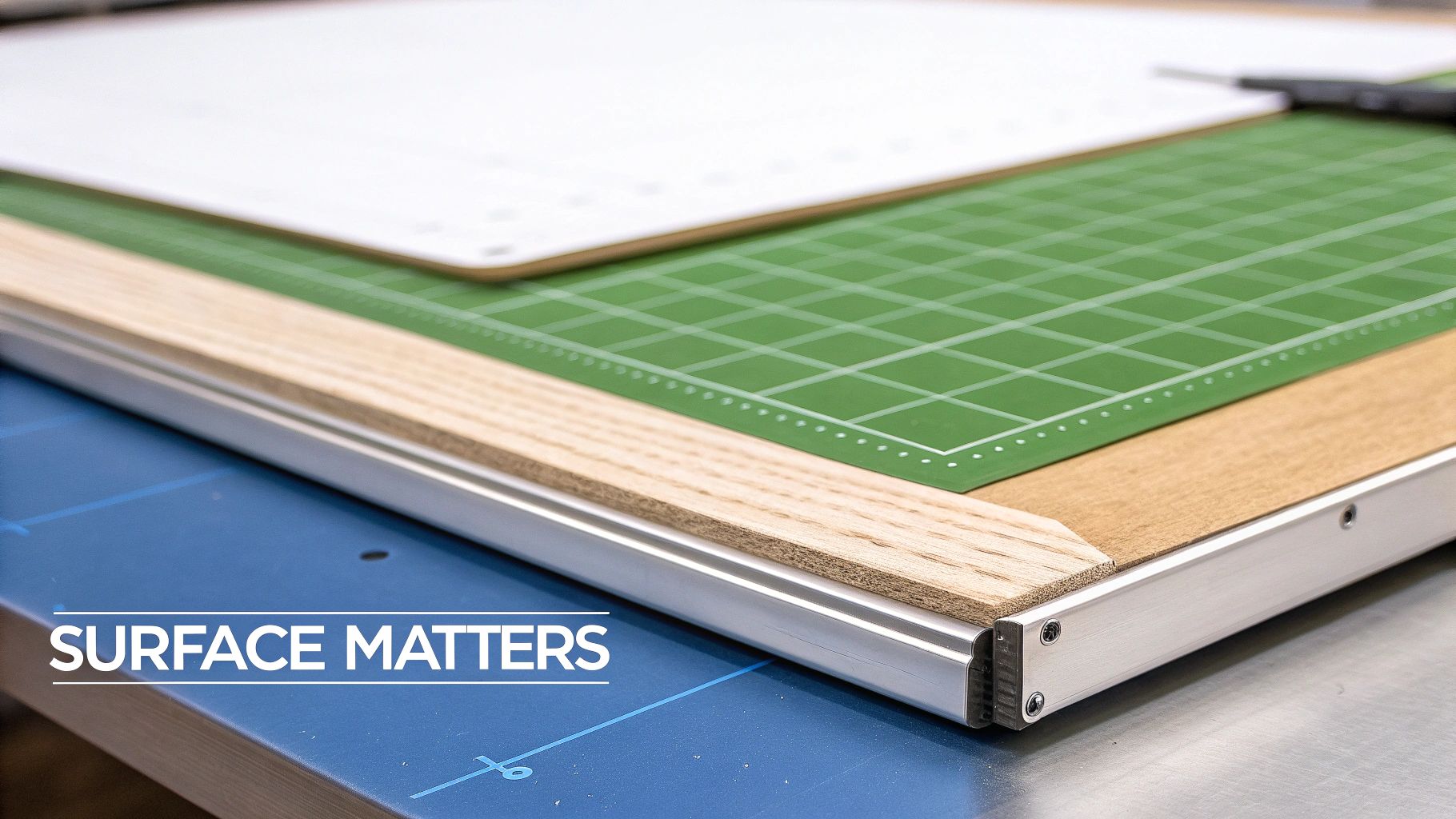
It helps to think of the tabletop like one blade of a pair of scissors. A cheap, poorly made blade will snag fabric and go blunt in no time, but a high-quality one glides through material like butter. The same principle applies here—the surface needs to support your tools, not fight against them.
Common Tabletop Materials
You’ll generally find a few common materials used for cutting tabletops, and each comes with its own set of pros and cons.
Laminate and Melamine are very popular, especially if you’re working with a tighter budget. These are essentially engineered surfaces where paper and resin are fused over a particleboard core. The result is a smooth, non-porous finish that’s a doddle to clean, and fabric glides over it beautifully.
The major downside, though, is how easily they can be damaged. One slip with a rotary cutter can leave a permanent slice in the surface, creating a groove that’s guaranteed to snag delicate fabrics down the line. They’re affordable, but you have to be careful with them.
Solid Wood is the premium choice—a true long-term investment. Tables made from hardwoods like maple, birch, or oak offer incredible stability and have a classic, timeless look. A solid wood surface is exceptionally durable and has a secret weapon: if it gets damaged over years of use, you can sand it down and refinish it, giving it a lifespan that laminate just can't match.
Of course, the trade-offs are cost and weight. Solid wood tables are much more expensive and far heavier, making them a more permanent fixture in your sewing room.
The Non-Negotiable Accessory: A Self-Healing Mat
No matter which tabletop you go for, a self-healing cutting mat isn't an optional extra—it's essential. If you use a rotary cutter, this is completely non-negotiable. These mats are made from a clever composite material that absorbs the cut from a sharp blade and then closes back up, leaving the surface smooth again.
Cutting directly onto any table surface with a rotary cutter, even solid wood, will quickly ruin both the table and your blade. A good mat delivers three crucial benefits:
- It protects your table surface from getting sliced to ribbons.
- It dramatically extends the life of your rotary blades by giving them a forgiving surface to cut into.
- It provides a gridded, non-slip surface for making incredibly accurate, straight cuts.
The perfect cutting setup is a combination of a sturdy table and a high-quality mat. The table gives you stability, while the mat delivers precision and protection. It ensures every project starts off perfectly. To find the ideal partner for your table, check out our complete guide on sewing and cutting mats.
Don’t Forget the Frame and Overall Stability
While we tend to focus on the top, the frame holding it all up is just as crucial. A wobbly table is a recipe for wonky cuts. Most modern cutting tables use frames made from sturdy metal, like steel. This gives you excellent stability and durability without the huge weight of a solid wood frame.
There’s also a clear trend towards more substantial equipment in the sewing world. In 2024, the UK sewing machine market brought in around USD 116.7 million in revenue, partly because more people are buying heavier, computerised machines. This shift puts greater demands on our workspaces, needing surfaces that can handle vibrations and support large, ambitious projects without budging. You can see more data on the growth of the UK's sewing equipment market to get a feel for this industry-wide shift.
Finding the Perfect Size for Your Workspace
Choosing the right size for your sewing cutting table is about much more than just whether it will fit in the room. You're essentially designing the heart of your workspace, a place that needs to be functional, comfortable, and efficient. Think of it like a chef's kitchen counter – everything needs to be within easy reach, with plenty of room to work without feeling cramped.
The wrong table can be a constant source of frustration. You'll find yourself wrestling with large pieces of fabric, or working hunched over in an awkward position. The goal is to strike that perfect balance between having a generous work surface for your projects and respecting the physical limitations of your space.
Understanding Your ‘Working Envelope’
Before you even start looking at table dimensions, you need to map out your ‘working envelope’. This isn't just the space the table takes up; it's the crucial clearance you need around it to work effectively. It’s the room you need to walk around, lay out a wide bolt of fabric, and manage large paper patterns without them ending up on the floor.
To figure this out, ask yourself a few practical questions:
- Can I move freely? You should be able to walk around at least three sides of your table without squeezing past walls or other furniture. Aim for a clearance of at least 3 feet (about 90cm) as a solid starting point.
- Can I handle my fabric? If you often use 60-inch wide fabrics for dressmaking or quilts, you need enough space to unroll and position them without the material bunching up against a wall.
- Can I reach my tools? Think about where your rulers, rotary cutters, and pattern weights will live. Your working envelope should let you grab them easily without having to stretch awkwardly across the table.
Get your tape measure out and map your room properly, remembering to account for things like door swings, where your sewing machine sits, and any existing storage units. This groundwork is the single most important step in creating a setup that truly works for you. For a deeper dive, check out our expert tips on planning your ideal sewing room setup.
Matching Table Dimensions to Your Projects
Once you know the maximum footprint your table and its working envelope can occupy, you can zoom in on the tabletop itself. The right dimensions really come down to the scale of the projects you tackle most often.
Standard Table Width:
You’ll notice many sewing cutting tables are around 60 inches (152cm) wide, and that’s no coincidence. Most standard bolts of fabric for dressmaking and quilting are between 44 and 60 inches wide. A 60-inch table lets you lay out most fabrics folded in half (selvedge to selvedge) with room to spare, which is perfect for cutting out pattern pieces.
Table Length:
Length, on the other hand, can vary wildly. You'll find compact models around 40 inches long, right up to professional tables stretching 8 feet or more. A longer table is an absolute game-changer for laying out entire garment patterns or long pieces for curtains and upholstery. It stops the fabric from hanging off the end, which can pull it off-grain and ruin your cut.
A generous, well-planned surface area isn't a luxury; it's a practical necessity. With momentum building in UK garment manufacturing, we're seeing a renewed focus on efficient cutting layouts. Many small and medium-sized businesses are reorganising their workshops to get rid of bottlenecks right at the prep stage.
This isn't just anecdotal. The Manufacturing Health Index reported that UK garment SMEs saw an average 128% jump in sales in the third quarter of 2024. When orders are flying in that fast, you simply have to be efficient, and that often means adding dedicated cutting stations. You can read the full report on UK garment supplier growth to see how the industry is adapting.
The Critical Importance of Ergonomic Height
Finally, let’s talk about height. This is probably the single most important dimension for your long-term health and comfort. A table that’s too low will have you hunched over for hours, leading to a world of back, shoulder, and neck pain. But one that’s too high forces you to raise your shoulders, creating tension and fatigue.
The sweet spot for a cutting table is a height that lets you stand with a straight back, your arms bent at a comfortable, near-90-degree angle while you work. For most people, this is roughly standard kitchen counter height, around 34-38 inches (86-96 cm). A great way to find your personal perfect height is to stand up straight and measure from the floor to your hip bone—your tabletop should be at or just below this measurement.
Because we all come in different shapes and sizes, an adjustable-height table is a fantastic investment. It gives you the power to dial in the surface to your exact ergonomic sweet spot, ensuring you can work comfortably and with precision for hours on end.
Essential Features That Improve Your Workflow
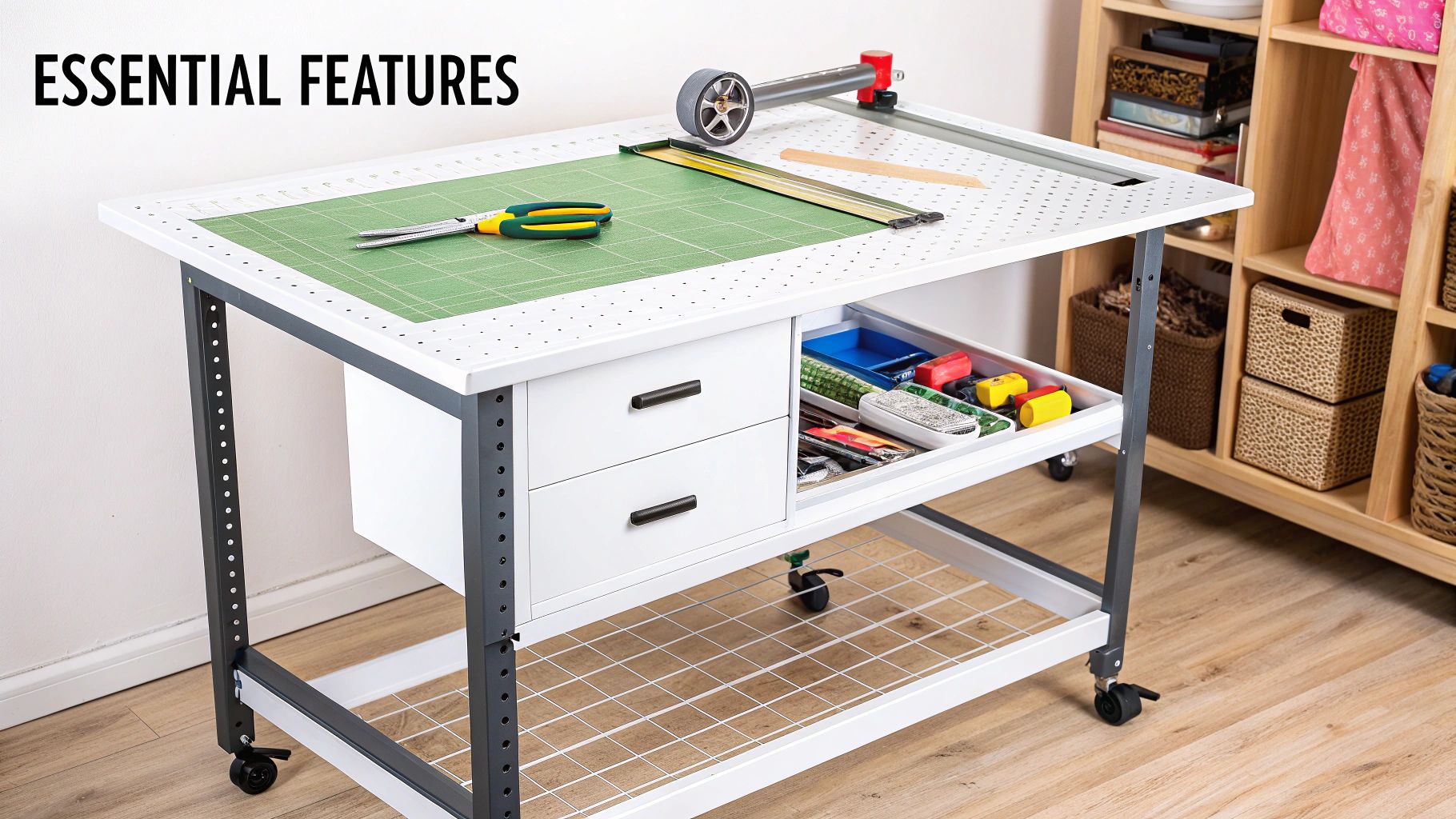
Once you've settled on the right size and material for your cutting table, the real magic lies in the details. Certain features can take a simple flat surface and transform it into the heart of your sewing room—a true productivity powerhouse. These are the clever additions that solve all those little frustrations we've all felt, making your creative process smoother and, frankly, a lot more fun.
A great table doesn't just sit there; it anticipates your next move. It's about having everything you need, right where you need it, so you can stay in that creative flow state. No more hunting for a ruler or digging for your favourite scissors. This is the difference between a table that simply works and one that truly works for you.
Integrated Measuring Grids and Rulers
Ask any seasoned sewist, and they'll tell you one of the most useful features on a purpose-built cutting table is a measuring grid printed right onto the surface. This simple but brilliant idea turns your entire workspace into a giant ruler, letting you make quick, accurate measurements without constantly reaching for a tape measure.
It’s an absolute lifesaver for tasks like:
- Squaring up fabric: You can instantly see if your fabric is perfectly on-grain before making that crucial first cut.
- Quick checks: Need to double-check a pattern piece dimension or a seam allowance? It’s right there at a glance.
- Cutting long strips: Making bias binding or quilt sashing becomes so much faster and more precise.
While a self-healing mat offers a similar grid, having one on the table itself gives you a permanent, large-scale reference that’s always ready to go. It’s a small detail that saves you countless minutes over the course of a project.
Smart Storage Solutions
Clutter is the enemy of both creativity and precision. A table with well-designed storage is a total game-changer for keeping your workspace tidy and efficient. This could be anything from simple open shelves to deep drawers, each with its own purpose.
An organised workspace is a productive workspace. When your tools are neatly stored yet instantly accessible, you reduce friction in your workflow, allowing you to move seamlessly from one task to the next.
Open shelves are perfect for things you grab all the time, like pattern weights, rotary cutters, and small rulers. Drawers are better for tucking away less-used tools, spare blades, or marking pens that would otherwise clutter up your surface. After all, a huge part of the process is organizing your sewing supplies effectively. For a deeper dive into making your creative area work harder, check out our guide on sewing table storage for more great ideas.
Mobility with Locking Castors
Being able to move your cutting table around easily can be surprisingly handy, especially if your sewing room doubles as a guest room or you're working in a busy studio. Tables with castors (wheels) give you this flexibility, letting you shift your setup without a fuss.
But let’s be clear: when you’re cutting, that table needs to be rock-solid. The last thing you want is a table that wobbles or slides as you press down with a rotary cutter. That’s why locking castors are a non-negotiable feature. They give you the best of both worlds: effortless movement when you need it, and unshakeable stability once you’ve locked it down. It’s a feature that makes your entire space more versatile.
Getting Your Cutting Table Set Up and Keeping It That Way
A great cutting table is a serious piece of kit for your sewing room, and like any professional tool, it needs a bit of care to keep it performing at its best. Getting the initial setup right is the first, and most important, step. This isn't just about bolting it together; it's about building the stable, precise foundation you need for accurate work.
Your table will likely arrive flat-packed. Before you even pick up a tool, lay everything out and check it against the parts list. Take your time with the assembly—rushing can lead to wobbly legs or a wonky top. Make sure every screw and bolt is snug, but don't go overboard and strip the threads. An extra 20-30 minutes of careful assembly now will save you countless headaches down the line.
Nailing the Stability
With the table built, your next job is to make it perfectly level. A wobbly surface is a disaster for cutting. Even the slightest rock can cause your fabric to shift, turning a perfect cut into a frustrating mistake. You might think your floor is flat, but tiny imperfections can throw everything off.
Here’s a simple routine to get it rock-solid:
- Grab a spirit level and place it in the centre of the table. Check the level both along the length and across the width.
- Nearly all good tables come with adjustable levelling feet. Tweak them one by one until the bubble on your spirit level sits dead centre.
- Give the table a good 'wobble test'. Push down firmly on each corner. If there's any movement at all, fine-tune the feet until it's completely rigid.
A stable cutting surface is non-negotiable for precision work. Taking the time to level your table correctly is the foundation for every accurate cut you will make on it.
Long-Term Care for a Pristine Surface
Regular maintenance will protect your investment and keep your workspace in top shape for years. How you clean it depends on the tabletop material, especially if you’re using a cutting mat on top. For a deeper dive into how all these parts work together, have a look at our guide to choosing the perfect dressmaking cutting table.
To keep your table looking and performing its best, try to build these habits into your routine:
- For Laminate and Melamine: A quick wipe with a damp, soft cloth and a tiny bit of mild cleaner is all you need. Steer clear of harsh, abrasive cleaners or scourers—they’ll scratch the surface, and those scratches are there for good.
- For Self-Healing Mats: Every so often, give your mat a gentle clean with lukewarm water and a drop of soap. This lifts all the tiny fibres and dust out of the cuts. Let it air dry and, crucially, always store it flat to stop it from warping.
- Protect the Surface: This is a big one. Never, ever use a rotary cutter or push pins directly into the tabletop. Your self-healing mat is the table's best friend; think of it as an essential shield.
- Tighten Up: Every few months, especially if you move the table around, give all the screws and bolts a quick check to make sure they’re still tight.
Stick with these simple setup and maintenance tips, and your cutting table will remain the reliable, accurate heart of your creative space for years to come.
Common Questions About Sewing Cutting Tables
Even with all the options laid out, a few practical questions always pop up. Let's tackle some of the most common queries I hear, giving you clear, straightforward answers to help you choose and use your table with confidence.
What Is the Ideal Height for a Sewing Cutting Table?
The perfect height is all about ergonomics. For most people, that sweet spot is counter height, which is usually between 34-38 inches (86-96 cm). This height lets you stand comfortably, cutting and pinning without hunching over and straining your back or shoulders—a classic complaint from anyone who’s spent too long working on a low dining table.
Here's a simple trick to find your personal ideal height: stand up straight and measure from the floor to your hip bone. Your tabletop should be around that level, allowing your hands to rest on it with a slight, natural bend in your elbows. This is exactly why adjustable-height tables are so brilliant; they let you dial in the surface to your exact needs.
Can I Just Use My Dining Room Table?
Look, a dining table can work in a pinch, but it’s not a great long-term solution if you sew regularly. The biggest problem is the height. Dining tables are built for sitting, so they're far too low for cutting fabric while standing. You’ll be forced to bend over, which is a fast track to back and neck pain.
On top of that, their surfaces just aren't built for the job. Pins will scratch the finish, and one slip with a rotary cutter can leave a permanent scar. A proper sewing cutting table gives you the right ergonomic height and a durable surface, not to mention handy features like measuring grids that make your work more accurate and comfortable.
How Can I Create a Large Cutting Surface in a Small Room?
Limited space is a classic challenge for sewers, but there are some clever ways around it. A folding cutting table is often the perfect answer for a small room. It gives you a generous work area when you need it and then packs away neatly in a cupboard or against a wall.
Another great strategy is to use two smaller desks or cabinets of the exact same height. You can keep them separate for everyday tasks and simply push them together when you need a bigger surface. Just lay a large, portable cutting mat over the top to create one seamless workspace. Thinking modular is the key to making a compact sewing area work hard.
A self-healing cutting mat isn't just an accessory; it's essential for protecting your investment. Using a rotary cutter directly on any table surface will ruin both the table and your blade.
Do I Really Need a Self-Healing Cutting Mat?
Yes. Absolutely. If you use a rotary cutter, a self-healing mat is non-negotiable. These mats are made from a clever composite material that absorbs cuts from a sharp blade and then effectively reseals itself, keeping the surface smooth for the next cut.
Using a rotary cutter directly on your table will leave permanent gouges and dull your blade almost instantly. A self-healing mat protects your table, extends the life of your rotary blades dramatically, and provides a non-slip, gridded surface for making perfectly straight, precise cuts. It's the single most important partner for your sewing cutting table.
At Display Guru, we know that the right tools are the foundation of great work. We invite you to explore our range of professional-grade equipment designed to support your creative vision. Visit us at https://www.displayguru.co.uk to find the perfect additions to your studio.