

Your Guide to Choosing the Perfect Adjustable Dress Mannequin
Imagine a standard mannequin. It's like a statue, beautiful but rigid, representing just one specific size. An adjustable dress mannequin, on the other hand, is your creative partner—a dynamic form that can shapeshift to match countless real-world bodies. It’s the versatile secret weapon every sewer, designer, and retailer needs in their toolkit.
The Real Value of an Adjustable Dress Form
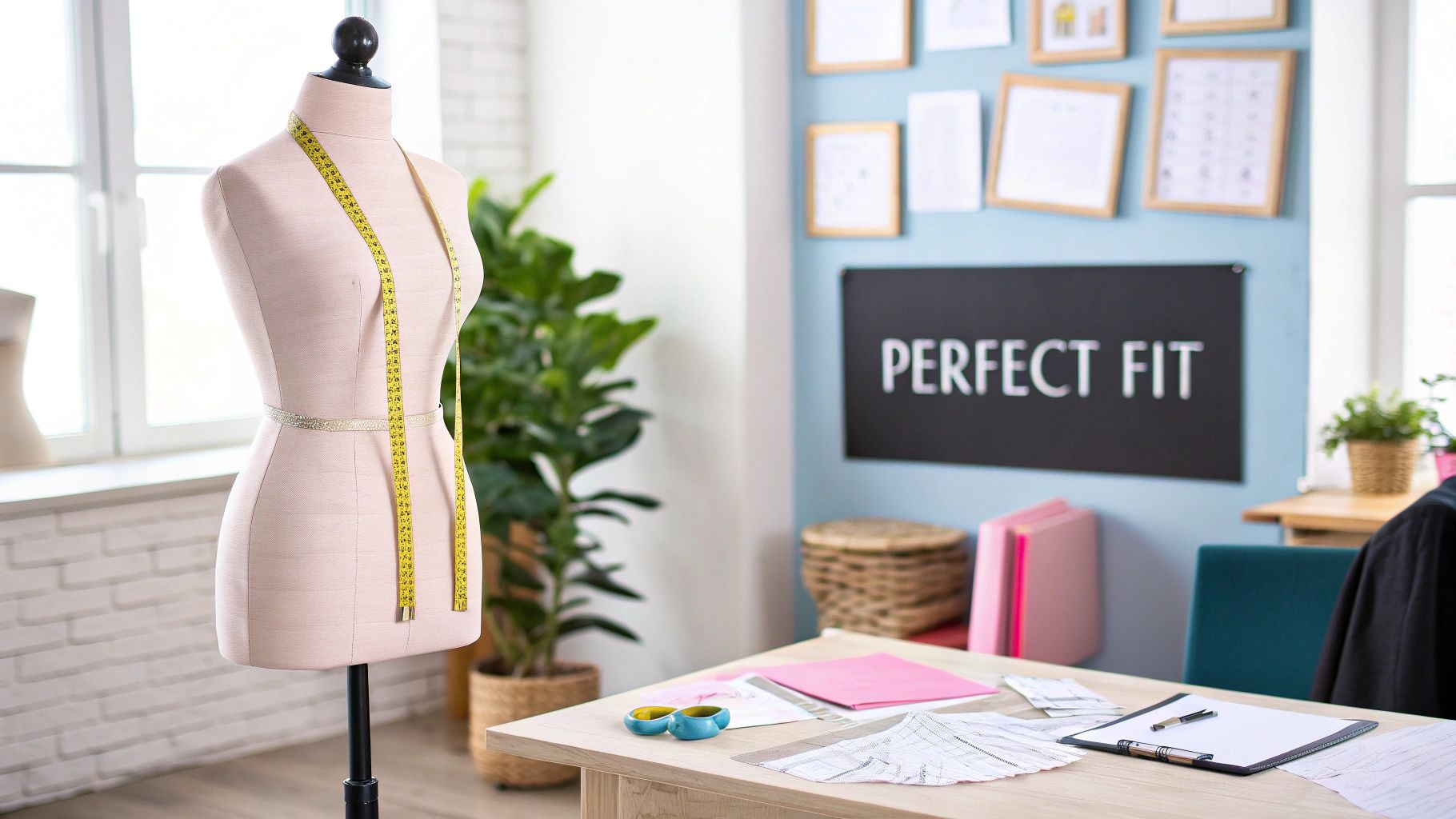
An adjustable mannequin is far more than just a static display piece. It becomes an active participant in the entire lifecycle of a garment, from the first pin to the final presentation. Think of it as an investment in precision, efficiency, and a truly realistic fit. For anyone serious about clothing, this single tool helps you work smarter, not harder.
The most obvious win? Nailing that perfect fit. By simply turning a few dials, you can set the exact bust, waist, and hip measurements you need. This allows you to replicate a client’s unique shape or test a design on different body types, ensuring garments hang correctly and drape beautifully long before anyone tries them on. The amount of time you save on guesswork and endless alterations is incredible.
Why Adaptability is Crucial Today
In today's fashion world, "standard sizing" often doesn't cut it. Customers come in all shapes and sizes, and adjustable mannequins are essential for bridging the gap between old-school sizing charts and real human bodies.
With size-inclusive ranges becoming the norm in the UK market, retailers can't just rely on a single, fixed size 10 or 12 display form anymore. Adjustable models give visual merchandisers the power to represent plus-size, petite, and in-between fits on the very same unit. This flexibility is not just practical; it's smart business, reducing the need to buy multiple fixed-size mannequins.
An adjustable mannequin isn't just a tool; it's a body double. It's your silent partner, ensuring every stitch and seam aligns perfectly with the body you're creating for. It's the very foundation of a bespoke fit.
This versatility is a game-changer in retail, where presentation is everything. For visual merchandisers, an adjustable form is a strategic asset for creating displays that genuinely connect with a diverse customer base. You can learn more about crafting powerful displays in our complete guide to visual merchandising.
A Must-Have Tool Across Professions
From a quiet tailoring studio to a bustling high-street shop floor, the benefits of an adjustable form are felt everywhere. It gives every professional a unique edge in their craft.
The table below highlights how different experts get the most out of an adjustable mannequin, demonstrating just how versatile this single piece of equipment can be.
Key Benefits of an Adjustable Mannequin by Profession
| Profession | Primary Benefit | Display Guru Solution |
|---|---|---|
| Professional Tailors | Guarantees a precision fit for individual clients, dramatically reducing the number of fitting sessions needed. | Our multi-dial forms allow for exact measurement replication, creating a true body double. |
| Fashion Designers | Provides a realistic, 3D canvas for draping fabric and developing patterns from scratch. | Pin-friendly polystyrene models make creative experimentation seamless and intuitive. |
| Retail Merchandisers | Showcases a wide range of clothing sizes with a single, adaptable unit, saving space and money. | Our models feature durable stands and easy-to-use dials, perfect for busy shop floors. |
| Home Sewers | Acts as a personal stand-in, making it possible to fit and alter your own clothes perfectly. | We offer a wide range of sizes, ensuring you can find a perfect match for any personal project. |
Ultimately, whether you're a seasoned professional or a passionate hobbyist, the right mannequin can completely elevate the quality and efficiency of your work.
Finding the Right Partner for Your Craft: A Guide to Mannequin Types
Choosing an adjustable dress mannequin isn't about finding the "best" one on the market. It's about finding the right partner for your specific creative work. They aren't all built the same; their design and features are tailored to different needs, whether you're a hobbyist sewer or a professional designer. Getting to grips with these differences is the first step toward making a smart investment.
The most common type you'll come across is the dial-adjustable mannequin. Picture a system of precise gears inside the torso. You simply turn a series of dials—usually at the bust, waist, and hips—to expand or contract the form to hit the exact measurements you need. This makes it a brilliant tool for home sewers and tailors who work with a wide range of body shapes and sizes, as you can reconfigure it in minutes.
Pin-Friendly Foam-Backed Forms
For designers and pattern makers who live and breathe draping, a foam-backed mannequin is the gold standard. Unlike their dial-adjusted cousins that can have gaps between the panels, these forms offer a solid torso. They're typically made of polystyrene covered in fabric, creating a seamless, pinnable surface. This is absolutely essential for sculpting fabric directly onto the form, as you can push pins straight in without hitting a void.
Display Guru’s polystyrene models are crafted with this professional need at their heart. They provide a firm, reliable surface that can handle constant pinning, blending the stability required for draping with the adjustability needed for perfect fitting.
Professional-Grade Forms with Advanced Features
At the top end of the scale, you’ll find professional-grade forms kitted out with features designed for demanding work. These mannequins often include clever details like collapsible shoulders, a lifesaver when you need to slip tight-fitting garments on and off without stretching or damaging them. Built for a lifetime of use, they are the trusted choice for fashion schools, design studios, and couture ateliers.
These advanced models show a real understanding of the garment-making process, where every second counts and garment care is non-negotiable. While traditional forms were often heavy fibreglass—which still accounts for around 68.5% of mannequin material revenue in the UK—the tide is turning. Lighter plastic and polystyrene models are quickly becoming favourites. Why? They're easier to pin, more budget-friendly, and a lot less hassle to move around a studio.
Choosing your mannequin is like choosing a paintbrush. A fine-detail brush is perfect for intricate work, while a broad brush is better for large strokes. Similarly, a dial-adjustable form is ideal for fitting various sizes, while a foam-backed form excels at the art of draping.
For retailers, the decision often balances durability with visual appeal. An adjustable form means a single unit can display multiple sizes from a new collection, which is a huge plus for visual merchandising. We dive deeper into this in our guide to choosing mannequins for shops. Ultimately, each type of mannequin brings something unique to the table, ensuring there’s a perfect match for every project and every passion.
Finding Your Perfect Fit and Adjustment Features
Choosing the right size range for your adjustable dress mannequin is probably the most important decision you'll make. Get it right, and you have a trusty sidekick for years of projects. Get it wrong, and you're in for a world of frustration. The golden rule is simple but absolutely crucial: start with your smallest measurements.
An adjustable mannequin can only get bigger. While you can always add padding to build up certain areas, you can never shrink it smaller than its minimum settings. So, you must pick a form where your smallest measurement sits comfortably within its lower range. For example, if your waist is your narrowest point, make sure the mannequin you're considering can be dialled down to match it.
This decision tree gives you a quick visual guide to figuring out which mannequin type is the best match for your creative work.
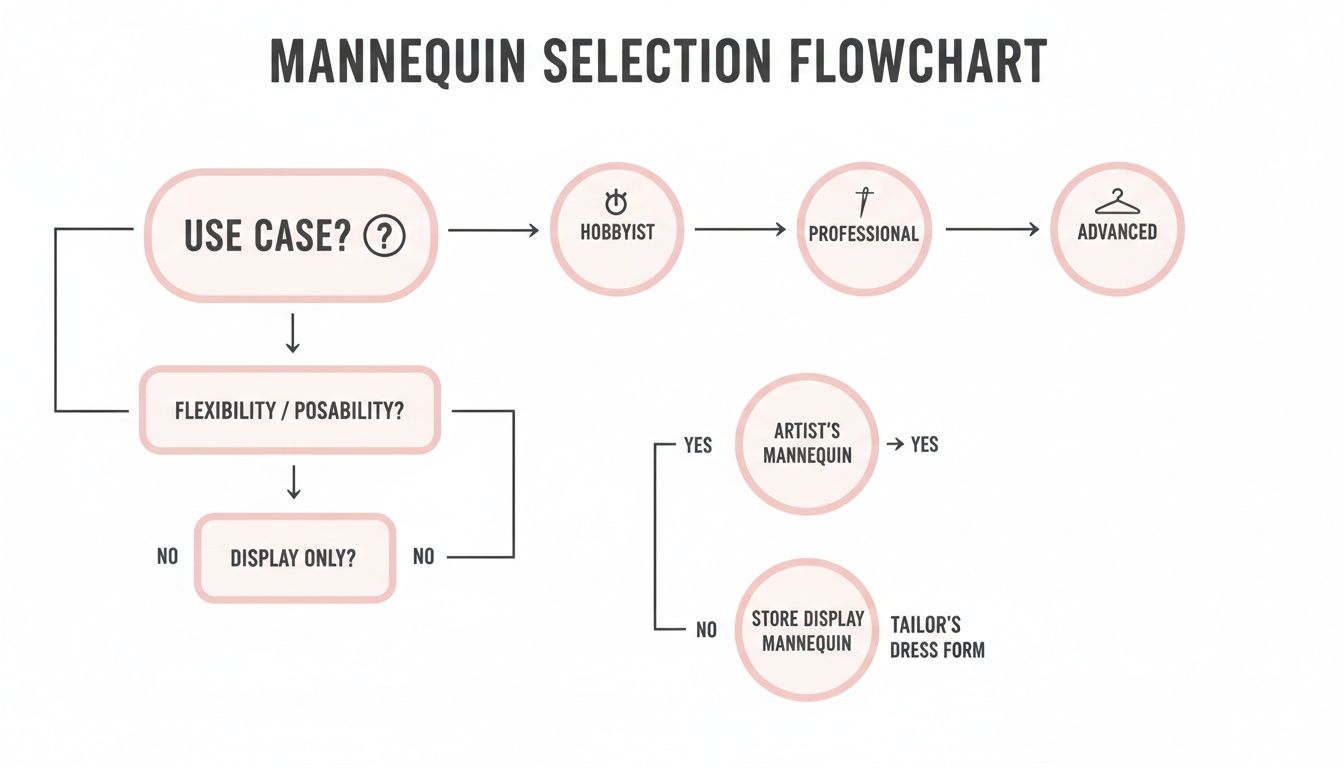
As you can see, the perfect choice really boils down to whether your projects demand frequent size changes, professional-level draping, or complex garment construction.
Understanding Key Adjustment Points
The real magic of an adjustable dress form is in its adjustment points. These are typically dials that control the bust, waist, and hips. Most good models also include a back-length adjustment, which is vital for getting the torso fit just right, particularly if you're working with taller or more petite figures. A neck adjustment is another common and very handy feature.
When you're making adjustments, the key is to turn the dials slowly and bit by bit. It's much better to adjust all the dials together in small increments, rather than expanding one area completely before moving on to the next. This balanced approach protects the internal mechanism and ensures the form keeps a realistic, proportional human shape as it expands.
Remember, the goal isn't just to match numbers on a tape measure; it's to create a three-dimensional replica of a human body. A properly adjusted mannequin acts as a true-to-life canvas, showing you exactly how a fabric will hang and drape on a real person.
Matching Mannequin Sizes to UK Dress Sizes
Trying to translate generic mannequin sizes like "Petite" or "Medium" into actual UK dress sizes can often feel like a bit of a guessing game. To clear things up, we've put together this straightforward guide. Of course, always double-check the detailed product descriptions on Display Guru for the most precise measurements. You can find a more in-depth look at this topic in our comprehensive guide to mannequin measurements.
This chart provides a clear comparison to help you choose the right size with confidence.
Adjustable Mannequin Sizing Guide vs UK Dress Sizes
| Mannequin Size | Bust Range (cm) | Waist Range (cm) | Hip Range (cm) | Approx. UK Dress Size |
|---|---|---|---|---|
| Petite | 71 - 86 cm | 59 - 74 cm | 76 - 91 cm | 6 - 10 |
| Small | 84 - 104 cm | 66 - 84 cm | 91 - 112 cm | 10 - 16 |
| Medium | 100 - 116 cm | 77 - 93 cm | 101 - 117 cm | 16 - 20 |
| Large | 111 - 128 cm | 89 - 105 cm | 117 - 132 cm | 20 - 24 |
By starting with your smallest measurement and using a clear sizing chart like this one, you can pick an adjustable dress mannequin that will be a precise and reliable foundation for all your creative work.
Setting Up and Customising Your Mannequin
The moment you unpack your new adjustable mannequin is always exciting; it’s the first step towards bringing your designs to life. Assembly is usually a simple affair—just attach the torso to the stand, secure the base, and you're ready to start. The real magic, though, begins when you start tailoring the form to your exact needs.
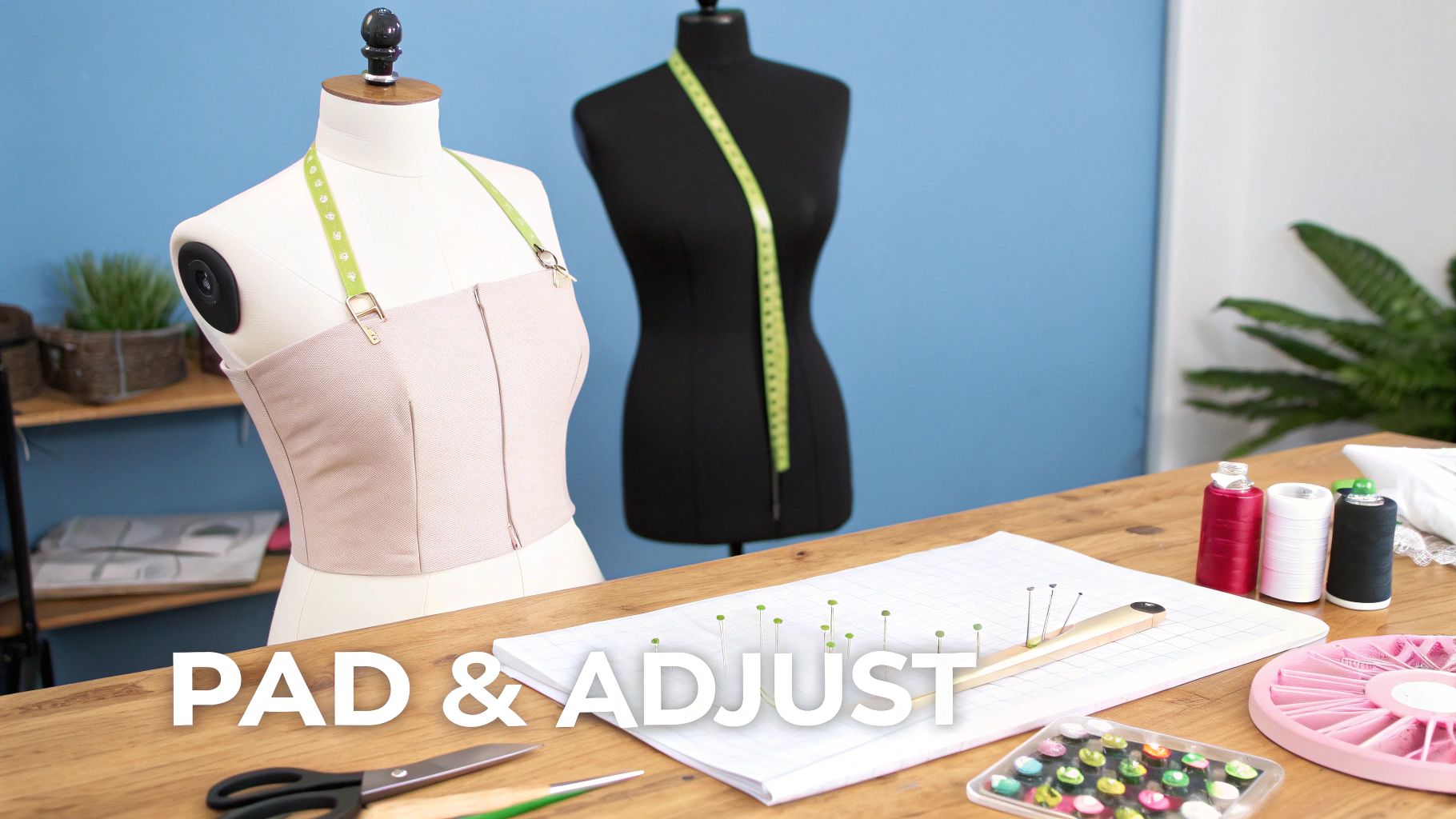
Now, for those adjustment dials. My best advice here is to go slowly. To keep the internal mechanism working smoothly and maintain a natural, proportional shape, it's crucial to turn the dials bit by bit. Don't just expand the bust all the way out before touching the waist. Instead, work your way around the body, adjusting all the dials a little at a time. This gradual approach keeps the contours realistic and prevents putting too much stress on the internal gears.
Creating a Custom Body Double
The dials will get you into the right ballpark, but the real secret to a truly bespoke fit lies in padding. This is where you transform a standard form into a precise body double for yourself or a client, capturing all the unique curves, slopes, and asymmetries that make us individuals.
You don’t need anything fancy—polyester batting, wadding, or even specially designed foam pads will do the trick. The process itself is straightforward but incredibly effective:
- Start with a Base Layer: First, pull a close-fitting top or a stretch mannequin cover over the form. This gives the padding something to cling to.
- Identify Key Areas: Figure out where you need to add more volume. This might be the bust, upper back, stomach, hips, or shoulders.
- Add Padding Gradually: Begin layering thin sheets of batting over these areas. I find it helps to pin or tape them down as I go to keep everything in place.
- Check Measurements: Keep your tape measure handy! You’ll want to check your progress constantly to make sure you're building up to the correct dimensions.
- Finish with a Cover: Once you’re happy with the shape, place a final, snug-fitting cover over everything. This creates a smooth, pinnable surface to work on.
When you meticulously pad your mannequin, you're not just adjusting it—you're sculpting a stand-in. This ‘body double’ shows you exactly how fabric will drape and hang on a real person, taking the guesswork out of fittings and guaranteeing a flawless result every single time.
Mastering the Hem Marker
Another feature you'll come to love, especially on many Display Guru models, is the built-in hem marker. This simple device is an absolute lifesaver for getting a perfectly level hem on skirts and dresses—a task that can feel almost impossible when you're working on your own.
The marker is usually a small chalk puffer on an adjustable pole. You just set it to the height you need and then rotate the mannequin to puff a crisp, even chalk line all the way around the garment. It’s a small detail that gives your finished pieces that professional, beautifully finished look.
Taking the time to set up and customise your mannequin properly will pay you back tenfold, making every project smoother and more polished. For more practical advice, check out our guide on how to dress a mannequin for both fitting and display.
Advanced Uses for Designers and Retailers
Once you move beyond the hobbyist's sewing room, the adjustable mannequin transforms from a helpful tool into a vital business asset. For professionals in the bustling worlds of fashion and retail, these forms are essential for pushing creative boundaries and solving day-to-day commercial problems.
To a fashion designer, an adjustable mannequin is essentially a 3D sketchbook. It’s the bridge between a conceptual sketch and a tangible garment. This is where you can drape complex patterns, experiment with how a tricky fabric hangs, or invent a completely new silhouette from scratch. A robust model, like the ones we offer at Display Guru, is built to withstand the endless pinning and adjusting needed to perfect a design.
Visual Merchandising and Retail Impact
In any shop, how you present your clothing is everything. Adjustable mannequins are a secret weapon for visual merchandisers, allowing them to showcase a full range of sizes with just one form. It's a real game-changer for keeping a shop floor looking sharp and consistent.
Instead of cluttering the space with mannequins in every size, a single unit can be quickly tweaked to show how an outfit looks as a size 8, a 14, or an 18. This flexibility ensures every garment is displayed in the most flattering way possible, which helps customers imagine how it will look on themselves. This is a fundamental part of compelling visual merchandising. To learn more, check out our guide to modern retail display solutions.
The digital storefront is just as important, and new technology is changing the game. For instance, AI product photography for fashion brands is creating new ways to display clothing online, often without a live model. This makes getting the fit absolutely perfect on an adjustable mannequin more crucial than ever before.
Costume Design and Institutional Use
Costume designers working in theatre and film have their own unique set of challenges. They often need to create intricate costumes for actors who are only available for a handful of quick fittings. Here, an adjustable form becomes an indispensable stand-in.
It allows the designer to work on complex, layered pieces for hours on end without the actor needing to be there. This not only saves an incredible amount of time but also guarantees the final costume fits flawlessly for the performance.
For professionals, an adjustable mannequin is not just a fitting tool; it is a problem-solver. It streamlines workflow, enhances creativity, and ensures that the final garment, whether on a stage or a shop floor, perfectly honours the original design intent.
This professional need also extends to the classroom. We're seeing more and more UK universities and fashion colleges investing in high-quality adjustable forms for their design programmes. These institutions need durable mannequins that can handle constant use by hundreds of students learning pattern cutting, draping, and fitting techniques semester after semester.
Keeping Your Mannequin in Top Condition
Think of your adjustable dress form as a trusted partner in your work. It's a real investment in your craft, and like any quality tool, a little bit of care goes a long way. With some straightforward maintenance, it’ll serve you well for countless projects over many years.
Looking after it is simpler than you might think. For the fabric cover, a quick once-over with a lint roller or the upholstery brush on your vacuum will keep dust and stray threads at bay. If you spot any small marks, a damp cloth with a touch of mild fabric cleaner should do the trick—just remember to test it on a less visible spot first.
Protecting the Adjustment Mechanisms
The real magic of your mannequin is inside—the dials and gears that let you shape it perfectly. Being gentle with these is the number one rule for keeping it in great working order.
When you're changing the measurements, turn the dials slowly and smoothly. Never, ever force them if they feel stuck. If you meet any resistance, the best thing to do is to back it off a little before gently trying again. This simple habit prevents you from straining the intricate mechanism inside.
Think of the adjustment dials like the tuning pegs on a guitar. You wouldn't wrench them around; you make small, careful turns to get the perfect note. It's the same principle here—gentle handling keeps your mannequin perfectly in tune with your vision.
How you store your mannequin matters too. When you’re not using it, pop a cover over it to keep the dust off. It's also wise to keep it out of direct sunlight, which can fade and eventually weaken the fabric. And try to avoid storing it in damp places like a garage or basement, as the moisture isn't great for the internal parts.
Following these simple steps will ensure your Display Guru mannequin stays in prime condition, ready to bring your creative ideas to life with precision and reliability, project after project.
Got a Few More Questions?
Even after digging into all the details, it’s natural to have a few last-minute questions before you commit. Let's tackle some of the most common ones that pop up, so you can choose your new mannequin with total confidence.
A big one we hear all the time is about pinning. Can you just stick pins straight into any adjustable mannequin? The short answer is no, it really depends on what’s under the fabric. Many basic models use a hard plastic body, which is impossible to pin into. For proper draping and fitting, you absolutely need a pin-friendly surface. That's why professionals lean towards forms with a polystyrene body, like the ones we offer at Display Guru.
Sizing and Stability Concerns
So, what happens if your measurements are stuck between two sizes? It’s a classic dilemma. The best advice is always to size down. Think of it this way: you can always add padding to a smaller form to perfectly match your own curves, but you can’t shrink a mannequin that’s already too big. Starting smaller gives you the flexibility to build a true body double.
Another key concern is stability. Will it hold up a heavy wool coat or a beaded wedding dress without toppling over? A well-made mannequin absolutely will. The secret is in the base. A mannequin built for serious work will have a sturdy, weighted stand designed to handle substantial garments. Whether it’s a tripod or a solid round base, a strong foundation is non-negotiable for working safely and accurately with heavier fabrics.
Ready to find the perfect creative partner for your sewing studio or retail space? Explore the full range of professional, adjustable, and pin-friendly forms at Display Guru. Find your ideal mannequin today.