


Prop and Costume Guide: Roles, Design and Practical Use
London recorded no new dedicated prop and costume-making spaces between 2018 and 2022, while its total fell from 78 to 72, according to the Greater London Authority's cultural infrastructure report. Behind every convincing coat, battered suitcase or mechanical creature is specialist work that needs space, equipment and careful planning.
For a newcomer, the craft starts with a practical question: what must this item do during the performance? Its appearance matters, but so do the performer's movement, the audience's viewpoint and the way the item will be maintained. Good prop and costume choices answer those constraints together.
What Props and Costumes Do in a Production
A prop is an object an actor handles or that dresses a scene, such as a letter, chair, cane or telephone. A costume is everything an actor wears, including footwear, wigs, hats, gloves and jewellery. Department boundaries differ between productions, but this distinction gives you a useful starting point.
Say a character enters wearing a worn grey coat and checks a cracked pocket watch. Before the actor speaks, the audience might read financial hardship, attachment to the past or an effort to preserve respectability. Change the coat to immaculate wool and the watch to polished gold, and the same entrance suggests a different history.
A costume is a character's first line of dialogue. A well-chosen prop works like punctuation: small, but capable of changing how the whole scene reads.
Meaning must survive use
The coat still needs to let the actor reach into its pocket. The watch must open when cued, and its chain mustn't catch on the lining. An attractive object that prevents the action isn't a successful design.
Colour also needs testing in context. A sombre garment can appear unexpectedly bright under performance lighting, weakening the intended mood.
This work extends beyond theatre. The Office for National Statistics' film and television production dataset records enterprise counts and turnover across the UK's film and television production businesses. Costume makers, prop fabricators and suppliers support that wider production economy.
Start with the action: Identify what the audience should understand, then establish what the performer needs to do.
Successful work connects three concerns: each item's storytelling role, its design for stage or screen, and its safe, repeatable use throughout a production.
Prop and Costume Categories and What Each One Does
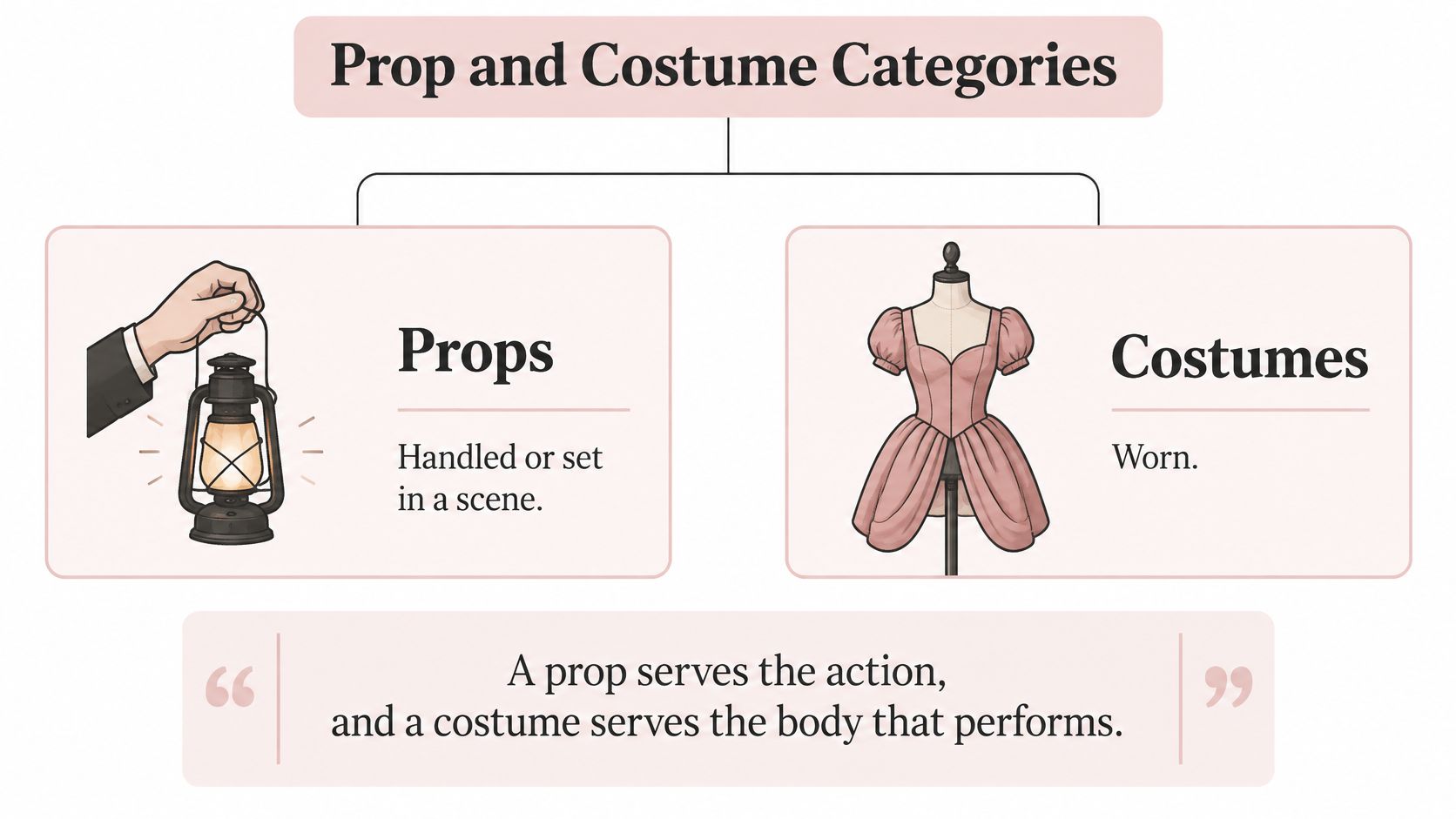
A prop serves the action, and a costume serves the body that performs it.
The simplest split is between objects handled or placed in a scene and items worn by performers. These categories help teams allocate construction, checking and backstage responsibilities.
Prop and costume categories compared
| Category | Typical examples | Main design focus | Performer interaction |
|---|---|---|---|
| Hand props | Letters, canes, swords, mobile phones | Weight, grip and durability under handling | Held, passed and used throughout the action |
| Set props | Furniture, food, books, lamps | Scale, surface finish and response to lighting | Used within a scene, sometimes without direct touch |
| Worn costume | Jackets, dresses, uniforms, period coats | Fit, movement and quick-change design | Worn for whole scenes and across the performance |
| Footwear and headwear | Boots, shoes, hats, wigs | Stability, comfort and hair continuity | Must stay secure through movement and dance |
| Accessories | Jewellery, bags, spectacles, gloves | Scale, reflectivity and repeatability | Often small and easily lost or damaged |
| Specialist items | Masks, puppets, prosthetics, animatronics | Articulation, safety and performer access | Operated or worn by a trained performer |
A hand-prop letter needs more than convincing handwriting. Its folds must support the actor's handling, its envelope must open reliably, and any information the audience needs must be legible from the intended viewpoint. Prepare replacement paper pieces when the action destroys them.
A set-prop sofa presents a different problem. If someone sits, falls or stands on it, the frame and joints need assessment for that action. Upholstery can disguise a structure, but it can't make an unsuitable structure safe.
Materials follow the task
For worn costume, the fabric's behaviour matters as much as its colour. Use fabric draping techniques to investigate how cloth hangs around the body before committing to a silhouette.
Printed garments introduce another decision. If a character needs a customised all-in-one costume, Raccoon Transfers DTF onesie tips provide a focused starting point for considering decoration placement. Test a sample for stretch, comfort and cleaning compatibility before applying the design to the finished garment.
Overlap needs an owner
A pocket watch is a hand prop when an actor takes it out and checks it, but may be treated as an accessory when it remains attached to a waistcoat. A glove becomes central to the props plot when someone throws it down as a challenge.
A stolen bag may need a controlled-release strap rather than an ordinary fastening. Assign responsibility for that mechanism explicitly. Ask how the performer will touch the item, then name who presets, checks, cleans and repairs it.
How Designers Turn a Script into Props and Costumes
Begin with a breakdown, not a shopping list. The script tells you what must happen; research and testing establish how to make that action convincing.
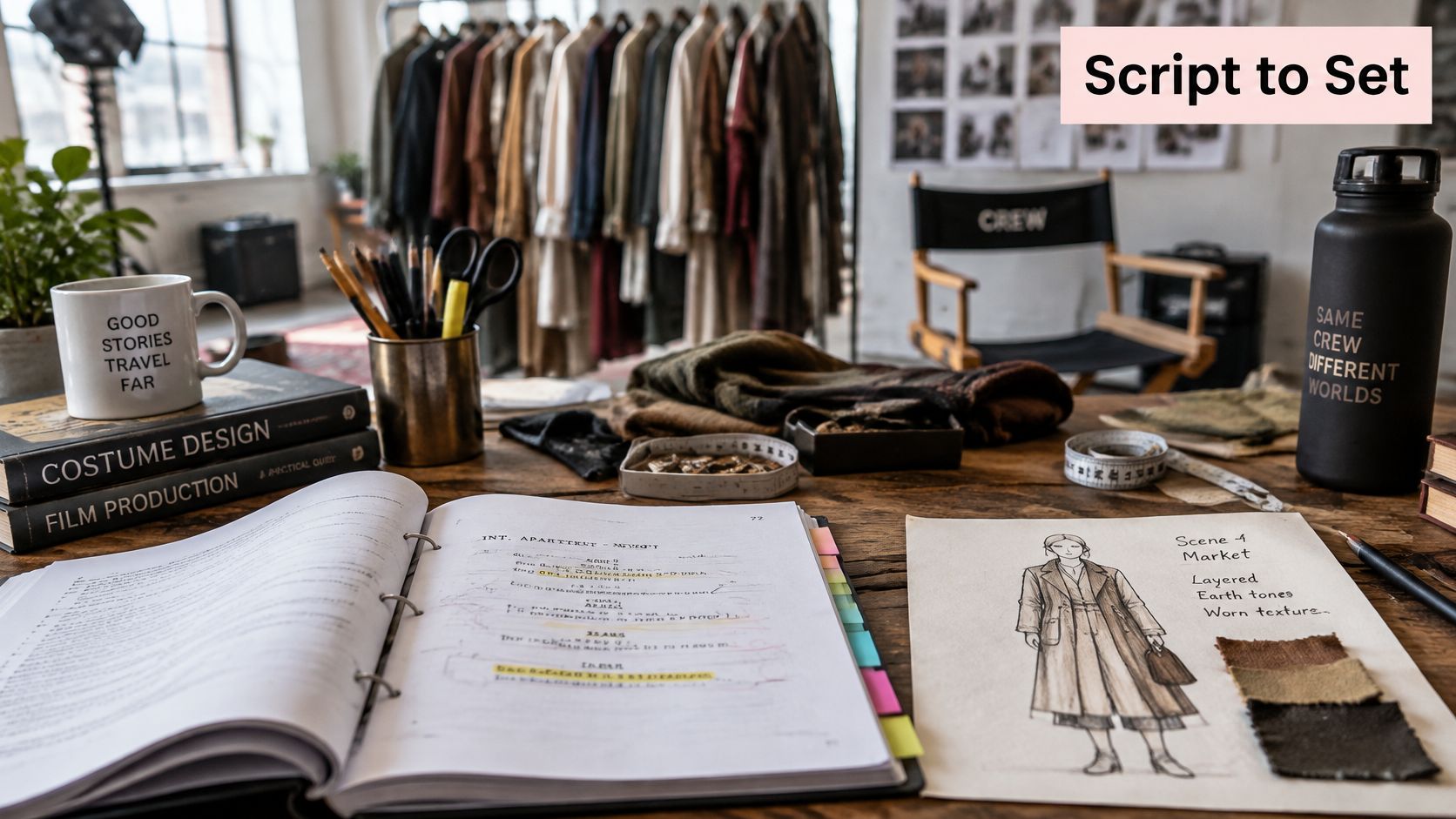
The workspace should keep those decisions visible, with script pages, swatches and sketches alongside the developing costume.
Build the design in sequence
- Break down the script by scene. Record every character appearance, garment, carried object and change of condition, including wet clothing, torn letters and food consumed during the action. A missing requirement is easier to resolve at a desk than during a dress rehearsal.
- Research the production's world using photographs, paintings, archives and surviving objects. Look beyond decorative style to occupation, climate and daily routines, because these explain why a character would own or wear something.
- Measure the performer and establish movement needs. Record sitting, kneeling, reaching, dancing and change requirements alongside the body measurements. These actions determine ease, seam placement, pocket access and fastening choices.
- Set the budget and choose whether to make, hire or adapt stock. Include alteration labour, cleaning, transport and return conditions rather than comparing acquisition costs alone.
- Develop sketches, mock-ups and material samples. A card model can reveal an awkward handle position; a toile, a trial garment in inexpensive fabric, can expose a restrictive sleeve. Test proposed colours and finishes under the actual lighting or camera setup.
- Confirm fit and fastening positions before final construction. Resolve the difficult movement in the mock-up, then carry the approved changes into the pattern and construction notes.
The wider costume design for theatre process also requires coordination with direction, lighting and stage management. A design decision isn't settled until the departments affected by it know what has changed.
Standardise the method, not the performer
The SOLT and UK Theatre State of British Theatre report reports that 48% of new hires lack necessary skills, particularly in technical roles, and identifies costume making among shortage craft skills. Written methods and supervised practice help newcomers learn a dependable process rather than copy an unexplained habit.
An adjustable form and consistent measurement sheet can support repeatability, but a standard mannequin can't represent every performer. Seated posture, mobility devices, orthotics and sensory requirements may demand a bespoke approach.
Discuss those needs privately when measurements are planned. Record functional requirements, such as avoiding pressure at a brace edge, without circulating unnecessary personal information.
How Stage and Screen Demands Differ
The same object can require different construction because a theatre audience and a camera inspect it differently.
Stage and screen demands compared
| Factor | Stage | Screen |
|---|---|---|
| Viewing distance | The whole figure must read from the back row | The camera may frame a single detail |
| Detail tolerance | Fine detail can disappear at a distance | Stitching, weave and surface wear may be visible |
| Durability | Must withstand repeated performances and possibly touring | Must withstand the planned action and repeated takes |
| Quick changes | Changes may happen rapidly in the wings | Changes follow the shooting schedule, with live transitions where required |
| Continuity | Checked against a costume plot and photo record | Matched shot by shot across shooting days |
| Light response | Stage lighting can flatten colour or alter apparent texture | Exposure, lighting and grading affect recorded tones |
| Repair access | Often limited to offstage windows, intervals or after the show | Work may pause between setups, but delays affect the schedule |
The comparison below is a useful visual checklist before choosing materials.
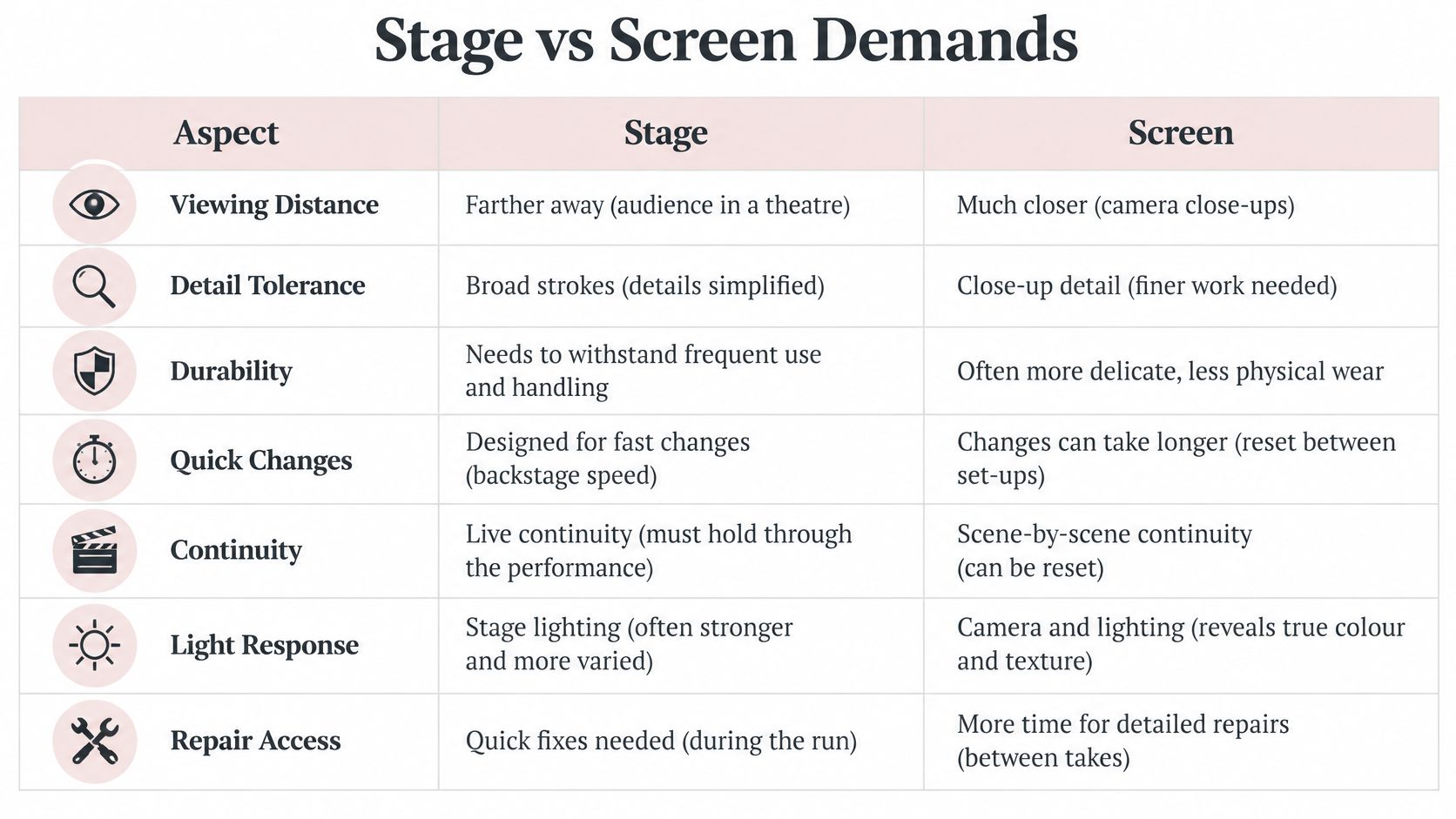
Distance changes the finish, not the safety standard
A plastic cup may look convincing across a theatre but reveal a moulding seam in close-up. For a stationary screen insert, real glass might provide the desired appearance, provided the risk assessment permits it. For a fall, struggle or thrown object, select a suitable safe substitute and adjust framing or lighting instead.
A stage sword needs secure handling, an appropriate balance and construction suited to the choreographed action. A screen production may use separate versions for close-up detail and physical action. A convincing finish doesn't establish that a weapon prop is safe; competent specialists must approve its intended use.
The video below offers an additional visual reference alongside these design comparisons.
Screen continuity records a particular moment
If a character spills tea halfway through a scene, the wardrobe record needs to distinguish the clean costume from each required stain state. Photograph button positions, sleeve rolls, jewellery placement and visible wear, with records labelled to the relevant scene and shot.
Live performance requires a coherent progression through the evening. Screen teams may need to recreate a moment after intervening work has changed the garment or prop.
For filmed theatre and livestreams, test from both the furthest audience position and the nearest camera framing. Broad stage ageing may look painted on camera, while delicate screen detail may disappear from the auditorium.
Judge stage work across the room and through repetition. Judge screen work through the lens and against the continuity record.
How to Run a Costume Fitting and Use Props Safely
A fitting is a controlled test of the performer, garment and action together. Prepare a private changing area, a stable form, a mirror, a pin cushion, a tape measure and a written alteration sheet before the performer arrives.
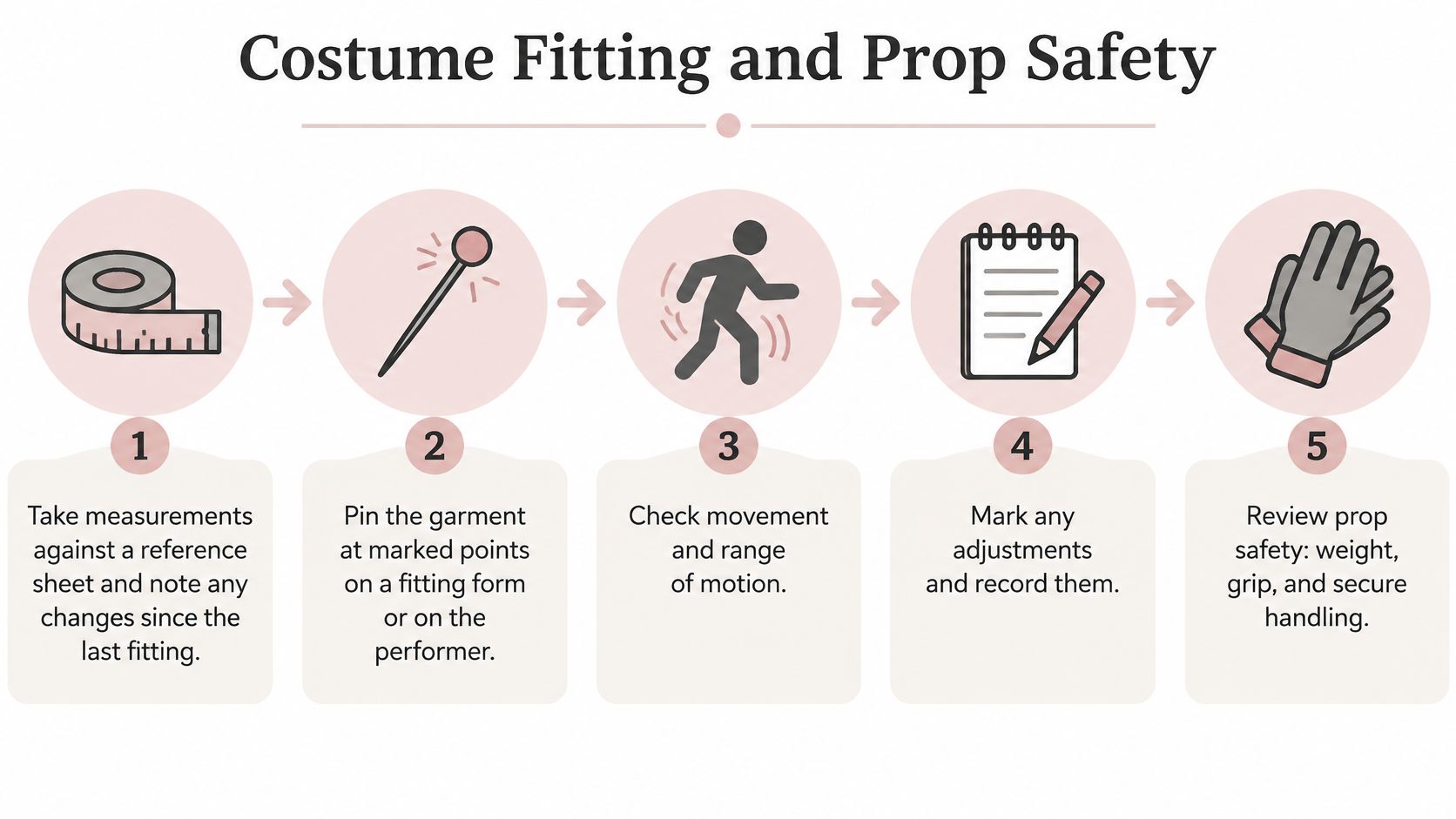
Fit, test and record
- Check measurements against the reference sheet. Note changes since the previous fitting and confirm the intended undergarments and footwear. Use a consistent costume measurement guide so different team members measure from the same reference points.
- Pin at marked alteration points on the form or performer, checking centre lines, shoulder balance and hem position. Explain before touching the performer and keep pins away from areas involved in the movement test.
- Test the actual movement. Ask the performer to sit, raise their arms, bend and rehearse the change sequence at a controlled pace. Watch for seam strain, riding hems and pressure points, not just the silhouette in the mirror.
- Check hooks, press studs, zips and hidden closures under the intended movement load. Make sure a fastening can be reached by the person who must operate it.
- Photograph approved views with consent. Record front, back and side, then label the images and list each alteration. Keep measurement records and fitting photographs accessible only to the people who need them.
- Hand the garment to wardrobe with alteration zones marked and unresolved issues identified. Remove loose pins before release and confirm who will check the completed work.
Digital measurement methods require the same care over consent and access. Robosize's explanation of how 3D body scanning works is useful background when considering that approach, but a body model doesn't replace a movement fitting.
Check props with the costume on
A handle that feels secure in a bare hand may slip against satin gloves. Rehearse grip, passing, pocket retrieval and return with the intended costume, checking sharp edges, pinch points and snagging jewellery.
Weapons, electrical effects and mechanically operated items need competent specialist assessment. Don't improvise a substitute just because it looks similar.
Treat fire safety as an approval process
The UK fire-safety guide for small and medium places of assembly says props, scenery, display materials and stands should be fire-retardant or treated with a proprietary system; materials of unknown combustibility should be kept off an open stage and stored in a 30-minute fire-resisting enclosure when not in use.
Obtain supplier test evidence before fabrication and agree material acceptance with the venue's responsible person. Record the material, treatment, application date and maintenance condition.
Don't assume treatment remains effective after laundering, abrasion, repainting or touring. The finished assembly, including coatings, adhesives and trims, needs consideration within the venue's fire-risk assessment.
Keep ignition sources controlled, combustible storage limited and escape routes clear. A garment rail or prop trolley must have an agreed parking position, not occupy whichever backstage gap happens to be available.
Reusing, Storing and Caring for Props and Costumes
Give every reusable item an inventory record containing:
- Identification and dimensions: A unique reference, measurements and clear photographs.
- Materials and treatment: Construction materials and fire-treatment status.
- Condition: Repair history, cleaning information and known faults.
- Location and restrictions: Storage position, ownership and limits on alteration or reuse.
The National Theatre's research and development report identifies repurposable modular design and digital asset cataloguing as relevant directions for extending the life of production assets. In practice, detachable fittings, replaceable trims and reversible finishes let a team change the appearance without discarding the whole item.
Read reuse figures by their measure
Reuse benchmarks for props and costumes
| Measure | Benchmark or result | Context |
|---|---|---|
| Theatre Green Book Basic Standard, previous life | At least 50% of production materials | Previous-life requirement reported through the National Theatre's sustainability programme, alongside the future-life requirement below |
| Theatre Green Book Basic Standard, repurposed afterwards | 65% of materials | Future-life requirement under the same standard |
| Birmingham Rep, Withnail and I props and furniture | 69% with a previous or future life | Combined measure for the production, reported in January 2025 by Birmingham Rep |
| Chichester Festival Theatre, House Party costumes | 66% reused or made from recycled materials | Production results published in June 2024 by Chichester Festival Theatre, including the props result below |
| Chichester Festival Theatre, House Party props and furniture | 73% reused or made from recycled materials | Same production and reporting period |
| Theatre Green Book Festival 2025, costume sourcing | 48% to 93% reused or recycled | Range between productions reported through the National Theatre sustainability programme linked above |
| Theatre Green Book Festival 2025, props sourcing | 31% to 91% reused or recycled | Range between productions in the same festival reporting |
These aren't interchangeable measures. A combined previous-or-future-life result doesn't establish how much was second-hand at acquisition. Keep sourcing and destination fields separate in your own records.
Judge the whole working life
Buying new durable fitting equipment can be reasonable if it supports repeated garment use rather than disposable fixes. Assess repairability, adjustability, cleaning, storage footprint and eventual resale or donation, not whether the purchase is new.
Choose storage that preserves the item's shape. Support heavy garments appropriately, keep delicate trims from rubbing against neighbouring pieces, and use labelled containers for small accessories. Planning storage for fabrics also helps keep reusable lengths identifiable rather than buried in unmarked bags.
Before returning a garment to stock, inspect seams, fasteners, dye transfer and laundering damage. Record faults immediately and separate items awaiting repair from those approved for use. A searchable inventory only helps if its condition notes are trustworthy.
Plan Your Prop and Costume Kit for the Next Show
Start with the work your team struggles to complete reliably. A crowded store may need clearer locations before it needs more equipment; inconsistent alterations may need a shared fitting method before another sewing machine.
Make the next changes manageable
- Audit current stock. Flag records missing dimensions, treatment evidence or repair history. Separate unidentified materials from approved working stock so an apparently convenient piece isn't selected without assessment.
- Choose a small group of standards to introduce first. A shared measurement sheet, consistent alteration marks and labelled repair trays can give apprentices and cross-trained staff a common method without replacing the whole workshop.
- Decide hire versus purchase by intended use. Hire a distinctive piece needed only for a particular production when suitable stock is available. Consider purchase for an item with a clear recurring role, accounting for cleaning, maintenance, transport and storage.
- Establish a supervised fitting station. Choose an adjustable form where its measurement range meets the task, or a suitable fixed-size pin-friendly form with planned padding. Keep the tape measure, fitting notes and alteration tools together.
- Create a material-entry check. Assign someone to confirm fire-treatment evidence and inventory status before new materials enter the working stage area. Unresolved evidence should trigger a review, not an assumption.
For that fitting station, our Display Guru tailor dummies use pin-friendly polystyrene for clothing and fabric. We also sell torsos, tripod stands, round base stands, torso covers, and tagging pins and labels; our Kids Children's Bendy Dummy Mannequin has a bendable plastic skeleton for dynamic posing.
Arrange the handover as carefully as the workstation
Put completed costumes on a clearly identified ready rail, with repairs and unapproved items elsewhere. Use the practical layout considerations in our costume rails guide to organise access without turning the fitting area into overflow storage.
Before rehearsals begin, name the people responsible for presets, checks and returns. A modest kit with clear ownership is more useful than a large stockroom where nobody knows which items are ready.
Display Guru offers pin-friendly tailor dummies, body forms, garment rails and replacement dummy parts for costume fitting and organisation. Visit Display Guru to choose forms and storage equipment that match your next production's fitting tasks, available space and plans for reuse.