


A Practical Guide to Costume Design for Theatre
Costume design for theatre is so much more than just putting clothes on actors. It's the art of creating a visual language, where every stitch, fabric, and accessory tells a story. Think of it this way: every garment is a piece of dialogue, giving the audience a powerful first impression of who a character is, where they've come from, and their place in the world of the play before they even utter a line.
The Role of Costumes in Theatrical Storytelling
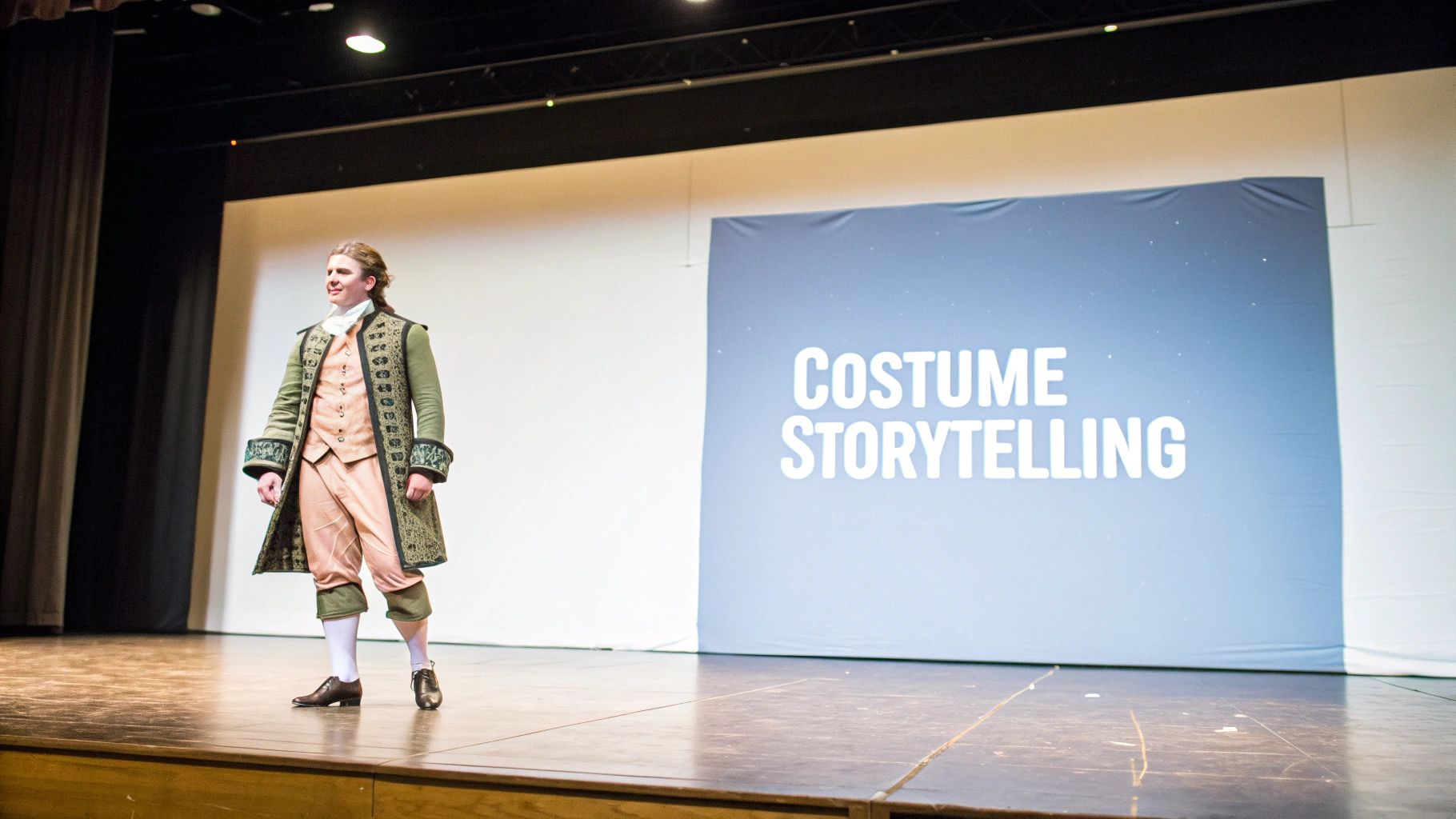
Costumes are a visual shortcut, the very first layer of information the audience receives. In a single glance, they can establish the entire world of the play. It's a silent language; the precise cut of a jacket, the scuffs on a pair of boots, or the luxurious drape of a fabric can speak volumes.
This visual vocabulary needs to be both consistent and deliberate. A costume designer is essentially a creative problem-solver, meticulously ensuring that every character's look aligns perfectly with the director’s vision and the script's core themes. It's a deeply collaborative process, working hand-in-hand with the whole creative team to build a cohesive and believable world on stage.
Communicating Character and Status
At its most fundamental level, costume design defines the individual. A thoughtfully designed outfit can instantly signal a character’s social standing, their profession, personality, and even their inner emotional state. A crisp, tailored suit shouts authority and wealth, while frayed, ill-fitting clothes might suggest poverty or a mind in turmoil.
But it goes deeper than just stereotypes. Subtle choices in colour and texture can reveal hidden facets of a character. For instance, a character feeling trapped or constrained might be dressed in restrictive silhouettes, whereas a free spirit could be shown in flowing, unbound fabrics. The goal is to make the audience feel they intuitively understand something vital about each person the moment they walk on stage.
Establishing Time and Place
Costumes are absolutely essential for anchoring the audience in a specific time and place. Whether a play is set in the cobbled streets of Victorian London, the sun-drenched arenas of ancient Greece, or a gritty futuristic dystopia, the wardrobe is the primary signifier of that era. This demands painstaking research to authentically capture the silhouettes, materials, and styles of the period.
Even when a production takes a more abstract or timeless route, the costumes still ground the performance in the unique reality being created for the stage. They are a crucial piece of the "world-building" puzzle that makes a theatrical experience truly immersive.
"I have to outfit the performers so the story can best be told. And I always say my job is making clothing work on the actor." – Jess Goldstein, Tony Award-winning Costume Designer
Driving the Narrative Forward
Beyond simply setting the scene, costumes are active players in moving the story along. A character’s entire journey can be visually tracked through what they wear. A subtle shift in a colour palette or the gradual distressing of a garment can mirror an internal transformation or a dramatic change in fortune.
These visual cues help the audience follow character arcs and grasp thematic shifts without needing a single word of exposition. It's a powerful narrative device, similar to the storytelling required in dynamic retail environments, like when you learn how to create effective window display ideas.
Translating the Script into Visual Concepts
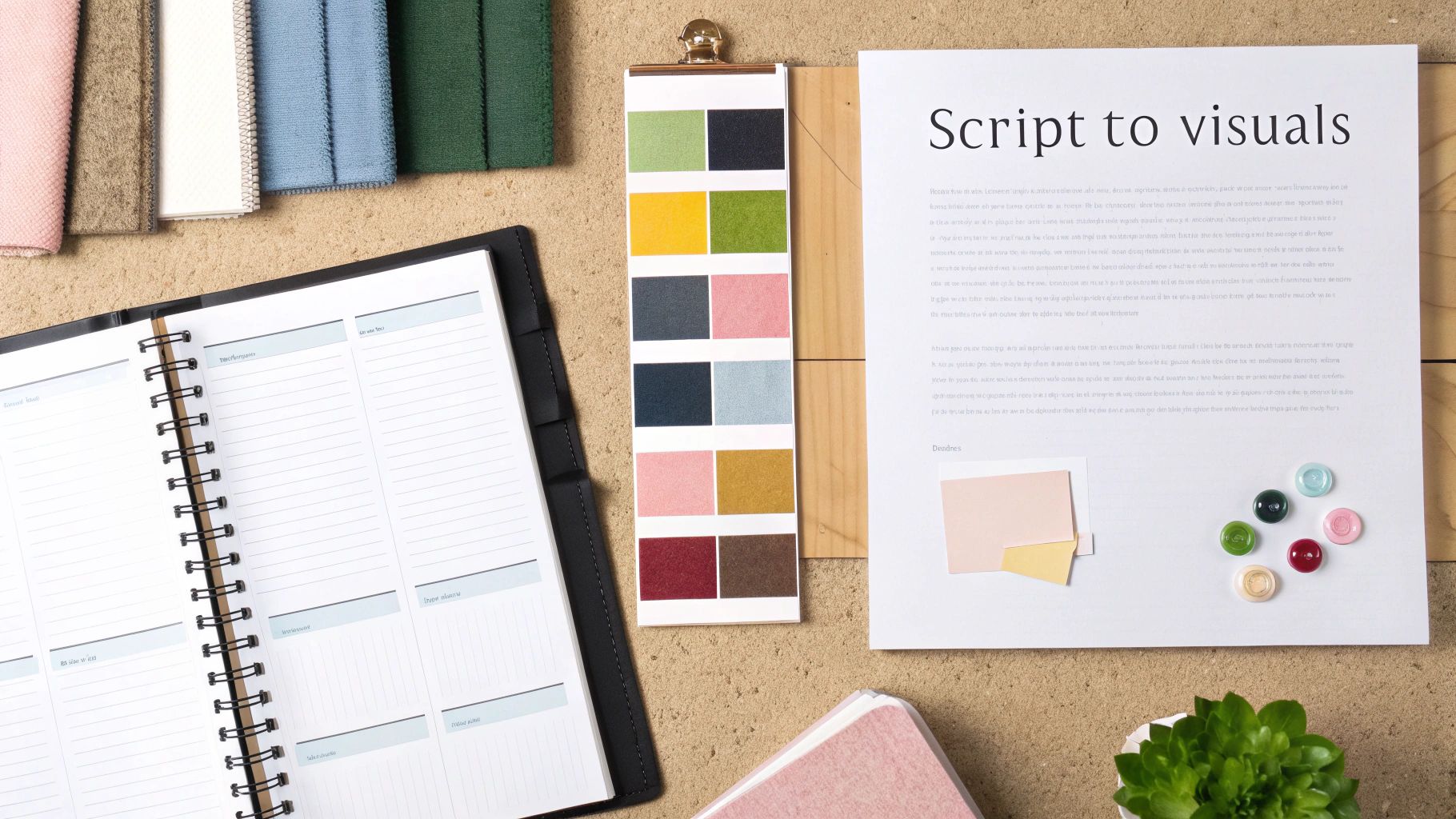
Before you even think about fabric, the script is your most important tool. Every great costume starts life right there, on the page. The first job is to deconstruct the words and begin reassembling them into a visual language that will tell the story. This isn't just a quick read; it's an investigation.
Think of yourself as a detective combing a crime scene for clues. Your first pass is to get the gist of the story, but every read after that needs a laser focus. You’re hunting for hints about each character's journey, the world they live in, and the unspoken themes bubbling under the surface. This deep dive into the text is the bedrock of every creative decision you'll make later on.
The script tells you what is happening; your creative interpretation will show the audience how it feels.
Conducting Thorough and Effective Research
Research is the backbone of any believable costume design for theatre. Whether you're dressing a Shakespearean tragedy or a brand-new play set in a fantasy realm, your choices need to feel intentional and grounded. This means going much deeper than a few quick image searches.
For a period piece, you’ll want to immerse yourself in primary sources. Look at paintings, old photographs, personal letters, and even surviving garments from the time. The goal isn't just to see what people wore, but to understand why. Social norms, the materials they had access to, and how clothes were actually made all contribute to creating something that feels authentic on stage.
The drive for historical accuracy has a long and storied history in British theatre. In 1823, James Planché's designs for King John at Covent Garden were a turning point. He ditched the convention of actors wearing the fashions of the day and instead undertook meticulous research into 13th-century clothing. It was a revelation, proving that authentic costuming could massively boost a show’s impact.
That legacy of rigorous research is still alive and well, informing everything from sprawling period dramas to cleverly stylised modern takes.
Building Mood Boards and Colour Palettes
With a head full of ideas, you need a way to organise them into a cohesive plan. This is where mood boards and colour palettes come into their own. A mood board is so much more than a collage of nice pictures; it's a carefully curated collection of images, fabric scraps, and textures that nails the emotional tone of the production.
Your mood board should help you answer the big questions:
- What's the overall atmosphere? Is it dark and oppressive, or bright and hopeful?
- What textures define this world? Think coarse wool, smooth silk, or cold, rusted metal.
- Are there any architectural or artistic styles that shape the look?
From this big-picture vision, you can start building specific colour palettes for each character. Colour is a hugely powerful tool on stage. It can communicate personality, signal who’s on which side, and even track a character's emotional state as the story unfolds.
From Concepts to Collaborative Sketches
Once your vision starts to solidify, it’s time to pick up a pencil. Initial sketches are where your abstract ideas become tangible designs for the first time. They don't have to be gallery-worthy masterpieces, but they absolutely must communicate the silhouette, key details, and overall feeling of each costume.
These sketches are your passport to collaboration. They become the main talking point in meetings with the director, set designer, and lighting designer, making sure everyone is on the same page. Nailing down these ideas early ensures your costumes will feel like a natural part of the show's world, saving a lot of headaches and expensive changes down the line. If you want to sharpen your drawing skills, our guide on what is fashion illustration is a great place to start.
Bringing Designs to Life with Fabric and Construction
With sketches signed off and the vision crystal clear, we get to the part where the real magic happens. This is where we move from two-dimensional drawings to tangible, wearable art—a hands-on process that’s a blend of artistry and pure engineering. It's the stage where abstract ideas meet the practical realities of fabric, thread, and the human form.
The journey from paper to pattern is one of the most thrilling parts of costume design for theatre. It's the moment theory becomes physical, and every single choice—from the type of stitch to the weight of the fabric—directly shapes the final garment. You need a deep, practical understanding of your materials and techniques to make sure the costume not only looks right but actually works for the actor wearing it.
The Language of Fabric Selection
Choosing the right fabric is a lot like casting an actor for a role; it has to be a perfect fit. The weight, texture, and drape of a textile aren't just minor details; they are powerful storytelling tools. A heavy, coarse wool moves and feels completely different to a lightweight silk, and that movement instantly tells the audience something about the character.
Stage lighting brings its own set of challenges. A fabric can look completely different under the intense glare of a follow spot. A subtle pattern might wash out and disappear entirely, while a shiny satin could bounce light back into the audience's eyes. This is why seasoned designers always do "light tests," holding up swatches under stage lights to avoid any nasty surprises on opening night.
And of course, durability is non-negotiable. Theatre costumes go through hell. They endure sweat, vigorous movement, lightning-fast quick changes, and constant laundering. Your chosen fabric has to be tough enough to survive the entire run of a show without disintegrating.
From 2D to 3D Foundational Techniques
Once your materials are sourced, it’s time to give the garment its structure. There are two main ways to go about this, and each has its own strengths.
-
Flat-Patterning: This is the more mathematical, precise method. You draft a pattern on paper using the actor's exact measurements. Think of it as creating a detailed architectural blueprint for the costume, which guarantees accuracy and makes it easy to replicate.
-
Draping: This approach is far more sculptural and intuitive. Here, the designer works directly on a body form or tailor's dummy, pinning and shaping the fabric to build the silhouette. It’s a fantastic technique for creating organic, flowing designs where you want to let the natural fall of the fabric do the talking.
More often than not, a combination of the two gives you the best of both worlds. A designer might drape a tricky bodice to get the shape just right, then switch to flat-patterning to draft the sleeves and skirt. To really get a handle on this, it's worth diving into different construction methods, and you can learn more by exploring various sewing techniques for both beginners and experts.
The Costume Shop Workflow
A professional costume shop is a hive of organised chaos, especially as a deadline looms. Efficiency is everything, and a solid workflow is what keeps the train on the tracks. The process usually flows from cutting the fabric from the patterns to the initial assembly, often called the "first stitch."
During this construction phase, tools like pin-friendly polystyrene body forms are an absolute godsend. They serve as a stand-in for the actor, letting the sewing team constantly check the fit, drape, and silhouette without having to call the performer in for endless sessions. For a busy theatre wardrobe, this is a massive time-saver.
These tailor's dummies are what allow for those tiny, precise adjustments that make a costume look truly professional. They aren't just a convenience; they're a core piece of equipment that enables the high level of craftsmanship theatre demands. Using an adjustable form means you're building the costume with the actor’s unique posture and shape in mind right from the very beginning.
This meticulous approach means that by the time the garment is ready for its first fitting with the actor, it’s already incredibly close to the final vision. Getting it right at the build stage makes the whole fitting and alteration process that much smoother, saving precious time and energy as the production hurtles towards opening night.
Achieving the Perfect Fit Through Fittings and Alterations
A brilliant sketch and perfectly chosen fabric are a great start, but they mean very little if the final garment doesn't fit the actor. The fitting room is really where the art of costume design is tested and perfected. It’s a crucial, collaborative process that transforms a well-made garment into a true second skin for the performer.
This journey is far more than a simple try-on session. Think of it as a series of structured appointments, each one designed to ensure the costume not only looks right but also functions flawlessly under the heavy demands of a live performance. Each stage is there to help you spot and solve problems early, saving precious time as opening night gets closer.
Mapping the Fitting Journey from Mock-up to Final Touches
The fitting process actually starts long before your expensive final fabrics are cut. The very first step is the mock-up fitting, where you’ll use an inexpensive material like calico or muslin to test the waters. This initial version lets you and your maker check the basic silhouette and seam placements without risking costly textiles. It's the structural blueprint stage, the place for making major adjustments to shape and proportion.
After that, the actor is called in for fittings with the actual costume, which may still be in various stages of completion. These sessions are all about refinement. The goal is to balance your aesthetic vision with the actor's practical needs, making sure they can breathe, move, and perform every action the script calls for—from a dramatic duel to an intricate dance number.
The process typically unfolds like this:
- Measurement Session: Before a single piece of fabric is cut, you need detailed and accurate measurements. For a proper look at this crucial first step, you can explore our easy guide on how to take body measurements for clothes.
- Mock-up Fitting: A test garment is created to get the pattern and overall fit just right.
- First Costume Fitting: The actor tries on the garment made from the final fabric, often before it's fully finished.
- Final Fittings and Dress Rehearsal: Minor tweaks are made, and the costume is tested with all its layers, accessories, and under the full glare of stage lights.
The Art of a Productive Fitting
A successful fitting is built on clear communication and a deep respect for the actor's craft. It's a two-way street where the performer gives essential feedback on comfort and mobility. A costume that restricts movement or causes discomfort can genuinely get in the way of a performance, so their input is absolutely invaluable.
As the designer, you need to be a quick-thinking problem-solver, ready to tackle common alteration challenges on the spot. This could mean letting out a seam for a bit more room, adding hidden gussets for better arm movement, or reinforcing stress points to prevent a wardrobe malfunction during a physically demanding scene.
"Observing how actors react in the mirror when first trying on their costume/clothing is invaluable. Even in period clothing you have to believe that their characters would have chosen that garment for themselves."
This collaborative spirit is what ensures the final costume supports, rather than detracts from, the performance.
The visual below breaks down the simplified journey from raw material to a constructed garment, which leads directly into this crucial fitting phase.
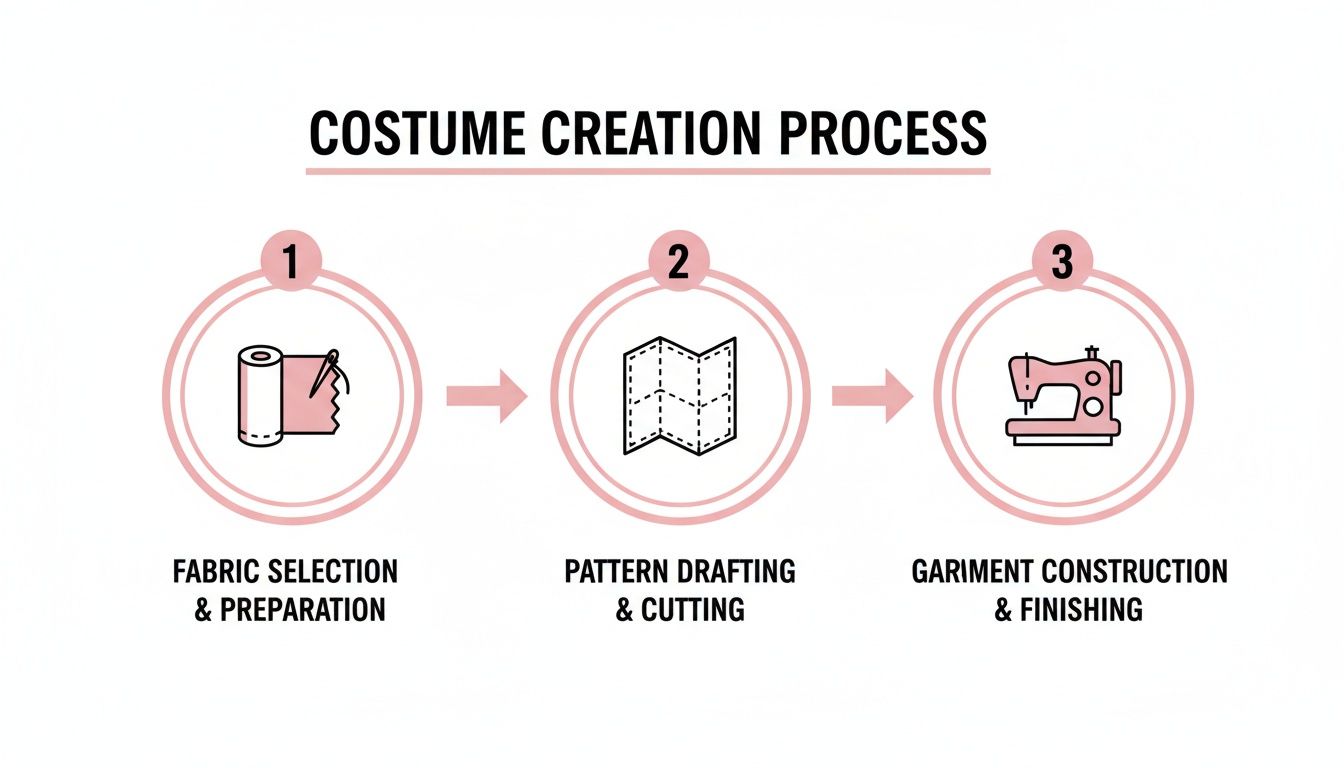
This workflow really shows how each step logically builds upon the last, ending in a finished piece ready for the actor's first fitting.
To make this process even clearer, here's a look at the stages you'll work through in the fitting room.
Theatre Costume Fitting Workflow Stages
| Fitting Stage | Primary Goal | Essential Tools |
|---|---|---|
| Initial Measurements | Capture precise body dimensions to draft the base pattern. | Measuring tape, measurement chart, pencil. |
| Mock-Up Fitting (Calico) | Check silhouette, proportion, and seam lines. Make major structural changes. | Calico/muslin mock-up, scissors, pins, marking chalk. |
| First Fitting (Final Fabric) | Assess the fit in the actual material. Check drape, comfort, and initial mobility. | Partially constructed garment, pins, tailor's chalk. |
| Final Fitting(s) | Fine-tune details, hem lengths, and closures. Ensure complete freedom of movement. | Full costume, accessories, stage shoes, safety pins. |
| Dress Rehearsal | Test the costume under show conditions with lighting, movement, and quick changes. | Quick-change supplies (snaps, magnets), repair kit. |
Each stage serves a specific purpose, moving the garment from a raw concept to a performance-ready piece of art.
The Indispensable Role of Mannequins and Body Forms
In the fast-paced world of theatre, an actor’s time is a precious commodity. They are often tied up in rehearsals, leaving the wardrobe team with very limited windows for live fittings. This is exactly why professional dress forms and adjustable mannequins are not just helpful—they're essential.
A pin-friendly body form, padded out to the actor's exact dimensions, becomes their perfect stand-in. This allows the sewing and alterations team to continue their work with total precision, even when the performer is on the other side of the building. They can drape, pin, and stitch adjustments directly onto the form, confident that the changes will translate accurately to the actor’s body. This capability is a genuine lifesaver during the intense final weeks before a show's premiere.
8. Managing the Wardrobe: Budgets and Backstage Logistics
While creativity is the soul of costume design, the vision simply can't come to life without a solid grasp of logistics and financial planning. The backstage world is a finely tuned machine where every pound, every minute, and every garment is meticulously tracked. This is the business end of costume design for theatre, and mastering it is every bit as crucial as perfecting a sketch.
Successful wardrobe management is all about that delicate dance between artistic ambition and the real-world constraints of time and money. From the initial budget breakdown to the final curtain call, every decision you make has a ripple effect. This requires a unique blend of skills: you need to be a savvy negotiator, a meticulous planner, and a calm problem-solver, especially when the pressure is on.
Crafting a Realistic Costume Budget
Every production, whether it's a small fringe show or a West End spectacular, runs on a budget. Your first job is to break it down into a spending plan that actually works. This means forecasting the cost of every single element needed to bring your designs from the page to the stage.
This financial roadmap has to cover everything:
- Fabric and Materials: Your biggest outlay, covering main fabrics, linings, and all the notions like buttons and zips.
- Labour: The cost of hiring your team of cutters, stitchers, and any other specialist makers.
- Specialty Items: Sourcing or renting specific pieces like period footwear, wigs, or unique accessories.
- Contingency Fund: This is non-negotiable. Always set aside 10-15% of the total budget for the inevitable surprises.
A huge part of managing the wardrobe is just smart procurement. This is particularly true for accessories, where knowing your suppliers and options for mastering costume jewellery bulk buying can seriously stretch your budget. It’s a constant negotiation, balancing quality with cost, but getting it right is the mark of a pro.
The Costume Plot: Your Backstage Bible
The costume plot is the master document for the entire wardrobe department. It's a detailed chart that tracks every single item worn by each actor in every scene. It is the definitive guide that ensures nothing gets lost in the organised chaos of a live performance.
Think of it as a master spreadsheet. You’ll have columns for the character, the actor, the scene number, and every single garment and accessory they wear. This document is absolutely essential for planning quick changes, creating dressing room assignments, and even organising the laundry rota. A show simply cannot run smoothly without a clear and accurate costume plot.
A well-structured backstage area is non-negotiable. It’s a workspace that needs to be efficient, safe, and capable of handling intense pressure. The layout, from dressing stations to repair areas, must be planned with military precision.
Running a Smooth Backstage Operation
When the show is live, the backstage area transforms into a high-stakes, fast-paced world. The secret to success? Flawless organisation. Every tool and every garment must have a designated home, allowing the wardrobe crew to work with speed and pinpoint accuracy.
Durable garment rails are the backbone of this system. They're used to line up costumes in the exact order they’re needed for quick changes, with clear labels and logical placement being vital. For a more detailed look at setting up this essential bit of kit, you might find our guide on how to use heavy-duty costume rails for productions helpful.
Sometimes, the simplest tools make the biggest difference. For instance, strategically placed dump bins are invaluable for managing laundry, sorting accessories, or holding items ready for a quick repair. These practical, no-fuss solutions prevent clutter and streamline the workflow, letting the crew focus on what matters: executing perfect changes, night after night.
Your Questions Answered: A Theatre Costume Design FAQ
As we've journeyed from the initial script breakdown to the final stitch, a few practical questions always seem to pop up. Whether you're a student sketching your first designs, a theatre lover curious about what happens behind the curtain, or an emerging designer ready to make your mark, this section tackles some of the most common queries I hear in the industry.
Think of this as a chat with a seasoned pro, offering straightforward advice to help you navigate the wonderful, sometimes chaotic, world of costume design for theatre.
How Do You Get Started in Theatre Costume Design?
Breaking into this field is less about a single "big break" and more about a combination of solid training, hands-on work, and building genuine connections. A degree in theatre design or fashion is a fantastic start—it gives you the theory and the language. But the real learning happens in the theatre itself.
Many of us got our start by volunteering for local community or student productions. This is where you truly learn the rhythm of a show, from the organised chaos of a quick change to the practicalities of a fitting. It’s the perfect environment to start building your portfolio and meeting people who are just as passionate as you are.
- Look for internships: Get yourself into a professional costume shop as an assistant or intern. The experience is invaluable.
- Build your portfolio: Document everything, even the smallest projects. Keep your sketches, research boards, and take great photos of the finished costumes on the actors.
- Connect with people: Go to industry nights, talk to directors and other designers, and don't be shy about asking for opportunities.
Getting your hands dirty as a wardrobe assistant, stitcher, or dresser gives you a 360-degree view of how a wardrobe department really works. That ground-level understanding will make you a much smarter, more practical designer down the road.
Is Historical Accuracy Always the Goal?
This is one of the most exciting creative questions in our line of work. While solid historical research is often the foundation of a design, slavish accuracy is rarely the main point. The ultimate goal is always to serve the story and the director’s vision for that specific production.
Sometimes, a director might deliberately sidestep historical purity to make a thematic point or help a modern audience connect with a classic play. Think of a Shakespeare tragedy set in the 1930s to draw out themes of economic despair, or a Greek classic with a punk-rock edge.
"Even in period clothing you have to believe that their characters would have chosen that garment for themselves."
This gem from designer Jess Goldstein really gets to the heart of it. The costume has to feel psychologically right for the character, no matter the era. The final look is always a carefully considered blend of historical fact and artistic licence, all in service of the narrative.
How Do You Design on a Limited Budget?
Working with a tight budget isn't just common in the theatre world; it’s practically a given, from fringe shows to even larger regional productions. It forces you to be resourceful, clever, and a brilliant problem-solver. A small budget isn’t a barrier—it’s a creative prompt.
Your best friend here is smart sourcing. This means becoming a master of charity shops, developing a great relationship with costume hire houses, and learning to see the hidden potential in existing clothes. You quickly learn that building every single piece from scratch isn't always the smartest move.
Here are a few tried-and-true strategies for making a small budget go a long way:
- Prioritise Your Spending: Put the money where it will have the most impact. This usually means focusing on the principal characters or the most important visual moments.
- Rent or Borrow: For specific items like military uniforms or elaborate ball gowns, hiring is almost always cheaper and more effective than making them yourself.
- Upcycle and Modify: You'd be amazed what new buttons, a different collar, or a quick dye job can do. A secondhand garment can be completely reborn with a few simple changes.
- Master Creative Ageing: Making new clothes look old is a core skill. Techniques like sanding, grating, and using paint or dye can add decades of "life" to a costume for next to nothing.
Designing successfully on a shoestring is a mark of true ingenuity. It’s all about making clever choices that deliver the biggest storytelling punch for every pound spent, proving that a brilliant idea doesn't need a blockbuster budget to shine.
At Display Guru, we know what it takes to bring a production to life. From getting the silhouette just right on our adjustable tailor dummies to keeping your backstage area running smoothly with our heavy-duty garment rails, our equipment is built for the demands of the theatre. Explore our collection and find the professional tools to support your creative vision.