




Hanging Rails with Covers: A Practical Buyer's Guide
You know the scene. A back room rail looks fine after steaming, then by the next morning the shoulders have picked up dust, two hangers have hooked together, and the room has gone cold enough for the fabric to feel wrong to the touch. In a small shop, a costume store, or a sewing room, that's usually the moment people realise a bare rail isn't the problem, the room is. Hanging rails with covers work when they're treated as a proper storage and workflow system, not just a sleeve thrown over a bar.
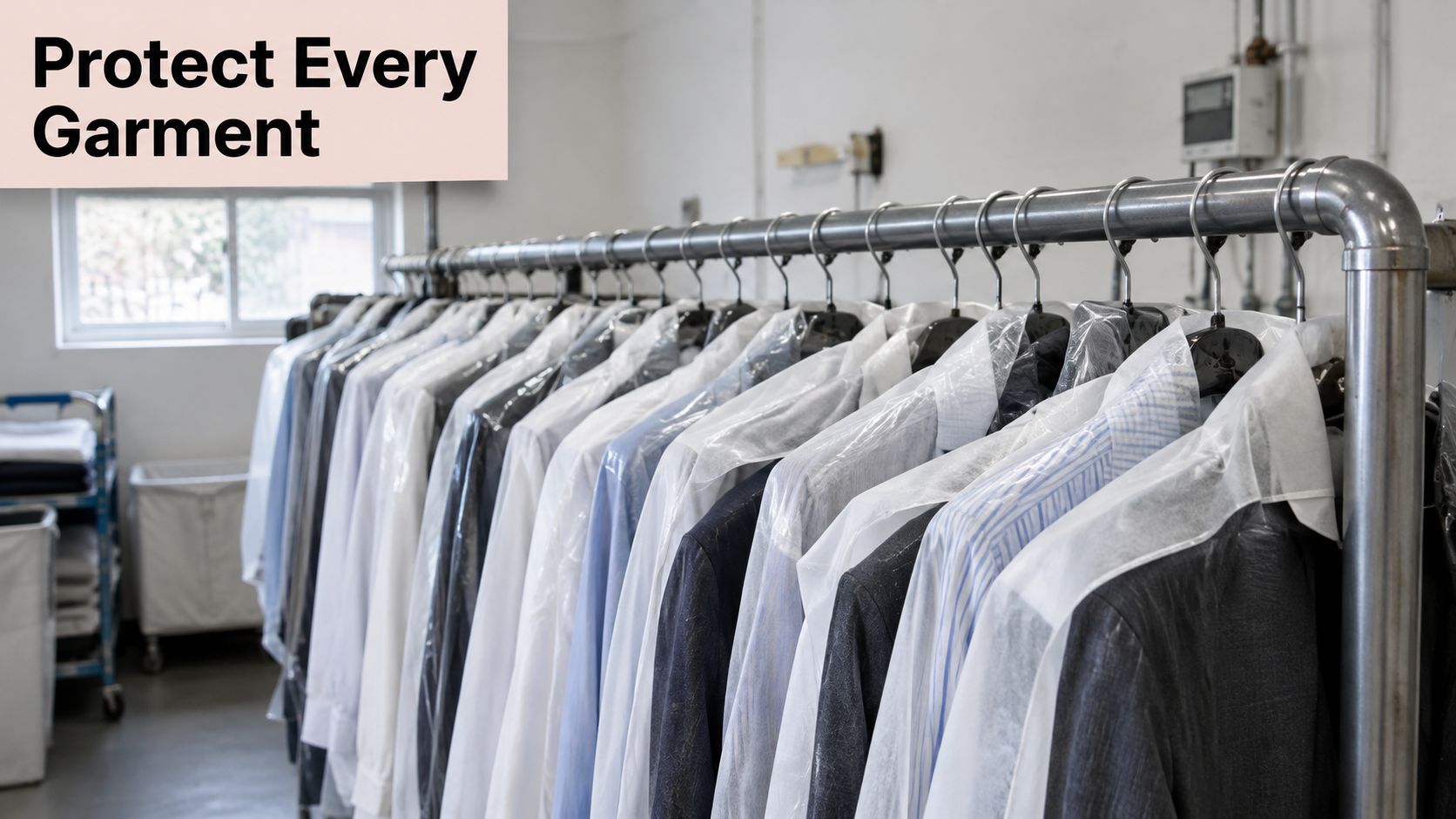
When a Simple Rail Is Not Enough
A rail can look tidy and still fail at the job. I've seen fresh stock go out on a Friday, then come back on Monday with a fine dust line along the shoulders because the back room was left open, or with a snag where one crowded hanger rubbed into the next. In a theatre store, the same thing happens faster, because costumes tend to be handled more often and packed back into less forgiving spaces.
A cover changes that, but only if the setup makes sense. UK conservation guidance treats hanging as suitable for sound costume, including many twentieth-century and military collections, and it uses hanging, boxing and rolling as the main textile-storage methods. It also makes the practical point that covers help with dust protection and snag prevention between adjacent garments, which is exactly what goes wrong in busy rooms.
A cover is not there to hide a bad setup. It works when the garments, hangers and room are already under control.
That's why this isn't really a question of whether a rail looks neater covered. It's about whether the rail is holding the right kind of stock, whether the spacing is generous enough, and whether the room is dry enough that the cover won't trap a fresh problem inside it. For a useful outside perspective on garment storage, cruelty-free winter storage tips from Pandemonium Millinery are a good reminder that protection always depends on the item and the conditions around it.
If your own rail is being used for returned stock, staged garments, costumes between fittings, or pieces waiting for collection, you're already in the territory where a cover earns its keep. If it's packed shoulder to shoulder, sitting in a damp room, or holding garments that still need inspection, the cover alone won't save it.
What a Hanging Rail with a Cover Actually Does
A covered rail is best thought of as a system, not a product. The rail carries the load, the hangers support the garment shape, the cover reduces outside contamination, and the room around it decides whether that protection holds up. If any one of those parts is wrong, the cover becomes a polite way of hiding a mistake.
UK conservation guidance is clear on the two main benefits. First, the cover helps keep dust off the textile surface. Second, it reduces snagging where adjacent items touch and catch on trims, buttons or rough fibres. That matters just as much in a back-of-house retail rail as it does in a costume archive, because damage usually starts with contact, not catastrophe.
Think of the cover as controlled access
A cover should let staff see enough to identify what's inside, while still cutting down on dirt and accidental handling. It is neither a wardrobe door nor a sealed vacuum bag. In practice, that means a covered rail is useful when people need to return to it regularly, inspect items, and move them in and out without re-hanging them from scratch.
The rail itself can be fixed to a wall or free-standing, and both can work. What matters is that the rail is stable enough for the garments it's carrying, and that the cover doesn't force the garments into each other. For a different storage context, the logic behind gallery picture rail systems is similar, in that the support needs to be secure and level before the display or storage system does its job.
The practical rule
- If the garments need regular checking, the cover should open easily and close without fighting the rail.
- If the rail is for long-term holding, the cover and hangers need to preserve shape, not just block dust.
- If the room is busy, the rail needs enough clearance that staff can remove one item without scraping the next.
A covered rail only earns its place when those details are handled at the same time. Leave one of them out, and the cover becomes decoration.
Cover Materials and Construction Compared
The material choice matters because the cover is doing more than sitting there. It has to suit the room, the inspection rhythm and the kind of garments on the rail. In professional costume storage, National Museums Scotland notes that costume bags were formerly made from washed cotton, while Tyvek is now more commonly used, which tells you something important about how conservation thinking has shifted over time. The goal is not just neatness. It's protection without creating a sealed, damp pocket.
| Cover materials at a glance | Dust protection | Breathability | Visibility of garments | Typical best fit |
|---|---|---|---|---|
| Clear PVC | Strong dust barrier | Low | High | Short-term visual identification where moisture is controlled |
| Tyvek | Strong | Better than sealed plastic | Low to medium | Costume storage, back-of-house handling, protective hanging |
| Washed cotton | Good | High | Low | Conservation-minded storage and gentler handling environments |
| Lightweight non-woven fabric | Moderate to good | Usually moderate | Low | Retail back rooms and studio use where access matters |
| Zippered dust jackets | Good when closed properly | Varies by build | Medium | Commission work, returns, and stored garments that need regular inspection |
The temptation is to buy the clearest or cheapest option. That usually isn't the best call. Clear covers help with identification, but if they are too sealed for the room, they can create condensation risk. Cotton is gentler in feel, but it won't show the contents as well. Tyvek has become common in conservation settings because it balances protection and handling better than many basic plastic solutions.
Read the product description for function, not marketing
If the listing says “dustproof” but says nothing about how the cover breathes, opens or hangs, treat that as a warning. A good cover should be specified in terms of seam strength, opening type, access to hangers and how it sits over the rail. Those details matter more than a glossy photo of a neat row of jackets.
Visibility is useful, but only if it doesn't come at the expense of moisture control.
For a buyer, the right question is simple. Is this rail for short transfers, everyday stock holding, conservation-minded storage, or display prep? That answer should decide the material, not the other way round.
Load Capacity, Hanger Shape and Spacing
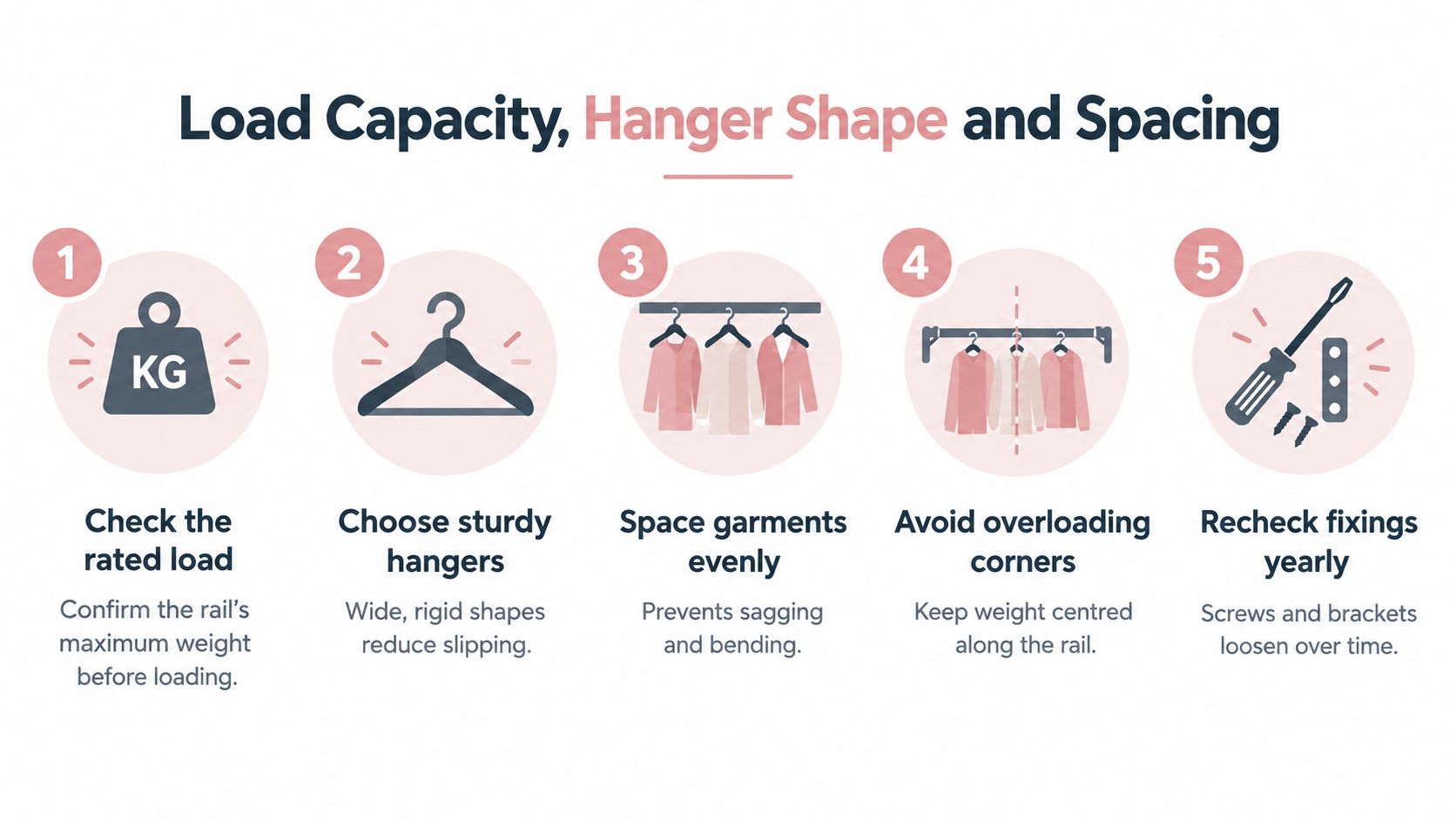
A covered rail still fails if the load is wrong. National Museums Scotland warns that rails should not be overfilled, especially when covers are absent, because crowding causes snagging and creasing. The same logic applies when the rail is covered, because the fabric layer doesn't stop garments pressing into each other underneath it.
Start with the rail, not the cover
A wall-fixed rail and a free-standing frame don't behave the same way. The wall-fixing, brackets and end supports have to suit the load, and the rail has to stay level so hangers don't drift into one another. If the rail sags in the middle, the cover will sag with it, and the centre of the rail becomes the place where garments start touching.
That's why shaped hangers matter. Padded or wide hangers spread the load better than thin wire ones and reduce shoulder distortion on fitted garments, coats and costume pieces. Wire hangers are fine for a quick transfer, but they're not the answer for proper storage when the garments need shape retention.
Space is protection
- Leave air and hand space between garments so the cover doesn't compress them.
- Keep heavier pieces centred along the rail, not clustered at one end.
- Watch for early warning signs, like collars leaning, sleeves folding hard into one another, or the cover bulging tightly across the front.
If you're fitting out a rail in a stockroom, the safest habit is to size it around the actual garments, not the available wall space. That often means the rail looks less “full” than people expect. That's a good sign, not a waste of space.
If the cover has to force the garments into shape, the rail is already overloaded.
A well-loaded rail handles better, lasts longer and makes inspection easier. That is the benchmark that matters, not how many hangers you can squeeze in.
Breathable or Sealed Covers in UK Conditions
UK humidity changes the cover choice. A sealed cover can keep dust out, but in a room with poor heating or limited airflow it can also hold moisture against the garments. Wiltshire Council identifies sustained indoor relative humidity above 65–70% as a risk for condensation, mould and damage, and recommends roughly 40% household relative humidity. That is the condition to judge against, not the sales copy on the bag.
What works in a damp room
In an unheated spare room, loft conversion, basement, garage or stockroom with patchy heating, a breathable cover is usually the safer default. It keeps dust off the rail while still letting air move, so you are less likely to create a sealed moisture pocket. That matters most after steaming, after a fitting, or when garments come back slightly damp from use.
A sealed plastic cover still has a place. Short transfers between clean and dirty areas, or temporary transport in a controlled, dry room, can justify it. It should not be used to hide a damp room problem, and it should not replace ventilation or sensible room control.
For longer-term protection against pests in UK storage, see our guide to garment bag moth proof options. That issue sits alongside moisture control, because a cover only works properly when the room around it is managed well.
The decision rule is simple
- Use breathable covers in most UK storage and studio settings.
- Reserve sealed covers for brief handling or controlled transport.
- Let garments cool and dry before you cover them.
- Check the room itself in spaces that go cold or damp, especially where stock sits for long periods.
If you are comparing a cover for hanging coats, fur-look pieces or seasonal storage, professional laundry service for households is a useful reminder that clean garments still need the right environment around them. A garment can be fully dry and still suffer if the room air stays wet.
Partial enclosure often wins
More enclosure is not always better. In a room that is not tightly controlled, a cover that allows some exchange can outperform a tight seal that traps problems inside. In British conditions, that trade-off matters as much as dust control.
Retail, Costume and Studio Use-Cases
In a small clothing shop, a covered rail often becomes the quarantine point. Returned stock goes there first, then staff inspect seams, hems, labels and linings before the pieces rejoin the sale floor. That's a practical response to the scale of the UK retail environment, where retail employs about 2.87 million people in 2024, making up 10% of all UK jobs, generating £429 billion in turnover and contributing about 9% of UK gross value added, according to the UK retail-sector report cited earlier. The numbers don't describe the rail itself, but they explain why flexible back-of-house storage matters.
A theatre costume department uses the same hardware differently. Show pieces may hang under covers between productions or during a run, but the inspection rhythm is tighter and the garments are usually more delicate. Costume teams often need a rail that can be opened, checked and re-covered quickly without crowding the garments, because one snag on a beaded trim can ruin a stage piece fast.
A home sewing studio is the third common pattern. Finished commissions waiting for collection need protection from dust, pets and accidental fingerprints, but they also need to stay visible enough that the maker can pull the right piece without rummaging. In that setting, a lightweight breathable cover and clear labelling usually beat a heavy sealed jacket.
Different spaces, different priorities
- Retail back rooms need quick sorting, visible labels and frequent access.
- Costume stores need gentler spacing and careful garment identification.
- Home studios need simple protection without making the rail awkward to use.
The hardware can look the same from the outside, but the operating logic changes. A rail that suits stock rotation in a shop may be too open for costume work, while a conservation-minded textile cover may be too slow for a busy fitting room.
Installation, Labelling and an Inspection Routine
The cleanest rail I've ever fitted became a problem two weeks later because nobody could tell what was inside it. The fix was simple. The team labelled the cover externally, spaced the garments properly and started checking the rail on a set day each week. A covered rail should always be treated as a temporary protection and inspection-control tool, not passive storage.
For wall fixing, start with the structure you have. Solid walls, studwork and dot-and-dab boards all need different fixing choices, and the rail must be level so hangers don't drift and twist. If you're looking for the right support hardware, browse rail end supports from Neasden Hardware alongside the rail itself, because the support points are what keep the system straight.
A short working routine
- Fix the rail securely. Make sure it suits the wall and the intended load.
- Check the rail is level. Even a small slope changes how hangers sit.
- Leave clearance at both ends. The cover needs room to move without snagging.
- Label the outside of the cover. Staff should know what's inside without opening it.
- Inspect weekly. Look for damp patches, odour, staining or pest activity before it spreads.
For guidance on the rail hardware side, clothes rail and brackets is a useful reference point when you're deciding how much support the installation needs.
If staff can't identify the contents quickly, they stop inspecting it often enough.
That's where hidden damage starts. A closed cover is helpful, but only when people still look inside on a regular rhythm. If the rail lives in a room that swings between warm and cold, or if stock gets returned damp from fittings, the inspection habit matters as much as the material.
Choosing the Right Covered Rail for Your Setting
The simplest decision rule is the one that holds up in real rooms. Match the cover to the environment, not the garment alone, and treat the rail as an inspection tool as much as a storage tool. Once you think that way, the rest becomes easier to judge.
Measure the room and the load first. Choose a breathable cover for most UK conditions. Leave proper clearance so garments aren't crushed together. Fix the rail properly, then inspect it on a regular schedule. That sequence works for a home studio, a retail stockroom and a costume department because it starts with conditions, not assumptions.
A few answers come up again and again. A cover won't fix damp. If the room is already too humid, you need room-level moisture management, not just a different fabric sleeve. The same rail can be used for display and storage in some cases, but usually not without compromise, and that's fine because the job changes the setup.
If you're choosing covered rails for a shop, studio or costume room, look past the glossy product photos and check the support, spacing, access and material first. Display Guru supplies garment rails and display hardware for working spaces like these, so if you're planning a practical install rather than a decorative one, visit Display Guru and build the rail around the room you have.