



Buy Scaffolding Pole: The UK Buyer's Guide to Tube Standards
UK scaffold poles are standardised around 48.3 mm outside diameter with a 3.2 mm wall thickness for Type 3, but if you're buying anything beyond light decorative use, Type 4 at 4.0 mm is the safer place to start. The problem is that a pole isn't just a length of steel, it's a system part, and the wrong tube can look fine while still being the wrong fit for the fittings, the load, or the job.
Why Buying Scaffolding Pole Is Not Like Buying Steel Pipe
Buyers often start by comparing length and price. That order is flawed, because a scaffold pole only makes sense when it matches the couplers, clamps, and configuration that will hold it in place, not when it arrives on a lorry.
Standardisation changed the buying question
UK tube-and-fitting practice moved away from earlier habits that used nominal 2-inch water pipe and into a standardised 48.3 mm system with defined wall thickness and compatibility requirements, first through EN 74:1988, then BS 1139-2.1:1991 as described in the tube-and-clamp guide. That shift matters because a pole that looks close enough can still seat badly in a coupler, which affects fit and load transfer.
Practical rule: if the tube and the fittings don't belong to the same recognised system, don't assume they'll behave like a system.
The habit of treating a scaffold pole like generic steel stock causes most buyer confusion. A shopfitter, costume team or display maker might only see diameter and length, while the key issue is whether the pole can be connected safely and consistently to the rest of the build. The wrong assumption saves money at checkout and costs more in rework, delivery, or rejection later.
The safest mental model is simple. You're not purchasing raw metal, you're purchasing a component that must lock into a defined arrangement. That's why compatibility outranks headline length, and why a plain description like “scaffolding pole” is too vague on its own.
Why this matters for non-construction buyers
For visual merchandising, props or temporary display work, the risk is often hidden rather than dramatic. A tube that seems sturdy can still be the wrong diameter for the fittings, which means the structure depends on improvised connections instead of designed ones.
If you need a pole for a garment rail, a backdrop frame or a shop display, it helps to compare it with a dedicated clothing rail pole guide rather than assuming every steel tube serves the same purpose. The buying mistake is usually not “too weak,” it's “wrongly specified.”
Understanding BS EN 39 and Critical Dimensions
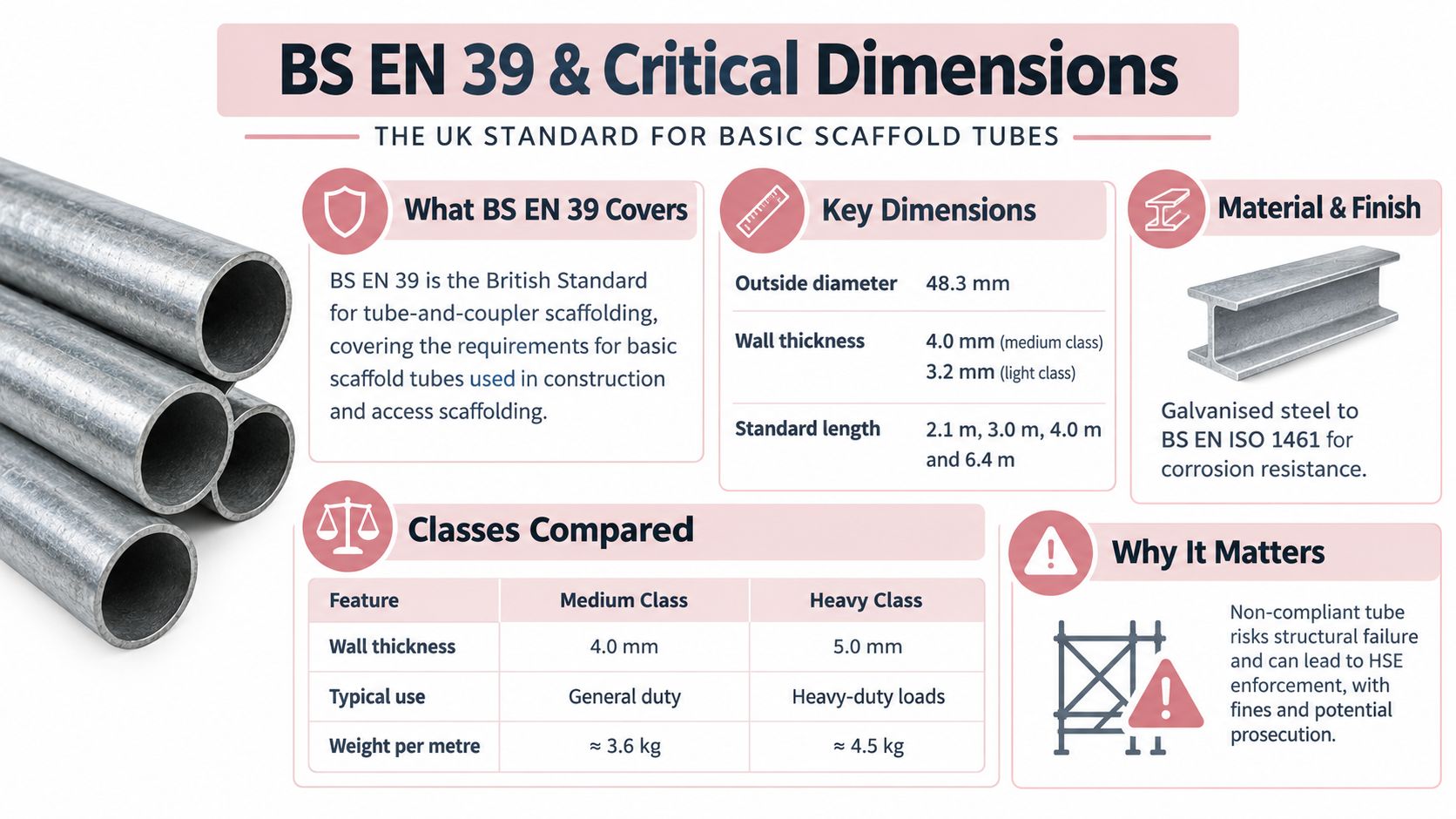
BS EN 39 is the key reference when you are buying tube for tube-and-coupler work. It sets the nominal outside diameter at 48.3 mm, and it recognises two common wall thicknesses, 3.2 mm for Type 3 and 4.0 mm for Type 4 according to the BS EN 39 summary. Those figures are not cosmetic detail. They control whether the tube fits the coupler properly and whether the assembly behaves as a system.
Type 3 and Type 4 are not interchangeable labels
Type 3 uses a 3.2 mm wall, while Type 4 uses 4.0 mm. The thicker Type 4 tube is about 23% heavier per metre because its nominal mass is 4.37 kg/m compared with 3.56 kg/m for Type 3, as shown in the BS EN 39 nominal mass table. The extra 0.81 kg/m raises dead load, transport effort and the feel of the finished assembly. For a shopfitter or display team, that can mean harder handling, more strain on fixings, and a higher chance of ending up with a build that feels heavier than planned.
| Tube type | Wall thickness | Nominal mass |
|---|---|---|
| Type 3 | 3.2 mm | 3.56 kg/m |
| Type 4 | 4.0 mm | 4.37 kg/m |
The practical question is not which tube sounds stronger in the abstract. It is which tube suits the intended use, and whether the supplier can identify it clearly enough for you to verify. The BS EN 39 marking and traceability requirements cover marking, coatings, inspection and testing, so you can check the specification instead of guessing from a galvanised finish alone the BS EN 39 marking and traceability requirements.
A bright silver finish does not prove suitability. Identification does.
What to ask for before you order
Ask for the designation, wall thickness, coating, and manufacturer identification. If the tube will be used for more than decorative work, confirm whether it is intended for EN 74 couplers and whether the setup needs a recognised configuration such as TG20 or a bespoke design NASC guidance.
If you have already checked size against scaffold pipe diameter guidance, use that as the starting point, then verify the specification, the coupler match and the marking. That is how you avoid paying for cheap tube that looks right, then creates hidden costs in rejection, rework or unsafe fit.
Safety Checks and Inspection Protocols
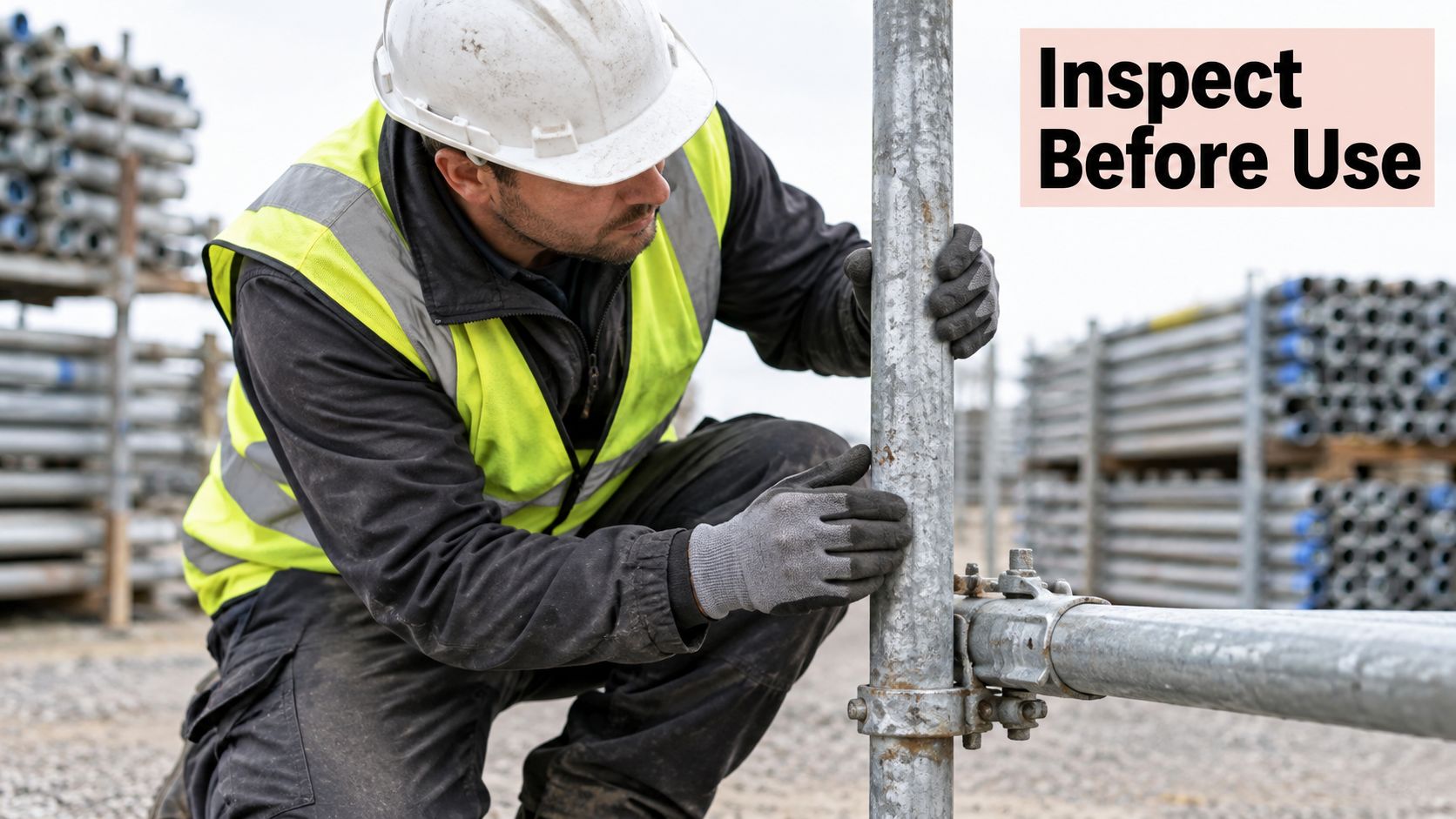
A pole can look acceptable and still be wrong for the job. Corrosion, dents, ovality, cracked welds, damaged ends, and unclear provenance change how the tube sits in a coupler and how load moves through the structure. Inspection guidance from HSE scaffolding information puts that into practical terms: condition matters because fit and load transfer depend on it.
A simple incoming-goods check
Use the same checks every time a delivery arrives.
- Check the ends first. Crushed or split ends can stop couplers seating properly.
- Run a visual line down the tube. Look for bends, ovality, impact dents, and obvious twist.
- Look for corrosion loss. Surface rust is one thing, but heavy coating loss can point to deeper deterioration.
- Confirm identification. If you cannot identify the tube clearly, you cannot match it to the right use.
- Confirm provenance and storage history with the supplier, then match the verified condition to the intended task. Poor storage, mixed stock, or unknown history raises uncertainty before the pole ever reaches site.
If a pole arrives damaged, treat it as a rejected component, not a bargain.
The inspection duty does not stop at purchase. The HSE says scaffolding must be inspected after installation or before first use, at intervals of no more than seven days, and after events that could affect safety, such as high winds or substantial alteration. That means a quick visual check at delivery is only the first filter, not the final decision.
Why used poles need extra caution
Second-hand tube can still be serviceable, but only if its condition is clear. Ask for consistent identification and a realistic condition assessment before you accept it. A pole with the right diameter but worn ends or heavy corrosion may still create problems when the coupler tries to grip it.
For hanging rail or heavier display projects, this heavy-duty rail guide is a useful reminder that strength only helps when the full build is inspected and suited to the task.
From Construction Sites to Boutique Retail Displays
A builder's scaffold and a shop display often use the same family of tube, but they don't face the same demands. Construction work has to deal with working loads, weather, access, movement and formal inspection. A retail display usually cares more about appearance, repeat assembly and how neatly the tube fits into the room.
Different use, different risk
For a load-bearing scaffold, you need a compliant tube, the right fittings and a competent person to confirm the whole arrangement. For a garment rail, prop frame or visual merchandising rig, the question is usually whether the pole is strong, cleanly finished and compatible with the intended brackets or connectors. Those are different decisions, even when the raw material looks similar.
That's why a cheap pole can become expensive fast if it cannot be incorporated into a recognised configuration. If a tube doesn't match the connection system, the buyer pays twice, once for the tube and again for the work needed to make it usable.
A good comparison is to think in terms of function, not category. Construction work asks, “Can this safely support the intended scaffold arrangement?” Display work asks, “Will this assemble neatly, hold its shape and suit the space?” The answer to one does not automatically answer the other.
When a simpler solution may be better
Some projects don't need construction-grade scaffolding at all. A temporary display, costume rack or set piece may only need a strong, well-finished pole that fits its brackets cleanly and doesn't look out of place in the room. In those cases, overbuying compliance can waste budget, while underbuying compatibility can waste the whole project.
If you're comparing display options, it also helps to look at scaffolding clothes rails alongside a broader resource such as Stretch Fabric Counters UK, Printed Exhibition Counters, because shopfitting often mixes fabric display, counters and tube-based structures in one scheme. The best choice is the one that suits both the visual brief and the fixing method.
Navigating UK Costs and Logistics
The sticker price is only the starting point. For scaffold pole buyers in the UK, freight has pushed imported scaffold-tube landed prices up by approximately 15% between April and June 2026, with pressure expected to continue through 2026 scaffolding market reporting. That makes delivery timing and stock location part of the cost, not an extra detail.
Why the cheapest tube can cost more
A short, pre-cut tube may look dearer on paper, yet it can save cutting time, waste and handling. A full-length tube can show a lower unit price, but the delivered bill often rises once transport, storage, offloading and any on-site cutting are added in. Buyers who only compare list prices miss that second layer.
Publicly listed UK examples show scaffold tubes advertised from £5.79 plus VAT upward. That figure still does not describe the whole spend, because VAT, delivery method and tube length can shift the final amount more than the headline price suggests.
Cost rule: if a supplier can't explain delivered price, you don't yet know the full price.
The logistics questions people forget
Long steel tubes are awkward to send to a residential driveway or a small studio. Check whether the vehicle can unload safely, whether the packaging suits the length, and whether storage space is ready when the delivery arrives. Unloading access, packaging length and storage readiness are part of the purchase, not afterthoughts.
Waste matters too. Longer tubes can leave more offcut waste if your build only needs shorter spans. Shorter tubes can reduce waste, but the unit cost may rise. The right answer depends on how many poles you need, how you will store them, and whether the purchase supports a one-off build or repeated use.
For buyers who also source shopfitting parts, this supplier overview is useful background. It shows why the better buying decision starts with fit for the job, not the lowest sticker price.
Final Checklist for Your Purchase
Before you buy, check five things in order. First, compatibility, because the pole has to work with the fitting system you plan to use. Second, specification, which means confirming the tube type, wall thickness and identification rather than relying on a generic product name.
Third, condition, especially if the pole is used or has travelled through multiple hands. Fourth, delivery cost, because VAT, long-item transport and handling can change the total more than the advertised price. Fifth, intended use, since display work, access work and load-bearing scaffolds do not carry the same tolerance for risk.
A good purchase is one you can explain clearly afterwards. You should be able to say what standard it meets, what fittings it suits and why its condition is acceptable for the job.
Frequently Asked Questions About Buying Scaffolding Poles
Where should I buy in the UK? Buy from a supplier that can state the tube specification, coating and compatibility with the intended fittings. If the listing only says “scaffolding pole” without more detail, treat that as a warning sign.
Can I cut scaffolding poles to size? Yes, a pole can be cut for a project, but the cut edge, the loss of original length and the effect on the intended use all matter. If the tube is for structural or access work, cutting should be considered carefully because the finished piece still has to fit the system and the job.
What if I need compatible fittings as well? Don't treat fittings as an afterthought. The tube and coupler have to belong to the same compatible arrangement, or the connection can become unreliable. If you're unsure, ask the supplier to confirm the matching fitting system before you place the order.
Is a used pole always a bad idea? Not at all. A used pole can be a sensible purchase if it's clearly identified, straight enough, and free from meaningful damage or corrosion. The problem is uncertainty, not age.
Display Guru helps makers, retailers and costume teams choose display hardware with the right balance of strength, finish and practicality. If you're comparing scaffold-style poles for rails, fittings or visual merchandising, visit Display Guru to see what fits your project and avoid buying a tube that looks right but works wrong.