




Hanging Rails for Cupboards: A Practical UK Guide
You've loaded a wardrobe with winter coats, shut the doors, and noticed the hanging rail has started to bow. Or perhaps a wall cupboard looked secure until one fixing loosened and the whole run began to pull away from the plasterboard. These failures rarely come from the rail alone. They usually result from a mismatch between the span, the bracket pattern, the expected load and the wall behind it.
Hanging rails for cupboards are structural hardware. They support garments, shop stock and stored accessories, then transfer that weight through brackets, cabinet panels and, in wall-mounted systems, the fixings into the building fabric. The right choice depends less on appearance than on the complete load path.
Why the Right Hanging Rail Matters More Than It Looks
A rail can look adequate in its packaging and still be wrong for the installation. A short wardrobe rail may last for years when its brackets are fixed into sound cabinet sides, while a longer run can fail quickly if two small plugs are carrying the load in plasterboard. The tube is only one part of the structure. The wall substrate, fixing pattern and support spacing determine whether the installation stays secure.
A cupboard rail carries a live load. Clothing shifts, hangers collect in one area, shop stock is replenished and users pull items forward. These repeated movements add bending and twisting, particularly on a long span with limited support. Early warning signs include:
- Visible bowing: The centre drops while the ends remain level.
- Loose sockets: End brackets rotate or pull away from the cabinet side.
- Cracked board: Plasterboard around a fixing crushes or splits.
- Door interference: A sagging rail or overloaded cabinet affects alignment.
UK retailers list rails in several length and diameter bands. The DIY.com furniture hardware catalogue records 132 products in the 500–1000 mm length range and 87 in the 1000–1500 mm range, with broad availability in the 20–29.99 mm and 10–19.99 mm diameter bands. That range gives installers options to match the tube, brackets and intermediate supports to the cupboard rather than forcing one standard fitting into every opening.
Practical rule: A rail is only as reliable as its weakest interface. A strong tube fixed into weak board remains a weak installation.
Start with the expected contents and rail span, then assess the cabinet material or wall substrate. Masonry may accept suitable plugs and screws, while plasterboard often needs fixings positioned into studs or a support method designed for the board. The correct load rating means little if the fixing pattern cannot transfer that load safely. That check avoids a return visit to repair a cupboard that should have been specified correctly from the start.
What Hanging Rails for Cupboards Actually Do
A cupboard hanging rail is usually a horizontal tubular or oval section held by end sockets, side brackets or intermediate supports. In a wardrobe, hangers sit on the tube. In a utility or shop setting, the same basic component may carry bags, packaged stock or accessories.
The load path is straightforward:
- The stored items load the hangers.
- The hangers press down on the rail.
- The rail transfers that force into its brackets.
- The brackets push into the cabinet sides, shelf or wall.
- Wall-mounted systems pass the force through screws, plugs and the wall substrate.
Think of a curtain pole fitted into a deep window reveal. The pole spans the opening, but the brackets do the structural work. If the pole is sound and the brackets are poorly fixed, the installation still fails. A cupboard rail behaves in much the same way.
The rail's advertised capacity and the cabinet's actual capacity are separate questions. A tube might tolerate a substantial distributed load, while a thin melamine side panel splits around a screw. A wall rail may also have a high published rating, yet lose most of its practical safety if the fixings sit only in weak plasterboard.
For broader storage planning, countertop organization tips remodel offers useful ideas on arranging frequently used items around available space. The same principle applies inside a cupboard, organise the load before choosing the hardware.
The three jobs usually assigned to these rails are different:
- Garment hanging: Coats and dense clothing create a concentrated, moving load.
- Stock organisation: Retail items may be added or removed throughout the day.
- Accessory storage: Bags, belts and lighter items need convenience more than maximum capacity.
For a wall-mounted application, compare the construction and load path with this wall-mounted hanging rail guide, then check the wall before treating the product rating as a safe working limit.
Fixed, Telescopic and Under-Shelf Rails Explained
The three formats look similar in a catalogue, but they solve different fitting problems. Fixed rails give the most controlled result when the cabinet width is known. Telescopic rails help when the opening varies or the installer needs a reversible solution. Under-shelf rails save space but transfer their entire load into the shelf above.
| Format | Construction | Typical length range | Bracket style | Best-fit use case |
|---|---|---|---|---|
| Fixed | Single tube or section, cut or supplied to size | Short to medium stocked lengths | End sockets, side brackets and optional centre support | Permanent wardrobes and fitted cupboards |
| Telescopic | Inner and outer sections with a spring or push-fit adjustment | Adjustable overlapping spans | End cups or compression-style supports | Retrofit wardrobes and replacement rails |
| Under-shelf | Rail mounted below or slotted into the shelf above | Usually short to medium runs | Shelf clips, underside brackets or integrated sockets | Shallow cupboards and compact storage |
Fixed rails
A fixed rail is the cleanest choice when the internal measurement is stable. Side-mounted sockets can screw directly into cabinet panels, keeping the load close to the carcass and reducing movement. A cut-to-size oval rail also gives a better finish than an overextended adjustable tube.
The weakness is installation tolerance. Measure incorrectly and the rail may be too short for the sockets or too long to sit squarely. Long fixed runs need planned intermediate support, not a hope that the tube will remain straight.
Telescopic rails
Telescopic construction suits older wardrobes, rental properties and openings where the exact finished width is uncertain. The installer can adjust the length between two sides without cutting metal. That convenience comes with a trade-off: the overlapping sections and friction points can flex more than a single, properly supported tube.
Don't choose a telescopic rail for a heavy coat cupboard just because it fits. Check how the manufacturer defines its load rating, where the supports must sit and whether the rail is intended for compression between sides.
Under-shelf rails
Under-shelf rails work well where vertical clearance is limited. They keep hangers close to the shelf and can make use of otherwise wasted space. However, the shelf becomes the critical structural component. If it is only supported at its ends, poorly fixed or made from a weak board, a strong rail cannot correct the problem.
A practical reference for this format is the clothes rail under shelf guide, especially when comparing underside clearance and fixing options.
Materials, Diameters and Load Ratings in Plain English
A rail rating only makes sense alongside its material, section shape, support spacing and fixing pattern. UK catalogues commonly list tubular systems in diameter bands including 10–19.99 mm and 20–29.99 mm (DIY.com wardrobe rail listings). Specialist suppliers also show oval sections and lengths such as 998 mm, 1000 mm, 1100 mm, 1200 mm and 1500 mm (Interfit wardrobe rails).
| Material | Common diameter or section | Typical load per metre | Best for |
|---|---|---|---|
| Chrome-plated steel | Round or oval tubular section | Depends on wall thickness, support spacing and manufacturer test | General wardrobes and cupboards |
| Oval aluminium | Often specified by width and depth rather than diameter | Depends on section depth and bracket system | Longer garment runs where low weight helps |
| Stainless steel | Round or oval tube | Depends on grade, wall thickness and supports | Damp rooms and hard-wearing installations |
| White-coated steel | Round or oval tubular section | Depends on coating, section and fixings | Utility rooms and colour-matched interiors |
Why oval sections are popular
An oval section can put more material away from the neutral axis in the direction of bending. In practical terms, a well-designed oval rail may resist sag better than a round tube made from similar material with comparable wall thickness. The difference becomes noticeable across an unsupported span, especially when heavy coats collect near the middle.
Chrome-plated steel suits many domestic cupboards because it is familiar, reasonably priced and rigid enough for typical use. Aluminium reduces the weight of the rail and can perform well with a matching bracket system, though its low weight does not compensate for poor support. Stainless steel is useful where moisture or repeated cleaning makes corrosion resistance more important than cost.
The wall and fixing pattern can limit the result before the rail itself does. A rail with a high published rating can still pull loose from weak plasterboard, overloaded plugs or thin cabinet material. Masonry fixings need sound brick or block, while plasterboard installations may require suitable cavity fixings or a timber support behind the board.
Read the test conditions before comparing ratings. A manufacturer may quote a uniformly distributed load, while cupboard users often create a concentrated load from dense garments in one area. UK suppliers typically list maximum ratings such as 20 kg and 30 kg under stated conditions. Those figures still require the correct bracket spacing and fixings.
For terminology and section sizing, this guide to scaffold pipe diameter offers a useful comparison, but cupboard rails should be selected against the tested rail, bracket and fixing system as a complete assembly.
Sizing the Rail to Your Cupboard Width and Weight
Measure the internal width between the cabinet sides, not the external carcass. End brackets take up space, so the rail must fit between them without forcing the sides apart. Allow roughly 15–25 mm at each side for end brackets where the design requires it, then confirm the socket depth before cutting.
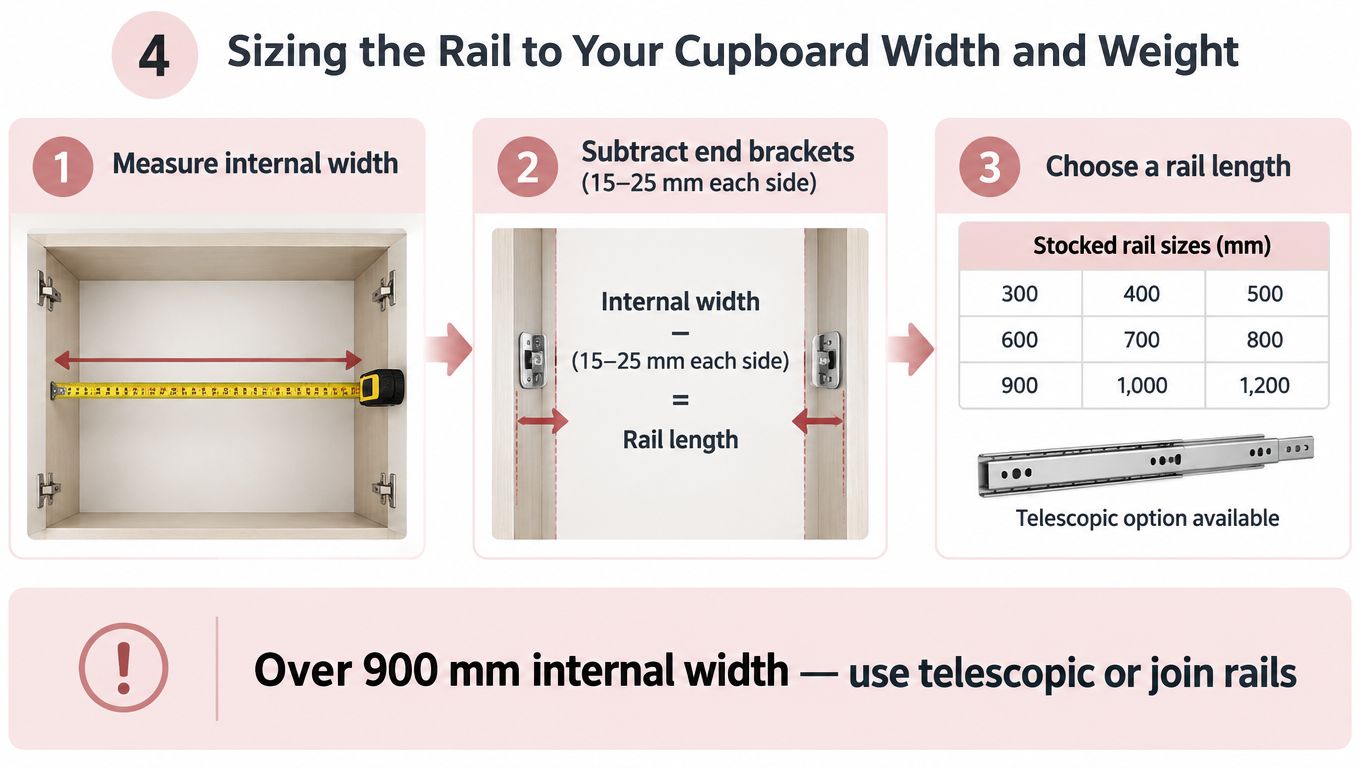
Span length affects support as much as the rail's stated load rating. A rail longer than about 900 mm generally needs a centre support for heavy clothing. One supplier's schedule specifies two brackets for 500 mm and 900 mm rails, then three brackets for a 1200 mm version within its tested system. That additional bracket limits mid-span movement and helps prevent the rail twisting under an uneven load.
A worked sizing example
For a 1200 mm internal wardrobe opening holding 25 kg of clothing, choose a rail and bracket set rated above the expected load under the manufacturer's stated test conditions. Fit end supports and a correctly positioned centre bracket. Secure every bracket into sound cabinet material, rather than relying on a thin decorative back.
The load path matters more than the tube rating alone. If the cabinet sides cannot hold the bracket screws, alter the arrangement instead of forcing the hardware. A rear support strip, an under-shelf rail or a wall-mounted suspension system can transfer the load more reliably.
Use screws suited to the actual material. A short wood screw in a cabinet side does not provide the same hold as a longer fixing in masonry, and a screw in plasterboard needs a suitable anchor. Check the rail against the cabinet reference lines, then add garments gradually with the weight spread across the span.
Installer's check: Put the heaviest garments near the centre during testing. This reveals sag and bracket rotation before the cupboard enters daily service.
Matching the Rail to Your Wall Type
A wall-mounted rail only works when the wall can receive the load. The tube rating describes the rail assembly, not the plasterboard, brickwork or timber behind the fixing.
Plasterboard and stud walls
A fixing that bites only into plasterboard can pull through under a modest cupboard load, especially when the rail is loaded away from the wall. The preferred arrangement is to align each bracket with a timber or metal stud and use a suitable screw. Where that isn't possible, choose a cavity fixing designed for the board thickness and the required shear and pull-out forces.
Metal cavity anchors and specialist plasterboard fixings can be useful, but they aren't interchangeable. Check the anchor's working load, installation tool and clearance behind the board. If the rail supports a wall cupboard, add an anti-lift or anti-drop measure where the system requires one.
Masonry walls
Sound brick or blockwork provides a better fixing base than unsupported plasterboard. Use a plug and screw combination suited to the masonry, drill without damaging the hole and keep fixings away from weak mortar edges where possible. Hollow block, old brick and a cavity behind the face require different anchor depths and installation methods.
A cabinet support rail can be rated to 90 kg per pack of two when used with a 3 m support rail, but the manufacturer's conditions still require suitable wall fixings (Howdens wall-mounted cabinet support rail). The rail distributes force. It doesn't turn weak anchors into strong ones.
Timber backing
Timber studs, noggins and properly installed backboards provide a dependable fixing point when the screw length and thread suit the material. Confirm the timber's position with a detector or pilot hole, and avoid assuming that every visible line behind a cabinet is structural.
For a useful comparison with professional wall-mounted storage, see these medical storage wall systems. The same design principle applies: the rail spreads force, but the building interface carries it.
A 15 kg rail fixed correctly can be safer than a 40 kg rail fixed incorrectly. For further practical context on wall installation, use this hanging rail wall-mounted guide, then verify every bracket against the actual substrate.
When a Modular Rail System Beats Fixed Brackets
Fixed brackets are simple and economical when the cupboard width, load and layout won't change. Each bracket usually concentrates force through a small number of screws, so the installer must hit strong cabinet material or wall structure at every support point.
A modular rail-and-hanger system changes that arrangement. A continuous top-hung channel or slotted strip can spread the load along a series of fixings, while clipped hangers allow the cabinet position to move without drilling new holes. That makes it particularly useful for retrofit cupboards, shopfit walls and storage that gets reorganised.
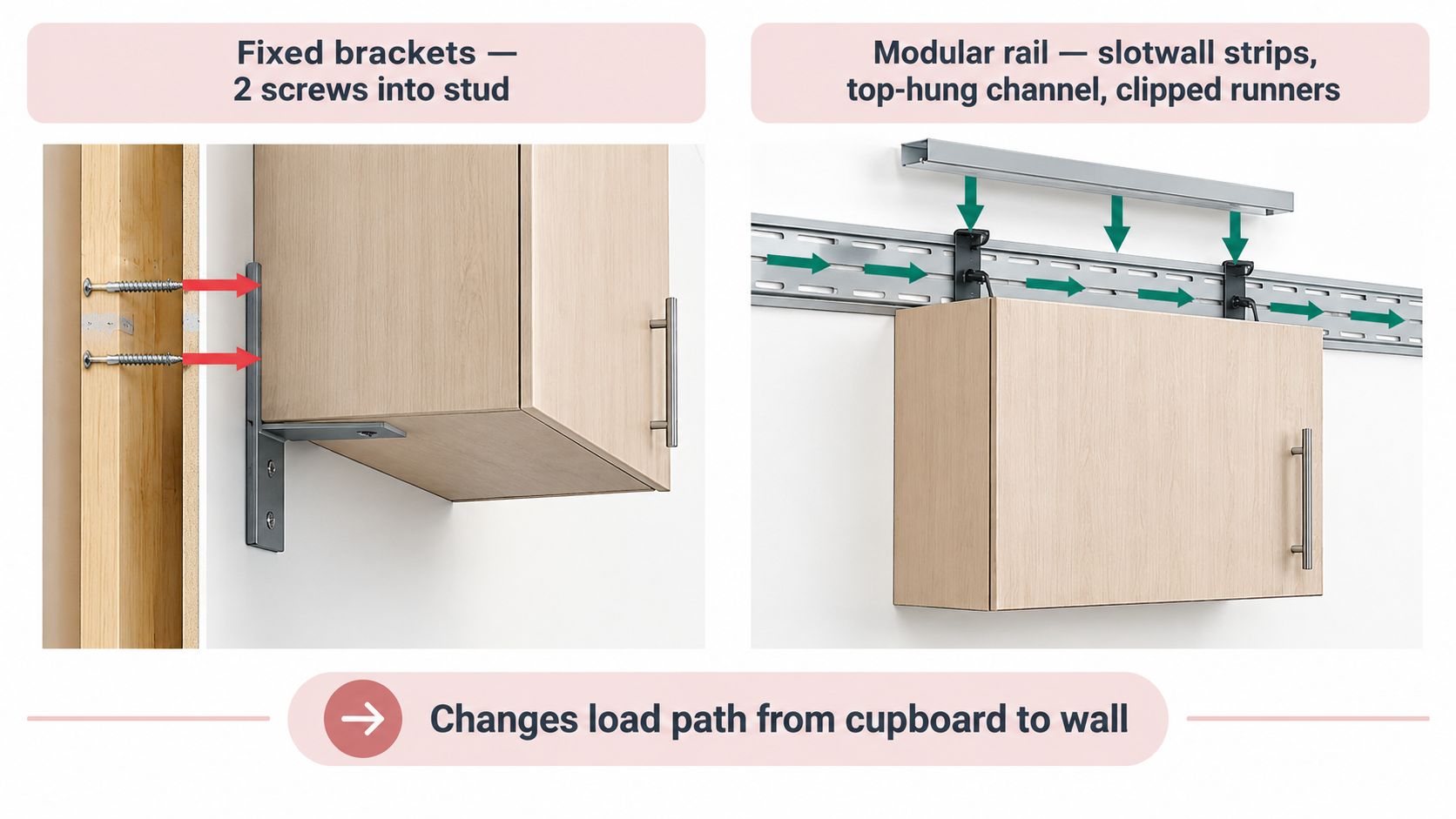
Where modular systems earn their keep
A modular system is a strong choice when:
- The wall is uneven: A continuous channel can offer more fixing positions than isolated brackets.
- The layout changes: Hangers can be repositioned without leaving a row of redundant holes.
- The cabinet is shallow: Top-hung hardware can avoid the depth needed for conventional side brackets.
- The load varies: Retail displays, rental storage and seasonal wardrobes benefit from adjustable positioning.
The trade-off is compatibility. Use the manufacturer's hangers, clips and covers together, and follow the published load per metre. A channel may distribute load effectively across its length, but each fixing still needs adequate substrate and the channel may have a lower local capacity than a heavy fixed bracket pair.
For a 1200 mm wardrobe retrofit, a single continuous channel may offer a cleaner adjustment path than several isolated brackets, provided the wall fixing pattern is engineered for the cabinet mass. Modular hardware isn't automatically stronger. It is often more adaptable, and adaptability is the feature that justifies the extra components.
Buying Checklist for UK Homes and Shops
Bring the opening measurements and wall details when ordering. A rail's rating means little if the cabinet panel, bracket spacing or fixing cannot transfer the load safely into the substrate.
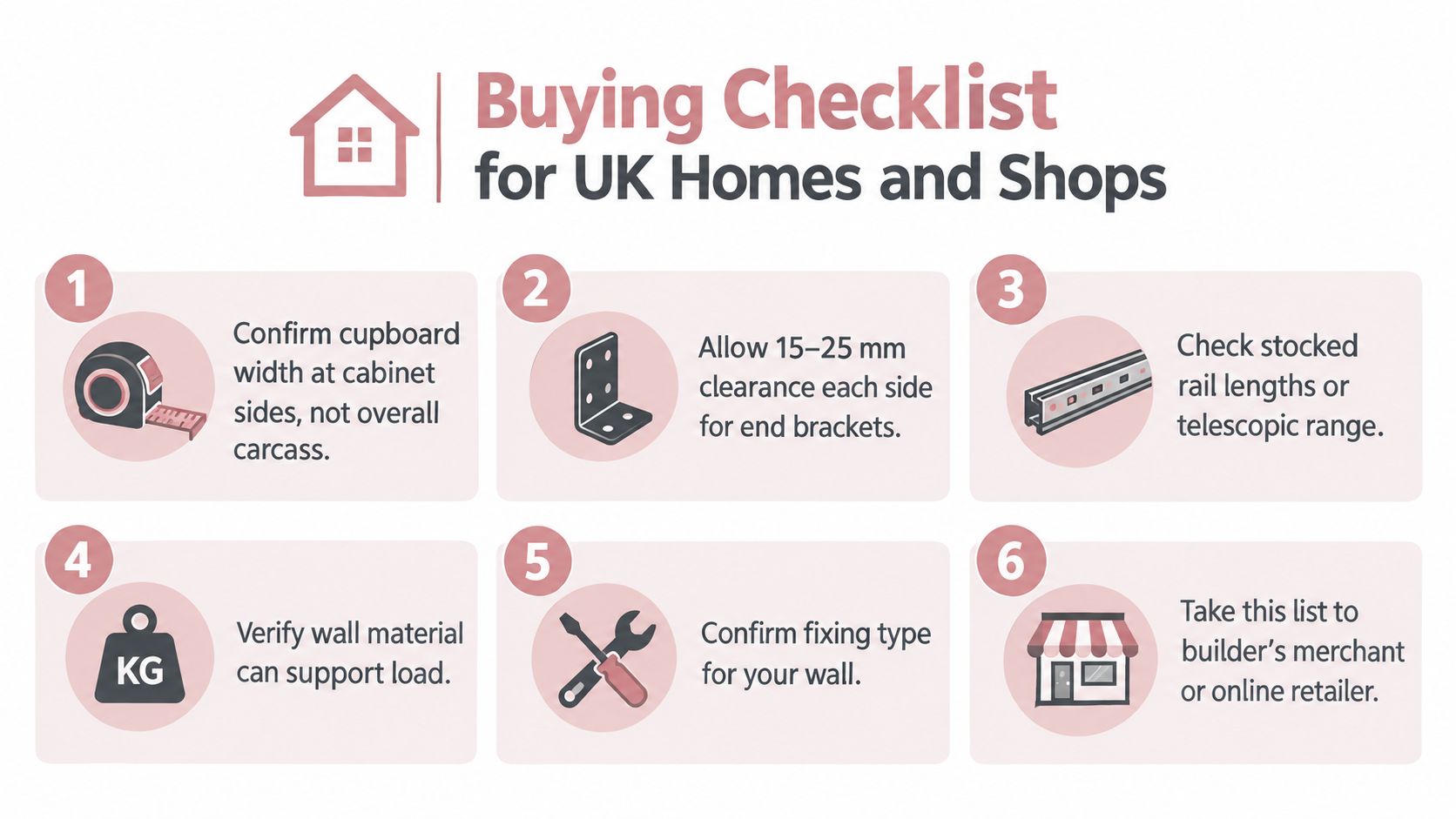
- Confirm the opening: Measure between the cabinet sides, not across the outer carcass.
- Reserve bracket space: Allow for end sockets, commonly 15–25 mm per side.
- Choose the format: Fixed oval rails suit permanent wardrobes, telescopic rails help with uncertain retrofit openings, under-shelf rails suit shallow cupboards, and modular channels suit layouts that may change.
- Check the load path: Read the rail and bracket rating, then check the cabinet panel, shelf and wall carrying the force.
- Specify the fixing: Use screws in timber, suitable plugs in sound masonry, and rated cavity anchors or stud fixings in plasterboard.
- Plan the clearance: Leave room above the rail for hanger hooks, and check that doors, shelves and clothing will not clash.
The UK market includes standard lengths such as 998 mm, 1000 mm, 1100 mm, 1200 mm and 1500 mm. Some rails can be trimmed on site under the manufacturer's instructions (Interfit wardrobe rails). Wall-mounted cupboard systems may use 2 m or 3 m rails, while some suspension rails carry ratings from 105 kg to 150 kg under specified fixing conditions (PWS cabinet hangers). Treat these as complete-system ratings, not as permission to overlook a weak wall or sparse fixing pattern.
For shop and display work, order the rail, brackets, fixings and replacement parts together. A guide to shop fitting supplies helps build the wider hardware list before installation.
Before drilling, mark each bracket, locate studs or sound masonry, and check the rail position against doors and shelves. Level the empty assembly, load it gradually, and inspect the centre span and fixings after initial use. This is cheaper than repairing a pulled-out plasterboard anchor or split cabinet carcass.
Display Guru supplies garment rails, display hardware and shopfitting equipment for wardrobes, retail interiors, tailoring spaces and visual merchandising projects. Visit Display Guru for practical rail and display solutions, with product support before and after ordering.