




Rubber Outdoor Doormats: A Complete UK Buying and Care Guide
The shop is open, but the entrance already looks untidy. A wet Monday has brought grit, leaves and muddy footprints across the threshold. One corner of the old mat has curled upwards, the perimeter feels slick, and a customer pushing a trolley hesitates before crossing it. The mat hasn't failed in one dramatic moment. It has gradually stopped doing its job.
That pattern is common with entrances in UK homes, shops, cafés, offices and public buildings. A rubber outdoor doormat can remove water and debris, protect interior flooring and create a stable transition, but only when its compound, pattern, dimensions and installation suit the site. A cheap mat may look practical on a dry day and become an obstruction during heavy rain or busy wheeled traffic.
The right buying question isn't just, "Is it non-slip?" You need to ask whether the mat stays stable, drains properly, remains level and can be crossed safely by shoes, wheelchairs, pushchairs and trolleys. This guide applies that facilities-minded test from first measurement to routine care.
Why Your Entrance Mat Is Quietly Failing
The first warning sign is often the floor around the mat, not the mat itself. A manager notices that staff are mopping the same strip beside the entrance repeatedly, while grit is being carried further into the shop. The rubber may still look intact, but water is pooling underneath, the edges have moved and the walking surface has become contaminated with fine dirt.
A mat can fail in several small ways:
- Movement: A light surface-laid mat shifts every time a customer changes direction.
- Edge damage: Repeated footfall catches a corner until it curls into a trip point.
- Blocked drainage: Leaves and grit fill channels or holes, leaving water at the threshold.
- Poor scraping: A smooth or flattened pattern leaves moisture and soil on footwear.
- Interior contamination: Dirt passes straight through the entrance and abrades flooring inside.
Retailers should also treat the entrance as part of the customer journey, not as an isolated cleaning product. The mat affects the first few steps, sightlines, queue movement and the way a person with a trolley or mobility aid approaches the door. These practical considerations sit alongside broader retail store layout best practices, particularly where the entrance joins display areas or narrow circulation routes.
Practical rule: If a mat needs frequent repositioning, it isn't secure enough for a busy entrance.
The cheap replacement trap
Replacing a mat with another low-cost mat can hide the symptom without solving the cause. A narrow product may leave the busiest line of travel uncovered. A thick product may catch beneath the door. A solid-backed design may hold water against paving, while an unweighted sheet may lift in wind or migrate under footfall.
For a domestic doorway, the consequence may be a muddy hall and damaged flooring. In a commercial setting, the consequences are broader. A raised perimeter can interfere with wheelchair wheels, walking aids, pushchairs and stock trolleys, while a slick outer edge can create a hazard precisely where people are turning or slowing down.
The UK market context helps explain why buyers encounter such a wide range of imported products. Rubber and vinyl mats account for about 10–12% of UK doormat sales, mainly in heavy-duty locations such as industrial entrances, lobbies and outdoor applications, according to IndexBox's UK doormat market analysis. The same source estimates total UK doormat retail value at roughly £220–260 million in 2026, with imports representing about 88–92% of domestic consumption by value, so a buyer needs to assess the specification rather than assume that a familiar product format is suitable.
A reliable mat is a small piece of entrance infrastructure. It should stay where it was installed, remove the kind of dirt the site receives and present a smooth, predictable route indoors.
Rubber Compounds Explained Without the Jargon
A rubber datasheet can make compound selection seem more technical than it is. Think of the materials as footwear. Each has a different balance of grip, resilience, comfort, resistance and price.
The four common families
Natural rubber feels like a grippy, cushioned trainer. It remains flexible in cold conditions and gives a pleasant, resilient step, but oil can attack it. It suits pedestrian entrances where traction and comfort matter more than exposure to vehicle fluids.
Recycled rubber is closer to a sturdy work boot made from re-ground tyres. It tends to be dense, hard-wearing and economical, making it attractive for outdoor and industrial-style applications. It can have an initial odour, and some formulations feel less flexible in deep frost. Ask about composition and finish rather than assuming all recycled rubber behaves identically.
SBR, or styrene-butadiene rubber, is the all-round gym shoe. It offers a practical balance between wear resistance and cost, which is why it appears frequently in commercial matting. Its suitability depends on the formulation and exposure. A south-facing doorway with prolonged sunlight may demand better UV protection than a shaded entrance.
Nitrile rubber resembles a kitchen clog. It is chosen where oil resistance and heat stability are more important, such as cafés, takeaways, workshops and entrances near vehicle areas. It can cost more than a basic compound, but the premium may make sense when grease, oils or aggressive cleaning are part of daily operations.
| Compound | Feel underfoot | Oil resistance | Cold tolerance | Typical cost | Best UK use |
|---|---|---|---|---|---|
| Natural rubber | Grippy and cushioned | Limited | Good flexibility | Mid-range | Sheltered pedestrian doors |
| Recycled rubber | Dense and firm | Variable | Formulation-dependent | Economical | Outdoor, industrial-style entrances |
| SBR | Balanced and resilient | Moderate | General-purpose | Mid-range | General commercial use |
| Nitrile | Firm and stable | Strong | Good stability | Higher | Food service, workshops and vehicle-adjacent areas |
Cost descriptions are intentionally relative. A supplier's price also reflects backing, thickness, pattern, edging and cutting. An environmentally focused buyer may also compare material choices with broader eco-friendly mannequin considerations, but sustainability claims should be checked against the actual product composition and expected service life.
Match the material to the doorway
Start with three questions. Does sunlight fall directly on the mat for much of the day? Could oil, grease or road residue reach it? Is the priority lowest purchase cost, longest service or the most comfortable step?
That process avoids a common mistake, choosing a compound because it sounds premium rather than because it solves a site problem. A covered home porch may need little more than a flexible, grippy material. A café entrance beside a kitchen exit needs a different resistance profile. A shop beside a busy car park needs careful thought about water, salt, soil and wheeled access.
Surface Patterns and What They Actually Catch
A mat pattern is a debris-management system. It determines whether water is channelled away, grit is held below the walking surface, or dirt is scraped from footwear and carried into the mat.
UK-oriented guidance commonly uses a 1.5 m dirt-scraping zone in the direction of travel as a practical entrance benchmark, as described in First Mats' DrainAway rubber matting guidance. The available mat should give people enough contact with the surface before they reach the internal floor, rather than offering a narrow decorative strip that misses the main walking line.
| Pattern | Catches best | Lets through | Accessibility impact | Cleaning effort | Best UK location |
|---|---|---|---|---|---|
| Ribbed | Water and fine dirt along channels | Larger leaves and loose debris | Generally smooth for ordinary pedestrian use | Easy brushing and rinsing | Domestic doors and covered shop entrances |
| Studded or nibbed | Mud and coarse grit | Some water, depending on spacing | Can feel harsh for wheelchairs and small wheels | Moderate, with debris around studs | Muddy gardens and workwear entrances |
| Honeycomb or open-grid | Leaves, stones and heavy debris below the surface | Fine soil and water into the voids | Stable only when level and firmly supported | Higher, because the mat needs lifting | Tree-lined paths and exposed thresholds |
| Brush inserts | Fine soil from smooth soles | Leaves and larger debris may remain on top | Can resist some small wheels | Frequent clearing in leaf fall | Clean, dry pedestrian entrances |
Ribbed rubber
Ribbed rubber is often the safest starting point for a home or ordinary retail doorway. The channels give water somewhere to travel and provide a modest scraping action without creating an overly aggressive surface. Under trolleys and constant footfall, however, soft ribs can flatten and lose definition.
Studded and nibbed designs
Studs work well when the problem is mud on boots. They lift dirt from the sole and give outdoor footwear a more active scraping surface. The trade-off is comfort and wheeled movement. A wheelchair tyre, pushchair wheel or trolley caster may feel every raised point, especially if the mat is thin, flexible or poorly supported.
Open-grid and brush surfaces
Open-grid mats are useful where leaves and stones arrive in volume. The debris drops below the walking plane, but someone must lift the mat to clear the substrate. Brush inserts give fine scraping action but need more attention when wet leaves cover the bristles.
Selection rule: Choose the pattern for the debris your entrance receives, not for the pattern that looks most attractive in a catalogue.
Sizing and Thickness for Real UK Entrances
A shop entrance can have a mat that matches the door width yet still fail in wet weather. If it ends before visitors complete their first stride, water and grit reach the internal floor. Measure the route people take, including the clear width between frames, the distance from the threshold outward, and any wall, display, step or gate that narrows the approach.
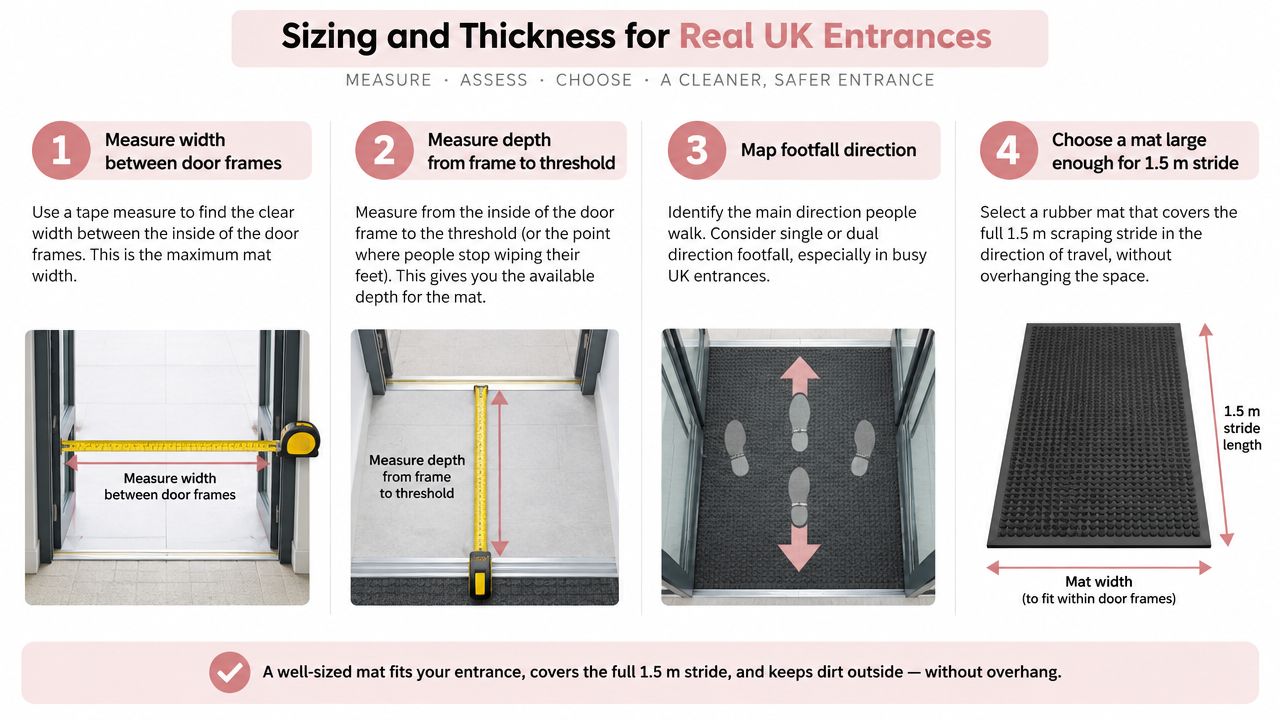
Measure the route, not just the door
People do not always enter centrally. Double doors create several approach lines, while a queue or display can shift footfall to one side. Mark the route from the outer landing to the internal floor, then cover the main stride zone rather than sizing only to the frame.
Use this starting sequence:
- Measure the clear opening between the door frames.
- Add 200–300 mm in the direction of travel to extend coverage beyond the threshold.
- Check the rebate or recess depth before selecting the mat thickness.
- Confirm door clearance with the mat installed, including the sweep of an automatic closer.
- Allow for safe edges, keeping the mat out of turning points and narrow approaches.
Space constraints often decide the final size, so planning how to maximize small spaces can help you fit useful coverage without obstructing the route. The 1.5 m scraping-zone guidance remains a useful benchmark where the building allows it. A smaller mat installed flush and securely is safer than a larger one that blocks the door or projects into a walking line.
Choose thickness around the installation
Low-profile rubber suits tight door clearances and wheeled traffic. A thicker well mat offers more material and deeper scraping capacity, but only if the recess is designed to receive it. Thickness is therefore an installation decision, not merely a measure of how hard-wearing the mat appears.
A surface-laid mat needs a rubber backing, secure fixing and chamfered edges. UK commercial entrance guidance recommends keeping loose-laid or surface-laid matting level with the adjacent floor, using suitable backing, bevelled edges and secure fixing to reduce slip and trip risks. IntraSystems' entrance matting guidance explains the practical importance of that transition.
Check the door in operation before ordering. A mat that catches the door can prevent full opening, strain an automatic operator and shift out of position. Order from the measured clearance and recess, not from a generic thickness label.
Accessibility and Compliance for UK Entrances
Accessibility changes the specification completely. A mat isn't suitable for a commercial doorway merely because its rubber surface claims to be slip-resistant. It must also remain stable, level and traversable for people using wheelchairs, mobility scooters, walking aids and pushchairs.
UK guidance emphasises that entrance matting shouldn't create a trip hazard or impede wheelchair users. The preference is generally for recessed or flush solutions, with the mat integrated into the floor rather than left as a loose obstacle. Facilities teams should consider the relationship between the mat, the entrance threshold, the surrounding floor and evacuation routes, while checking the applicable British standards, fire requirements and building guidance for the specific premises.
What a safe transition looks like
The strongest practical benchmark is straightforward. A rubber entrance mat should sit flush with or below the adjacent floor, with tapered or bevelled edges where a surface-laid installation is unavoidable. It shouldn't have a raised perimeter that can catch a shoe, caster or small wheel.
| Criterion | Surface-laid rubber mat | Flush or recessed rubber mat |
|---|---|---|
| Stability | Depends on weight, backing and fixing | Supported by the recess and less likely to migrate |
| Edge risk | Curling and raised lips need active control | Edges can be integrated into the surrounding floor |
| Wheelchair movement | Can be uncomfortable or difficult if thick or uneven | More predictable when level and firmly supported |
| Trolley access | Casters may catch at the leading edge | Continuous transition reduces snagging |
| Door clearance | Must be checked carefully | Recess allows controlled depth |
| Maintenance | Easy to lift, but can move during use | Requires planned access to the mat well |
| Specification focus | Fixing, bevels and low profile | Recess depth, support and correct replacement size |
The Equality Act 2010 makes access a practical responsibility for businesses, not just a design preference. A shop owner should therefore inspect how the entrance behaves in use. Watch a wheelchair user approach at an angle, observe a pushchair crossing the edge and test a loaded trolley over the transition. A product can feel secure under a shoe and still present a problem to a small caster.
Slip resistance isn't the whole test
Wet slip resistance matters, particularly at exposed entrances. UK-oriented technical guidance points to around R10 minimum for wet commercial areas, while drainage features help remove water from the contact zone, as set out in the First Mats guidance linked earlier. Treat that as one specification point, not a complete compliance certificate.
Ask the supplier for the relevant test information, installation instructions, fire classification and compatibility with the entrance system. Product marketing may say “DDA-friendly” or “non-slip”, but the installation must still deliver a level, secure route in the building where the mat will be used.
Weather Resistance and Drainage in UK Conditions
A rubber mat that copes with a dry May doorway can behave differently through a wet UK winter. Rain, fallen leaves, mud and frost test the drainage route, edge profile and rubber compound. For a shop owner, weather resistance is also an accessibility issue. Water, grit and a raised edge can change how a wheelchair caster, pushchair or loaded trolley crosses the entrance.
Start with one practical question: where does water go after it leaves the shoe? Raised ribs or nibs create channels across the surface. Open-grid designs let water and debris fall below the walking area. Drainage holes and channelled undersides can reduce pooling, but only when the paving, grate or other supporting surface provides an outlet.
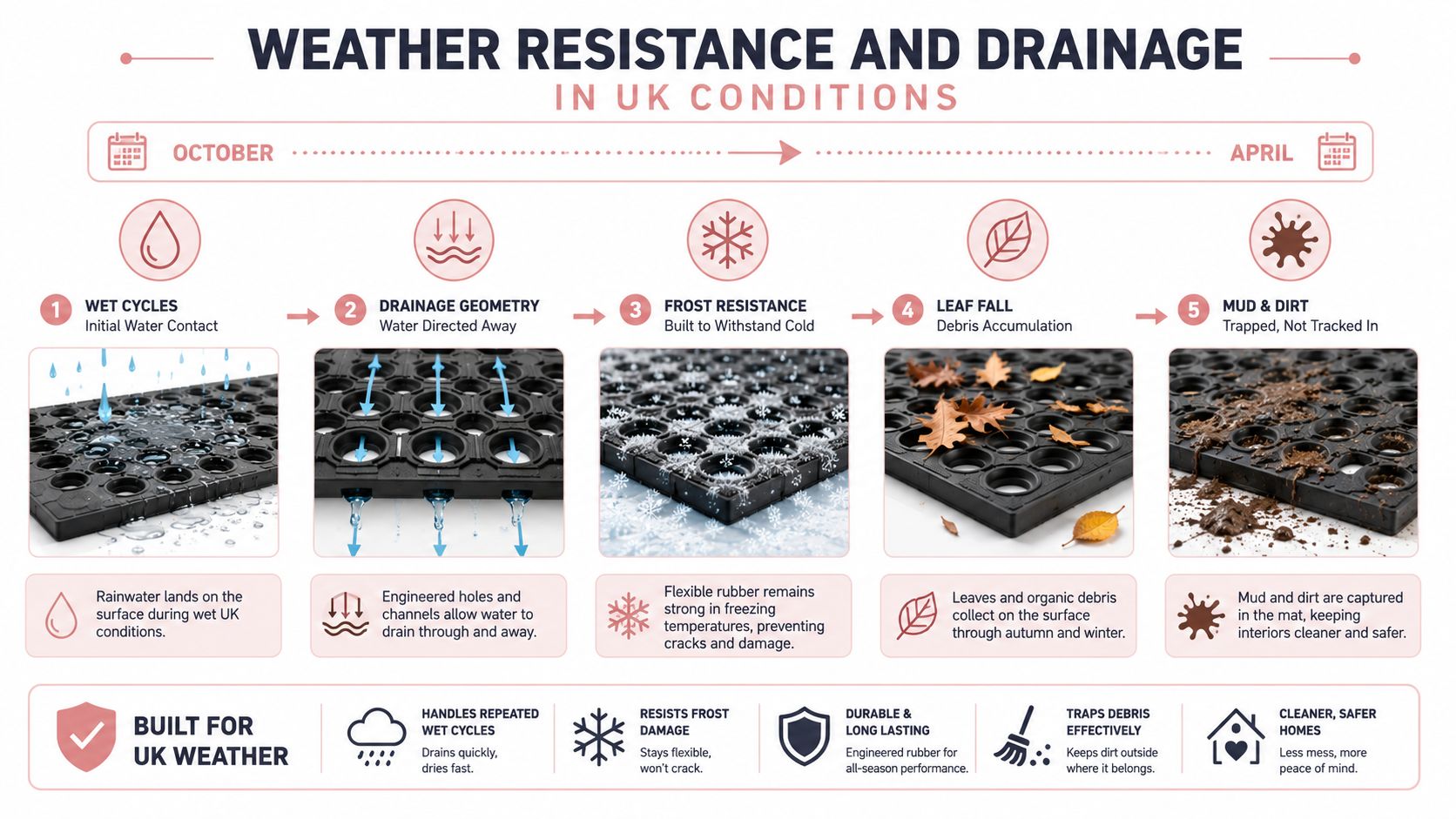
Drainage is a system
A solid-backed mat on an exposed threshold may hold water underneath. The trapped moisture can leave a slippery film at the perimeter, stain paving and keep the underside damp between cleaning sessions. An open design only works properly when the substrate is reasonably level and its drainage path remains clear.
Bevelled edges do more than reduce a trip point. They soften the change in level, help rain shed away from the perimeter and make the crossing more forgiving for wheels. Treat the mat, paving, grate, threshold and surrounding fall as one route for water.
Watch the perimeter: A mat can drain through its centre while leaving a wet film around the edge, creating the hazard it was meant to prevent.
Frost and exposure
Freeze-thaw conditions put pressure on trapped moisture and weaker materials. Dense rubber with a suitable compound can remain more stable, but inspect for hardening, cracks and distorted edges after cold weather. A south-facing entrance also receives stronger UV exposure, which can age a low-cost formulation faster in direct sunlight.
Nitrile-rich rubber suits locations exposed to oil, grease or road contamination. An ordinary pedestrian entrance may suit natural, recycled or SBR-based rubber instead, provided the product is rated for outdoor use and its drainage design matches the site.
Autumn debris creates another failure point. Leaves can bridge an open grid, block channels and hold moisture against the mat. Choosing the most open pattern does not remove that risk. The pattern must be matched with a lifting and clearing routine that the site team can maintain.
For decorative areas beside the entrance, surrounding hardscape affects water movement and cleaning access. Buyers comparing outdoor tile costs and selection should check finished levels, falls and threshold details alongside the mat. Seasonal installations also need planning. See this guidance on outdoor Christmas figure placement and installation when checking how temporary displays may affect drainage and access around the doorway.
A short product demonstration can show staff how water and debris should pass through the mat:
Cleaning and Maintenance Routines That Work
Maintenance should be simple enough for the person opening the premises to complete without special equipment. A good routine removes loose grit before it becomes embedded, keeps drainage paths open and identifies physical deterioration before the mat becomes unstable.
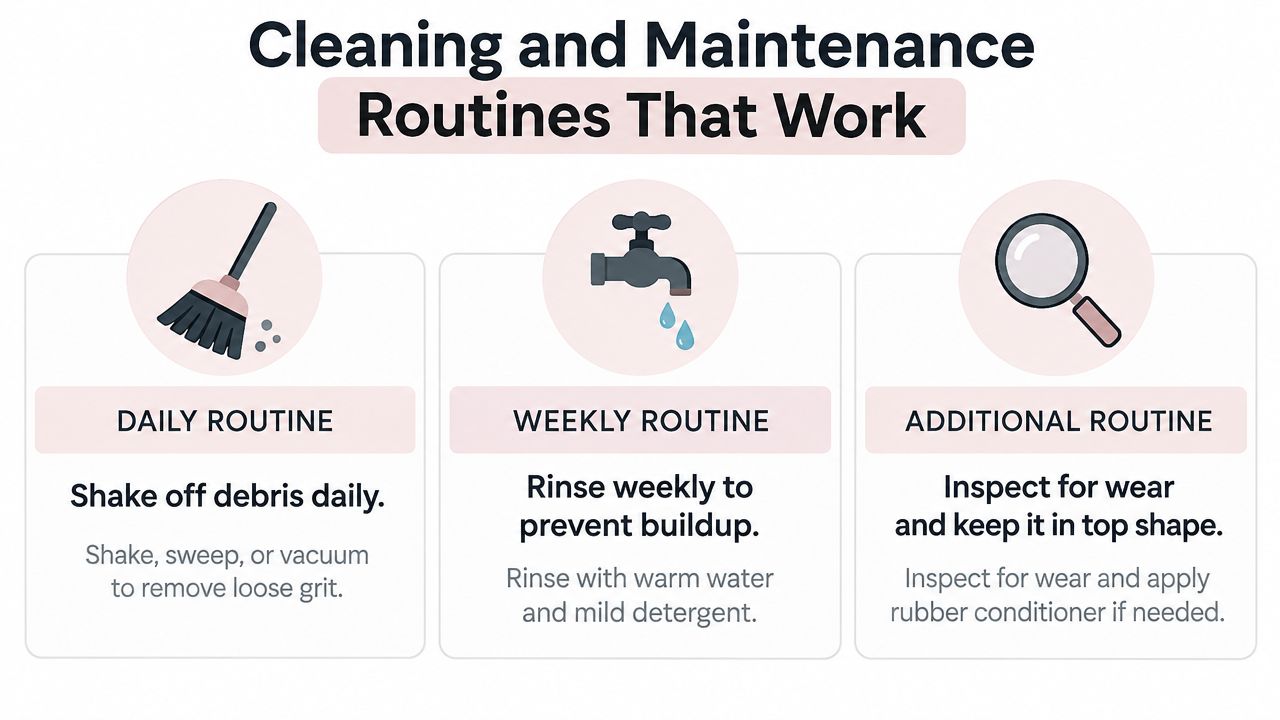
The daily check
Shake, sweep or vacuum the walking surface. Focus on the entry line, side edges and any channels where grit gathers. In a shop, this quick task is easier before opening, when staff can lift one edge safely and check whether the mat has migrated.
Don't ignore movement. If the mat has shifted, clean the floor beneath it, inspect the backing and return it only when the fixing or positioning has been corrected.
The weekly wash
Rinse with warm water and a mild detergent, then work a stiff brush along the direction of the ribs, studs or honeycomb cells. Rinsing alone may move dirt around without releasing the film that makes a rubber perimeter feel slick.
Allow the mat to drain and dry in a position that doesn't create a pond beneath it. Clean the supporting surface at the same time. Black staining on paving, a damp smell or a persistent wet outline can indicate that moisture is staying under the mat rather than passing away.
Seasonal inspection
At a deeper clean, lift the entire mat and clear the underside, drainage holes and surrounding recess. Check for:
- Curling corners: Replace or refit the mat before the edge becomes a trip point.
- Hardening and cracks: Cold weather can expose a compound that has lost flexibility.
- Loss of bevel: A damaged edge may no longer provide a safe transition.
- Slippery perimeter film: Investigate trapped moisture, detergent residue or degraded rubber.
- Black tide marks: Check for prolonged dampness and material breakdown.
- Persistent odour: Clean the substrate and assess whether the mat is retaining moisture.
These signs are replacement triggers, not invitations to use harsher chemicals. Avoid solvent-based degreasers and concentrated bleach, which can damage rubber compounds and binders. Use a product approved for the specific material, and test any conditioner in an inconspicuous area. Advice about suitable cleaning products should be kept separate from leather care guidance, such as this discussion of Stardrops leather cleaner, because a rubber mat needs a different chemical approach.
Store spare mats rolled or flat according to the supplier's instructions, in a dry place away from direct sunlight and heat. Don't put a damp mat into storage. Let water leave both faces first, and avoid folding it across a sharp crease that could become a permanent curl.
Matching the Right Mat to Your Entrance
The best specification combines five decisions: what arrives on footwear, how people cross the entrance, how much water the site receives, what the door can clear and how the mat will be cleaned. A product can be excellent in one location and unsuitable in another.
Rubber matting also has a long UK engineering history. Forbo reports that its Telford site began producing rubber matting from recycled material in 1924, and that it now makes an average of about 18 km² of Nuway matting each year, with the product family developing through later decades in response to changing designs and materials, as described in Forbo's history of Nuway entrance matting. The lesson for today's buyer is simple: entrance matting is engineered flooring, not just a disposable accessory.
Three practical buyer profiles
| Profile | Entrance type | Recommended mat | Key spec |
|---|---|---|---|
| Suburban homeowner | Covered front porch | Flexible natural or recycled rubber with ribbed or open-grid surface | Width matched to the door, bevelled edges, straightforward weekly cleaning |
| Independent shop or café | Busy public entrance with wet and dirty footwear | Heavy-duty SBR or nitrile product | Deep scraping zone, secure flush or recessed installation, drainage and documented wet-performance information |
| School, clinic or office | Wheelchairs, pushchairs and regular wheeled traffic | Low-profile, stable rubber system | Continuous level contact, chamfered transitions, suitable accessibility and fire documentation |
A homeowner should prioritise stable placement, enough width for the normal approach and a pattern that can be cleared without dismantling the porch. A café should put oil resistance, drainage and cleaning capacity higher on the list, particularly where the entrance connects to a service area. A school or clinic should start with the wheeled route and specify the mat around that movement, not around the product's appearance.
For any entrance, ask three questions before ordering:
- Footfall: Who crosses the mat, and what footwear, wheels or loads do they bring?
- Exposure: Will rain, leaves, frost, sunlight, mud, salt or oils reach the surface?
- Clearance: Can the door, wheelchair, pushchair and trolley cross a secure, level edge without catching?
The answers determine whether you need a simple surface-laid mat or a properly designed recessed entrance system. They also reveal where a cheap rubber mat fails, usually at the edges, beneath pooled water or during wheeled movement.
Display Guru supplies practical retail and shopfitting equipment, including garment rails, body forms, tailor's dummies and dump bins, supported by pre- and post-sales help. If you're organising a shop entrance alongside a wider display refit, visit Display Guru to explore the range and speak with the team about your layout requirements.