




Garment Rack and Shelves: A Practical UK Buyer's Guide
You've got a rail full of hanging stock, folded fabric leaning against a wall, and no clear place for returns, patterns or finished work. Customers pull one garment forward and three others slide down behind it. In the studio, the same problem appears as creased clothes, buried accessories and a cutting table that has become permanent storage.
A garment rack and shelves should solve that workflow, not merely fill an empty wall. Hanging rails protect visibility and reduce creasing, while shelves handle folded garments, fabric, shoes, boxes, patterns and accessories. The right combination makes picking, fitting, restocking and selling easier. The wrong one creates an attractive obstruction that fails as soon as stock changes.
UK storage research places laundry and clothes storage among six core household-storage categories. It also identifies total household storage as the category with the highest market penetration in 2023, with female buyers leading male buyers and Northern Ireland recording the highest regional penetration for total household storage, as reported in this UK wardrobe-storage analysis. That matters because clothing organisation serves a broad consumer need, not a narrow sewing niche.
Why You Need a Combined Garment Rack and Shelving System
UK consumers buy around 61 garments per person each year but typically wear only about 25% of the clothing in their wardrobes, according to this UK clothing-storage analysis. Whether you're managing a boutique stockroom, a costume rail or a home sewing room, visible organisation makes that volume easier to inspect, rotate and protect.

Treat hanging and folded storage as one plan
A rail is the right home for dresses, jackets, altered garments and anything that creases easily. Shelves are better for folded knitwear, boxed stock, fabric lengths, patterns, footwear and small accessories. Buying either item in isolation usually pushes the other category onto the floor, a workbench or an unsuitable top rail.
Use the system to create clear working zones:
- Hanging zone: Keep saleable or fitting-critical garments visible and easy to remove without disturbing the rest.
- Folded zone: Store fabric, knitwear and packaged items on shelves with labels facing outward.
- Working zone: Leave a defined area for intake, steaming, alterations or photography rather than using active stock storage as a temporary dumping point.
A good layout also improves merchandising. A customer can see a complete outfit when the rail carries the garment and the shelf beneath holds folded alternatives or accessories. For guidance on combining display furniture with a coherent retail presentation, use these retail display unit ideas.
Judge the system by daily movement
The useful test isn't whether the furniture looks tidy on installation day. It's whether a team member can find a garment, check its condition, return it to the correct zone and keep an aisle clear without shifting half the room.
Tailors and dressmakers need clean access for fittings. Students need storage that can change as projects develop. Costume teams often need rapid identification across many sizes and scenes. Retailers need presentation at the front and controlled back-stock handling behind it. Home sewists need vertical capacity without sacrificing the work surface.
Choose shelves and rails together, then check the structural details before placing an order. Load ratings, floor stability, wheel locks, shelf span, rail height and fire clearances matter more than a matching finish.
Modular Systems vs Fixed Units
The first buying question is simple: will the layout change during the next eighteen months? If the answer is yes, modular construction normally earns its place. If the room, stock profile and operating method are settled, fixed units can provide a cleaner, more economical refit.
| Criterion | Modular system | Fixed unit |
|---|---|---|
| Upfront cost per running metre | Usually higher because of connectors, adjustable components and expansion options | Often lower when the design is simple and the footprint is known |
| Load capacity | Strong when correctly configured, but every bay and accessory needs its own rating | Can be specified for a stable, heavier-duty installation |
| Assembly time | May take longer initially, especially with multiple levels and accessories | Often quicker for a straightforward, permanent arrangement |
| Reconfigurability | Rails, shelves and bays can be moved, extended or rearranged | Changes can require dismantling, replacement or a new installation |
| Lifespan in a changing environment | Better suited to growing stock, moves and revised merchandising | Suits an established room with limited operational change |
When modular wins
Modular systems suit a growing sewing studio where fabric, finished garments and equipment will change position. They also work well for pop-up retail, costume departments that re-stage collections and small shops that may relocate. Height-extension poles, centre bars and adjustable shelf positions let one bay support different garment lengths and stock types.
The trade-off is discipline. A modular system is only as safe as its installed configuration. Adding a shelf, changing a rail position or concentrating boxes on one level can alter the load path. Keep the supplier's assembly instructions and capacity information with the system, not in an inaccessible office file.
When fixed wins
Fixed units make sense for a known floor plan, a dedicated stockroom or a refit where heavy boxed inventory will remain in one place. They can look more integrated and may reduce the temptation to keep changing the layout without reviewing stability and loading.
Don't choose fixed just because it looks cheaper on a quotation. Price the cost of future disruption, including dismantling, making good walls and replacing components that no longer fit. A display-led shop may outgrow a fixed unit long before the steel or timber has failed.
For systems that combine display, shelving and hanging components in one coordinated structure, this integrated display system guide is a useful reference point.
Shopfitter's rule: buy modular when change is part of the business model, not because “flexible” sounds attractive on a brochure.
Load and Weight Planning for UK Installations
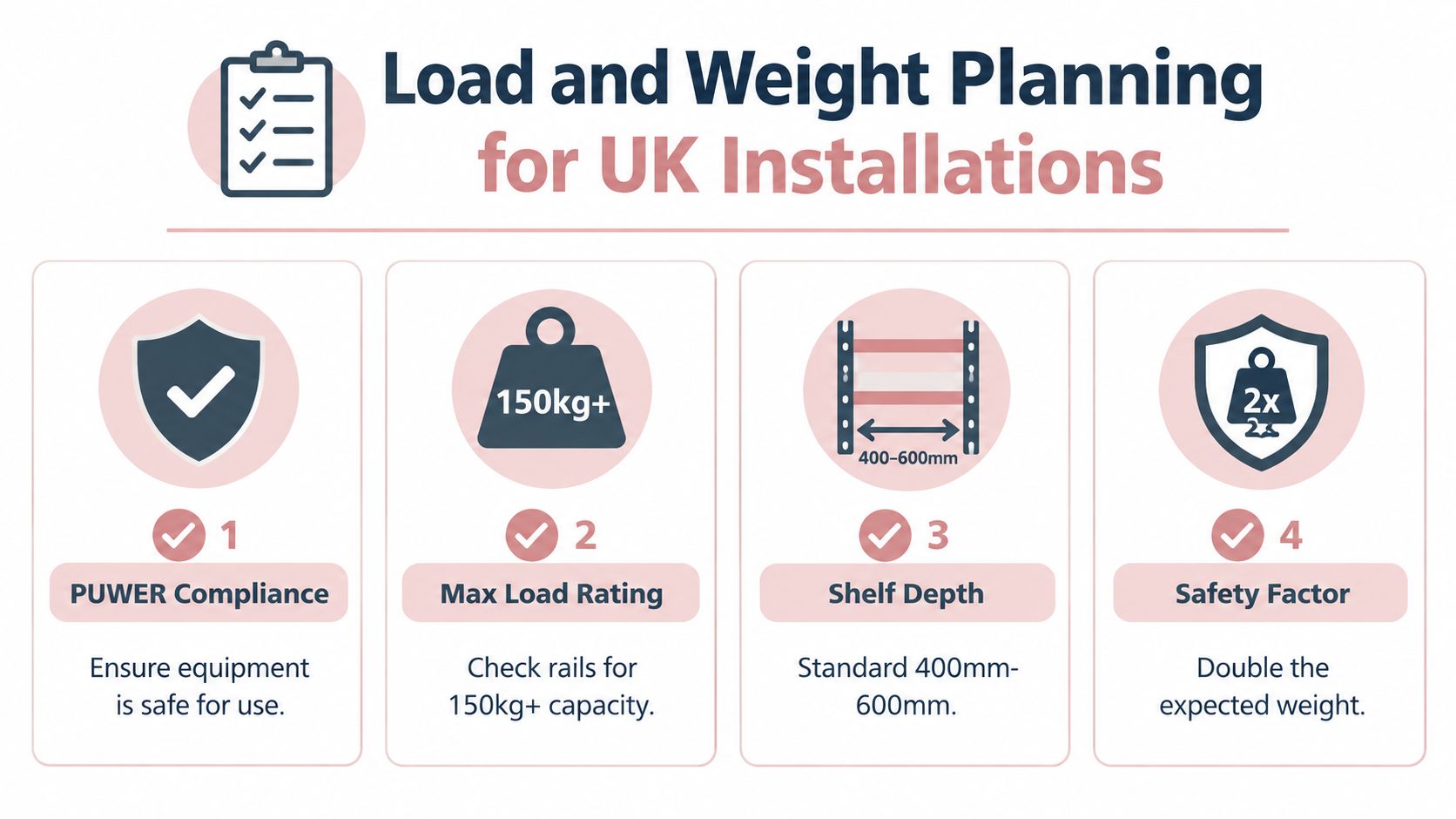
A garment rail designed for customer-facing display isn't automatically suitable for boxed back stock. Treat workplace rails and shelves as work equipment under PUWER, and specify them around the loads they will carry.
SEMA's hand-loaded shelving guidance describes individual goods as typically weighing less than 25 kg and a complete shelving bay as typically carrying less than 4 tonnes, as outlined in this SEMA shelving guidance bulletin. Those are benchmarks, not permission to load any bay to those figures. The manufacturer's published safe working load must match the exact product and configuration.
Calculate the real load
Add the weight of folded garments, fabric boxes, storage containers, display hardware and any concentrated item that might be placed on a shelf temporarily. Don't estimate only the average load. A shelf that usually carries light knitwear may later receive a dense box of shoes, tools or pattern books.
Capacity depends on shelf span, bracket or beam geometry, material thickness, connection design and how evenly the load is distributed. Longer spans generally demand more careful specification, while uneven loading can create local stress even when the total weight appears acceptable.
Put heavy stock on lower levels. Raising the centre of gravity increases overturning risk and makes manual handling harder. Keep lighter merchandise and seasonal overflow higher, provided the unit and access method allow it.
Ask the supplier three direct questions
- What is the safe working load for this exact bay and shelf configuration?
- Does the rating assume an evenly distributed load, and what changes if the shelf is concentrated at one point?
- Can the system be altered with extra shelves, rails or wheels without written manufacturer approval?
Every commercial installation should display or provide clear capacity information. Never drill, weld, cut or substitute connectors without approval. For heavy-duty hanging requirements, compare the construction and rating of a heavy-duty hanging rail with the lighter rail you'd use for visual display.
Configurations That Fit Real Floor Plans
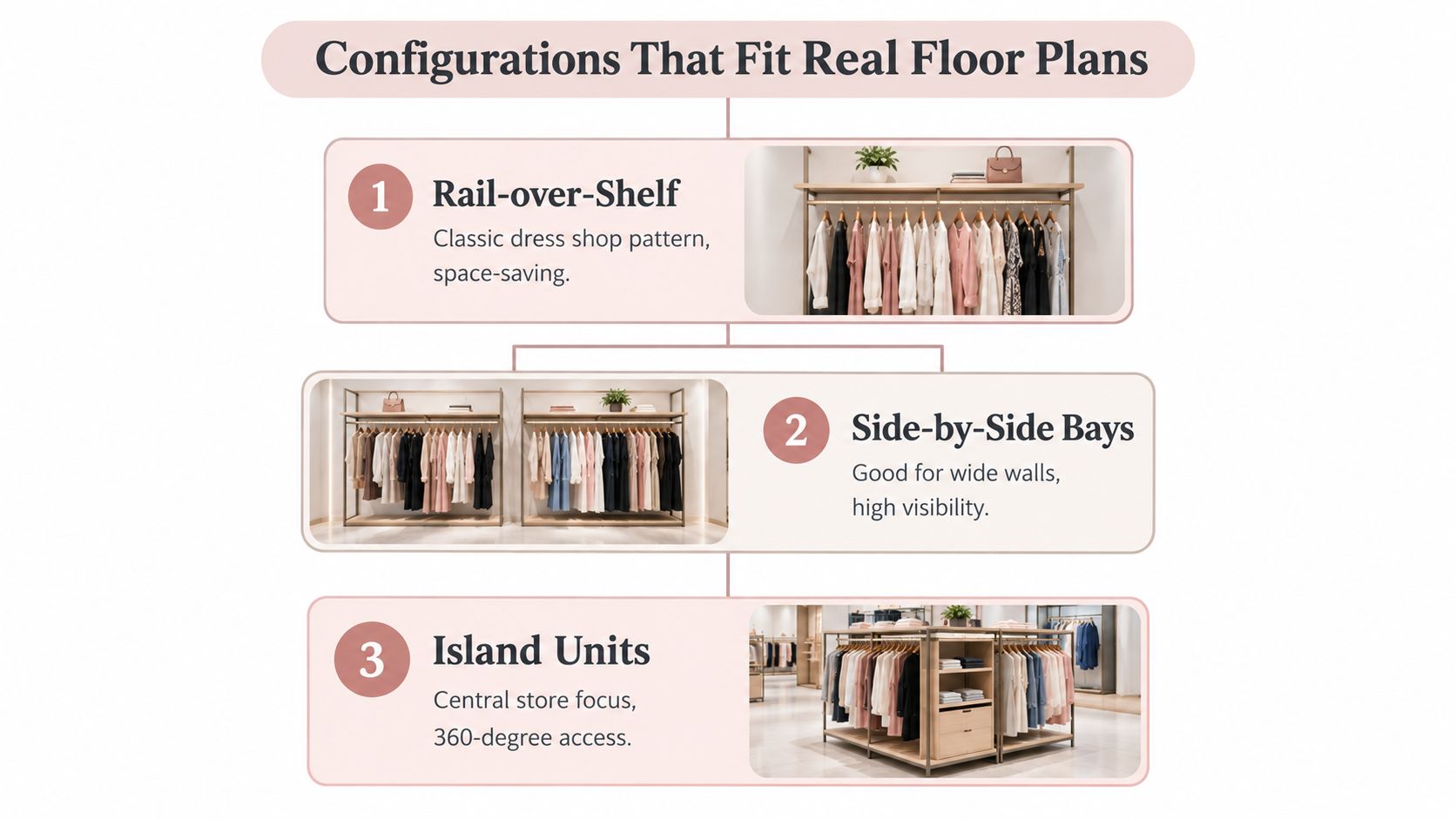
The best configuration depends on how garments enter, move through and leave the room. A rail that looks efficient on a drawing can obstruct fitting access, block cleaning or turn a stockroom into a one-way maze.
Rail over shelf
This is the classic dress-shop arrangement. Hanging garments sit above a lower shelf that carries folded alternatives, handbags, shoes or boxed stock. It uses wall height efficiently and keeps a complete product story within one bay.
Use it on a selling wall or behind a fitting area. Keep the shelf level clear enough for customers to see and reach products without brushing against hanging hems. The weakness is capacity. A rail-over-shelf bay can become visually dense if you use it as both display and deep back stock.
Side-by-side bays
Side-by-side bays suit wide walls and stockrooms where staff need clear category separation. Give each bay a role, such as size, collection, customer order, alteration status or garment type. This approach improves picking because staff can return items to a defined address instead of creating one long undifferentiated rail.
It also makes future changes easier to isolate. You can alter one bay without dismantling the entire run, provided the structure is designed for that arrangement.
Island units
An island unit creates a central merchandising focus and allows access from more than one side. It works for new collections, coordinated outfits or a temporary promotion. Keep the central fixture low enough to preserve sightlines and avoid turning the shop floor into an obstacle course.
Island storage is less suitable for a narrow stockroom. It consumes circulation space and demands careful attention to aisle width, emergency routes and trolley movement.
Wall-mounted systems
Wall-mounted rails and shelves preserve floor space and make sweeping or vacuuming easier. They're a strong choice for compact studios, though the wall must be suitable for the fixings and the installer must account for the actual load.
Place frequently handled items at comfortable reach, reserve lower shelves for heavier stock and keep seasonal or overflow items higher. For a broader approach to representing spaces accurately before installation, these floor plan tips for agents can help you record doors, windows and circulation constraints.
Designing a Returns-Ready Rack and Shelf Workflow
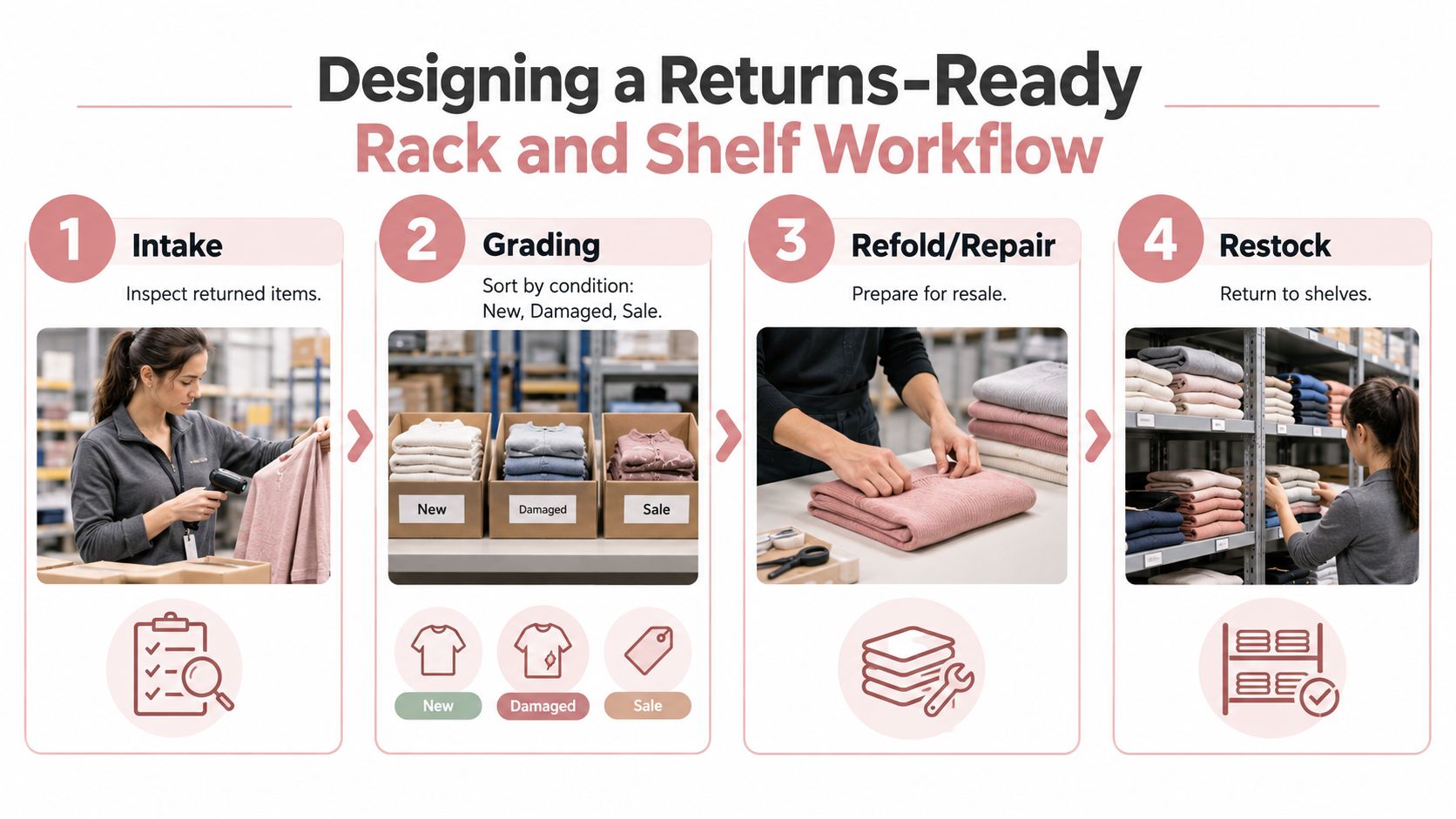
Returned garments shouldn't go straight back onto the saleable rail. They need a condition decision first. UK apparel returns can reach 27% for online purchases versus about 12% for store purchases, and processing a return can cost up to twice the original delivery once transport, labour, warehousing and handling are included, according to this UK apparel returns report.
Build zones around condition
Use one integrated run, but separate its functions with labels, colour coding and physical spacing. A simple sequence is:
- Intake: Place newly returned or altered garments here first. Nothing moves directly to saleable stock.
- Inspection: Hang crease-prone items so staff can check seams, marks, odour, missing labels and fit information.
- Steaming or repair: Keep garments awaiting treatment on a dedicated rail, close to the equipment but away from packaging and finished stock.
- Photography: Give online sellers a clean, identifiable zone for items needing new images or condition records.
- Quarantine: Use a clearly marked shelf or rail for damaged, disputed or incomplete items.
- Ready to sell: Move only approved garments to the active stock rail or shelf.
Rails work best for garments that need visual inspection and wrinkle prevention. Shelves suit folded returns, boxed exchanges, packaging supplies and items waiting for a decision. The important point is not the furniture shape. It's the visible separation between stages.
Make the process hard to ignore
Label every zone at eye level and use one status per location. Don't rely on memory or a handwritten note attached to a hanger. A garment should have a clear destination even when the person processing it changes.
Keep repair tools, steamers and electrical equipment outside the path of customer-facing stock. Remove packaging waste promptly so the returns area doesn't become a combustible holding zone or a source of mis-picks.
This layout supports recommerce and refurbishment as well as ordinary exchanges. It also protects the customer experience by reducing the chance that an uninspected garment reaches the active rail.
Fire Safety, Aisles and Clearance You Should Not Ignore
More hanging capacity isn't automatically better. Dense vertical garments can increase the speed of fire development, while tightly packed rails make inspection, movement and evacuation harder. A small boutique or sewing studio still needs a layout that protects people first and stock second.
UK warehouse guidance recommends keeping combustible stock at least 1 metre below ceilings or lighting, maintaining aisles of at least 2.5 metres, and leaving 0.5 metres between stored goods and internal walls, as set out in this UK fire-risk guidance. Apply those figures to the actual room, then check doors, heaters, lighting, sockets, irons, extension leads and emergency routes.
Keep density under control
Don't push garments tightly against lights or heaters. Don't use the top of a rail as an improvised shelf for cardboard boxes. Don't let packaging, offcuts or textile waste accumulate beneath a display run.
Create a clear route through the room and keep fire exits, electrical panels and access points unobstructed. If a new rack changes the route, raises the storage height or brings textiles closer to heat-producing equipment, review the fire-risk assessment rather than assuming the old layout still applies.
For broader workplace context, this guide to essential health and safety advice for builders is useful because it reinforces the need to assess the surrounding work environment, not just the furniture.
Use covers carefully
A cover protects garments from dust, but it can also hide overcrowding, damage and poor housekeeping. Choose a cover that fits the rail, keep it away from heat sources and don't use it as a reason to pack more stock into the same run. This clothes rail cover guidance helps frame covers as garment-protection accessories, not a substitute for safe spacing.
Keep combustible stock visibly separated from heat, lighting and escape routes. If you can't inspect the space quickly, the layout is too dense.
Buying Checklist and Long-Term Maintenance
Take a written specification to the supplier. Start with the safe working load for every shelf and rail, then confirm the finish, base type, wheel locks or levelling feet, shelf adjustment range and compatibility with accessories you already own. Ask whether the unit is intended for display, back-stock storage or both. Those are different duties.
Use this short procurement list:
- Measure the room: Record walls, doors, windows, heaters, lighting, sockets and the actual circulation route.
- Define the stock: Separate hanging garments, folded items, fabric, boxes, accessories, returns and tools.
- Choose the structure: Select modular construction if the layout may change, fixed construction if the plan and load profile are stable.
- Confirm installation: Check floor condition, wall suitability, levelling requirements and who will assemble the system.
- Record capacity: Keep the manufacturer's ratings and loading instructions where staff can find them.
Maintenance must be routine rather than reactive. Carry out trained visual checks at appropriate intervals, and arrange a competent-person inspection at least every twelve months where the risk assessment requires it, following the HSE storage-equipment guidance. Inspect uprights, welds, fasteners, bases, wheels, end stops and shelf levels. Isolate damaged equipment until it's repaired or replaced.
Review the system when your stock profile, premises or workflow changes. A move from light display garments to boxed inventory, a new heater, a revised customer route or a returns process can all invalidate yesterday's layout. For a practical source of rails, shelves and related shop-fitting supplies, compare components against your written specification rather than buying by appearance alone.
Display Guru supplies garment rails, clothing display racks, tailoring forms and related display equipment for retailers, sewing professionals, costume teams and home studios. Match the rail and shelf combination to your stock, workflow and safety requirements, then visit Display Guru to review suitable components for your installation.