




Waste Bins UK Retail Sourcing Guide
A customer leaves a coffee cup beside the till, a supplier delivery adds cardboard to an already crowded stockroom, and the only available bin is a general-waste container hidden behind a garment rail. By closing time, recyclable packaging, food residue and residual waste have become one unpleasant, expensive mixture.
For UK shop owners and studio managers, choosing waste bins isn't a minor facilities purchase. The right setup protects customer flow, supports workplace compliance, reduces overflow and keeps the shop looking deliberate rather than improvised. The wrong setup consumes selling space, creates contamination and leaves staff sorting waste under pressure.
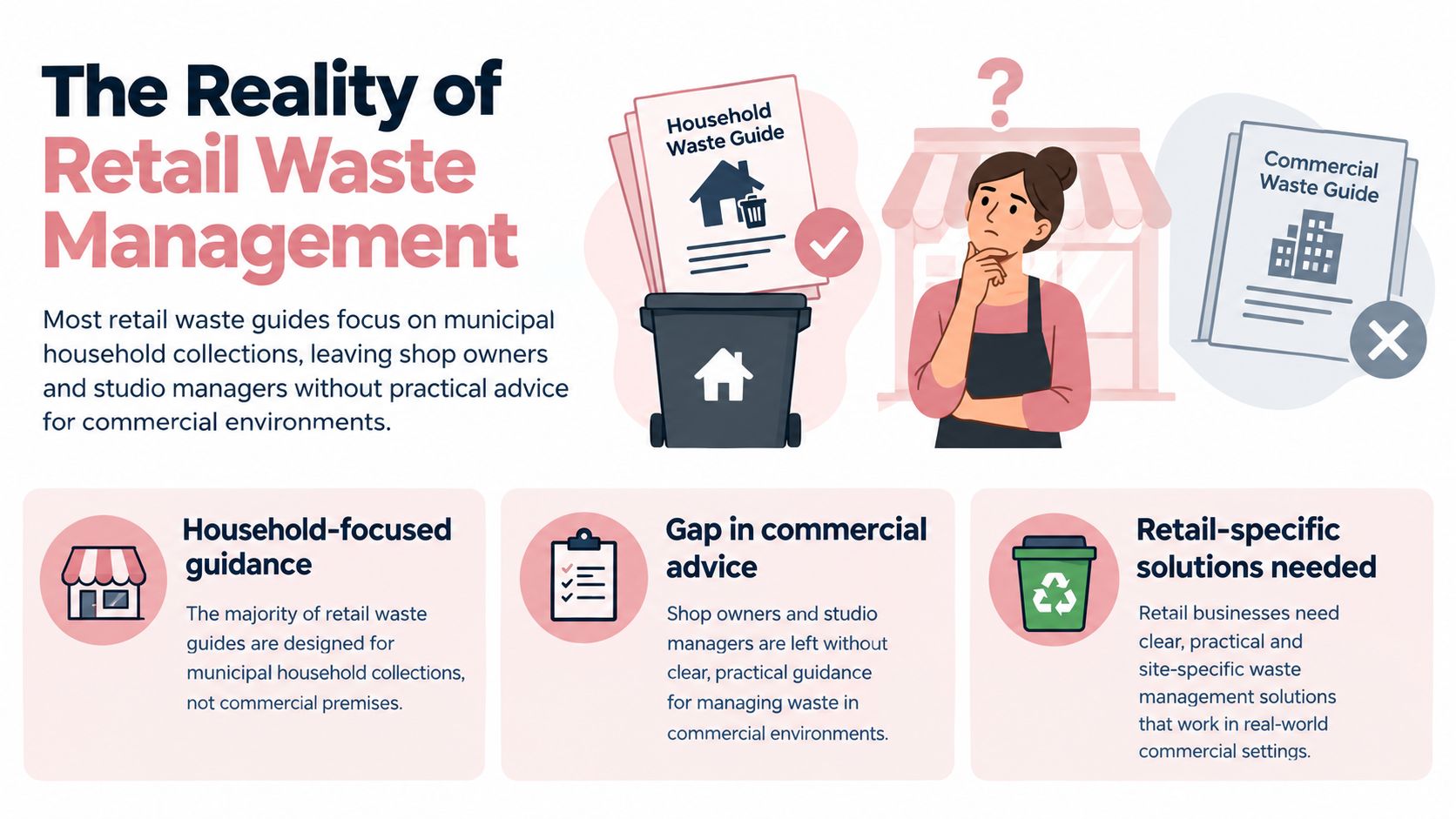
The Reality of Retail Waste Management
By mid-afternoon, a shop floor can have three different waste problems at once. Delivery cartons are piling up in the stockroom, customers are dropping receipts and cups near the till, and staff are trying to keep disposal points tidy without blocking sightlines or walkways. That is why retail waste needs its own setup. Household-style advice rarely helps when floor space is selling space and every bin has to work around customer flow.
The wider UK picture explains why retailers still need to plan for both recycling and residual waste. In 2023, UK households generated approximately 25.9 million tonnes of waste, and the national recycling rate was 44.6%, according to the UK government's harmonised waste statistics. In practice, that means a significant share of material still goes into residual streams, so a shop that only plans for recycling will run into overflow, contamination or both.
Why the national picture matters to retailers
Retail waste does not appear in a steady domestic pattern. It arrives in bursts. Cardboard and void fill build up after deliveries, staff-room waste clusters around breaks, and customer-facing rubbish turns up anywhere people stop, browse or wait. A fashion boutique, a salon retail area and a craft studio may all need bins, but not in the same places and not for the same materials.
Collection rules also vary across the UK, and so do accepted materials, bin colours and service arrangements. For a retailer, that affects day-to-day operations more than headline recycling figures do. A layout that works in one town can fail in another if the contractor wants different separation, sack presentation or collection access. Check local requirements before ordering containers or fixing signage.
Practical rule: Treat every bin as part of a movement system. It must be easy to reach, easy to understand and easy for staff to empty without crossing customer routes.
That principle matters most in smaller shops, where one badly placed bin can create two problems at once. It interrupts browsing and makes contamination more likely because customers will use the nearest opening, not the correct stream. Back-of-house, the same issue shows up as wasted labour when staff have to re-sort mixed waste before collection.
A useful facilities perspective is available in this guide to waste management for facilities, especially for managers balancing cleaning routines, storage limits and contractor access. The same logic applies on the shop floor. Define each waste stream, give it a clear location, and assign ownership.
For layout ideas that connect fixtures, storage and disposal points, review these retail shop supplies. Good retail waste management is not about adding more bins. It is about placing the right ones where staff and customers will use them properly.
Navigating Simpler Recycling Rules for Shops
A shop can look tidy on the floor and still fail the test in the stockroom. Under England's Simpler Recycling rules, waste separation is now part of day-to-day shop operations, not just a sustainability policy. From 31 March 2025, workplaces in England must separate dry recyclables, food waste and non-recyclable waste before collection. Businesses with fewer than 10 full-time-equivalent employees are scheduled to be required to comply from 31 March 2027, according to government guidance on Simpler Recycling.
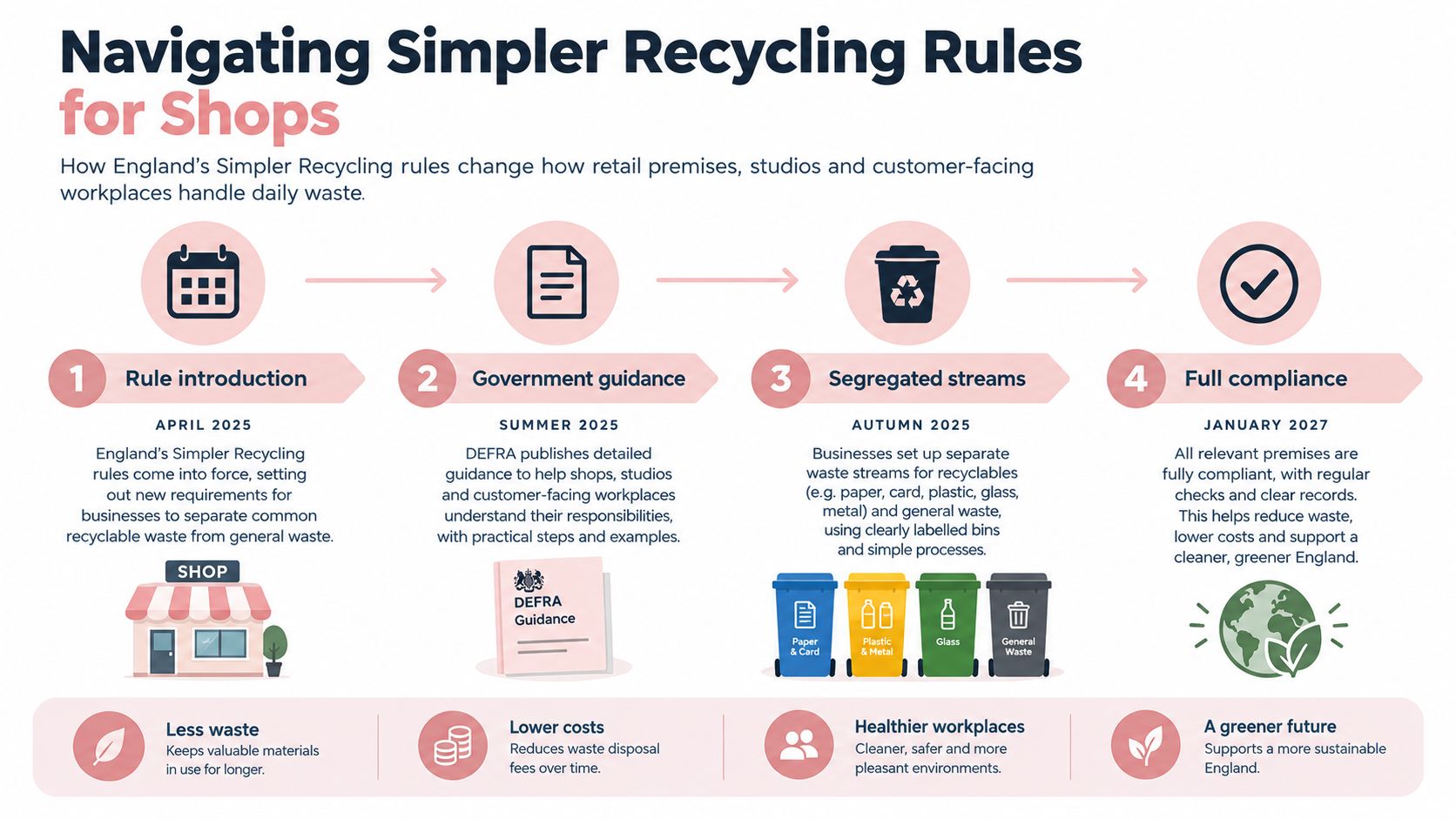
For retailers, the main mistake is treating the rule as a standard three-bin purchase. The required waste streams may be similar across premises, but the working setup is not. A small fashion shop may produce hangers, tags and staff kitchen waste. A hair or beauty studio may generate product packaging, towels and refreshment waste. A homewares retailer may have far more cardboard and protective wrap from deliveries. The bin plan has to reflect what moves through the premises, where it appears, and how staff can handle it without disrupting service.
Start with the waste your premises creates
Walk the site during a normal trading day before changing anything. Check the till point, staff area, delivery and unpacking space, fitting rooms, treatment or workshop stations, and any customer seating. Record where waste is created, who touches it first, and whether it stays clean enough for the intended stream.
Then set the shop up by zone:
- Back-of-house separation: Keep dry recyclables, food waste and residual waste separate where boxes are opened, stock is processed and staff prepare drinks or food.
- Customer-facing provision: Decide whether customer bins are needed at all. Shops are not generally required to provide them, but if you do provide bins, the waste collected still needs to be separated correctly under the workplace rules.
- Staff responsibility: Assign a simple check to opening, closing or cleaning staff. Clear ownership prevents mixed bags from being left for someone else to sort.
- Contractor alignment: Confirm accepted materials, container types, presentation rules and collection frequency with your waste contractor before you buy bins or print labels.
In compact shops, every bin choice affects selling space and customer flow. Removing customer bins can protect display room and cut contamination, but litter may build up around the till or entrance. A single general-waste bin is easy to place, but it works against separation. In many stores, a paired residual and recycling point is the more workable option, as long as the labels match what the contractor will collect.
Build compliance into the daily routine
Make the process part of closing, not an extra task people remember only when there is a problem. Staff should check for visible contamination, secure full sacks, wipe food-contact areas and move containers to the agreed collection point. Keep the written procedure in the stockroom or staff area where the work happens.
If your shop falls into the later compliance group, use the lead time well. Test bin positions on busy days, watch where overflow starts, and check whether staff can empty containers without crossing customer routes. It is easier to adjust a layout early than to deal with rejected loads, cluttered back rooms or a system the team stops using.
Selecting the Right Bin Types and Capacities
The best waste bins UK retailers can buy aren't selected by capacity alone. Collection frequency, waste density, handling route and visual position matter just as much. A large container may reduce emptying trips, but it can block a stockroom aisle. A compact bin may preserve circulation, yet overflow before the next collection.
Planning guidance illustrates why separate streams need separate capacity. Typical arrangements include a 140-litre general-waste bin, dry-recycling capacity of 140, 240 or 360 litres, a 23-litre food-waste container, and larger communal containers such as 360 or 1,100 litres in higher-volume settings, according to Enfield Council's waste and recycling planning guidance.
Match the container to the zone
| Retail zone | Suitable approach | Main trade-off |
|---|---|---|
| Till and entrance | Compact, lidded or open customer-facing receptacle | Visibility versus discreet appearance |
| Staff kitchen | Dedicated food-waste container plus residual provision | Odour control versus emptying frequency |
| Stockroom | Wheeled containers or contractor-approved sacks | Capacity versus manoeuvring room |
| Tailoring or craft bench | Small stream-specific containers close to the work surface | Convenience versus multiple containers |
| Large homewares operation | Higher-capacity wheeled units in a defined service area | Fewer handling events versus footprint |
A customer-facing dump bin should be easy to recognise without looking like a temporary skip. Open access works for clean packaging in some settings, but a lid can contain odours and conceal untidy contents. In a tailoring studio, placing a small container directly beside the cutting or packing station usually works better than expecting staff to carry scraps across the room.
For back-of-house waste, size the container around the route to collection. A large wheeled bin is useful where deliveries generate substantial packaging and the floor can accommodate a turning path. It isn't useful if staff must drag it through a narrow customer corridor or park it beside an emergency exit.
Buy for the busiest routine, not the average quiet day. Overflow is most damaging when it occurs during deliveries, promotions or events.
Before ordering, sketch the bin footprint on the floor with tape or cardboard. Test the lid, handle and door clearance. Retail managers looking beyond basic municipal models can find waste bins at Material Handling USA as a reference point for comparing receptacle formats, while UK buyers should still verify local contractor compatibility, dimensions and delivery arrangements.
Lidded options deserve particular attention where food or liquid waste is present. This guide to waste bins with lids can help when comparing concealment, access and presentation. Do not buy a larger bin just because it appears better value. An oversized container can encourage mixed disposal, take valuable stockroom space and become harder to move safely.
Space Planning and Fire Safety Requirements
A waste bin that works on paper can still fail on the shop floor. I have seen bins squeezed behind a till point, parked beside a fire door, or wedged into a stockroom corner where nobody can open the lid without shifting delivery boxes first. Once the fit-out is finished, those mistakes are expensive to fix, so bin storage needs marking on the plan at the same time as shelving, counters, circulation space and staff access.
West Suffolk guidance advises storing containers in designated areas that reduce fire risk, with domestic and commercial waste kept separately. It also highlights fire, odour and noise effects on nearby properties in its published waste guidance. For shops, salons and studios, that makes the bin area part of the premises operation and part of the building frontage, especially in mixed-use locations or parades with homes above.
Calculate usable space, not just container dimensions
A standard 240-litre two-wheeled bin is often treated as a simple rectangle on a spec sheet. In practice, the footprint is only the starting point. Allow for the lid swing, the handle access, the turning arc and the route out to collection. If a member of staff has to drag the bin sideways past a rail, a display or a stack of incoming stock, the space is undersized even if the bin technically fits.
That matters in retail because back-of-house space is rarely empty for long. Seasonal stock, returns, packaging and cleaning equipment all compete for the same corners. A bin parked in the wrong place can slow replenishment, block cleaning, or create a daily habit of leaving waste temporarily in aisles and service corridors.
A workable plan should answer four points:
- Can staff reach it without moving stock? If access depends on shifting boxes, the setup will break down during deliveries.
- Can the bin leave the premises safely? Check thresholds, ramps, doors, slopes and the route to the collection point.
- Does it obstruct an escape route? Waste must not narrow or block fire exits, protected corridors or access to safety equipment.
- Is it kept away from combustible elements where possible? Cardboard and mixed waste increase fire load, so avoid storing containers against vulnerable building features.
Separate storage from customer experience
The best waste area is secure, washable, easy to inspect and easy to clear. It should also stay out of direct customer sightlines where possible, without being buried in a cupboard that creates a poor handling route or traps odour.
Use the same logic you would apply to a retail store layout that protects flow and service access. Keep customer movement clean, keep staff routes practical, and make sure collection staff can reach the containers without wheeling them through the sales floor at peak trading times. That balance usually matters more than squeezing in one extra fixture.
Preventing Contamination Through Smart Layouts
Adding more recycling bins doesn't automatically improve recycling. In a busy shop, extra openings can create extra opportunities for hesitation, especially when customers are holding packaging, cups or food at the same time.
WRAP's Spring 2025 Recycling Tracker found that 81% of UK residents put at least one non-recyclable item into recycling bins, according to its UK recycling tracker. The lesson for retailers is direct: capacity without clear decisions can make the system look more sustainable while producing a dirtier recycling stream.
Design for the moment of disposal
People don't study a policy while standing at a till. They scan the opening, recognise a familiar symbol and make a quick choice. Put the bin where disposal naturally occurs, then make the accepted materials visible at the point of action.
- Pair related streams: Place residual and recycling bins together so users can compare options without searching.
- Use local language: List the materials your contractor accepts, not a generic national list that may mislead.
- Show the opening: Keep signs above the lid or aperture and maintain an unobstructed view from the approach.
- Separate food at source: Put the food-waste point beside the staff kitchen or food-service activity, not at the far end of the stockroom.
- Review recurring errors: If the same packaging appears in the wrong stream, change the sign or location before adding another container.
The bin is a behavioural prompt. Its position and labelling are part of the equipment.
A retail display area can make this easier. Place waste points at decision points such as the till exit, customer seating or packaging removal station, while keeping them outside the main product sightline. Guidance on display units for retail is useful for thinking about sightlines, access and the relationship between practical fixtures and merchandise.
Staff need a separate routine. At closing, inspect the top layer of each container and remove obvious contamination before bags are sealed. Don't ask staff to hand-sort heavily mixed waste, and don't create a procedure that conflicts with safe handling or contractor rules. The strongest setup prevents mistakes upstream through pairing, contrast and clear examples.
A short visual demonstration can also help teams understand how placement affects behaviour:
Integrating Dump Bins into Visual Merchandising
A dump bin earns its place on a retail floor when it solves an operational problem without weakening the presentation. Used badly, it becomes a catch-all for unwanted packaging and clearance stock. Used deliberately, it can hold seasonal accessories, remnants, promotional items or sale merchandise while giving customers an obvious disposal point nearby.
The distinction is in the design brief. A waste receptacle needs cleanable surfaces, stable construction and an opening that discourages awkward handling. A merchandising bin needs proportion, visibility and a finish that suits the brand. Combining both functions works only when the contents remain clearly separated. Don't use one container for rubbish and stock just because both are described as bins.
Protect customer flow and brand appearance
Place customer waste receptacles near the point where packaging is removed, but not where they interrupt queue formation or product discovery. A till-side bin might support quick disposal, while a display dump bin can anchor a promotional zone near the exit. In a narrow boutique, a slim profile may matter more than maximum volume. In a craft shop, a sturdy bin can hold bulkier stock, but the product presentation must still allow customers to browse without leaning over waste.
Material and colour should support the environment. A clean, neutral finish can recede in a fashion shop, while a stronger contrast can help customers identify a disposal point in a busy studio. Whatever the finish, specify a surface that withstands frequent wiping and doesn't make small packaging difficult to remove.
The visual merchandising principles in these visual merchandising guidelines apply directly. Preserve sightlines, group related functions and avoid placing a practical fixture where it competes with the product you most want customers to notice.
Make the dual purpose explicit
If a bin holds merchandise, label or configure it as a display fixture. If it holds waste, make the waste function unmistakable. Ambiguity creates contamination, damages stock and leaves staff clearing up after customers who reasonably misunderstood the container.
Before installation, walk the route as a customer and as a closing member of staff. Check whether the fixture narrows movement, hides a sign, catches bags or creates a blind spot. Then test it during a delivery, a busy trading period and end-of-day cleaning. The best waste bins UK retailers choose are the ones that remain useful when the shop is untidy, busy and under pressure.
Display Guru supplies dump bins and complementary retail display equipment for shops, studios, tailors and visual merchandisers. Use Display Guru to source practical fixtures that support cleaner customer flow, organised presentation and a more considered waste-management setup.