



Dressmaking Dummies UK: The Practical Sizing Guide
Treat an adjustable dressmaking dummy as a tolerance system around a target body, not as an exact replica. For practical fitting, the client's bust, waist and hip measurements should ideally sit within about 3 cm of the corresponding form measurements.
You've pinned a toile neatly across the bust, balanced the shoulder seam and checked the hem on your dummy. It looks convincing on the stand. Then the client puts it on, and the neckline shifts, the waist sits too high and the back pulls across the shoulder blades. That frustrating gap between a tidy studio fitting and a real body usually begins with the wrong expectation of what a dress form is meant to do.
A useful dummy is a controlled fitting reference. It gives you a repeatable block for checking balance, drape, seam placement and alterations. It doesn't remove the need to measure the wearer, observe posture or make a toile. The best dressmaking dummies UK dressmakers use are the ones that can be measured, adjusted, padded and recorded with discipline.
Why your dress dummy is still not fitting right
The classic studio mistake is easy to recognise. A pattern is pinned to a mannequin, the side seams appear level and the darts point towards the bust apex. The dressmaker makes small refinements, removes the toile and assumes the block is ready. When the garment reaches a client with a fuller bust, a shorter back or a slightly forward shoulder, the same pattern behaves differently.
The dummy hasn't necessarily failed. It has been asked to represent a person when it can only represent a set of controlled dimensions.
Use the form as a reference block
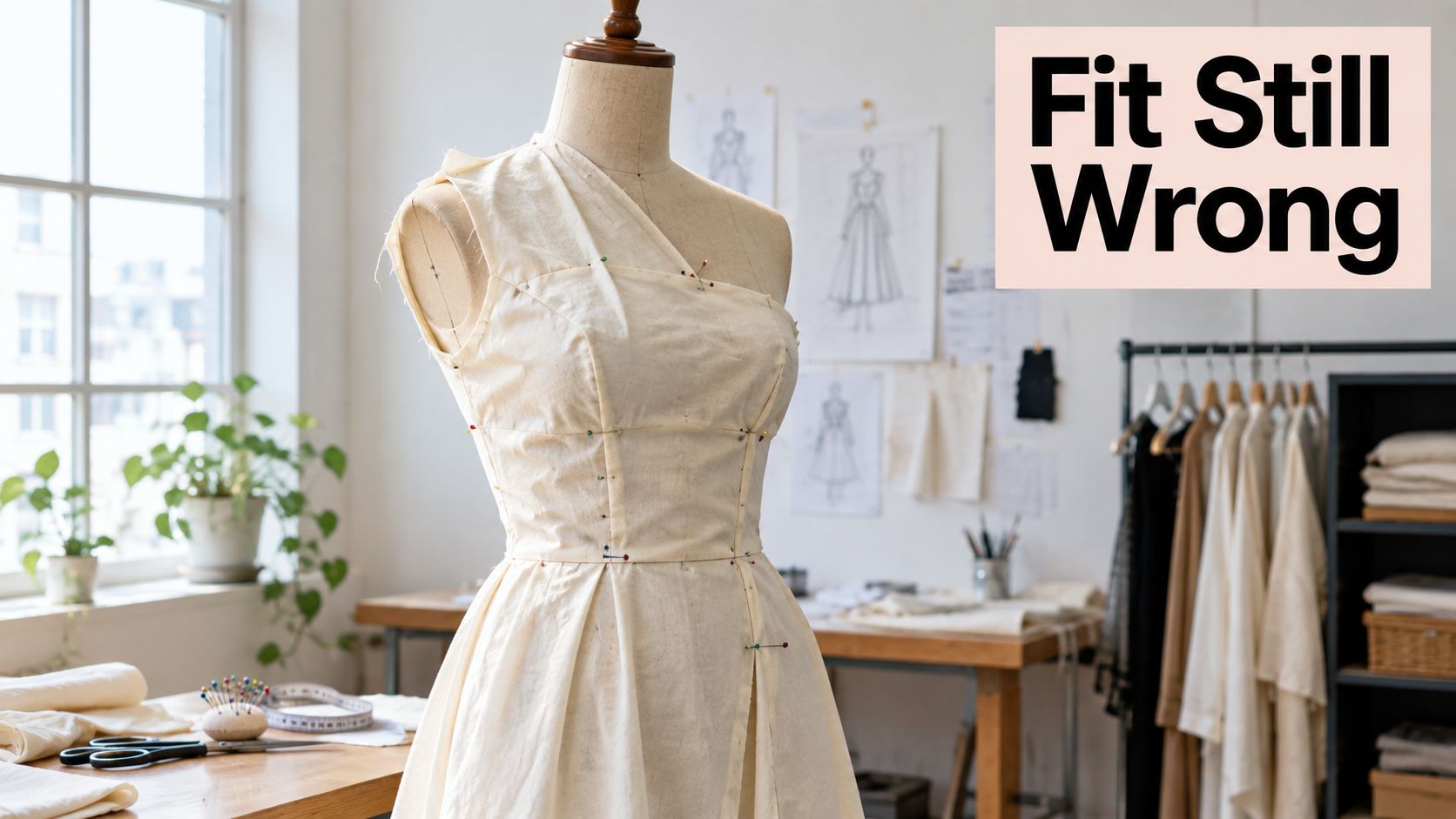
In a working room, the form answers practical questions. Does the side seam hang vertically? Is the sleeve head sitting in the right relationship to the shoulder? Does the collar roll cleanly? Is there enough ease across the seat or abdomen for the intended movement?
It doesn't answer every question about a live body. A standing form won't automatically reproduce a rounded back, a dominant shoulder, a low bust point or the way a client sits. That is why accurate measurement remains the starting point. A useful guide to body measurement for better apparel fit can help organise the measuring process before you alter the dummy.
Practical rule: Measure the form itself, write the measurements on a card, and treat every later fitting as a comparison against that recorded baseline.
A tolerance approach is more reliable than chasing a perfect replica. Compare the client's principal circumferences with the form, identify meaningful differences, then pad or reshape the form before transferring the adjustment to a cover. The research on clothing fit uses approximately ±3 cm around the bust, waist and hip as a practical dimensional conformity benchmark, although the form still needs checking for vertical relationships and posture (Journal of the Royal Statistical Society guidance).
Know when the dummy is the wrong tool
A dummy works well for pattern development, draping, visual balance and repeat fittings. It becomes less dependable when the work depends heavily on seated posture, unusual spinal curvature, marked asymmetry or a body that changes substantially after surgery.
For those clients, use the form to establish construction logic, then validate the garment on the person wearing it. A technical guide to mannequin measurements is useful when you need to compare a product listing with the actual circumferences and vertical points rather than relying on a size label.
What UK body shape data says about dressmaking dummies
A toile looks balanced on the dummy, yet pulls across the client's abdomen and drops at the back waist. That result usually reflects a shape mismatch, not a mysterious pattern error. A dress form is a controlled fitting reference, so its proportions must be understood before they are treated as a reliable stand-in for a body.
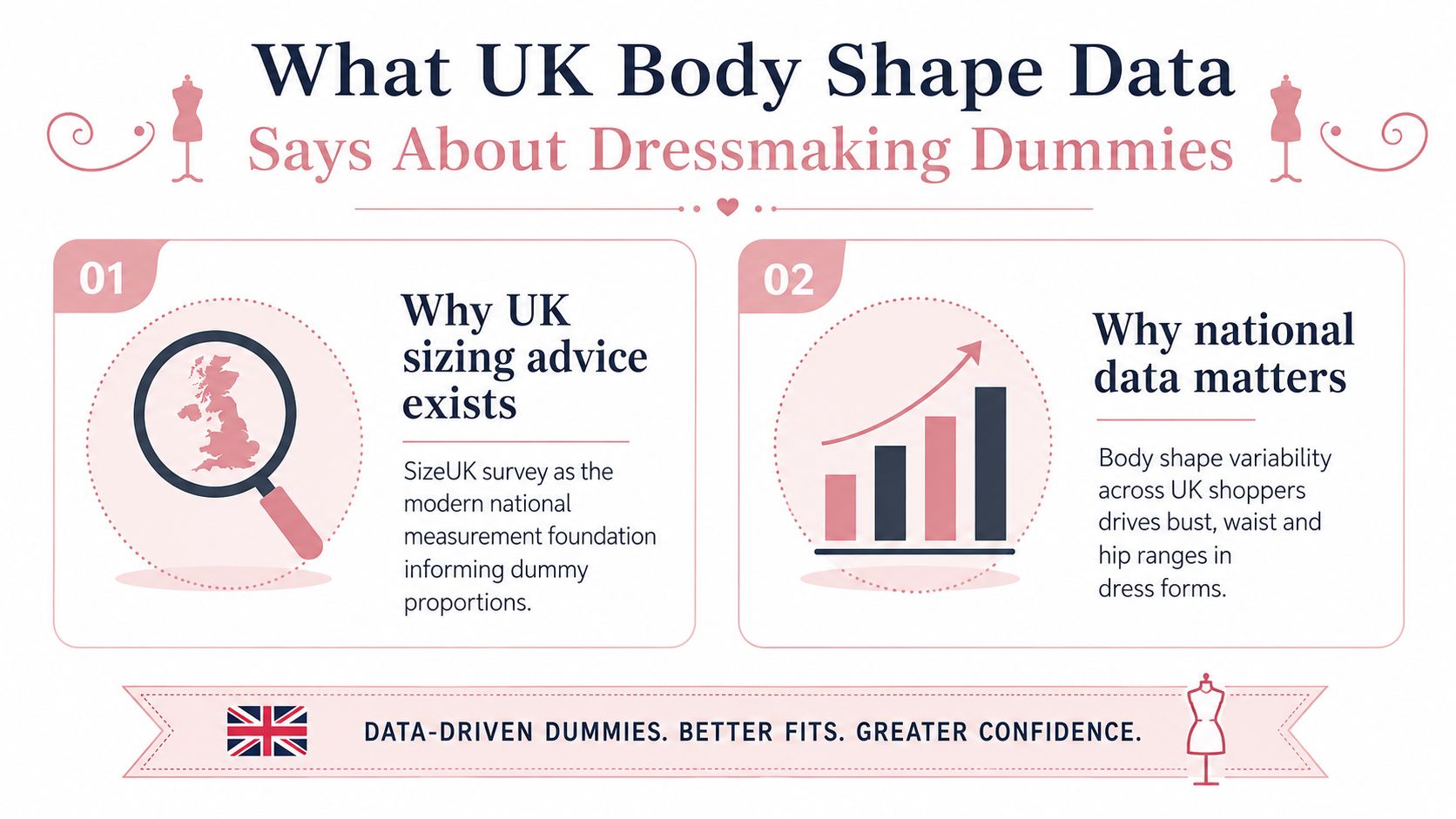
The strongest modern UK reference is the SizeUK national sizing survey, conducted principally during 2000–2001 and released in 2004. The project involved the UK Government, major retailers, universities and technology companies. It scanned approximately 11,000 people, including about 5,000 women and 5,000 men, aged from 16 to 90-plus (SizeUK survey background).
The survey followed the previous fully funded public government study from 1957. SizeUK recorded roughly 140 measurements per person, producing approximately 1.54 million individual data points, with a target accuracy of about plus or minus 1 centimetre at a 95% confidence level. It covered people standing and seated, marked anatomical landmarks, and recorded vertical, horizontal and seated dimensions (SizeUK information paper).
Size is not the same as shape
A UK size label cannot show whether the wearer has a long torso, short back, fuller abdomen, narrow shoulders or a different bust-to-waist relationship. A fixed dummy built around one average can support particular pattern tasks, but it cannot represent every client. Use the size label as a starting reference, then check the actual relationships that affect the garment.
SizeUK reported that more than 60% of UK shoppers experienced difficulty finding clothes that fit. It also recorded an average female waist measurement increase of 16.5 centimetres compared with the post-war 1950s population (SizeUK information paper). These findings help explain why an older block or inherited dress form can give a misleading fitting result even when its labelled size appears familiar.
Check the measurements that control the garment's balance:
- Bust and waist: Confirm that the form supports the intended dart intake and bodice shaping.
- Waist and hip: Check the contour needed for skirts and close-fitting trousers without flattening the pattern.
- Height and vertical points: Match bust height, waist position, hip height and back length.
- Posture: Establish whether the form represents standing garments only or must support a seated wearer.
A visual guide to body shape references can help compare silhouettes, but photographs and labels cannot replace tape measurements. A form may match the bust and hip while placing the waist, shoulder line or bust apex incorrectly.
The seated measurements also matter in studio practice. A standard standing dummy provides a useful base, not a complete solution for adaptive clothing, mobility-related fitting or pronounced asymmetry. In those cases, deliberate padding and live toile checks belong in the fitting method from the start.
Adjustable versus fixed dress forms for UK dressmakers
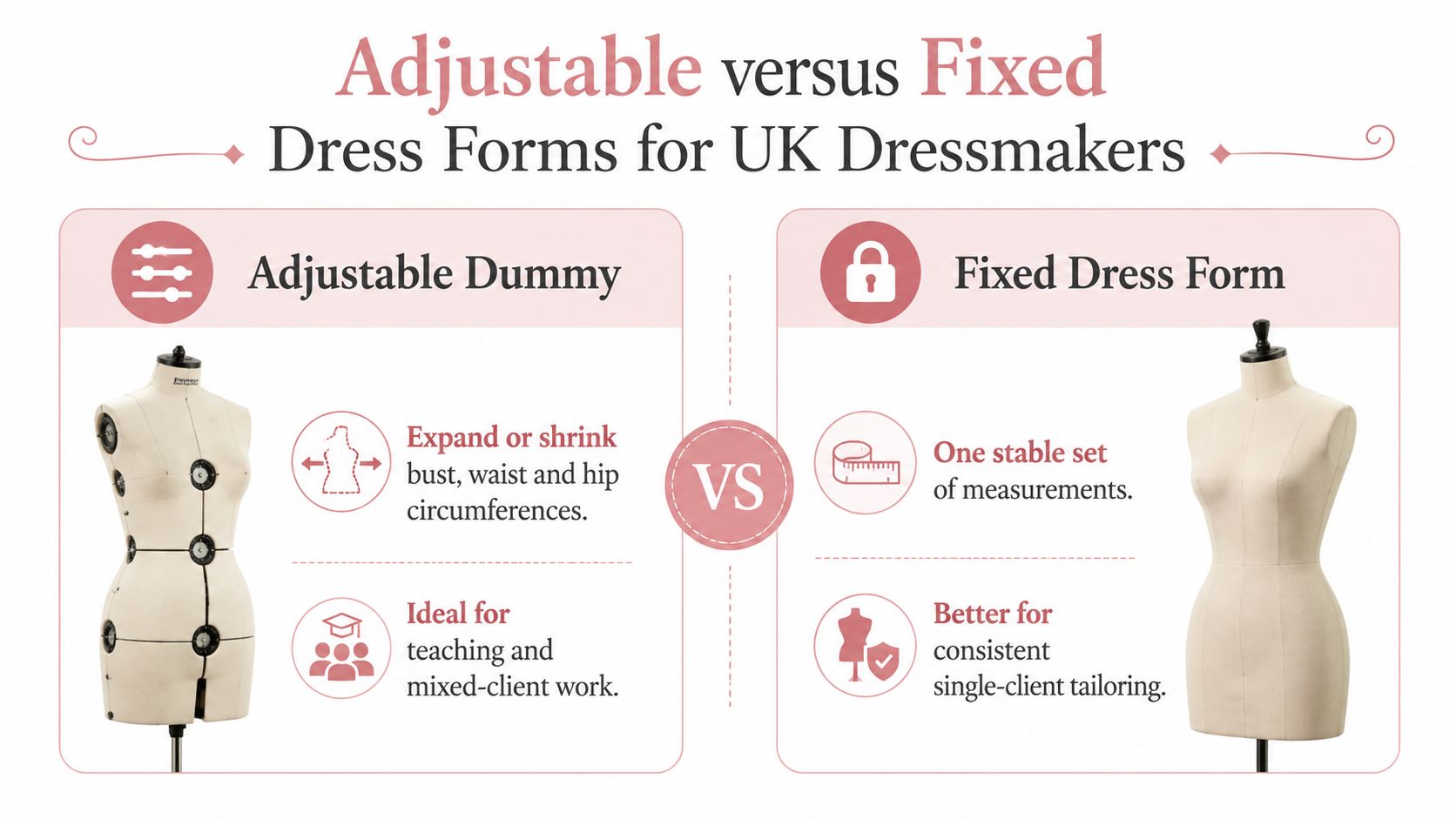
A single adjustable dummy can cover several clients, students or alteration jobs. Its dials change bust, waist and hip circumference quickly, which saves space and setup time in a working studio. The limitation is structural: most mechanisms widen or narrow sections more easily than they reproduce the way a real body carries its volume.
A fixed form gives you one stable reference. That consistency helps when you pin a toile, press close to the body or repeat a fitting over several days. It also gives you a dependable base for padding, often producing a more coherent silhouette than expanding separate sections until each reaches its limit.
Match the form to the work
| Studio requirement | Adjustable dummy | Fixed dress form |
|---|---|---|
| Mixed client sizes | Convenient starting point | Requires separate forms or padding |
| Teaching and demonstrations | Flexible for showing size changes | Stable for consistent exercises |
| One personal block | Works if carefully set and covered | Often easier to customise |
| Heavy pinning and pressing | Mechanisms may shift if poorly secured | Usually more stable |
| Non-standard proportions | May match circumferences but miss contours | Padding can create a controlled shape |
A product marked UK 10 may not match another form with the same label. Clothing fit and sizing research has documented substantial variation between garments carrying the same nominal size, so compare actual bust, waist and hip measurements before buying (clothing fit and sizing research). The label is a starting point, not a fitting specification.
Adjustment range isn't body accuracy
Set an adjustable form within a moderate working range. Expanding the bust while leaving a narrow shoulder line can produce the correct circumference but the wrong distribution for a bodice. Reducing the waist independently may create a contour that no client's block can follow cleanly. Check bust apex position, shoulder width, back length and the transition between each adjustment zone before trusting the result.
An adjustable dummy suits mixed work when its final setting is measured and held under a fitted cover. That cover turns a temporary dial position into a repeatable reference. For one personal block, a fixed form with measured padding may provide better control and fewer moving parts. Practical guidance on adjustable dress forms for sewing should be checked against the manufacturer's measurement chart and adjustment instructions.
Use the adjustable form for access to several starting sizes. Use the fixed form when shape, stability and repeatable tolerances matter more than range. A dummy is useful only when its changes remain within the logic of the pattern.
Pin friendly materials, stands and usable accessories
Surface material determines whether a dummy can survive daily dressmaking. A display mannequin may look polished in a shop window but resist pins, distort under pressure or offer too little depth for a proper toile. A sewing form needs to accept pins cleanly and hold fabric securely while you mark, drape and reposition pieces.
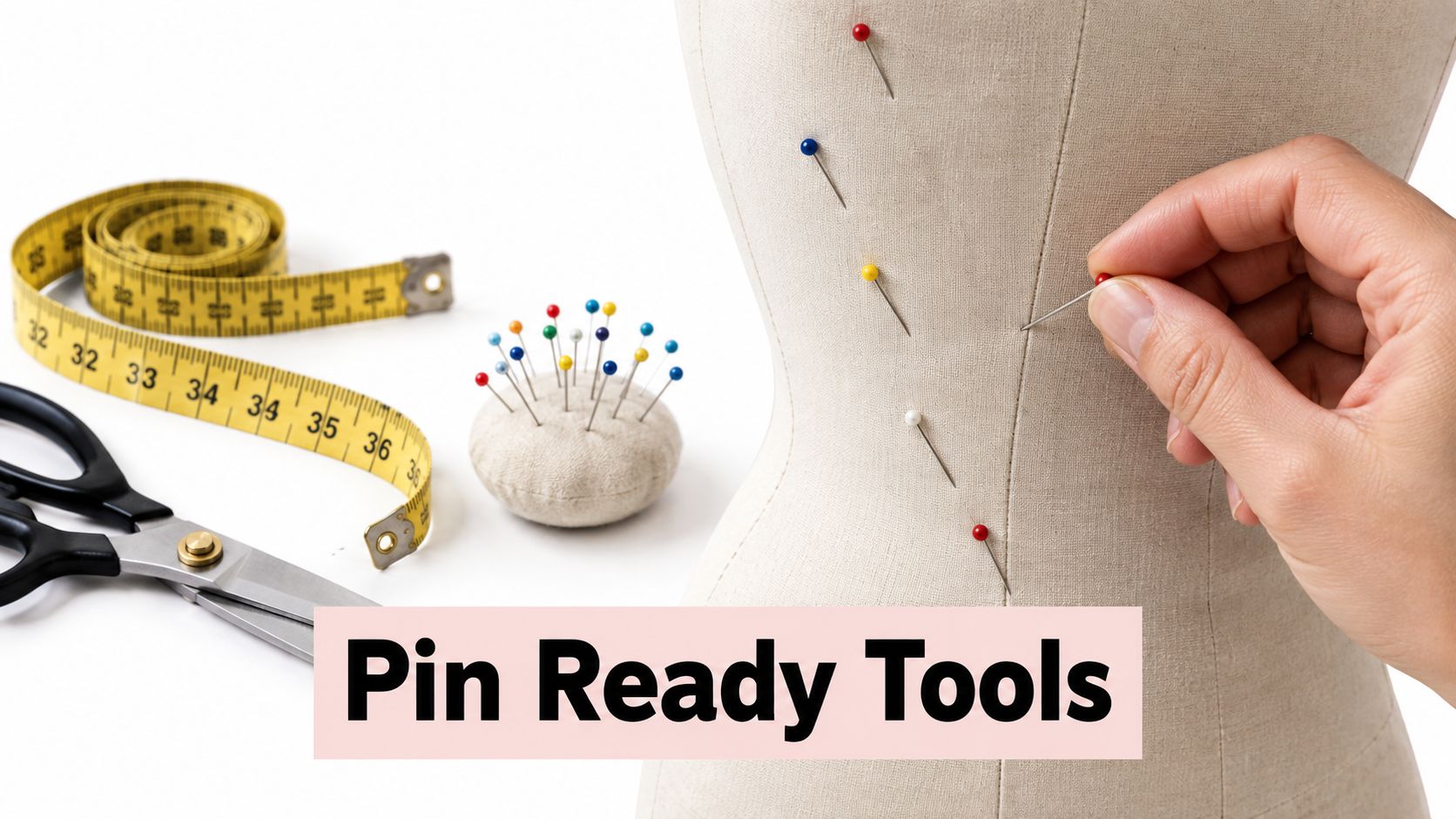
Pin-friendly polystyrene works well for active fitting because pins can enter the surface at useful angles. It suits toile placement, temporary tacking and contour padding. Fabric-covered forms are also practical for draping, especially when the cover is firm enough to prevent fabric slipping but not so thick that it hides the underlying shape.
Choose the stand for the pressure you apply
A stand affects more than appearance. A tripod gives useful positioning flexibility in a compact sewing room and can make it easier to reach the back of a garment. A round base takes up a different footprint but tends to feel secure when you're pressing, pinning firmly or working with heavier fabric.
Before ordering, check:
- Base stability: The form shouldn't rock when you apply pressure to a side seam or shoulder.
- Height adjustment: Make sure the stand can place the waist and hem at a useful working level.
- Pole position: A central pole can obstruct trouser work or affect how a skirt hangs.
- Weight distribution: Heavy garments need a base that won't shift as the fabric pulls.
- Storage: A collapsible tripod helps in a home room, while a permanent base may suit a teaching or costume studio.
Accessories that earn their space
A removable stretch cover is one of the most useful additions. It creates a clean surface for marking, hides small padding transitions and lets you preserve a customised shape for later fittings. Mark the centre front, centre back, bust line, waistline and hip line on the cover, then check those marks against the pattern rather than relying on the form's printed seams.
An adjustable waist marker helps with skirt and trouser work, but it must sit at the actual waist position for the client or block. A protective coating can extend the life of a polystyrene surface, although it shouldn't make pin insertion difficult. Test the surface with a spare pin before applying any finish across the whole form.
The cheapest dummy often saves money only at checkout. If the stand flexes, the cover slips or the surface won't take pins, every fitting takes longer and the form becomes a display object instead of a working tool.
Padding, posture and the limits of adjustable dummies
The difficult fitting is usually not the one where every circumference matches. It's the client whose waist is smaller than the standard form but whose hips are fuller, or whose full bust sits on a narrow shoulder frame. A rounded upper back creates a similar problem. The tape may confirm the required circumference while the garment still pulls because the volume is distributed in the wrong places.
Adjustable dials rarely reproduce shoulder slope, bust span, bust height, upper-back curvature or abdomen height. They can alter the outline while leaving the vertical structure untouched. That's why a form can measure correctly at the bust and still give a neckline, armhole or waist seam that sits incorrectly.
Build the shape in layers
Start by deciding which measurements matter most for the garment. For a fitted bodice, bust position, shoulder line, back length and waist placement may matter more than forcing every circumference to match at once. For a skirt, hip height, abdomen projection and seat shape can affect the toile more than a superficial size label.
Use materials with different jobs:
- Wadding or cotton batting builds gradual volume around the bust, abdomen, hip or upper back.
- Foam creates a firmer contour where a soft layer would compress during pinning.
- A well-fitting bra can help reproduce the support and distribution used by the client, provided it is covered securely and treated as part of the form.
- A stretch cover compresses the layers and gives you a stable surface for centre lines and balance marks.
Don't create a sharp step between padded and unpadded areas. Feather the edges, check the tape measurement at several heights and use a second cover if the first one allows the padding to shift.
Studio test: If the form only matches after every dial reaches an extreme position, stop adjusting and start contouring.
Validate with a toile
A customised form isn't finished when the tape measurements agree. Pin the garment toile, inspect the grainlines and compare the result with the client standing and moving. A diagonal drag line may point to a bust distribution issue, while a raised waist seam can indicate an incorrect vertical measurement rather than insufficient circumference.
For asymmetrical bodies, record left and right measurements separately and mark the difference on the cover. Don't flatten the larger side to make the dummy look tidy. For seated fitting, photograph or mark the posture reference and use the toile to assess compression, reach and access around the garment.
A practical guide to sewing with a dummy can support the basic draping workflow, but no adjustable form should be treated as an automatic replica. Padding a fixed form may produce a better personal block than stretching an adjustable one to its mechanical limit.
Where to buy dressmaking dummies in the UK
Buying a dress form online requires more checking than choosing a decorative mannequin. Product photographs show the cover and stance, but they rarely reveal whether the bust is high or low, how the shoulders slope, where the waist sits or how much of the stand intrudes into trouser work. Ask for the actual form measurements and compare them with the body or block you intend to fit.
A useful supplier should make the following clear:
- Measurement chart: Look for bust, waist, hip, neck, shoulder and height information where available.
- Adjustment method: Check whether dials alter separate areas smoothly and whether the final setting can be locked.
- Surface construction: Confirm that the covering or polystyrene is suitable for pinning and draping.
- Stand specification: Check the base type, height range and how the pole joins the body.
- Size coverage: Treat advertised UK sizes as identifiers, not proof of proportional compatibility.
- Support arrangements: Find out how the supplier handles questions about assembly, damaged goods and unsuitable sizing.
Compare the real cost of a wrong form
A dress dummy is bulky, so returns can be more complicated than returning a small sewing accessory. Before ordering, save the product measurement chart, check delivery conditions and read the return policy for large items. Confirm whether the form arrives assembled or flat-packed, and inspect the stand, knobs, cover and body as soon as it arrives.
For a student, one adjustable form may support several projects. For a bespoke tailor, two fixed forms with carefully recorded covers may be more productive than one mechanism that shifts between clients. A costume department may prioritise pinning depth and rugged construction, while a visual merchandising team may care more about finish and presentation.
The relevant choice is the one that reflects your workflow. Specialist suppliers may offer female and male forms, children's forms, tripod stands, round bases, adjustable bodies and pin-friendly surfaces. Dress forms for sewing provides a useful starting point for comparing those categories, but you should still request measurements before committing.
Once the form arrives, measure it yourself. Record the bust, waist and hip, mark the centre lines, check the waist height and test the stand under normal pinning pressure. If the body is close but not exact, customise it with padding and a stable cover. If the shape is wrong at a fundamental level, return it before you spend time building a block around it.
Display Guru supplies adjustable and pin-friendly polystyrene dressmakers' and tailors' dummy mannequins, with tripod and round-base stand options for sewing, fitting, draping and display work. Visit Display Guru to compare forms by size, construction and stand type, then choose the model you can measure, customise and use repeatedly in your studio.