




Garment Rack on Wheels: A Practical Buying Guide
A garment rack on wheels isn't automatically safe just because it rolls. In Great Britain, retail sales volumes rose 1.0% in August 2024, following a 0.7% increase in July, while total sales volumes were 2.5% higher than in August 2023, so retailers need mobile equipment that moves merchandise efficiently without creating a manual-handling problem.
The usual buying conversation starts with rail length, chrome finish and advertised capacity. That's backwards. A boutique assistant pushing a loaded rack across a shop floor, a costume team crossing a sprung theatre stage, or a tailor rolling wedding samples towards a fitting room is dealing with force, visibility, turning space and stopping control. The wheels solve only one part of the job.
The right garment rack on wheels is the one your staff can start, steer, stop and park safely on the actual floors in your premises. This guide treats the purchase as a workplace decision, not a catalogue exercise.
The War on Wheels
A boutique assistant has one hand on a rail and one eye on customers. The rack is full of dresses, the route cuts across a carpet transition, and the front castors catch as the load turns towards the window display. Nothing dramatic needs to happen for the operation to become hazardous. A sudden push, a blocked view or a rack that drifts while garments are selected can be enough.
UK Health and Safety Executive guidance defines manual handling broadly. It includes pushing, pulling, carrying and moving loads, not just lifting them. The HSE manual-handling guidance makes the central point clear for buyers: employers should avoid hazardous manual handling where reasonably practicable, assess unavoidable operations and reduce risk as far as reasonably practicable.
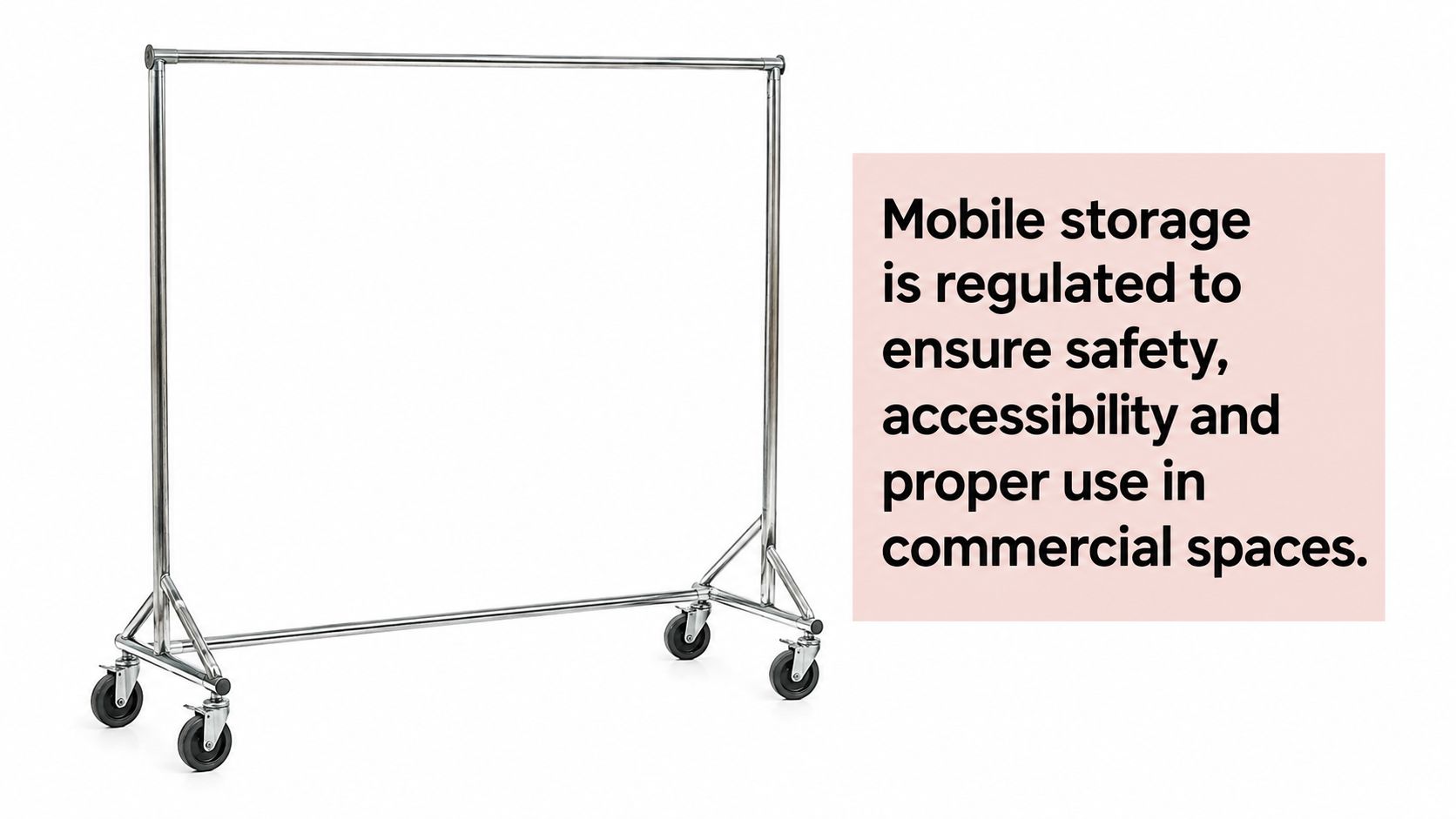
Wheels change the hazard
A fixed rail makes you lift or carry garments. A wheeled rail reduces that handling, but it introduces rolling resistance, runaway movement, collision risk and overturning forces. Those risks become more important when the route includes carpet, thresholds, ramps, corners or crowded aisles.
The HSE's RAPP method assesses pushing and pulling through factors including load weight, the force required to start and sustain movement, posture, route condition, slopes, corners and frequency. That means a supplier's static load rating cannot answer the question that matters most: can the person using this rack control it throughout the route?
Retail conditions justify the need for adaptable equipment, but they don't justify careless specification. ONS reported that clothing stores made the largest contribution to the monthly rise in non-food-store volumes in August 2024, when combined non-food-store sales volumes increased 0.6%. The ONS retail sales bulletin for August 2024 also shows why layouts and stock movement can change quickly, while making no claim that wheeled racks caused or measured those sales movements.
Practical rule: Buy for the person pushing the loaded rack across the worst section of floor, not for the empty rack photographed against a clean white wall.
The rest of the decision follows from that rule. Choose the format, castors, brakes and loading practice around the workplace, then worry about colour and finish.
Anatomy of a Garment Rack on Wheels
A product page becomes much easier to judge when you know what each part does. The rail holds the garments, but the base and castors determine whether the whole assembly behaves predictably under movement.
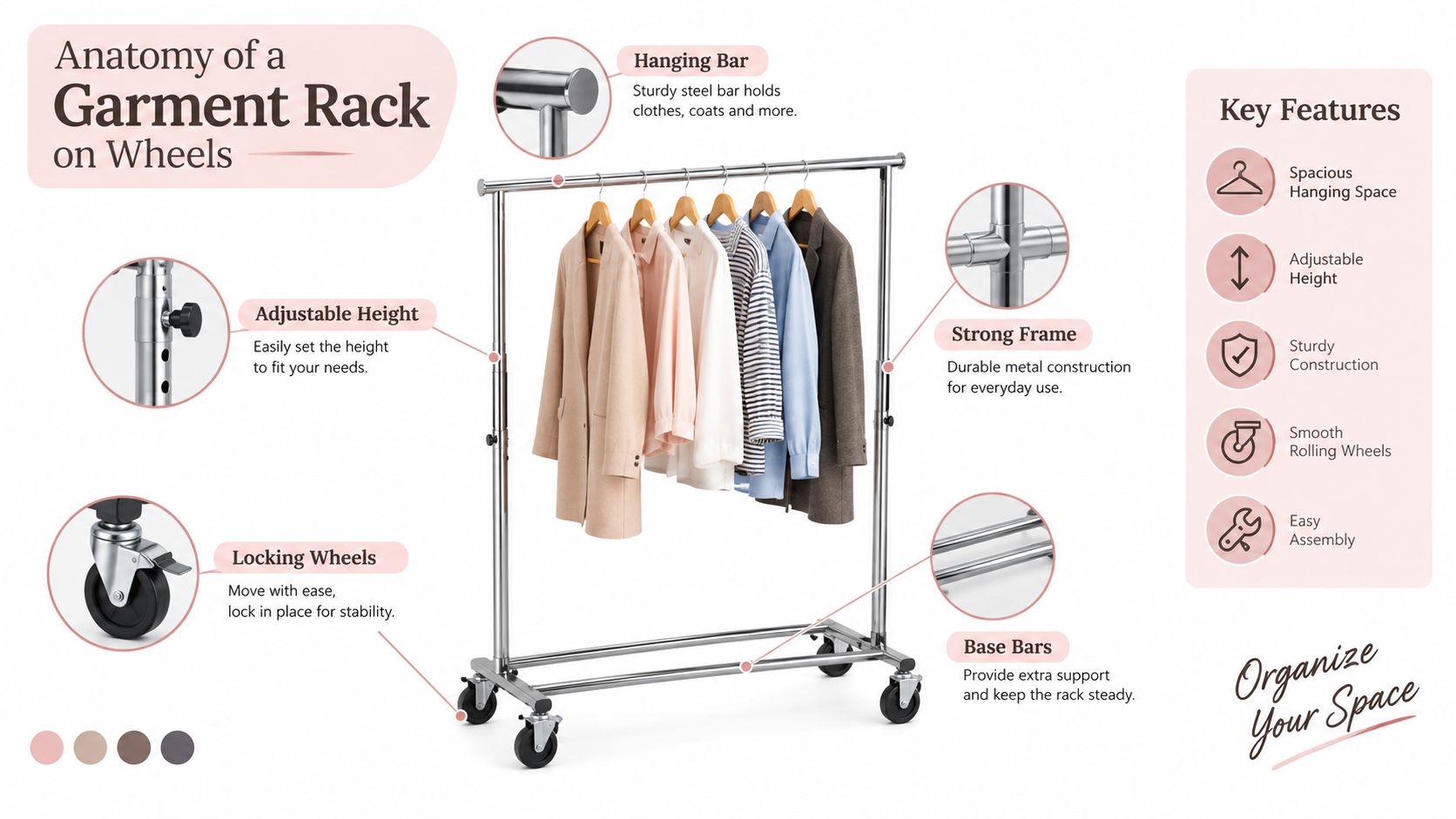
Start at the top
The hanging rail controls usable capacity and garment clearance. A longer rail may suit retail display, but it also encourages heavier loading and increases the turning envelope. Check the rail diameter and fixing method, especially if the rack will carry dense coats, bridalwear or costumes rather than lightweight samples.
The uprights connect the rail to the base. Adjustable uprights are useful when garments vary in length, but extra height can raise the combined centre of gravity. A rack should be tall enough to prevent hems dragging, not so tall that a dense hanging load sits unnecessarily high.
Connectors and joints deserve attention. Push-fit parts may assemble quickly, while bolted connections can provide a more rigid structure when the rack is frequently moved. Ask whether the manufacturer provides replacement fixings and whether the frame can be tightened after use.
The base carries the argument
A cross base or rectangular base spreads the load below the rail. A broad, rigid base improves stability by keeping the supporting footprint wide and placing the castors near the corners. It also reduces the temptation to treat a narrow decorative frame as commercial handling equipment.
The castors decide how the rack meets the floor. Diameter, tread material, swivel action and maintenance all affect starting force, steering and noise. Larger wheels generally cope better with minor floor transitions than small furniture castors, but wheel size alone doesn't guarantee safe movement. The route, load and condition of the castors still matter.
At least two lockable castors should be the minimum specification for a rack that will be parked during customer-facing work. Four brakes offer more control when the rack must stay fixed during fitting, dressing or selection, but they may add cost and can slow repositioning if operators use them as a substitute for proper route planning.
The finish is mostly a durability and presentation decision. Chrome, painted steel and powder-coated surfaces can all be appropriate, provided the frame remains rigid and the finish tolerates the working environment. For a closer look at construction choices, compare the terminology used in heavy-duty clothing rack guidance, then ask the supplier for base dimensions, castor details and verified load information rather than relying on the phrase “heavy duty”.
Matching Rack Formats to Real Workplaces
Different workplaces need different compromises. A rack that works beautifully as a flexible boutique display can be awkward in a stockroom, while an industrial Z-rack can look excessive in a small sewing studio.
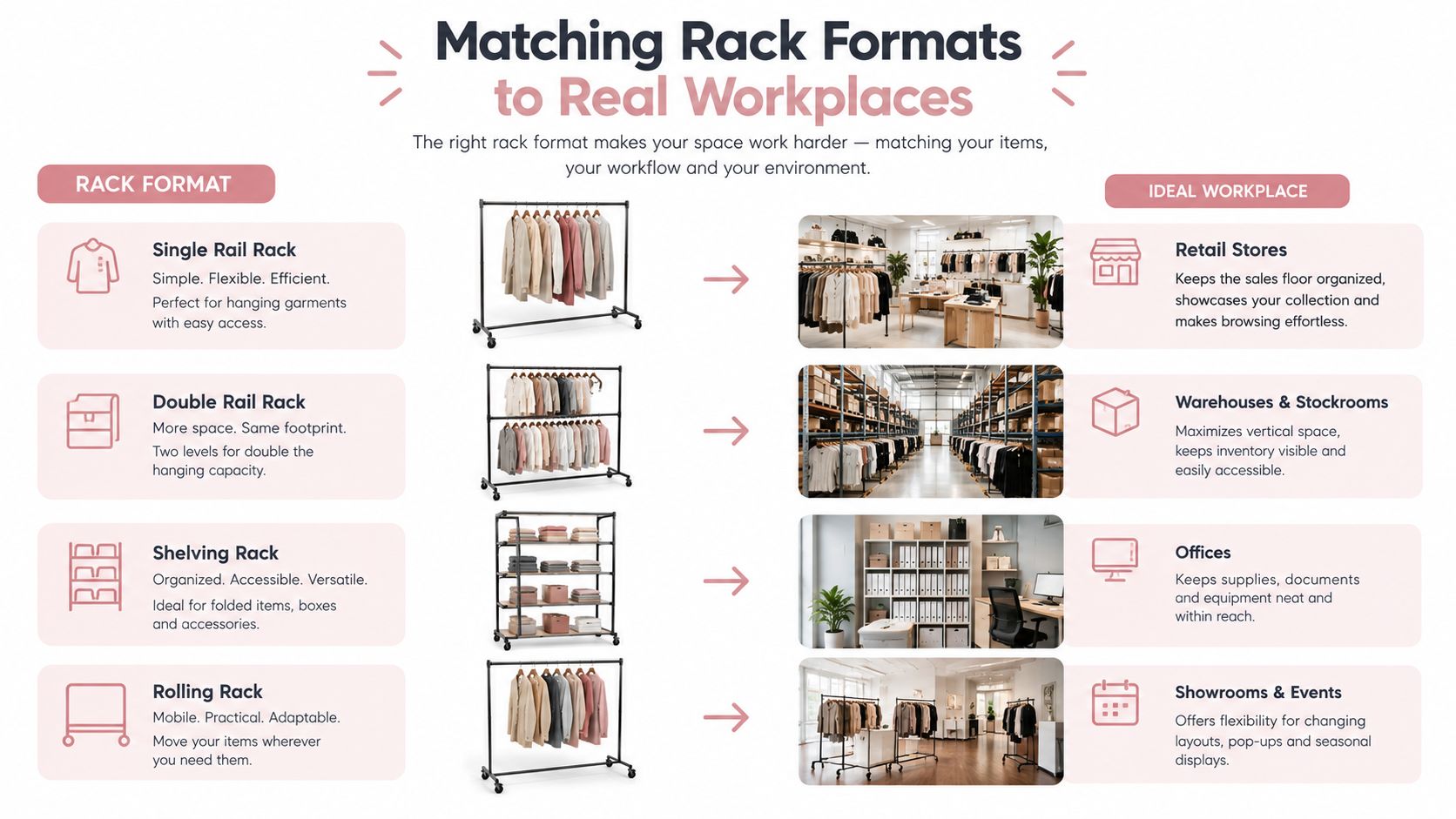
Match the frame to the job
| Rack format | Best fit | Main advantage | Typical failure |
|---|---|---|---|
| Single rail | Boutique display and fitting areas | Easy access and flexible presentation | Can become unstable when loaded high or unevenly |
| A-frame | Compact stockrooms | Good visual density and straightforward storage | Awkward through narrow doors and tight corners |
| Z-rack | Back-of-house retail movement | Strong layout for grouped stock and transfers | Bulky in customer-facing spaces |
| Heavy-duty industrial rail | Warehouse handling | Suits repeated movement and substantial loads | Over-specified for light garments and small rooms |
| Collapsible rack | Events, temporary sales and transport | Stores efficiently between uses | Folding joints and small wheels may reduce rigidity |
| Wall-hugging unit | Home sewing rooms and narrow studios | Uses limited floor width | Poor choice for regular long-distance movement |
A single rail is the natural choice when presentation matters more than density. It lets staff see garments quickly and works well for a boutique's changing display, but the base must be wide enough for the way the rail will be loaded.
An A-frame increases hanging storage in a back room, though its shape can make doorways and turns more difficult. A Z-rack is usually the stronger choice when staff transfer complete groups of garments between stockroom, shop floor and dispatch. For costume departments, collapsible transport matters, but folding convenience should never outweigh joint rigidity and brake performance. The practical details covered in costume rails for production environments are relevant here because costume teams often move grouped, delicate garments through changing work zones.
Consider the adjacent equipment
Tailors and print studios often move garments alongside pressing and finishing equipment. An ergonomic heat press stand can help define a more sensible work zone, but the rack still needs its own clear approach, parking point and turning space. Don't buy a compact rack just because the room is crowded. A compact rack that must be forced around worktables can create more risk than a larger model on a planned route.
Display Guru sells heavy-duty garment rails with push-fix wheels, including two-tier models in several rail lengths. Treat those options as a starting point for checking your route, load pattern and parking needs, not as a replacement for a workplace assessment.
Applying the RAPP Logic Before You Spend
The HSE RAPP approach gives buyers a better filter than a product photograph. RAPP considers Route, Accessories, Posture and Person, so the assessment follows the task rather than the marketing label.
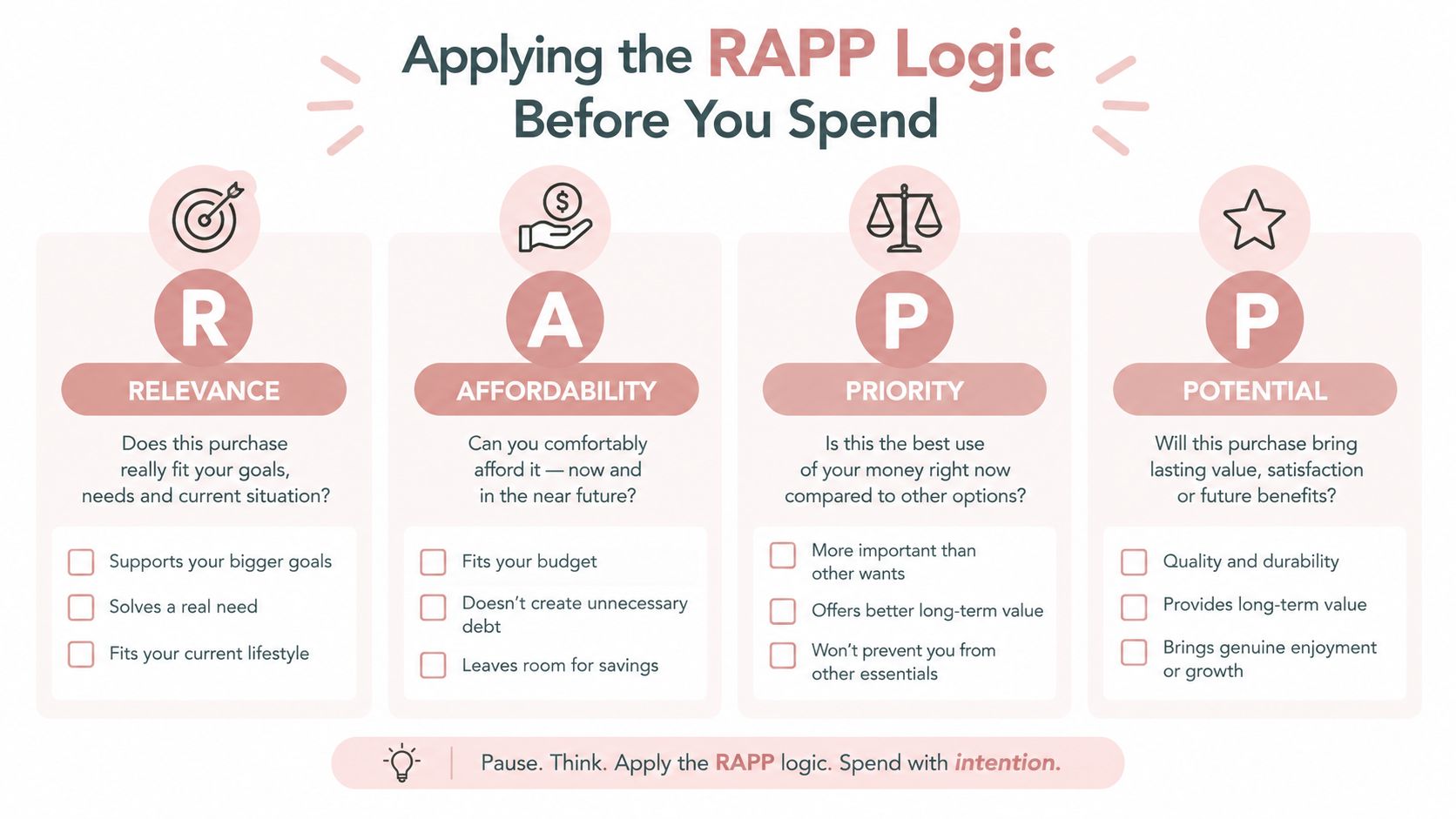
Route
Walk the complete path before ordering. Note the worst surface, not the easiest one. UK guidance identifies level, clean, dry and unbroken surfaces as the safest conditions for pushing and pulling, while uneven surfaces increase the initial force required.
Mark thresholds, carpet changes, ramps, slopes, corners and door clearances. Record where customers, boxes or sewing equipment regularly obstruct the route. A rack that moves well in a stockroom may be entirely unsuitable for a narrow customer aisle.
Accessories and equipment
Look at the surrounding setup. Door handles, ramps, lift entrances, fitting-room curtains and stockroom shelving all affect how the operator grips, turns and stops the rack. A handle or push bar positioned at a sensible height is preferable to pushing the hanging rail, which can disturb garments and encourage a bent posture.
Check whether the rack needs covers, garment bags, shelves or additional bars. Accessories add weight and may alter visibility. Keep the specification honest by assessing the complete working configuration, not just the bare frame.
Posture and person
The operator should be able to push with a controlled posture and maintain a clear view of the route. If the garments block sight of the floor ahead, reduce the load height or quantity. If the rack requires twisting around a corner or reaching over garments to steer, the design is wrong for that route.
Finally, assess the person doing the work. The HSE RAPP toolkit directs attention to load weight, starting and sustaining force, posture, route condition and frequency. Ask whether one operator can start the rack, maintain direction, stop it and park it without a sudden exertion. If not, specify a second person, change the route or choose alternative equipment.
The relevant capacity is the capacity the operator can control, not the largest load the rail can hold while stationary.
Write the answers down before comparing suppliers. Request castor diameter and material, brake arrangement, base dimensions, verified maximum load and any stability or test data. A supplier who can't provide those details hasn't given you enough information to make a responsible workplace purchase.
Reading Load Ratings Honestly
A maximum load figure describes a condition. It doesn't automatically describe a safe daily operating limit.
The first distinction is static capacity versus manoeuvring capacity. Static capacity concerns what the assembled rack can support while standing still. Manoeuvring capacity concerns what happens when the rack starts, turns, crosses a threshold, stops or encounters a person. Those are different mechanical demands, and a product page may not explain the difference.
Count the complete load:
- Garments: Dense coats, uniforms and costumes contribute more weight than lightweight shirts.
- Hangers: A large collection of hangers adds weight and can shift as the rack turns.
- Frame and accessories: Shelves, covers, lower bars and bags change the total load.
- Distribution: Concentrating garments at one end moves the centre of gravity sideways.
- Height: Heavy items hung high increase overturning risk during sudden movement.
A broad base and castors near the corners help, but they don't cancel poor loading. Keep heavier garments low and centrally distributed. Avoid building a tall, dense bundle that blocks the operator's view or creates a large overturning moment at a doorway.
Ask what the rating means
When a supplier states a load rating, ask whether it applies evenly across the rail, whether the rack was tested while moving, what floor conditions were used and whether the figure includes garment weight and accessories. If the response covers only the rail's ability to carry weight while stationary, treat it as a structural reference, not a daily loading instruction.
The practical approach is conservative. Establish a working limit based on the route, the people using the rack and the way garments are grouped. For further product terminology, strong clothing rails explained can help you compare rail construction, but your final decision still needs actual workplace testing.
Park the rack with brakes engaged, especially near customers, on slopes or while garments are being selected. A load that is stable while stationary can become difficult to control once an operator has to overcome floor resistance.
Planning Routes and Floor Layouts
Choose the route before choosing the rack. This single change prevents many bad purchases because it forces you to consider the movement pattern rather than the rack's footprint in isolation.
A boutique may need a flexible merchandising arc from stockroom to shop floor, around a display table and back through a fitting area. A tailoring studio may need a short path between sewing machine, steamer and fitting mirror. A stockroom may need a straight lane from incoming delivery to grouped rail, then onwards to dispatch.
Design the route on paper
Draw the premises and mark:
- Start and finish points, including where the rack will be parked.
- Floor changes, such as carpet, vinyl, thresholds and ramps.
- Turning points, especially corners where the operator loses sight of the front castors.
- Obstructions, including customers, tables, boxes and open doors.
- Parking conditions, including slopes and areas where garments are handled.
The best route is usually the one with fewer turns, fewer floor changes and a clear view ahead. Don't let a rack become a permanent obstruction. A parking position that narrows an aisle or blocks an escape route is a layout failure, not a storage solution.
| Route pattern | Typical friction | Castor size to favour | Brake rule |
|---|---|---|---|
| Boutique display loop | Customers, tight turns and changing fixtures | Larger, smooth-running castors | Lock whenever garments are selected or the rack is displayed |
| Studio work path | Tables, tools and short repeated movements | Castors suited to the actual floor and low noise | Lock at fitting, steaming and alteration points |
| Stockroom to dispatch lane | Thresholds, doors and grouped loads | Robust castors with stable swivel action | Lock during loading, unloading and handover |
| Delivery-bay transfer | Slopes, uneven surfaces and poor visibility | Larger wheels with verified route suitability | Never leave the rack unattended on a slope |
For wider merchandising decisions, use retail store layout best practices as a planning reference, then test the proposed rack path with an empty frame and a representative load. A route that looks generous on a plan may feel very different when the rail blocks sight lines.
If the operator has to fight the route, redesign the route before upgrading the rack.
Assembly, Brake Checks and Ongoing Care
A well-specified rack can become unreliable through poor assembly or neglect. Treat the first setup as a safety check, not a five-minute furniture job.
Assemble for rigidity
Follow the manufacturer's sequence and confirm that uprights, connectors and base fixings seat correctly. Check that the frame stands squarely before loading it. All castors should swivel freely, and the locking castors should engage fully without leaving the rack wandering.
Load the rack gradually for its first movement. Distribute garments across the rail and test steering, braking and visibility on the actual route. Recheck fixings after the rack has been used repeatedly, particularly if the frame experiences frequent starts, stops and threshold crossings.
Use a short inspection routine
A busy workplace needs checks that people will perform:
- Before use: Confirm that brakes engage, castors turn, the frame is straight and no fastener is loose.
- During movement: Watch for clicking, wobbling, unexpected drift or increased push force.
- After loading: Check that garments remain distributed and the operator can see the route.
- At regular intervals: Inspect tread wear, swivel action, brake function, rail damage and hanger hooks.
Do not lubricate or alter castors unless the manufacturer permits it. A temporary fix can change braking or introduce contamination onto a shop floor. Remove a rack from service if it develops a bent frame, damaged wheel, unreliable brake or loose connector.
For workplaces that also move boxed stock or accessories, folding trolleys on wheels offer a useful comparison in how mobility equipment should be checked, parked and maintained. The principle is the same: movement hardware needs an operating routine, not occasional attention after a near miss.
Common Buyer Questions Worth Answering
How much clothing can one person push?
There isn't a universal garment count that makes a rack safe. The relevant variables are the total load, garment distribution, floor condition, route length, slopes, corners, visibility and the operator's capability. A light rail on a clean, level floor is a different task from a dense rail crossing carpet and thresholds.
Use the RAPP logic and test the representative load. If one person can't start, steer and stop the rack smoothly, reduce the load, improve the route or assign assistance.
When is a second person needed?
A second person is appropriate when the operator loses visibility, the route includes difficult slopes or thresholds, the rack is difficult to stop, or the load requires more force than one person can safely control. The second person should have a defined role, such as guiding at the front or controlling a doorway. Two people shouldn't push unpredictably from different points.
A second operator is not a substitute for brakes or route planning. If the rack is unstable, change the equipment or loading method.
Are two locking castors enough?
Two lockable castors are a sensible minimum for many mobile rails, provided the rack has a rigid, stable base and the brakes prevent drift. Four lockable castors may suit a rack that must remain fixed while garments are handled, dressed or steamed, especially on a surface where movement is easy.
More brakes don't correct an undersized base, overloaded rail or damaged floor. Specify the brake arrangement around how the rack is parked and used.
What does “heavy duty” actually mean?
Treat it as an invitation to ask questions, not as evidence. Request the verified maximum load, whether the rating is static or mobile, base dimensions, castor size and material, brake details, frame construction and any stability or test information.
A rack earns a place in a professional workplace when its complete operating conditions are understood. If a product page gives only a finish, rail length and vague capacity claim, keep looking or contact the supplier before spending.
Display Guru supplies garment rails, tailor dummies, body forms and related display equipment for retail, tailoring, costume work and sewing studios. Visit Display Guru with your route measurements and working requirements, then choose a garment rack on wheels based on controllable movement, stable parking and the floors your team uses.