

Your Professional Guide to Full Body Mannequins
Think of a full body mannequin not just as a piece of plastic or fibreglass, but as your silent partner. It can be a patient fitting model in your studio, working around the clock, or your star salesperson on the shop floor. Getting the right one isn't just a purchase; it's a critical investment in your craft and your business.
Choosing Your Ideal Full Body Mannequin
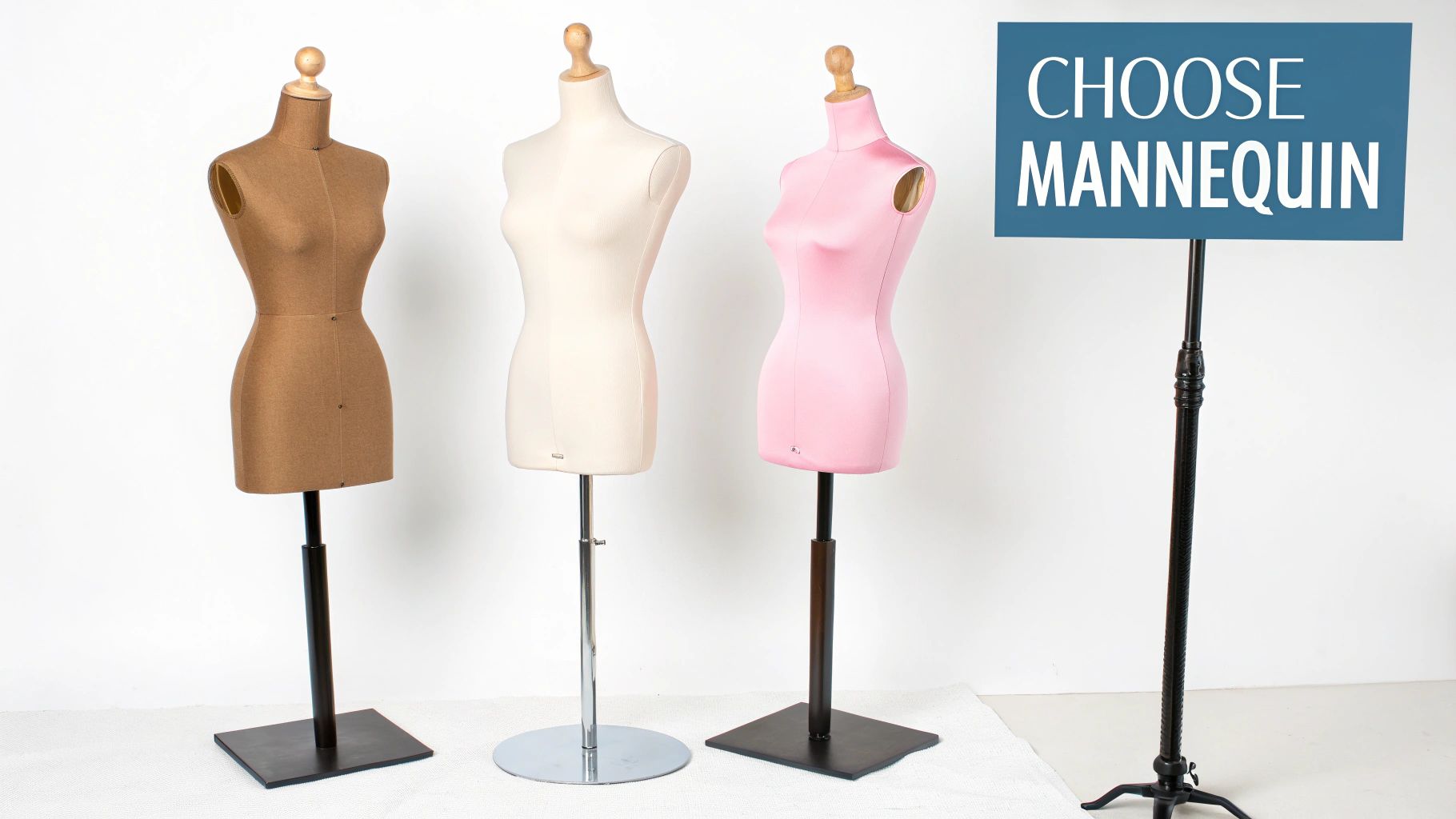
Picking the right full body mannequin is a lot like hiring for a role. You need to match the skills to the job. A bustling high-street shop needs a tough, static figure that can wear a collection beautifully day in and day out. A bespoke tailor, on the other hand, needs a completely different kind of partner—one they can pin into, drape fabric over, and adjust for hours on end.
It's about function, not just looks. The material, the sizing, even the type of stand it has will determine how well it works for you. This choice has a real impact on your daily workflow, how your garments are perceived, and ultimately, your sales. It’s no surprise the UK mannequin market hit USD 278.2 million in 2023 and is expected to climb to USD 649.7 million by 2030, all driven by professionals like you who need the right tools for the job.
Finding Your Perfect Fit
To make things simpler, think about your main goal. Is it for retail display or hands-on tailoring? This decision tree can point you in the right direction.
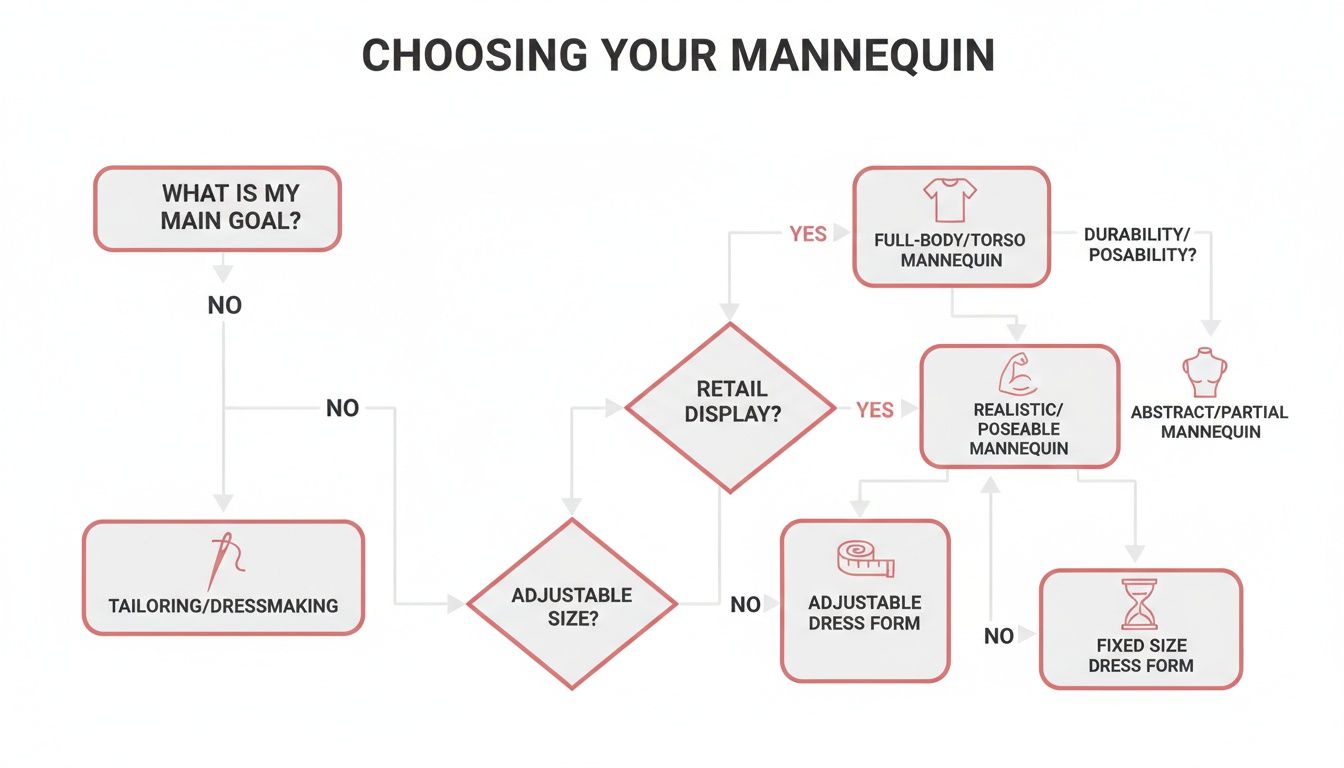
As you can see, retailers should focus on realistic poses and durability, whereas tailors and designers absolutely need pinnable surfaces and true-to-life sizing.
A Quick Guide to Professional Needs
Knowing what features matter from the start will save you a lot of hassle. For instance, if you're a designer, a pin-friendly polystyrene body is non-negotiable for working directly on the form. If you cater to a variety of body shapes, you'll want to explore the world of adjustable models when searching for the perfect full body female mannequin.
The table below breaks down the most common professional uses and matches them with the right kind of mannequin, so you can see at a glance what you should be looking for.
Matching Your Full Body Mannequin to Your Professional Needs
| Professional Use | Recommended Mannequin Type | Essential Features | Display Guru Solution |
|---|---|---|---|
| Retail Window Display | Abstract or Realistic Fibreglass | Dynamic poses, durable finish, easy to dress. | Our versatile fibreglass models with multiple pose options. |
| In-Store Merchandising | Headless or Ghost Mannequin | Neutral appearance, sturdy base, lightweight for moving. | Easy-to-move headless forms that keep focus on the clothes. |
| Tailoring & Dressmaking | Pinnable Polystyrene Body | Fully pinnable torso, accurate standard sizing, stable stand. | Our professional-grade, pin-friendly polystyrene mannequins. |
| Costume Design/Cosplay | Adjustable or Pinnable Full Body | Adjustable dials for custom sizing, pinnable surface. | Explore our adjustable forms for bespoke measurement needs. |
| Fashion Photography | Ghost or Realistic Mannequin | Removable parts (for ghost effect), matte finish to reduce glare. | Our specially designed ghost mannequins for perfect product shots. |
Ultimately, choosing a mannequin is about finding the right tool to help you do your best work, whether that’s selling a garment or creating one from scratch.
Your mannequin is a three-dimensional canvas for your work. Its purpose is to translate the flat pattern into a wearable form, making it one of the most essential tools in any fashion-related profession.
As technology marches on, digital mannequins are also making their mark. Understanding the fundamentals of 3D modeling can give you a real edge, providing context for both the physical forms we use today and the virtual ones of tomorrow.
Here at Display Guru, our focus is on providing high-quality solutions for every professional. Our range is built around durable, pin-friendly polystyrene models designed to stand up to real work. We back them with dedicated support, both before and after your purchase, to make sure you find the perfect fit.
What’s Under the Hood? Mannequin Materials and Build Quality
The material a full body mannequin is made from is probably the single most important factor in how it performs. It dictates its durability, its weight, and most importantly, what you can actually do with it. Think of it like a chef choosing the right pan for the job; the material makes all the difference between a perfect result and a frustrating mess.
You’ll generally come across two main types: fibreglass and polystyrene. Fibreglass is the old-school standard for retail display. It’s tough, rigid, and can be moulded into all sorts of realistic or abstract shapes that look fantastic in a shop window. But its biggest strength is also its biggest weakness for anyone doing hands-on work—you can't stick a pin in it to save your life.
For designers, dressmakers, and anyone creating garments, that’s a dealbreaker. This is where polystyrene comes in.
The Magic of Pinnable Polystyrene
Imagine a high-density corkboard perfectly sculpted into a human torso—that's essentially what a polystyrene mannequin is. Its core is made from a firm foam that’s forgiving enough to let you push pins straight in, over and over, without any real resistance or damage.
For anyone who creates clothing, this one feature changes everything.
Designers can drape fabric, play with new patterns, and make tweaks on the fly, seeing their ideas take shape in real time. Tailors can pin seams, mark up alterations, and check the fit with absolute precision. It's a completely different way of working compared to a hard fibreglass form. For a deeper look at matching forms to different settings, our guide on choosing mannequins for shops offers some great insights.
A pinnable surface turns a static display dummy into a dynamic creative partner. It’s the difference between looking at a blueprint and actually building the house.
Don't Overlook the Fabric Cover
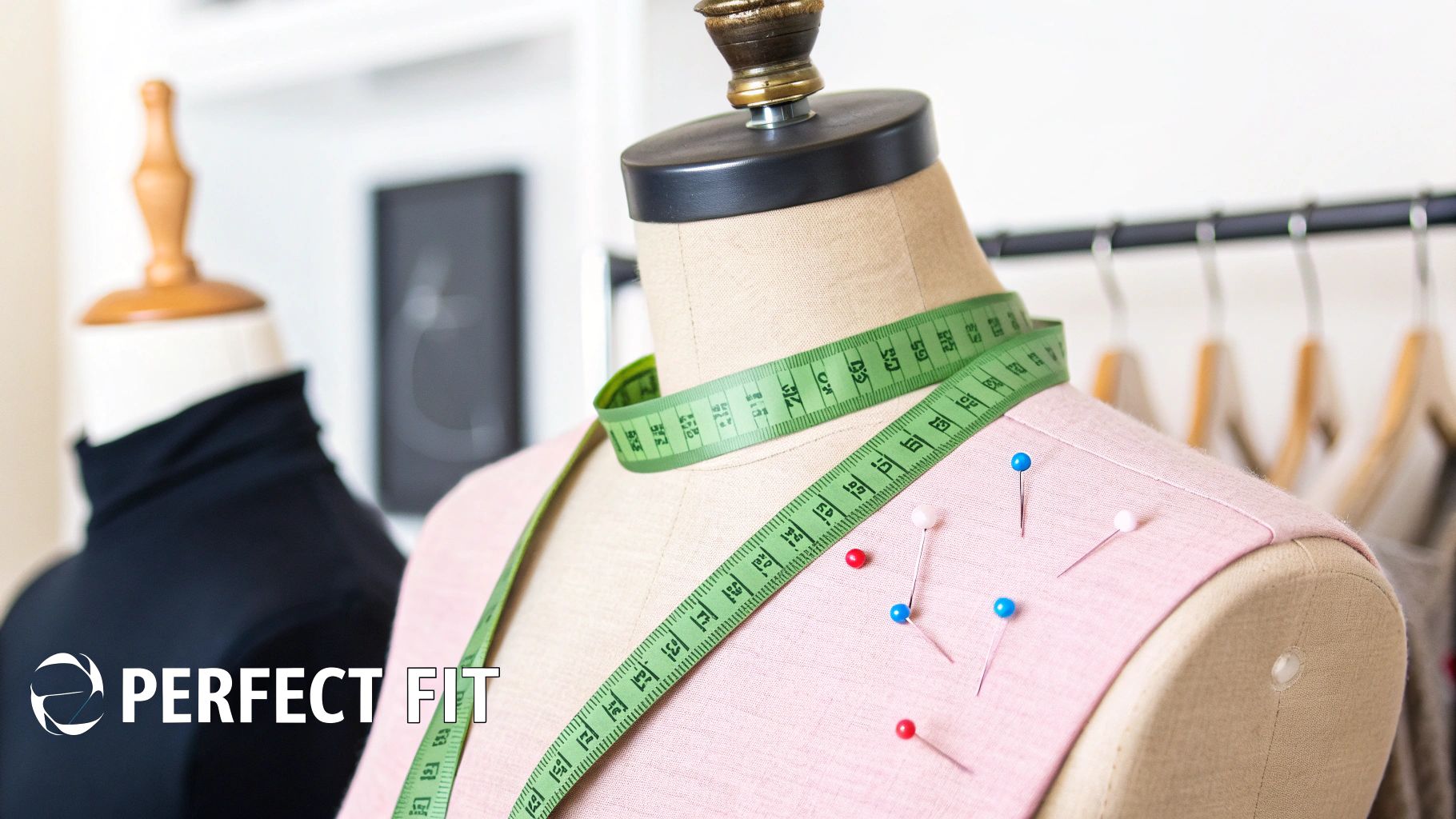
The material story doesn't stop at the inner core. The fabric covering the polystyrene body is just as crucial—it's the mannequin's skin. This outer layer provides the essential grip that stops fabrics from sliding around, which is a lifesaver when you're working with slippery materials like silk or chiffon.
You’ll typically see two main options for the cover, and each brings something different to the table:
- Linen: This is the classic choice, giving a professional look with a slightly textured finish. That texture provides fantastic grip, making it a firm favourite among professional tailors.
- Jersey: A softer, stretchier fabric that gives a very smooth surface. Its natural give is a real plus when you're working with knit fabrics, as it better mimics how the material hangs and moves on a person.
It's this combination of a solid polystyrene core and a quality fabric cover that really makes a professional-grade dress form.
Comparing Core Mannequin Materials
So, which one is for you? It really boils down to your day-to-day work. A retailer’s needs are worlds apart from a costume maker's, and the right mannequin reflects that. Here’s a quick breakdown to help you decide.
| Feature | Polystyrene (Pinnable) | Fibreglass (Display) |
|---|---|---|
| Primary Use | Tailoring, dressmaking, draping, and design work. | Retail displays, visual merchandising, and photography. |
| Pinnability | Excellent. Pins can be inserted anywhere on the torso. | None. The hard shell is completely impenetrable. |
| Durability | Lightweight yet resilient, but can dent from a sharp knock. | Very hard and durable, but can chip or crack if dropped. |
| Weight | Much lighter, making it easy to move around a studio. | Heavier and more solid, which adds stability on a shop floor. |
| Surface | Covered in fabric (linen/jersey) for grip. | Usually painted with a matte, gloss, or chrome finish. |
Ultimately, the way your full body mannequin is built defines its purpose. If you're using it for hands-on creation, a pinnable polystyrene body isn't just a nice-to-have feature—it's an absolute must.
Getting the Size and Fit Just Right
Fit is everything in fashion. It’s the difference between a garment that just hangs and one that truly sings. Whether you’re showing off a finished collection in a boutique or painstakingly crafting a made-to-measure piece, the dimensions of your full body mannequin have to be spot-on. We need to move beyond generic size charts, because real bodies rarely fit neatly into those boxes.
This is where you have to decide what you need most: a fixed, standard size or the flexibility of an adjustable form. Think of a fixed-size mannequin like a standard off-the-rack garment; it's built to a specific set of industry measurements. For a retailer displaying a consistent size run, this is exactly what you want—predictability and uniformity.
But for any kind of custom work, a fixed size is just the starting block. This is where an adjustable mannequin really comes into its own, becoming less of a static display and more of a true partner in the design process.
Why Starting with the Right Standard Size Matters
Before we get into the cleverness of adjustable forms, let's talk about the foundation: choosing the right base size. It's a classic trick of the trade to pick a mannequin that’s slightly smaller than your target measurements, whether that’s for your most common client or your standard sample size. Why? Because you can always add padding to build up to a specific shape.
A mannequin that’s too large, however, is a dead end. You can't make it smaller, and it immediately restricts what you can do. Getting that initial size correct is the first, most critical step for both accurate garment making and beautiful presentation.
To nail this, we’ve put together a comprehensive guide on taking and using mannequin measurements to help you choose with confidence. Here at Display Guru, we stock a huge range of sizes, so whether you’re working on children’s clothes or catering to diverse adult body shapes, we have you covered.
The Magic of an Adjustable Full Body Mannequin
An adjustable full body mannequin is the custom-fit suit of the mannequin world. These brilliant models are designed with dials and mechanisms that let you change their dimensions at all the crucial points. For anyone creating one-off pieces, this feature is an absolute game-changer.
You’ll typically find a series of dials—often 10 to 12 of them—placed at the bust, waist, hips, and sometimes even for the back length or neck. A simple twist expands or contracts the internal skeleton, letting you mirror a client's specific measurements with incredible accuracy.
An adjustable mannequin closes the gap between a standard dress form and a real human body. It gives a designer a three-dimensional, true-to-life canvas that truly reflects an individual's unique shape.
This ability to adapt is essential for so many creators:
- Bespoke Tailors: You can perfectly replicate a client’s unique body shape, saving them from endless, time-consuming fitting sessions.
- Costume Designers: Nailing an actor's precise measurements is non-negotiable for costumes that have to fit like a second skin and allow for total freedom of movement.
- Home Sewists: It's the secret to creating beautifully fitted clothes for yourself or family members who don't fit into standard high-street sizes.
Compressible Sections: The Detail That Makes a Difference
Looking beyond the dials, you’ll find that some high-end adjustable forms—and even some professional fixed models—have another clever feature: compressible sections. You’ll usually find these at the shoulders and sometimes the hips. These areas are built on a spring-loaded mechanism, so they have a bit of give.
This makes getting clothes onto the mannequin so much easier, especially when you're working with very fitted garments or delicate fabrics. Instead of wrestling a tight sleeve over a rigid shoulder and risking a popped seam, the form simply compresses to let the garment slide on. It’s a small detail, but one that makes the day-to-day fitting process smoother and safer for your creations.
Ultimately, your choice comes down to your work. Do you need the reliable consistency of a fixed-size form for retail, or the dynamic, customisable nature of an adjustable model for bespoke projects? By understanding how to master sizing and use adjustability to your advantage, you're not just buying a display tool—you're investing in something that will help you perfect every garment you create.
Selecting the Right Base for Stability and Style
Let’s talk about the unsung hero of your full body mannequin: its base. It’s easy to overlook, but this single component is the foundation for everything. It dictates how stable your mannequin is, how easily you can move it around, and even the overall look of your studio or shop floor.
Choosing the right stand is as much a stylistic decision as a practical one. You'll generally find two main options: the classic tripod and the more modern round base. Each has its own strengths, and the best one for you really boils down to how and where you plan to use your mannequin. Think of it like choosing tyres for a car—what works for a smooth city street isn't what you'd want for a bumpy country lane.
The Trustworthy Tripod Stand
There’s a reason the tripod stand is the go-to for so many professionals. It's a time-tested design that works. By distributing the mannequin's weight across three legs, it creates a wide, stable footprint that’s incredibly difficult to knock over. This is a lifesaver in a busy studio, especially when you’re pulling and pinning heavy fabrics.
Another real advantage is how well a tripod handles uneven floors. If your workspace has old floorboards or slightly sloped concrete, a tripod will find its footing where a flat base would wobble. For designers and dressmakers, that kind of reliability is non-negotiable. Plus, the classic look of a wooden or metal tripod adds a certain professional charm to any creative space.
The Sleek Round Base
On the other hand, the round base brings a clean, contemporary feel. Its minimalist design is a perfect fit for modern retail spaces where every square inch of floor space counts and the aesthetic needs to be sharp and uncluttered. The flat, weighted disc keeps the mannequin solidly anchored, provided it’s on a smooth, level surface.
This is the preferred choice for visual merchandisers who want the customer's eye to go straight to the garment, not the stand. Its smaller footprint lets you group mannequins closer together for more impactful displays without creating an obstacle course for shoppers. A sleek round base just effortlessly supports that high-end, modern brand image.
The stand you choose does more than just hold the mannequin up; it defines its presence. A tripod suggests a working artist's studio, while a round base speaks to minimalist retail curation.
Comparing Your Stand Options
So, how do you decide? It's a simple case of weighing up the practicalities. Are you pinning heavy wool coats in a workshop, or are you displaying delicate silk dresses in a boutique? This table breaks down the key differences to help you make the right call.
| Feature | Tripod Stand | Round Base |
|---|---|---|
| Best Environment | Design studios, workshops, tailoring spaces | Retail stores, showrooms, exhibitions |
| Stability | Excellent, especially on varied or uneven flooring | Excellent on flat, level surfaces |
| Footprint | Wider, requiring more floor space | Compact, ideal for saving space |
| Aesthetic | Classic, professional, traditional | Modern, minimalist, unobtrusive |
| Mobility | Lighter and often easier to reposition quickly | Heavier and more grounded for static displays |
At the end of the day, both stands provide a secure foundation; your choice simply comes down to the unique demands of your work. For a deeper dive, check out our complete guide on selecting a dress form stand that perfectly matches your needs. Here at Display Guru, we offer both options to make sure your full body mannequin is supported in style.
Creating Impactful Displays and Photographs
Your full body mannequin isn't just a stand for hanging clothes on; it's a silent salesperson. Whether it's catching eyes in a busy shop window or starring in your latest e-commerce photoshoot, its job is to tell a story about the garment it’s wearing. When you stage your mannequin well, you transform it from a simple prop into a powerful marketing tool that grabs attention and makes people want to buy.
It all starts with getting the clothes on properly. A garment that’s wrinkled, crooked, or poorly fitted instantly sends a message of carelessness and cheapens the product in a customer’s eyes. For a complete walkthrough on getting that perfect, professional finish, our guide on how to dress a mannequin is packed with essential tips. Once your mannequin is dressed to impress, the real creative work can begin.
Mastering the Art of Posing and Staging
Even a mannequin in a fixed pose can suggest movement and personality if you stage it cleverly. The key is to match the pose to the purpose of the clothes. Activewear just looks right on a mannequin in a dynamic, athletic stance, while a flowing evening gown calls for something more graceful and poised.
Layering is another fantastic way to build visual interest. Don't just stop at the main garment; think about how accessories can complete the narrative. A simple dress is instantly elevated with a well-chosen scarf, a belt to define the waist, or a handbag held just so. This approach not only creates a more engaging display but also nudges customers to see a complete outfit, often boosting sales of those extra items.
A well-staged mannequin doesn’t just show an item of clothing; it sells an entire look and a lifestyle. It helps the customer picture themselves in that outfit, feeling that same confidence.
Props are brilliant for adding context and depth to the scene. A mannequin in a summery dress, staged with a picnic basket and sun hat, immediately conjures up images of warm, lazy afternoons. If you're shooting for your website, a practical guide to photography studio props can give you great ideas for selecting accessories that build a compelling story around your product.
Essential Photography Tips for E-Commerce
For anyone selling online, the photography is everything. Your product images have to do the heavy lifting of a physical display, showing off the texture, fit, and quality of an item through a screen. Good lighting isn't just a nice-to-have; it's the single most important element for creating professional shots.
- Lighting for Texture: Position your main light (the key light) at a slight angle to the mannequin. This creates soft shadows that beautifully highlight the texture of fabrics like wool, denim, or linen, making them feel more real and appealing.
- Fill Light for Detail: Add a second, softer light (the fill light) on the opposite side to gently soften any harsh shadows. This ensures that important details, especially on darker garments, are clear and visible.
- Background Choices: There’s a reason clean, neutral backgrounds like white or light grey are the industry standard. They cut out all distractions, keeping the focus entirely on the garment and giving your website a clean, consistent look.
Capturing the Perfect Angles
The angles you shoot from can completely change how a garment looks and feels. To give your customers a full picture, you need to capture the product from several different viewpoints.
- The Full-Length Shot: Always start with a straight-on, full-body shot. This is your main hero image, showing the entire outfit as it’s meant to be worn.
- The Three-Quarter View: Taking a shot from a slight angle adds depth and shows off the garment’s silhouette and how it hangs on the body.
- Detail Close-ups: Get in close on the unique features—the buttons, any embroidery, the quality of the stitching, or the weave of the fabric. These shots are crucial for communicating craftsmanship and quality.
- The Back View: Don't forget the back! Customers need to see the entire design, including how it fastens or any interesting details they might otherwise miss.
By blending thoughtful staging with smart, systematic photography, your full body mannequin can become your most effective sales tool, helping you create images and displays that truly connect with customers and show off the quality of your brand.
Look After Your Mannequin, and It'll Look After You
A professional full body mannequin is a serious piece of kit and a real investment in your work. Look after it properly, and it will be a reliable partner for years to come. Think of assembly and regular upkeep not as chores, but as the key to protecting its functionality and appearance.
Your mannequin is as vital to your craft as a chef's knives are to theirs. If you neglect it, you’ll end up with wobbly stands, stained fabrics, and avoidable damage that gets in the way of your creativity. The good news is, keeping it in prime condition is surprisingly simple.
Getting Set Up
Your Display Guru mannequin is designed for a quick and painless assembly. We've made sure our stands and forms click together securely without you needing a degree in engineering or a massive toolbox. You should be up and running in just a few minutes.
Here’s a quick guide to putting it all together:
- Build Your Base: If you have a tripod stand, open the legs out wide to create a stable footprint. For a round base, just make sure it’s on a flat, level floor.
- Slot in the Pole: Pop the main support pole into its slot on the base. Most models have a simple screw or lock to hold it tight.
- Mount the Torso: Gently lift the mannequin’s body and slide it down onto the pole. Make sure it’s sitting level and is pushed all the way down for the best stability.
- Final Checks: Adjust the height so it’s comfortable for you to work with. Give everything a quick wobble-check to ensure all connections are secure before you start dressing or pinning.
If you hit any snags during setup, don't worry. Our Display Guru support team is right here on live chat or email to help you out. We want your experience to be brilliant, right from the moment it arrives at your door.
Long-Term Care and Cleaning
A little bit of consistent care goes a long way. Dust, oils from your hands, and just the general studio environment can build up over time, but a simple cleaning routine makes all the difference. How you clean it really depends on what it’s made of.
For our fabric-covered polystyrene models, keeping the cover in good nick is essential.
- Dusting Down: Once a week, give it a once-over with a soft-bristled brush or the upholstery attachment on your hoover to get rid of dust and loose fibres. A simple lint roller works wonders for a quick tidy-up, too.
- Tackling Stains: If you get a small mark on it, act fast. Mix a tiny bit of mild fabric detergent with cool water. Using a clean, white cloth, gently dab the spot—try not to saturate the fabric. It’s always smart to test it on a hidden area first, like the underside, just to be sure it doesn’t affect the colour.
Treat your mannequin’s fabric cover like you would a high-quality garment. Gentle cleaning keeps its texture and grip perfect for professional draping and fitting.
Try to keep your full body mannequin out of direct sunlight for long stretches, as the UV rays can fade the fabric. A simple trick is to store it away from windows or just pop a dust cover over it when it’s not in use. It’s a small step that makes a huge difference.
Frequently Asked Questions About Full Body Mannequins
Choosing a professional **full body mannequin** can feel like a big decision, and it’s natural to have a few questions. To help you feel confident in picking and using your new creative partner, we’ve put together some straightforward answers to the queries we hear most often from designers, retailers, and sewing pros.Getting these details right means you’ll not only choose the perfect tool for your work but also get the best possible return on your investment. Let's dive into everything from pinning techniques to proper cleaning.
Can I Use Pins Directly on Any Full Body Mannequin?
This is one of the most important things to get right, especially for any hands-on work. The short answer is a definite no; you can never assume a mannequin is pinnable. If you try to force pins into a hard surface like fibreglass, you'll end up with bent pins and permanent scuffs on your mannequin.
If you need to pin fabric, you have to choose a model built for it. Our Display Guru forms, for instance, are made with a high-density polystyrene core. This material is designed specifically to take pins smoothly, time and time again, without crumbling or losing its shape. It’s the ideal surface for draping, fitting, and pattern making.
A pinnable polystyrene form isn’t just a nice-to-have feature—it’s a fundamental part of the design process. It transforms a static figure into a genuinely interactive workspace for any creator.
Should I Choose an Adjustable or a Fixed-Size Mannequin?
What you plan to do with the mannequin will point you to the right answer. A fixed-size mannequin is brilliant for retail displays or for designers who consistently work to a specific sample size. They're incredibly durable and provide a clean, uniform look across a whole collection. Think of it as your reliable standard.
On the other hand, an adjustable full body mannequin is an absolute must-have for any custom or bespoke work. The dials let you accurately recreate a client’s unique measurements, which can save a huge amount of time during fittings. If your work involves creating garments for lots of different body shapes and sizes, the versatility of an adjustable form is something you can't do without.
What Is the Best Way to Clean My Mannequin?
A little bit of care goes a long way in making your mannequin last for years. For our fabric-covered models, a gentle and regular cleaning routine is the way to go.
- Routine Dusting: Once a week, go over the surface with a lint roller or a vacuum cleaner using a soft brush attachment. This will pick up any surface dust or stray threads.
- Spot Cleaning: If you get a small mark on it, gently dab the area with a damp cloth and a very mild fabric cleaner. It’s always a good idea to test the cleaner on a hidden spot first, just to make sure it doesn't affect the colour.
- Avoid Soaking: Never soak the fabric with water or use harsh chemicals. This can easily damage both the cover and the polystyrene core underneath.
Which Base Is More Stable a Tripod or a Round One?
Both the tripod and round bases we offer at Display Guru are designed to be extremely stable, but they have different strengths depending on the setting.
A tripod stand tends to have a wider footprint, which gives it fantastic balance on all sorts of surfaces, even slightly uneven workshop floors. It's a classic, dependable choice for a busy studio. In contrast, the flat round base has a sleek, modern look and is rock-solid on level ground, making it a perfect fit for contemporary retail spaces where every inch of floor space counts.
Ready to find the perfect silent partner for your studio or shop? The team at Display Guru is here to help you select the ideal full body mannequin to bring your creative and commercial visions to life. Explore our complete collection of professional-grade forms and stands today. Find your perfect mannequin on https://www.displayguru.co.uk