




Fitted Door Mats: Choosing, Fitting and Maintaining Yours
You're standing in your hall on a wet morning, watching a loose mat slide across tiles, curl at one corner and catch under the door. It looked right in the shop. It doesn't work where it now sits. That small failure is the starting point for understanding fitted door mats, because fitting isn't about buying a prettier mat. It's about making the entrance itself work safely.
Why a Fitted Door Mat Is a Different Choice
A loose mat fails in predictable ways. It creeps on a smooth floor, rucks under a pram wheel, or presents a raised edge to someone using a walking frame. You can replace it with a heavier one and still have the same problem, because the problem isn't weight. It's the junction between mat, floor and threshold.
Think of the entrance as a short runway. Every shoe, wheel and stick crosses it, often carrying rain and grit. If that runway isn't level, people have to lift, steer around or step over something at exactly the point where they're also opening a door, carrying bags or pushing a trolley.
Fit means flush, not just the right outline
In the UK, fitted entrance mats are closely linked to accessibility rather than decoration, and British Standard 8300 guidance on entrance matting emphasises that entrance areas should be flush, step-free and slip-resistant for wheelchair users and people with visual impairments. That changes your buying question. You're no longer asking, "Does it cover the door?" You're asking, "Can everyone cross it without a jolt, a trip or extra effort?"
A mat that cleans well but makes the doorway harder to cross hasn't solved the entrance problem. It's swapped one problem for another.
The underlying expectation comes from the Equality Act 2010, which replaced the Disability Discrimination Act 1995 and reinforced that building access shouldn't disadvantage disabled users, as the same guidance explains. For a shop, surgery, school or block of flats, that's a practical design duty, not abstract law. For a home, it's still a useful test if children, older relatives or visitors with mobility aids use the door.
A fitted door mat therefore belongs to the floor build-up. Its recess, frame, surface, backing and edge detail have to work together. Traffic, weather exposure and threshold height then decide which system suits you. Once you see it that way, colour becomes the last decision, not the first.
What a Fitted Door Mat Actually Is
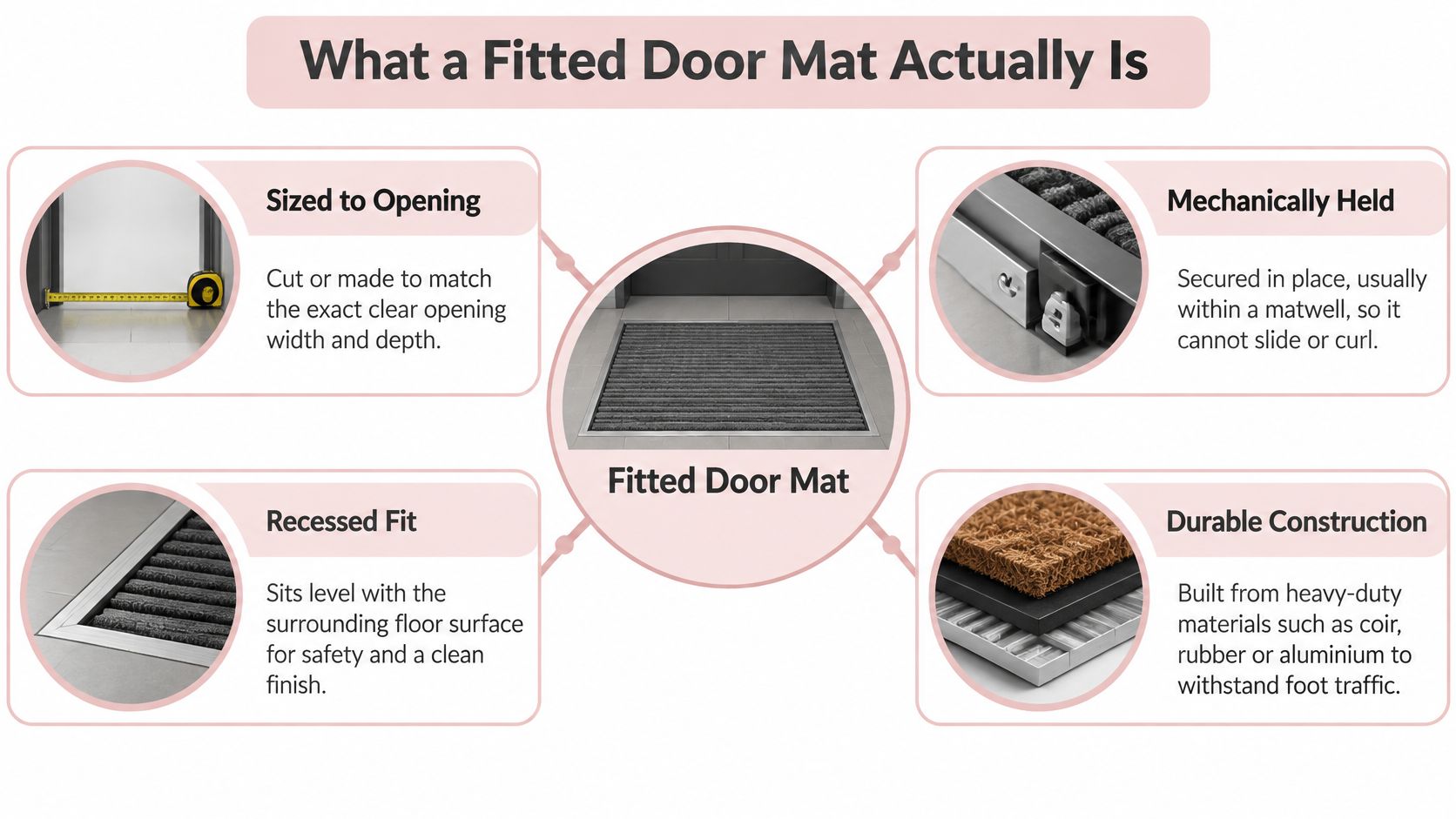
A fitted door mat is sized to a particular opening or recess and mechanically held in place, usually within a matwell. It isn't a loose mat that's heavy enough to stay put most days. If you can drag it aside with your toe, it isn't fitted in this sense.
Use a picture analogy. A loose mat leans against the wall. A fitted mat sits inside its frame, with the frame doing quiet but essential work. The recess controls height, the frame protects edges, and the fixing stops movement and curling.
Three jobs in sequence
Most well-specified fitted door mats are judged against three jobs. First, scrape off coarse dirt, grit and stones. Second, wipe finer particles from soles and wheels. Third, dry the moisture that's left so it isn't carried onto the floor beyond.
Those jobs don't have to be three separate products. Some mats combine coarse exterior fibres or rubber scrapers with absorbent wiping material in one construction. What matters is the order of work. If the first contact only polishes wet shoes without removing grit, the later surface has more to do and wears faster.
- Sized to opening: The mat matches the clear width and available depth, rather than leaving uncovered lanes at either side.
- Held in position: A frame, recess or fixing prevents sliding, lifting and edge curl.
- Level with the floor: The finished surface aligns with adjacent flooring so wheels and feet pass smoothly.
- Made to be serviced: The insert can be lifted or replaced without rebuilding the whole entrance.
That last point is often missed. A good fitted system isn't sealed in forever. It should let you clean the well, replace a worn insert and check edges before small movement becomes a hazard.
Materials and Backings Compared
Start with the surface your shoes meet, then check what's underneath it. A strong scraper on a poor backing will still move, hold water or deteriorate in the well. Conversely, a stable backing can't compensate for a surface that blocks wheels.
Natural coir scrapes muddy boots aggressively, which explains its popularity at country doors. Its weakness is movement over it. Deep, coarse fibres can make small wheels and mobility aids work harder, and government housing guidance specifically says communal entrance matting shouldn't be coir or another material that interferes with wheelchair use, a point covered in Greater Manchester accessibility by design guidance. You'll revisit that guidance during installation, because material choice and threshold detail can't be separated.
Ribbed carpet fibres are better at wiping and drying. They suit covered entrances and internal zones where coarse debris has already been removed. Rubber or PVC scrapers tolerate wet conditions and give a firm crossing surface, but they don't absorb much on their own. Aluminium systems with fibre or scraper inserts carry heavier traffic and spread loads across rails, although they need an accurate recess.
Surface and backing options at a glance
| Surface | Best for | Watch out for |
|---|---|---|
| Coir | Muddy, low-wheel-traffic doorways | Deep pile, difficult wheeled crossing |
| Ribbed carpet fibre | Wiping and drying inside the threshold | Saturation if it's the only defence |
| Rubber or PVC scraper | Wet exterior scraping and firm footing | Limited moisture absorption |
| Aluminium with inserts | Retail, offices and heavy trolley traffic | Cost, recess accuracy and drainage |
Backings control stability and moisture. Closed-cell rubber resists water passing through and usually stays put well. PVC backing gives a firm, economical base but needs checking for flexibility and edge integrity. Foam backing can feel forgiving underfoot, yet trapped damp is harder to ignore if the well stays wet. With underfloor heating, ask the supplier to confirm compatibility in writing rather than relying on a generic description.
One technical example makes the specification mindset concrete. A heavy-traffic aluminium entrance system specification lists a 17 mm product height, recessed-well installation, low slip potential tested to BS 7976-2 and BS EN 13501-1 Class Cfl-s2 for its PVC scraper. You don't need that exact product. You do need that level of detail before comparing prices.
Supplier question: Ask for total installed thickness, not just visible mat thickness. It's the complete assembly that has to finish flush.
Measuring the Opening and Choosing the Right Length
Measure the opening you're fitting, not the old mat you're replacing. Old mats shrink, stretch, wear unevenly or were wrong from the start. You'll take three measurements, and each one limits the products you can use.
First, record the clear opening width between finished edges at the narrowest point. Second, measure length in the direction of travel, from the door side towards the room. Third, measure installed depth from the top of the surrounding floor to the base of the recess. Check depth in several places because a well that looks flat may not be level.
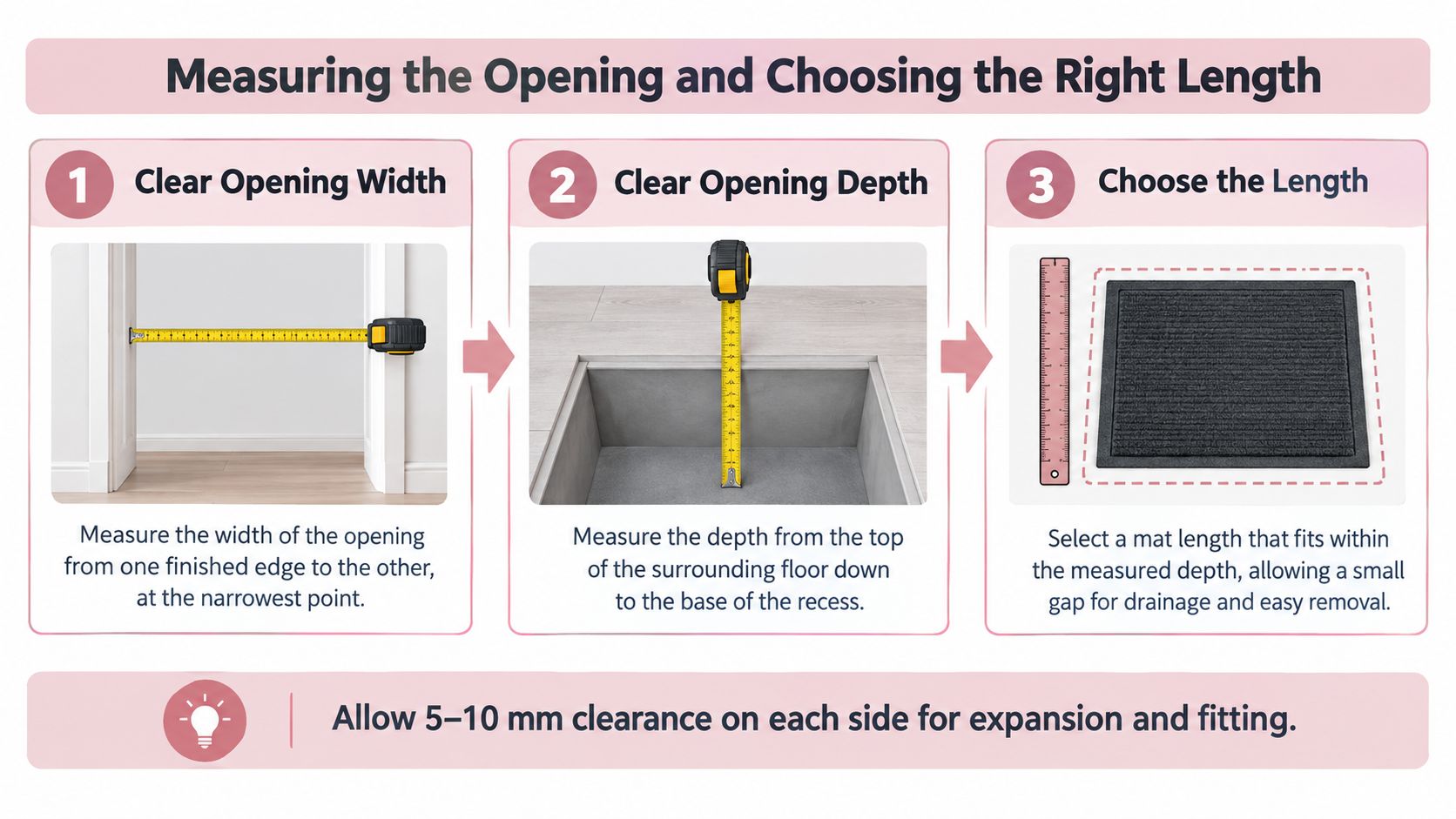
Length is track, not decoration
Think of length as laying track. The longer the track, the more chances each shoe or wheel gets to leave water and dirt behind. UK guidance identifies approximately 2.1 metres in the direction of travel for one full wheelchair wheel rotation and approximately 4.2 metres for two rotations, according to the British Standard guidance cited earlier. You may not have that space in a house, but the principle tells you why a token strip inside the door performs poorly.
Commercial guidance goes further. Approximately 5 linear metres is recommended where space and traffic permit, and around 40% of dirt and moisture may be removed in the first 1.5 metres, figures set out in UK entrance matting guidance from Parrs. The same guidance says 1 square metre of matting can retain up to approximately 0.5 litres of excess moisture or remove about 1 kilogram of dirt over a week. Treat those as capacity indicators, not promises, because weather, traffic and cleaning change the result.
If you're also replacing the door itself, coordinate clearances before ordering either item. A door buying guide for Atlanta homes is useful background on door selection, while UK threshold and frame dimensions still need local checking. For colour coordination once the dimensions are settled, this guide to choosing a beige door mat for a fitted entrance helps you keep appearance subordinate to fit.
Where length is limited, don't pretend otherwise. Specify stronger scraping followed by absorbent wiping within the available footprint, and accept more frequent cleaning. A short, high-performing mat is a compromise. A short, mostly decorative one is just a wet patch with edges.
Matching the Mat to the Use Case
There's no single best fitted door mat. The right answer changes when the traffic changes, and a product that's sensible for a farmhouse porch may be wrong for a care setting. Start by naming who crosses the threshold and what they bring with them.
For a domestic doorway, a low-profile fitted insert usually gives the safest balance. It keeps the threshold calm for children and older relatives while still wiping wheels and shoes. If the entrance opens straight onto pale flooring, coordination matters, but don't let it lead. These flooring tile ideas for compact kitchens show how adjoining finishes influence the look, yet slip resistance and flush height remain the entrance priorities.
For a rental property, permanence is the constraint. Choose a removable insert or surface-fixed frame that can be lifted for inspection and doesn't require cutting a new matwell. The landlord and tenant should agree who cleans and replaces it, because a fitted system that nobody maintains becomes a shared complaint.
Retail, care and pushchair traffic
A retail entrance needs load resistance as much as dirt removal. Trolleys, delivery cages and repeated footfall punish weak edges, so aluminium rails or sturdy ribbed systems make sense where the recess can support them. This comparison of dirt trapping door mats for busy entrances is a useful next step when traffic volume is your main pressure.
For care settings, public buildings and homes using mobility aids, make access the deciding factor. UK accessibility guidance on adapting access into the home warns that deep-pile mats and coir surfaces can impede wheelchairs, walking sticks and other mobility aids. That makes selection a safety decision as much as a cleaning decision.
A thinner mat that every wheel can cross easily may outperform a thicker, more absorbent mat in real life.
The same accessibility guidance identifies thresholds above 5 mm as potential trip hazards unless chamfered, with an accessible threshold generally not exceeding 15 mm. Measure the combined mat, frame and threshold height before you buy. If you can't keep the crossing smooth, change the construction rather than asking users to adapt around it.
Installation From Recess to Finished Floor
Installation is sequencing. If you prepare the recess badly, even a well-made mat will sit proud, rock, trap water or wear at one edge. Work from the bottom up and check levels before the mat goes in, not after.
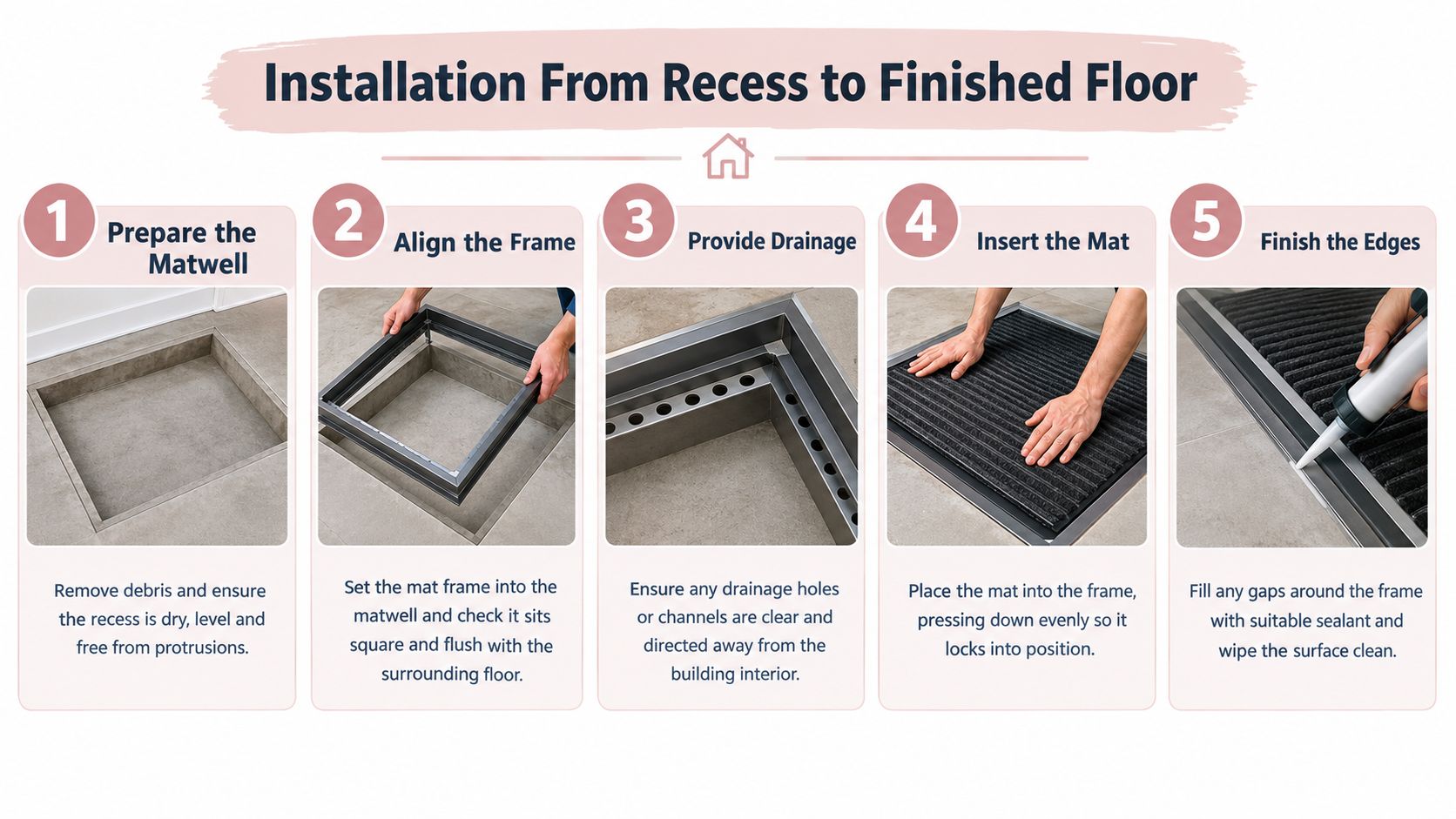
A competent sequence
- Prepare the matwell: Remove debris, confirm the base is sound and dry, and check depth across the whole recess.
- Align the frame: Set it square, load-bearing and level with the surrounding finished floor.
- Provide drainage: Keep channels or outlets clear so water doesn't pond beneath the insert.
- Insert the mat: Lower it evenly and confirm it can't creep, lift or bridge over high spots.
- Finish the edges: Close gaps neatly and verify there's no raised perimeter at the crossing line.
UK guidance referencing Building Regulations Part M states that floor-material changes must not create a trip hazard or impede wheelchair movement, as noted earlier from the Greater Manchester guidance. That's why recess depth, drainage and edge tolerance aren't fitter's details to leave unspoken. They're integral to a compliant fitted installation.
Watching the sequence helps you spot where millimetres are won or lost.
A recessed system suits new builds and renovations where floor levels can be coordinated. A surface-mounted frame with a suitable bevelled edge suits floors you can't break into, provided the ramp doesn't create a new obstacle. In both cases, put the specification on paper first. Include total installed thickness, well depth, drainage, edge profile, slip-test result, fire classification and underfloor heating compatibility where relevant.
Push back if the finished mat is described as "nearly flush." Nearly flush is still a lip. Ask the installer to run a straightedge across the junction and roll a loaded trolley or wheelchair over it before sign-off. You'll learn more from that test than from looking at the surface pattern.
Cleaning, Maintenance and Indoor Air Quality
A fitted door mat only removes dirt while it has capacity left. Once fibres are loaded and the backing stays damp, each new crossing can redistribute what the mat collected earlier. Maintenance is therefore part of performance, not an afterthought once the entrance starts to smell.
Build the routine around traffic and weather. Lift loose grit frequently in wet periods, vacuum or shake out removable inserts where the construction allows, and clean the well itself rather than only the visible surface. Check for standing water, dark patches, musty odour, curled corners and backing that stays wet long after the top feels dry.
A proportionate routine
- Daily attention: Remove surface grit and spot-check edges in busy or wet entrances.
- Weekly cleaning: Use the method the manufacturer specifies for that surface and backing.
- Seasonal reset: Lift the insert, clean and dry the well, inspect drainage and check for mould or deterioration.
For carpet-type inserts, professional guidance on extract carpet cleaning can help you judge when routine vacuuming is no longer enough. Don't use a wet method on a fixed system unless you can dry both insert and recess properly. Putting a damp mat back into a closed well defeats the purpose.
The indoor air point needs care. UK health guidance supports using a doormat or removing shoes to reduce indoor exposure to tracked-in contaminants, while NICE indoor air quality evidence notes that indoor environments can contain much higher concentrations of volatile organic compounds than outdoor air, with furnishings, construction materials and cleaning products among the sources. That doesn't prove a mat will improve air quality or eliminate allergens. It does argue against saturated mats and strongly fragranced, high-emission cleaning habits.
Hygiene rule: A mat should be a controlled place where dirt stops, not a damp reservoir where it waits.
If you're comparing constructions, this guide to rubber outdoor doormats and washable entrance options helps where hosing down is practical. Renters and small retailers should favour removable inserts they can lift, dry and replace without altering the floor. Whatever system you choose, drying time is a specification. If your entrance never gets it, choose a construction that tolerates that reality.
Common Mistakes and How to Avoid Them
Most failures are decided before installation day. The mat is too deep for its recess, too short for the traffic, or chosen for absorption without checking who has to cross it. By the time edges lift or wheels judder, you're paying to correct a specification error.
Watch for these recurring mistakes. Deep pile at an accessible entrance creates resistance for sticks and wheels. No drainage leaves water under the insert. Measuring the old mat repeats its errors. Ignoring door clearance produces scraping, binding or a mat trimmed in the wrong place. Comparing surface price alone hides frame, recess and cleaning costs.
Confirm before you order
- Finished height: Will mat, backing, frame and threshold finish flush or safely chamfered?
- Usable length: Does the direction of travel give shoes and wheels enough contacts?
- Surface choice: Can every expected user cross it without extra effort?
- Water route: Where does collected moisture go, and how does the well dry?
- Maintenance access: Can you lift, clean and replace the insert easily?
- Evidence: Has the supplier provided slip, fire and installed-thickness details for the complete assembly?
The contrarian point is worth repeating because it prevents expensive over-specification. The thickest or most absorbent mat isn't automatically best. For a safety-critical entrance, a thinner, firmly retained fitted door mat can be the better engineering choice even if it scrapes or dries slightly less. You're buying safe passage and dirt control together. If a product gives you only one of those, keep looking.
If you're fitting out a shop, studio or display space, Display Guru supplies garment rails, tailor dummies, body forms and merchandising equipment that help you present the space beyond the entrance professionally. Browse the range before your next refit and use the support team to match durable display kit to your layout, traffic and budget.