


Visual Merchandising Assistant: Role, Duties and Skills
The brief lands at 7.40am: a printed plan, two photographs of a look signed off by head office, and a note that the new season lands Thursday. Somewhere between the delivery bay and the shop floor, that plan has to become a real fixture with real stock on it, priced and shoppable by the time the doors open.
That gap between a picture and a sellable floor is where the visual merchandising assistant works. The job isn't styling for its own sake. It's installing, adjusting, recording and fixing, and it gets judged on whether customers can find, understand and buy what's in front of them.
What follows is the practical version of the role: what the day looks like, what it pays, where the trade-offs sit, and how to tell whether this is the side of retail you want.
What the Role Is and Where It Fits
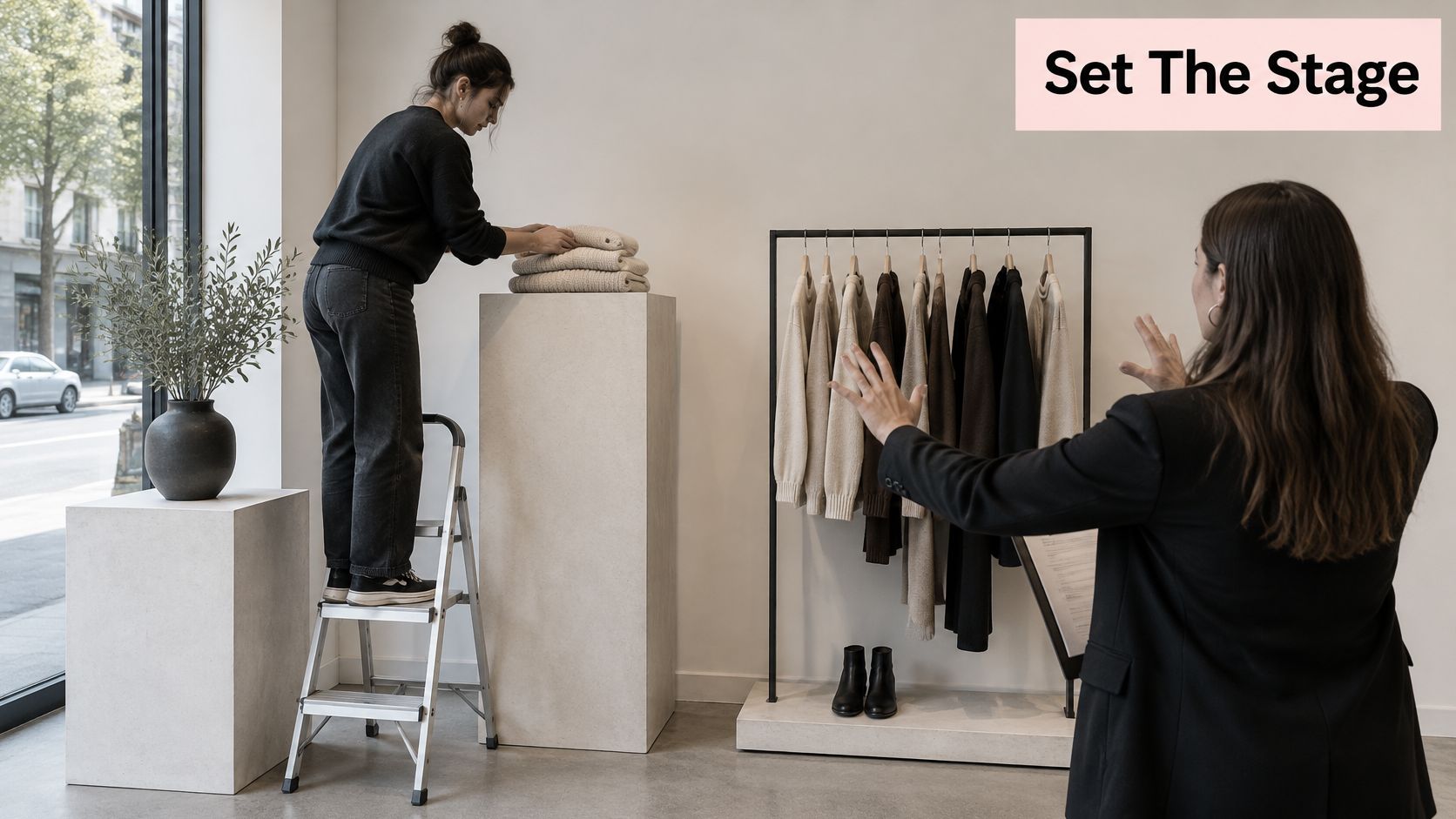
Think of a theatre run. The director decides what the audience should feel; the stage crew builds and resets the set so every performance works. A visual merchandiser sits closer to the director, planning layouts, budgets and seasonal concepts. The visual merchandising assistant is the crew: the person who carries the plan into shops, windows and in-store areas and makes it stand up under real traffic.
The brief comes from a visual merchandiser, a store manager or head office, and you report back to whoever set it. The working relationships decide whether you hit the date. Stock teams release the sizes you need, store operations control access to the floor, and sales staff field the questions about the display you built. A window dresser works only on the shop front. The assistant's remit runs across the whole floor.
Demand for that work is steady rather than explosive. UCAS reports 9,655 vacancies for visual merchandisers and related occupations in the previous year, with projected job growth of 2.57% over the following eight years. Modest, but it points to a recurring need for people who translate a concept into a physical display, whatever happens to store formats and online shopping. The wider context is a retail sector that had 2.81 million jobs in September 2024, according to the British Retail Consortium's analysis of Office for National Statistics figures.
Day to day the task list is concrete: prepare fixtures, arrange garments or products by colour and size, check sightlines, support seasonal installations, and keep displays standing after launch. If you'd rather debate a concept than build it, this isn't your job. If you want to see a plan become a sellable floor by Thursday, it is. Entry points sit with retailers themselves, and store and sales floor openings are where most assistants get their first shift. For a plain explanation of the wider discipline, see what visual merchandising in retail involves.
Core Duties and What Each One Produces
Every duty below ends in something a manager can walk up to and check. That's the discipline of the role: not "I had a good idea for the window" but "the window is dressed, priced, photographed, and the fixture behind it is full."
| Duty | What it involves | Typical output |
|---|---|---|
| Preparing fixtures | Setting up rails, body forms, bins and stands to the brief | Stable, dressed fixture ready for launch |
| Dressing windows and displays | Styling garments and props to the visual brief or plan | Finished window or feature wall |
| Arranging products | Grouping by colour, size or category with a clear entry point | Logical zone that customers can read quickly |
| Installing promotions | Fitting signage, price cards and seasonal stock on schedule | Campaign live on the planned date |
| Maintaining standards | Daily checks and resets as stock sells through | Consistent presentation across the floor |
| Recording display data | Logging configuration, dates and sales or stock measures | Display log linked to SKU performance |
| Coordinating teams | Liaising with stock, store operations and merchandisers | Issues escalated and replenishment prioritised |
Start at the glass. Dressing windows and displays is the visible end of the job: styling garments and props to the plan, taping a look so it survives a week of doors and hands, and finishing it from the pavement rather than from 30cm away. The output is a window or feature wall that matches what head office signed off.
Behind it, preparing fixtures carries the stock. Rails, body forms, dump bins and stands get built, levelled and weighted to the brief, and anything that rocks under a hand gets flagged within the hour. What's checked is a stable, fully dressed fixture ready for launch, not a half-built frame with a coat thrown over it. Arranging products decides how a shopper reads the zone: grouping by colour, size or category with one clear entry point gives them a route in, while a rack mixing six colourways and three fits gives them nothing. The output is a zone someone can read in two seconds from the aisle.
Installing promotions is a deadline job. Signage, price cards and seasonal stock go up on the day the campaign breaks, because a promotion live a day late has already cost a trading day. Maintaining standards then runs daily: refolding, resizing, pulling product forward, replacing sold-out pieces, resetting after a busy Saturday. Most of the hours go to that daily upkeep, and that decides whether the display holds or decays.
The part people underestimate: the log. A configuration, an implementation date and the sales or stock numbers that follow are what turn a display from an opinion into evidence.
Recording display data closes that loop, and coordinating teams is how the record stays true: you tell stock what's missing, tell operations what's blocking the aisle, and tell the merchandiser what the plan didn't account for. Props matter less than how they behave under load, which is why visual merchandising props that adjust quickly pay for themselves across a season of changeovers.
The week has a rhythm. New stock and briefs land early, fixture building and dressing follow, and mid-week resets respond to what the log is showing. Nobody grades you on the idea. They grade the floor at 9am on Saturday.
Pay, Hours and Progression Benchmarks
Two published profiles give you the money conversation before you walk into it.
| Source | Starter pay | Typical pay | Experienced pay | Weekly hours |
|---|---|---|---|---|
| National Careers Service, visual merchandiser | £23,000 | £27,000 midpoint | £31,000 | 36 to 40 |
| UCAS job profile, visual merchandisers and related | £8,804 | £21,294 | £43,064 | Not published |
The National Careers Service profile puts starters at about £23,000 a year and experienced workers at up to £31,000, with typical hours of 36 to 40 a week. That gap is £8,000, roughly 35% of the starter figure. The hours carry their own message: this is a full-time retail post with a rota, not an occasional creative assignment.
The UCAS profile spreads far wider, from about £8,804 for new workers through £21,294 as normal pay up to £43,064 for the highly experienced. The £34,260 between the lowest and highest cited level is the honest shape of the occupation: entry-level assistant work at one end, standard store-based roles in the middle, senior or specialist positions with real responsibility at the other.
Reading the two profiles side by side
Before you compare offers, check what each figure counts. One profile may be averaging part-time and short-term arrangements into the entry number, which drags it down without saying anything about a full-time assistant's actual rate. Treat both sets as benchmarks for negotiation, never as the offer on the table.
Ask what the pay band is and what specifically moves someone from assistant to merchandiser. A store that answers precisely has a structure. One that can't is improvising.
Progression is rarely about being the most creative person on the floor. It's accumulated retail knowledge, fluency in brand standards, the coordination of several projects at once, and the ability to execute a display independently without someone checking your spacing. The assistant who can run a changeover alone, hit the date and explain the numbers afterwards is the one who gets the next band.
Skills Employers Expect and How to Show Them
A display can look polished and still miss its purpose if the stock is unavailable, the price is wrong or the product is difficult to shop. Employers need assistants who can turn a merchandising plan into a sellable shop floor, connecting visual decisions with stock, pricing and sales information.
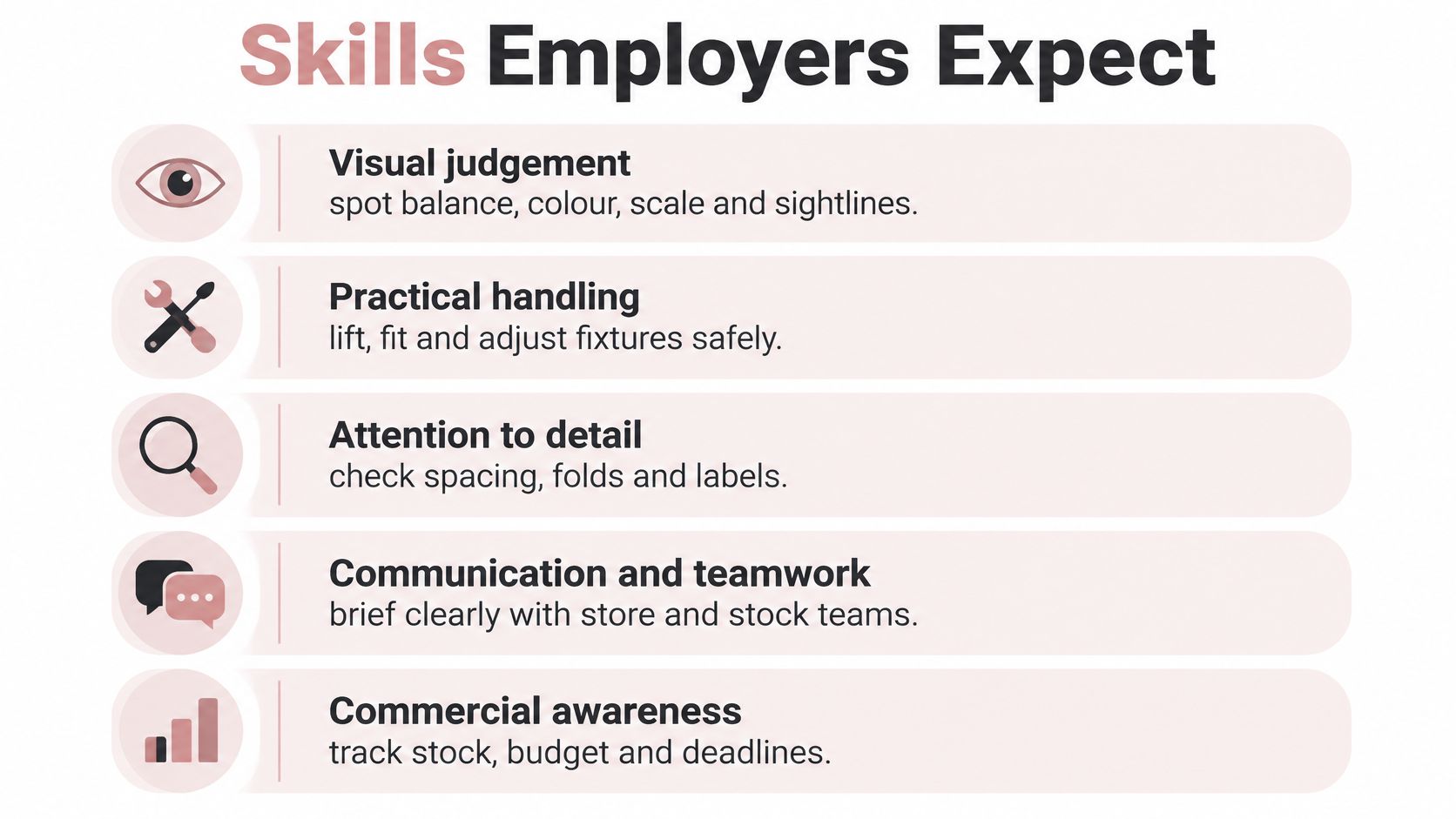
Visual judgement means assessing balance, colour, scale and sightlines. A rail that appears varied up close may read as a single block from across the shop. Practical handling means lifting, fitting and adjusting fixtures safely, often with tools rather than sketchbooks. Attention to detail covers accurate prices, even spacing, straight folds and signage customers can read easily.
Data literacy helps you judge whether the display is working commercially. In merchandising and display roles, staff may use product, stock and sales information to spot patterns and respond to changes in demand or availability. Track the measures relevant to your fixture, such as sales, stock cover, replenishment and markdowns, and check whether a change in presentation coincides with a change in performance. The Skills England occupational standard for merchandising assistants covers data and business decisions for that occupation. It should not be treated as a specific standard for visual merchandising assistants.
What the numbers look like in a working log
Keep a simple record of the display setup and when it went in. Compare its results with a comparable earlier period or an area where the layout stayed the same, if that information is available. Use the comparison as a prompt to investigate, not proof that the display caused a sales change. Low availability, incorrect pricing or slow replenishment can limit sales regardless of presentation. Check those conditions before redesigning the fixture.
Communication matters because display work depends on timely coordination with colleagues handling stock, pricing and replenishment. A missing size found early can be replaced; found late, it may leave the fixture incomplete for the rest of the day.
Teaching the teachable
Employers can train assistants on brand standards, fixture systems and till or stock software. Composition and the habit of checking a display from the customer's approach take practice, so show how you assess your own work rather than relying on claims about having a good eye.
Use evidence in an application: dated before-and-after photographs, a clear description of the change and a measured result where you have one. The guide to how to write a retail resume can help you describe display tasks in terms a store manager can assess. Colour choices should also support the product and the intended mood. Learn the basics of retail colour psychology so you can explain why a palette suits the display, rather than presenting colour as decoration alone.
How to Check a Display Before It Goes Live
Academic work presented in the Leeds Beckett Retail Institute conference proceedings frames visual merchandising as an in-store stimulus that produces cognitive, emotional and behavioural responses, and warns that excessive choice and poor environmental order can reduce shopper enjoyment, time in store and purchasing. That gives you a design rule with teeth: build around perceptual hierarchy, keep the cognitive load low, and remove anything that competes with the focal point rather than adding more signage to explain it.
The same body of work treats the discipline as floor layout, store design, windows, mannequins, lighting, product coordination and atmospherics together, so a zone gets assessed as a system rather than as a collection of props.
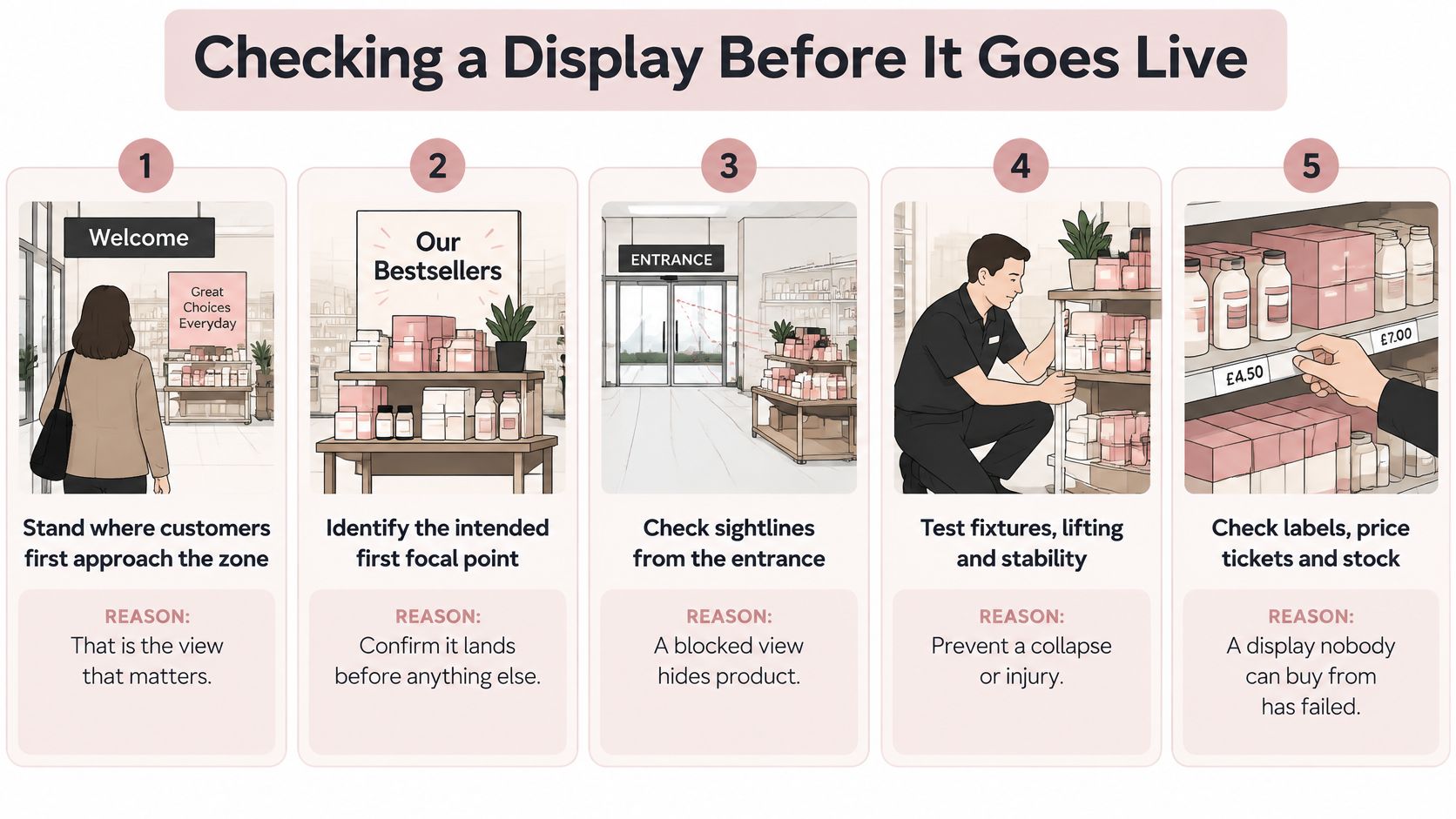
- Stand where customers first arrive. Walk in from the entrance or main aisle and stop where the zone first becomes visible. That's the view the floor gets judged on, not the one from inside the fixture where you've been working for two hours.
- Name the intended first point of attention. Say out loud what a shopper should see first, then move or remove whatever competes with it. If you can't name it in one sentence, the display doesn't have one.
- Test the story without a member of staff in it. Ask whether a stranger could tell what's being sold and how it's worn or used, with nobody explaining. If the answer needs a colleague, the signage or grouping is doing too little.
- Check legibility at that distance. Price, size, colour and usage information should be readable from where the customer stands, not from where you crouch.
- Group rather than label. Where a display holds many variants, use colour blocking, vertical grouping or clear category breaks. Adding more signage to a crowded fixture usually makes it worse.
- Strip out low-relevance noise. Props that don't support the story, old campaign cards, empty signage holders and stray hangers all read as disorder, and disorder is what depresses time in store.
- Review the zone as a system. Floor layout, windows, forms, lighting and product coordination all push on the same shopper at once. Fixing the mannequin while ignoring the lighting above it solves nothing.
- Sign off and log the configuration. Record what went live and when before you leave the floor. Without that record you'll have no way to tell next month whether the change worked.
Practical rule: if you can't explain the zone in one sentence and point to the product that proves it, the customer won't manage it either.
A zone passes when a customer walking past understands the offer, sees the price and reaches the stock without help. For the wider mechanics of tightening a floor, how to improve visual merchandising covers the layout decisions that sit above individual fixtures.
A Seasonal Window Changeover From Brief to Fix
The autumn knitwear brief arrived a week early, which was the first useful thing about it. The store was a two-storey town-centre unit with three windows and one stockroom that filled up fast in October. Before anything came out of the wrapping, the assistant checked with the stock team that the featured sizes and colours would be on hand for launch, and found that one of the three hero knits was landing in limited sizing.
On the Monday morning the old window came down, the body forms and rails went in, and the look got dressed to the plan. The check ran from the pavement first, then from the entrance, because those are the two views that count. The hero piece was half-hidden behind a prop at the entrance angle, so the prop moved left. Prices were confirmed against the system rather than against memory. The window went live on Monday afternoon, as planned, with the limited-size knit placed second in the story rather than first.
Three days later the log told a different story. The first-choice knit had sold out in the featured size, and the window was doing very little for that item because the rail behind it was empty in the sizes the display pointed at. That's a stock problem dressed up as a display problem.
The fix was unglamorous: flag the gap to stock, swap the featured piece for a size that was available, keep the rest of the composition intact, and record the change with the date and the previous configuration so nobody later mistook the original for the version that failed.

The reusable sequence:
- Brief week: confirm stock, sizes, colours and the launch date before you commit to a composition.
- Build day: strip the old installation, build fixtures, dress to plan, then run the sightline check from outside.
- Launch: go live on the scheduled date and log the configuration, the date and the featured SKUs.
- Day three: read the numbers, flag stock gaps, and correct the display rather than defending it.
- Record: note the change and keep the previous version on file, so the pattern is visible later.
Keeping campaign visuals consistent per SKU is where most of the discipline lives, and how to manage visual merchandising campaigns at scale is worth reading once you're handling more than one window. For the creative side, these retail window display ideas are a useful reference when you need a fresh approach within a fixed fixture budget.
Common Misconceptions and the Limits of the Role
That the job is mainly styling. Styling is the part that gets photographed. Installation, maintenance, data entry and coordination fill the rest of the week.
That a strong window guarantees sales. A display can't sell what isn't in stock, isn't priced correctly or isn't being replenished. Those failures show up as flat sales against a beautiful fixture, and they're the assistant's to escalate, not to hide.
That more props and signage always help. They usually don't. Excess choice and visual disorder tend to reduce how long people stay and how much they buy, so the discipline is subtraction.
That creativity alone is enough. Without product knowledge you won't know how the range is bought, which sizes carry the volume, or when a colourway is about to be marked down.
That it's only a short-term start. The pay spread and the widening responsibility described in the benchmarks above describe a career path, not a seasonal job.
The limits are worth naming plainly. An assistant can't fix a range problem, a pricing error or a supply failure with props and good lighting, and shouldn't try.
The honest test of the role is the floor you leave behind: readable, priced, stocked and standing, with a record that shows what changed and when.
Deciding Whether to Apply and Where to Start
Four questions settle most of the doubt. Do you enjoy physical, hands-on work with tools and fixtures? Are you comfortable keeping basic stock and sales records? Can you hit tight seasonal deadlines without dropping the daily reset? And can you travel between stores or work across more than one site? A yes to most of these suggests the role fits.
- Build a portfolio this week. Photograph displays you've dressed before and after, add the date, and add any measured result such as a sales change or sell-through figure. Ten dated pairs beat a page of adjectives.
- Get hands-on with fixtures. Body forms, garment rails, dump bins and stands behave differently under load and after repeated repositioning, and knowing how they adjust is what makes a build day fast. Display Guru sells body forms, full mannequins, garment rails, dump bins and baskets, furniture and other retail display products, and customers can chat with our online operators or use the Ask An Expert and Questions & Answers pages before buying.
- Ask employers the blunt questions. What training is provided, how progression is decided, and how much of the week goes on data logging versus building. The answers tell you whether the post is mostly execution or mostly administration, and that ratio matters more than the job title.
Ask before you commit to a course or an application. The stores that answer precisely are the ones with a structure worth joining.
If you're kitting out a floor or restocking the fixtures you build on, Display Guru supplies body forms, full mannequins, garment rails, dump bins and baskets, furniture and other retail display essentials, with a clear catalogue to work from. Browse the range at Display Guru, and if you're unsure which form or rail suits your space, our team can point you to the right option before you order.