


Theatre or Theater UK: Which Spelling to Use
In UK English the standard spelling is theatre for the art form, buildings and companies, while theater is the US form that stays only in proper names, quotations and imported sources.
Why do so many UK drafts still mix the two, as if a dictionary headword and a venue's own sign were the same kind of authority? They aren't. Your sentences follow British spelling. Someone else's registered name doesn't. Settling theatre or theater UK usage means separating those jobs before you touch find-and-replace.
The Short Answer for UK Writers
Theatre. That is the spelling for anything you write yourself.
UK English uses theatre for the art form, the building and the sector. You write a theatre company, West End theatre and theatre studies. Theater is the standard US spelling. It shouldn't appear in your own sentences, headlines or captions.
The difference is spelling only. Both forms are pronounced the same and mean the same thing. You aren't choosing a different art form, a different building or a shift in tone. You're choosing the letters that match the variety of English your reader expects.
The rule covers the writer's own text. Registered names, direct quotations and imported sources are handled on their own later. Don't fold those cases into the default, and don't let them leak into lines you composed.
Apply this three-point default on the next draft:
- Write theatre in all your own copy. That includes body text, subheads, captions and alt text you drafted.
- Keep theater only where it is part of a registered name or a quoted source. Don't invent a British version of someone else's title.
- Follow your house style guide if it sets a different rule. A US client brief can override the UK default for that one job.
House default: If you typed the sentence, the spelling is theatre. If someone else owns the name or the sentence, leave their letters alone.
The forms below sit side by side so you can check a live draft against them, term by term.
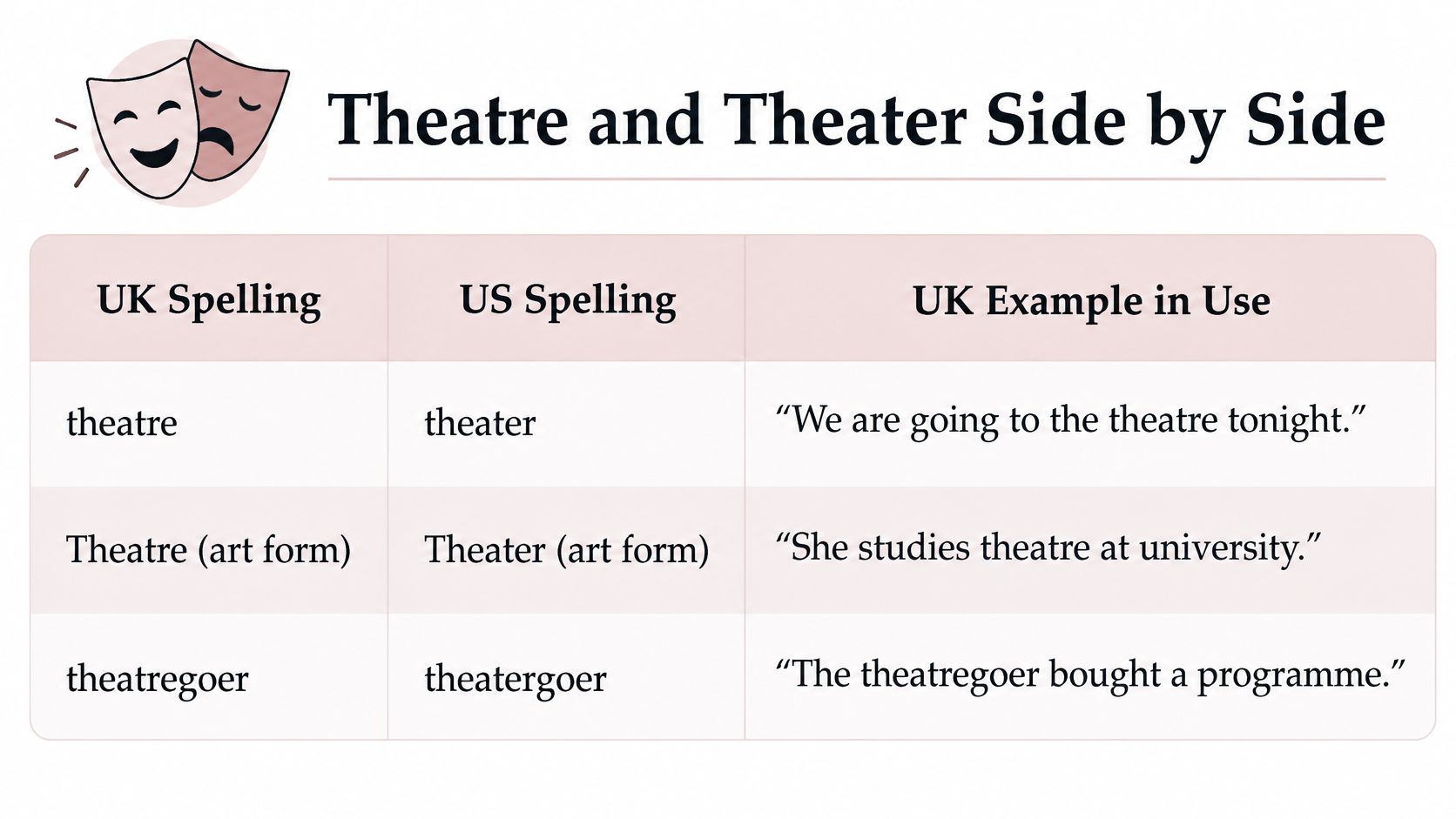
Theatre and Theater Side by Side
Use the table as a lookup, not as a rewrite of the whole piece. Each row is a common term: the UK spelling, the US spelling, and a UK example in use. Search your file for every theater, then match the hit to a row before you change a letter.
| Term | UK spelling | US spelling | UK example |
|---|---|---|---|
| Venue or art form | theatre | theater | a theatre in Leeds |
| Person who attends | theatregoer | theatergoer | a regular theatregoer |
| Adjective | theatrical | theatrical | theatrical costume (unchanged) |
| Theatre district | Theatreland | Theater District | evening in Theatreland |
| Company | theatre company | theater company | a touring theatre company |
The row that must not change
The adjective row is the reassurance. Theatrical is identical in both varieties, as in theatrical costume. Writers who are hunting US spellings sometimes "correct" words that were never split. Don't. If the letters already match on both sides of the table, leave the word.
Theatreland is the London district name in UK copy. Theater District is the New York form. A company you describe in your own words is a theatre company, as in a touring theatre company. Theatregoer takes the same -re and stays one word in straightforward UK copy. You may also meet the hyphenated theatre-goer in older house styles. Pick one and keep it.
How to run the lookup
Search the draft for theater and theaters. For each hit, ask whether the word is yours. If it is, change it to the UK column. If it is someone else's name or a quotation, stop and use the exceptions later in this article.
The table covers spelling only. A sentence that is correct in one variety stays correct in the other once the spelling is switched. You don't rewrite the grammar, the word order or the tense. "We are going to the theatre tonight" doesn't become a different construction in US copy. Only the vowel letters move.
Costume notes follow the same test. A line about hanging pieces on clip coat hangers between fittings should say theatre if you wrote it, even when the garment list sits next to a US play title.
Official UK Usage of Theatre
Official titles already answer the spelling question. UK bodies don't treat theatre as a flourish. They put it in the names of taxes, surveys and sector frameworks. The figures below are theirs. The spelling in those titles is the pattern to copy in your own sentences.
| Source | Figure | Detail |
|---|---|---|
| HMRC creative industries statistics, 2022–23 | 1,230 claims | £178 million in Theatre Tax Relief |
| HMRC creative industries statistics, 2023–24 | 1,380 claims | £261 million in Theatre Tax Relief |
| Theatres Trust modelling in the State of British Theatre report | 100 buildings | about £1.1 billion needed |
| National Theatre research report on the Theatre Green Book | 94% aware | 27% of productions at intermediate or advanced level |
| Arts Council England analysis of theatre in England | 2,173 organisations | 414 venues, 19% of the dataset |
| DCMS Participation Survey, England, 2023–24 | 10% of adults | watched a pre-recorded arts event, including theatre |
What the titles are evidence of
These titles and reports consistently use theatre. That gives UK writers an authoritative reference for their own copy, from a tax note to a schools handout. Students revising exam answers can find Drama and Theatre exam prep that keeps the same spelling in the subject name.
Keep the claim modest. The sources show consistent usage in their titles. They aren't a legal ruling on spelling, and they don't bind a US publisher. When you quote a figure, check that source's own title and keep its wording. A costume feature that cites public funding should still say theatre in the sentences around the number. Our notes on costume design for theatre follow that pattern in fittings, mock-ups and dress rehearsals.
Where Theater Still Appears in UK Writing
Theater can stay. It stays in four narrow cases, and nowhere else. Read the row before you "fix" a capitalised name.
| Context | UK spelling to use | When theater stays | Example |
|---|---|---|---|
| Venue or company name in your copy | the name as registered | the organisation writes it with theater | check the official website |
| Direct quotation from a US source | keep the original | inside quotation marks | a theater in New York |
| Film, brand or product names | exact brand spelling | the owner registers it with theater | check the owner's site |
| US-published references and citations | keep the published title | the title uses US spelling | citation as printed |
Registered names and quotes
If a venue, company or brand writes its name with theater, use the name exactly as that organisation writes it. Check the official website, not a social caption and not your memory of a poster. A direct quotation from a US source keeps its original spelling inside quotation marks, as in 'a theater in New York'. The quote marks show the letters aren't yours.
Brands, films and citations
Film titles, brand names and product names belong to their creators. Match the registered form, including the US spelling, even in a UK review. Academic references and US-published books follow the title page. If the published title uses theater, the citation uses theater. Changing it makes the reference harder to find.
Changing a venue's registered spelling to match your house style misnames the place. Readers searching for it won't land on the right box office.
Record each decision on your style sheet: the name, the URL you checked, and the spelling you kept. The next writer shouldn't reopen it. Rails and storage notes stay in UK spelling around that frozen name. A line about moving stock on costume rails still says theatre when the sentence is yours. This table is the exception list. Everywhere else, the general rule still applies.
Writing About the Spelling Itself
You can discuss the US form without adopting it. When the word is the subject, put theater in quotation marks so it reads as a term under discussion. The US spelling 'theater' differs from the UK theatre by the letters in the middle. The meaning is the same.
Match your draft to one of these patterns:
- Correct explainer: In US copy the spelling is 'theater'. In UK copy it is theatre.
- Incorrect, unquoted: We booked a theater for the fitting on Thursday.
- Corrected: We booked a theatre for the fitting on Thursday.
The incorrect line fails because theater is doing the writer's own work. No quote marks, no registered name, no citation. The corrected line puts the UK spelling back without changing the booking, the day or the fitting.
Don't put theater in your headings, even in a spelling piece. Use a heading such as UK and US spelling so the heading keeps the house form. Quoted uses still tell a reader what they searched for. Your own copy stays in UK spelling, including lines about props and costume handling.
Quoted uses of the word, where you are talking about the spelling, are excluded from the search routine below. Don't flag your own explanations as errors.
Apply the Rule and Run the Final Check
Run this routine on any draft before it goes out. The point of each step is to catch the repeat a manual read skips, without "correcting" a name the owner chose.
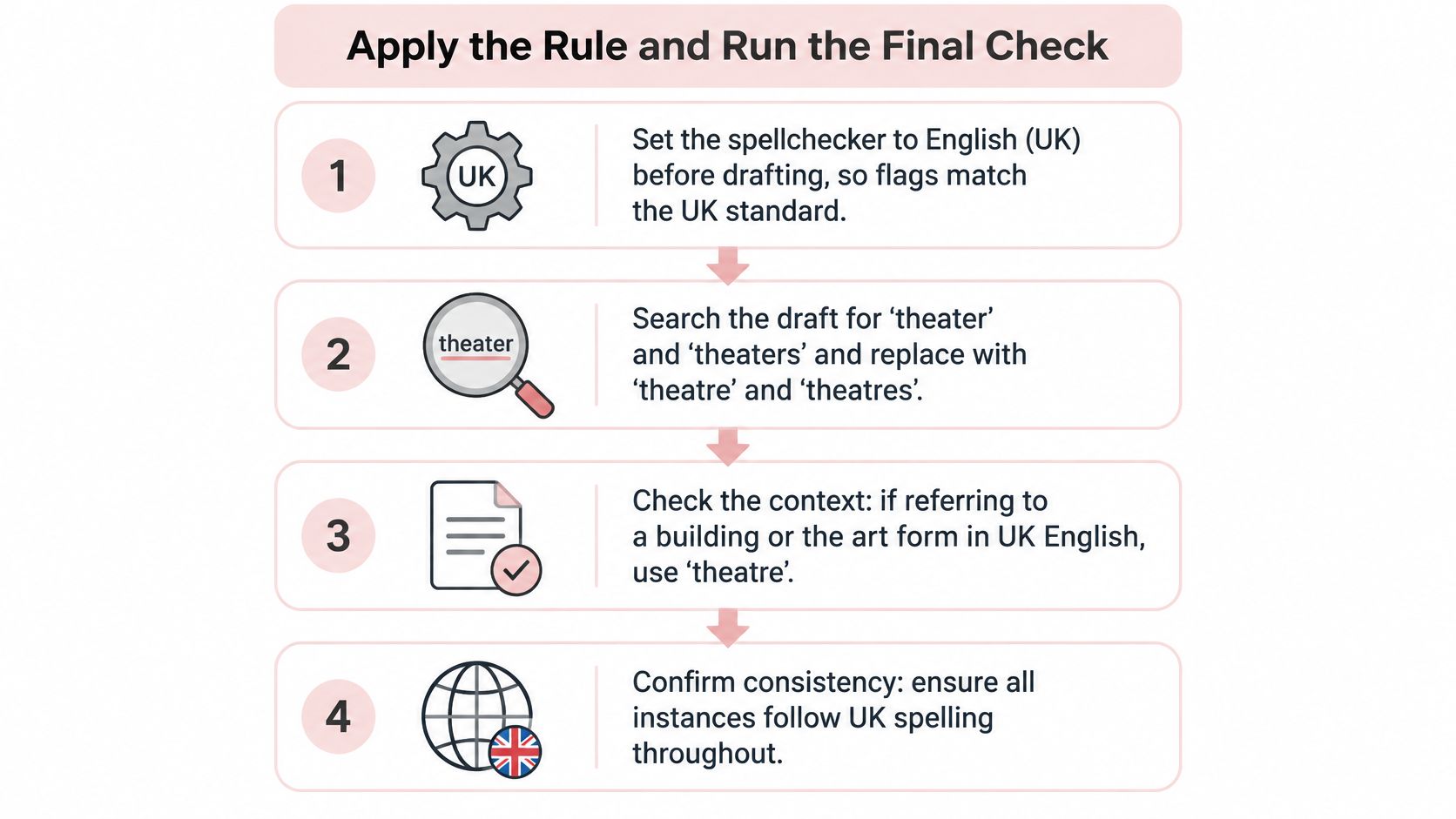
- Set the spellchecker to English (UK) before drafting. Flags then match the UK standard. A US dictionary will mark theatre as wrong and train you to accept the form you don't want. The slip is leaving the document on English (US) from a shared template.
- Search for theater and theaters and list every hit. A manual read misses the second and fifth repeat, especially in captions. Don't replace all. Listing comes first so a proper name isn't swept up.
- Sort each hit into three groups. Your own text changes to theatre. A registered name or brand stays once you've checked the official source. A quotation or citation stays unchanged, quote marks and all. The slip is treating all three groups as typos.
- Check plurals and compounds. Look for theatres, theatregoers, theatre-goer and theatre company. A global replace of theater can leave theaters half-changed, or it can split a compound you meant to keep.
- Check headlines, captions, image alt text and metadata. Spellcheck and on-page search often skip those fields. On our site at displayguru.co.uk, prices are shown in pounds sterling (£), and the same UK spelling belongs in product titles and alt text. A correct article with a US spelling in the title tag still looks inconsistent in search results.
- Record each proper-name decision on the style sheet. Note the source URL and the spelling you kept. The slip is leaving the decision in one writer's head, so the next feature "fixes" it back.
Writers who are new to UK arts desks can use this guide for new contributors chasing bylines alongside the style sheet, so a commissioning editor sees one spelling from the first paragraph to the bio.
A short walk-through of the same habit sits in the clip below. Watch it after the search, not instead of the search.
The five-minute pass
Run the search. Decide each hit against the exceptions. Look at headlines and metadata. Confirm the style sheet is updated. Storage copy is part of that pass: a caption for a double wardrobe hanging rail in a costume store should read theatre if you wrote it. The draft is ready when no unexplained theater remains and every exception has a source.
Display Guru supplies tailor dummies, garment rails and dump bins for costume fittings, retail display and sewing studios, so the same care you give to UK spelling can sit alongside tools that hold garments accurately between notes and rehearsals. Our catalogue is priced in pounds sterling and built for UK makers who write theatre in their own copy. Visit Display Guru to choose a form, a rail or a stand for the next production.