




Silver Clothing Rail Guide for Retail and Studio Use
A boutique owner has a delivery of new-season garments arriving tomorrow, but the shop floor is already crowded. One rail needs to move towards the window for a promotional display, another must return to the stockroom, and the sewing studio next door needs somewhere reliable to hang finished pieces without stretching them. The choice between a silver, black, or mixed-material rail suddenly becomes a decision about workflow, not decoration.
That distinction matters in a changeable retail environment. UK shoppers searched for “clothes rail” 4.3 million times in the last 12 months, with an estimated category market size of £3.2 million a year and a 3.5% conversion rate in the latest week. Searches also rose 5.5% over the most recent 90 days compared with the previous period, according to UK clothes rail demand data. A silver clothing rail sits inside that established category, but its value depends on more than colour.
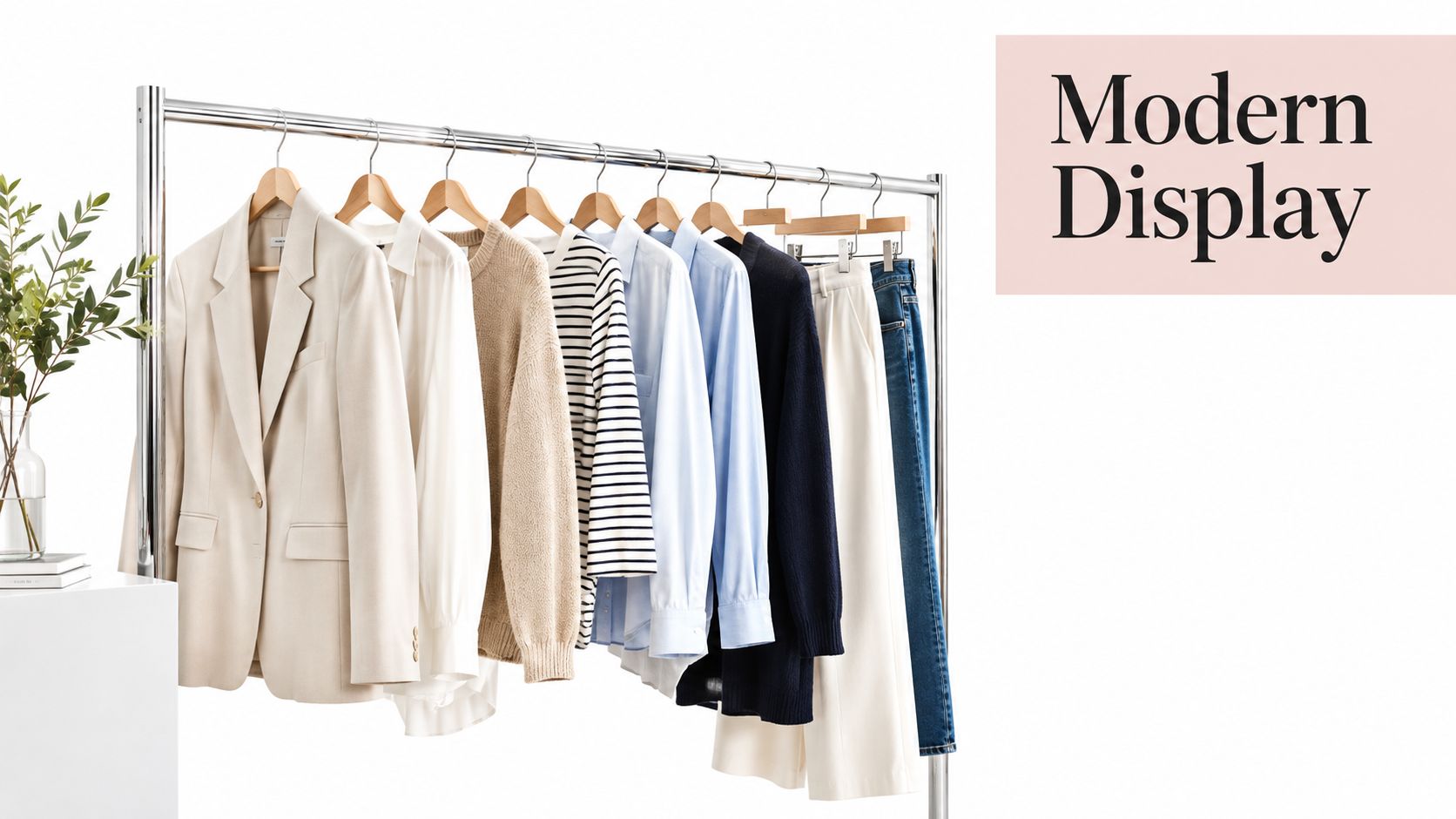
This guide approaches the rail as a practical fixture for retailers, dressmakers, costume teams, and sewing professionals. You'll learn how the silver surface differs from the steel structure beneath it, how to interpret load ratings, when freestanding or mounted formats make more sense, and how to care for the finish. The central question is simple: will the rail continue to work when your stock, layout, or trading conditions change?
Introduction to Silver Clothing Rails in Modern Display
Silver remains useful because it rarely dictates the identity of the garments around it. A boutique can place knitwear, denim, bridal samples, workwear, or vintage pieces on the same rail without creating an unintended colour story. In a dressmaking studio, the same neutral support keeps attention on fabric, cut, and fit rather than on a strongly styled fixture.
That makes silver a workhorse finish. It can sit beside timber, glass, painted walls, white shelving, or industrial fittings with little visual conflict. A matte black rail may contribute a stronger fashion statement, while a coloured rail can support a particular campaign, but those choices may become awkward when the shop changes brand direction or the fixture moves into a different room.
A fixture should earn its space
A rail earns its keep when staff can reposition it, customers can browse comfortably, and garments remain supported without the structure becoming cumbersome. For a small independent shop, that may mean using one fixture on the sales floor during the day and in a stockroom after closing. For a tailor, it may mean moving completed commissions away from cutting tables while keeping them accessible for pressing or fitting.
Silver also makes sense where resale or reuse matters. A neutral finish is less tied to one season's visual language, so a second-hand buyer, future tenant, or different department can usually integrate it without changing the surrounding scheme. That doesn't make every silver rail a good purchase. The frame, joints, wheels, finish quality, and stated capacity still require close inspection.
Practical rule: Treat the finish as one part of the buying decision. Treat the construction and the job it must perform as the foundation.
The category's active search demand reinforces the point. Buyers aren't looking only for a decorative object. They're searching for a familiar merchandising tool that can support garments in homes, shops, studios, and temporary spaces. A well-chosen silver clothing rail can therefore become part of a flexible operating system, rather than a fixture bought once and abandoned when the layout changes.
What Makes a Silver Clothing Rail Different
A silver clothing rail has two identities. The first is the visible finish, which may be shiny, satin, brushed, or softly metallic. The second is the frame beneath that finish, usually based on steel tubing, solid metal components, joints, feet, or castors. These two parts affect different outcomes, so separating them prevents a common buying mistake.
Think of a silver rail as you'd think of a bicycle. The paint or coating influences appearance and protection, but the tube shape, welds, wheel assembly, and frame geometry determine how the bicycle behaves. In the same way, a bright chrome effect can make a rail look substantial, but the section thickness, span, bracing, and connections determine whether it remains stable under garments.
Finish changes the way light behaves
Polished silver and chrome reflect more light than a dark matt surface. On a bright shop floor, that reflection can help the rail feel clean and open, particularly beside mirrors, glass, or pale walls. In mixed lighting, silver usually reads as restrained rather than as a strong brand colour, although a highly polished finish can show glare under direct spotlights.
Brushed or satin silver scatters light across a fine grain. It produces less mirror-like reflection and can make fingerprints less noticeable than they are on polished chrome. The trade-off is that the grain needs careful cleaning, because wiping across it can leave visible marks.
Silver isn't the same as stainless steel
The word “silver” describes the appearance, not necessarily the material. A rail may use steel with a chrome coating, stainless steel, polished nickel, or another silver-toned finish. Each option can have a different response to scratches, moisture, fingerprints, and cleaning products.
This is why a product description should be read in layers:
- Identify the base material. Look for steel tubing, stainless steel, aluminium, or a specific construction detail.
- Identify the surface treatment. Check whether the finish is chrome-plated, brushed, satin, polished, or painted.
- Check the structure. Adjustable joints, cross-braces, feet, and castors can affect practical performance more than the colour.
- Match the finish to the room. A reflective finish can suit a customer-facing display, while a softer surface may be more forgiving in a workroom.
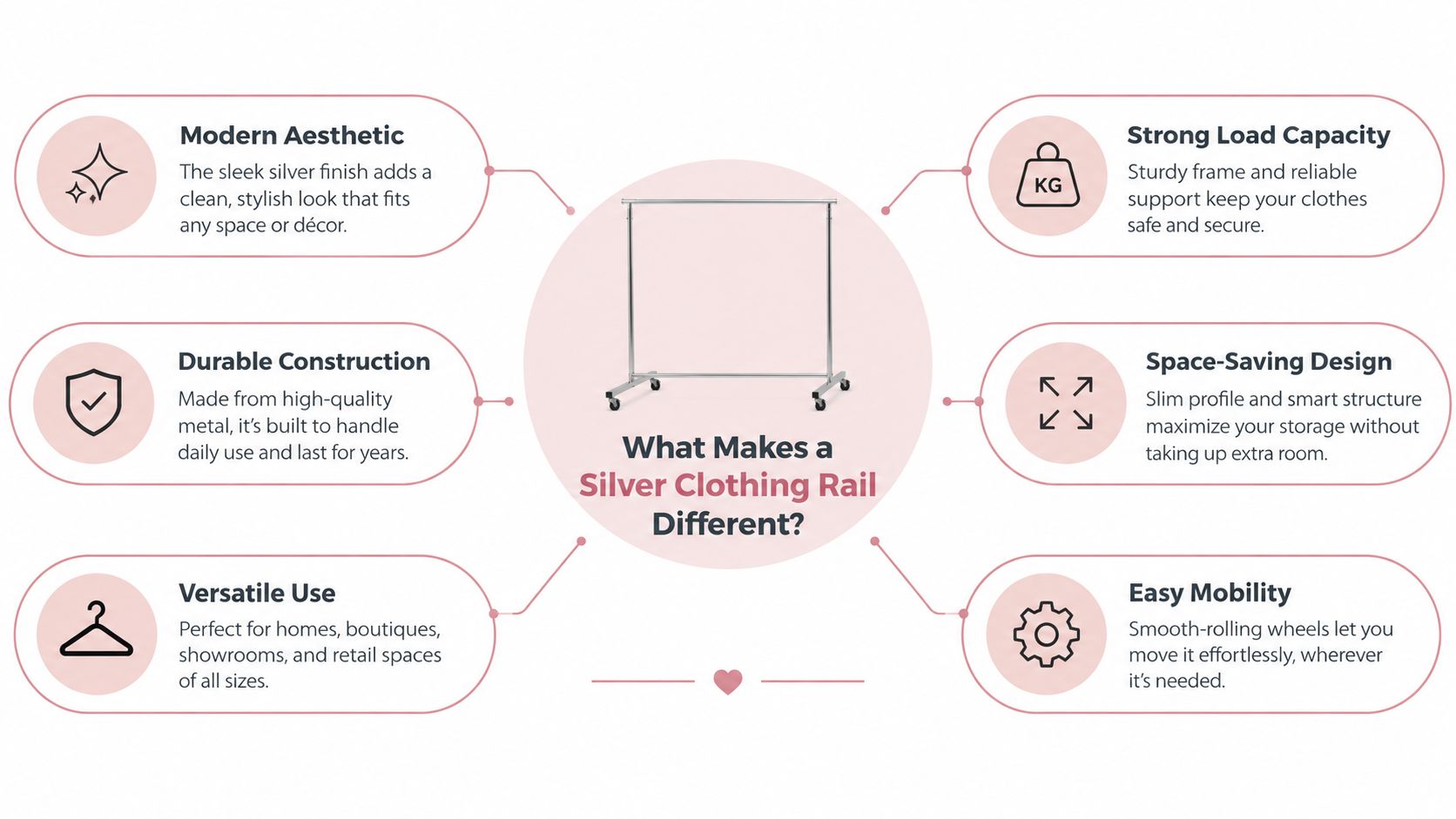
The useful mental model is straightforward. Silver controls visual integration. The frame controls working life. Once you understand that separation, you can assess a rail without assuming that a brighter finish automatically means stronger construction.
Silver Finishes Explained From Chrome to Stainless Steel
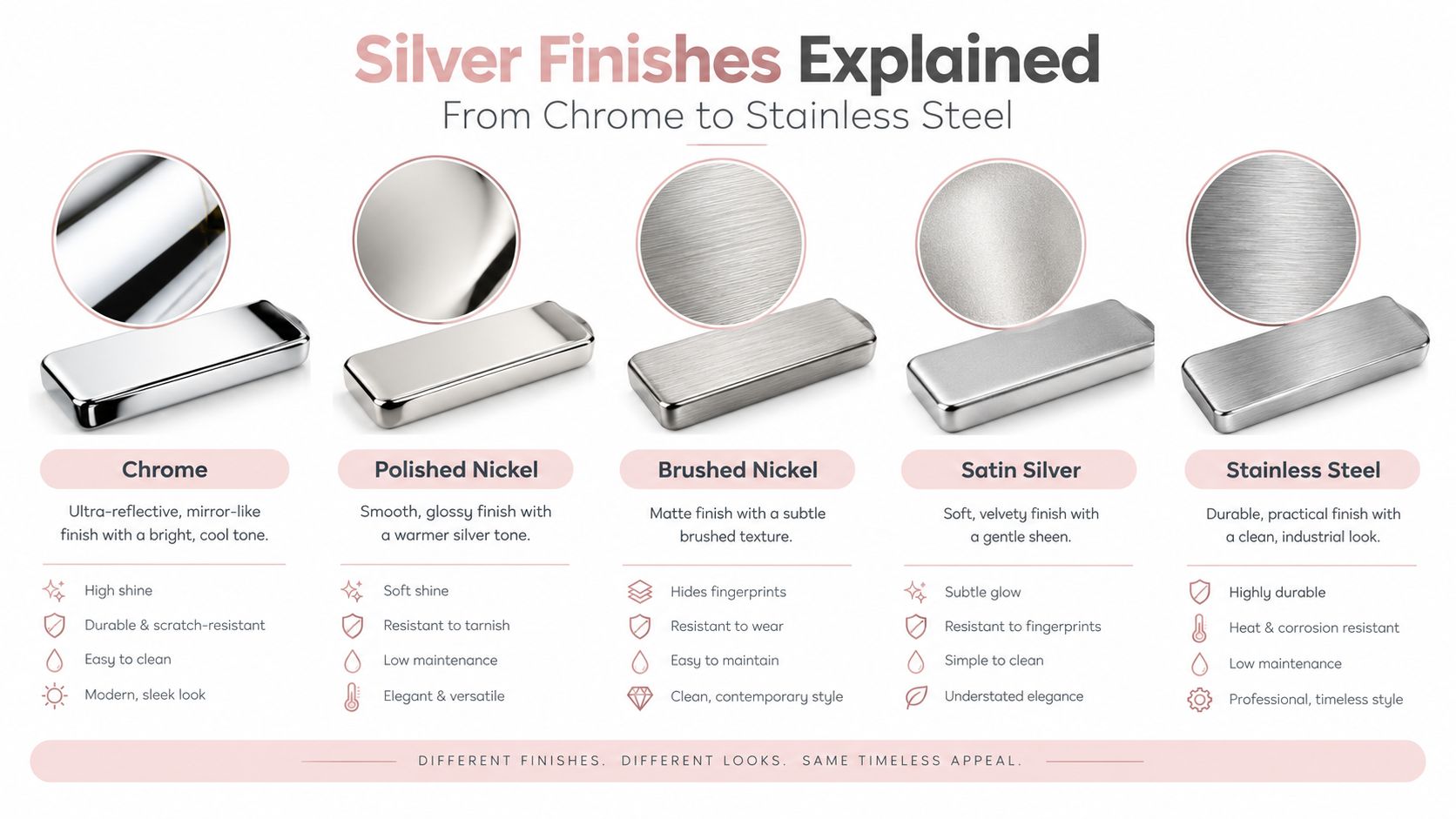
Chrome and stainless steel can both appear silver, but they create different experiences during daily use. Chrome generally gives the strongest shine. Stainless steel, especially in a brushed form, tends to look quieter and more textured. Neither finish is automatically right for every environment.
Chrome for high-impact presentation
Chrome is commonly applied as a surface layer over another metal. Its reflective appearance can suit a bright retail floor where the rail needs to look crisp beside mirrors, glass, and illuminated displays. It can also help a compact space feel visually lighter because the surface catches surrounding light.
The drawback is visibility. Fingerprints, smears, and small surface marks stand out more readily on a mirror-like finish. Cleaning therefore becomes part of the presentation routine, particularly around touch points such as end caps, height adjusters, and castor frames.
Use a soft cloth and a mild cleaning solution suitable for the product. Avoid abrasive pads and harsh scouring powders, since a polished surface can lose its even appearance when repeatedly scratched.
Brushed stainless steel for working environments
Stainless steel may offer a more muted silver appearance, with the brushed grain helping disguise minor handling marks. That can be useful in a busy workroom, costume department, or stockroom where staff move garments frequently and the rail needs to look orderly without constant polishing.
The grain must be respected during cleaning. Wipe in the same direction as the brushed lines rather than using random circular movements. This simple habit helps preserve the visual consistency of the surface.
Stainless steel can also be a sensible choice where the rail may encounter occasional moisture, though the precise grade and construction still matter. A label that says “stainless steel” doesn't remove the need to inspect joints, welds, feet, and fixings.
A practical comparison
| Consideration | Chrome-finished steel | Brushed stainless steel |
|---|---|---|
| Visual effect | Bright and reflective | Softer and more understated |
| Fingerprints | More noticeable | Often less obvious |
| Cleaning style | Gentle polishing with a soft cloth | Wipe with the grain |
| Best fit | Customer-facing displays and polished interiors | Studios, stockrooms, and busy handling areas |
| Structural meaning | Finish alone doesn't establish capacity | Material alone doesn't establish capacity |
The same principle applies to polished nickel, satin silver, and other metallic effects. They may change how a rail supports the visual merchandising scheme, but they don't replace a proper check of tube dimensions, joint stiffness, and the manufacturer's load guidance. For a closer look at a high-shine option, see this guide to chrome clothes rails.
Load Ratings and Strength You Can Trust
A silver rail earns its place in a busy UK shop by carrying stock safely through changing layouts, not by looking substantial. Garments rarely form a perfectly balanced row. Customers move hangers, staff may load dense coats on one side, and a mobile frame faces extra force whenever it is pushed.
UK retail listings show silver and chrome clothing rails with load ratings around 50 kg for standard single rails and up to 100 kg for reinforced adjustable rails, as shown in this UK clothing rail product listing. Treat these figures as reference points. The stated maximum may assume even distribution, a stationary frame, and a particular configuration.
The frame carries the real responsibility
Three construction details affect how confidently a rail handles stock:
- Wall thickness: Thicker tubing generally resists bending more effectively than a lighter section.
- Unsupported span: A long rail with little support can deflect under weight, even when the tube itself appears strong.
- Bracing and joints: Cross-bars, corner connections, welds, and locking mechanisms help the frame retain its shape.
Uneven loading deserves a separate check. A rail can perform well with garments spread across its length, then twist when heavy coats gather at one end. Distribute dense items instead of treating the rail like a shelf with all the weight concentrated in one place. This improves stability and can reduce strain on joints during daily handling.
| Rail type | Typical load rating | Key strength factor |
|---|---|---|
| Standard single rail | Around 50 kg | Heavy-gauge tubing with a simpler frame |
| Reinforced adjustable rail | Up to 100 kg | Better bracing, shorter unsupported spans, and stronger joints |
| Double-rail mobile frame using a 1.5 mm steel pole | Up to 180 kg in the cited structure | Double-rail geometry, wheels, and frame design |
| Lighter wardrobe-rail fitting | Around 12–15 kg | Smaller fitting and more limited structural support |
The cited commercial rail specification shows why tube thickness alone cannot predict capacity. A 1.5 mm steel pole can be rated to 180 kg in a double-rail frame with wheels, while lighter wardrobe-rail fittings may be limited to 12–15 kg. The frame arrangement, supports, and joints create that difference, not the silver appearance.
Read the small print: Check whether the rating applies to static storage, mobile use, evenly distributed garments, or a particular frame configuration.
For a shop floor, select a rail with practical room for dense stock and movement rather than loading directly to its limit. In a studio, assess the heaviest garments you handle, including coats, costumes, and partially completed pieces. A heavy-duty clothes rail guide can help you compare construction features when longevity and reuse matter more than finish alone.
Choosing Between Freestanding and Mounted Silver Rails
A boutique may need to turn a window display into a sale area before lunch, while a sewing room may keep completed garments beside the pressing station all day. The right silver rail depends on which task changes more often, the fixture's position or the stock it carries. Mobility or permanence sets the first decision, while the silver finish supports longer use, easier resale, and adaptation when the business changes direction.
Freestanding rails for changing layouts
Freestanding single rails suit boutiques that refresh windows, promotional zones, and seasonal collections. Add wheels when staff need to move stock without lifting the frame, then check that the castors lock securely. A rail that rolls easily but fails to stay still can become a nuisance near customers or fitting areas.
Double rails increase hanging capacity within one footprint, although the lower level can make browsing feel less open. Height-adjustable versions work like an adjustable workbench. They let one fixture hold short garments, long dresses, or pieces staged at different visual levels.
Pop-ups and temporary studios also benefit from freestanding rails. The frame can travel between locations, then return to a stockroom or workshop. Its limitation is stability: the floor should be reasonably level, and the frame needs enough depth and bracing to remain steady during movement.
Silver is practical here because a scratch or change in surroundings does not make the fixture unusable. A finish that sits comfortably beside different collections can preserve resale options when a shop closes, relocates, or changes its visual identity.
Mounted rails for a fixed working position
Wall-mounted rails suit stockrooms, sewing rooms, and narrow retail areas. They keep the floor clearer and make a long wall more productive, but the wall must accept the fixings. Installation should also match the expected load and the way staff handle garments.
A mounted rail works well when the same garments stay in one working position. A tailor might place one beside a pressing station for completed commissions. A stockroom team could run one along a wall for ordered collections, reducing the temptation to leave clothing on chairs or cutting tables.
Ceiling-hung rails create a distinctive visual effect and preserve floor space. They require careful installation and a suitable ceiling structure, so they fit planned interiors better than quick layout changes.
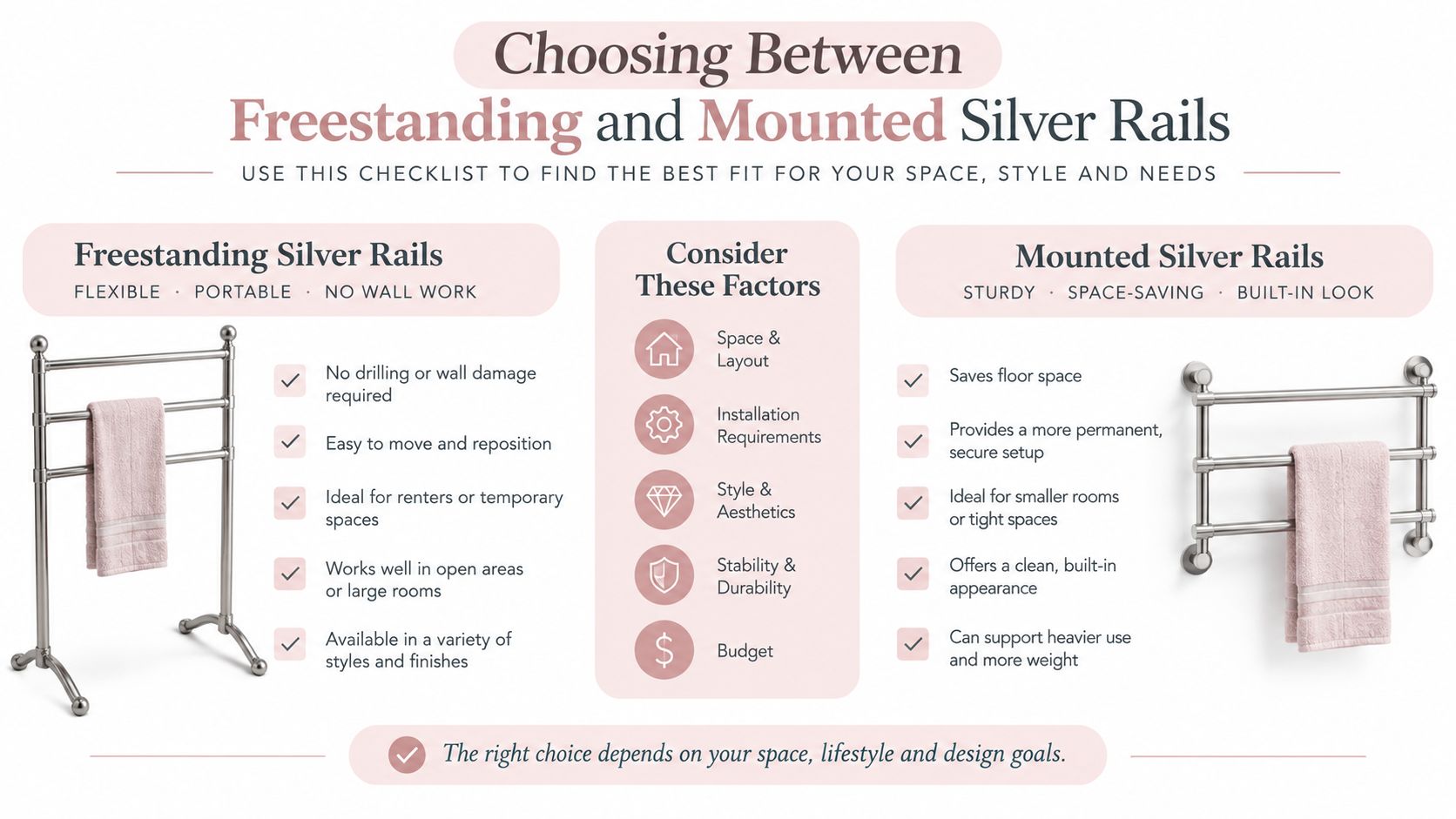
Construction matters more than the silver appearance. A commercial example shows how a complete frame, including its rails, wheels, supports, and joints, determines practical capacity. The same principle applies when comparing a mobile rail with a fixed one. Inspect the base, connection points, and wall or ceiling fixings rather than choosing by finish alone.
Use this wall-mounted clothes rail guide when assessing a fixed installation. Before buying, decide where the rail will live, what it will carry, and whether the room needs to change around it. That decision helps the silver finish serve an operational purpose, not merely a decorative one.
Ideal Uses for Silver Rails in Stores Studios and Pop Ups
Silver rails are especially effective when one fixture must perform several jobs. A retailer may use the rail for a front-of-shop edit in the morning, a fitting-room collection later, and stock organisation after closing. A dressmaker may move finished garments from a mannequin to a rail, then wheel them towards a client consultation area.
The finish helps because it's visually adaptable. Silver can sit beside a new wall colour, a different collection, or another supplier's display without forcing the rest of the room to match it. That quality becomes more valuable when the business can't assume that every season will bring the same customer response.
Retail floors under pressure
UK clothing store sales fell 2.4% in April 2026, with lower demand and greater price sensitivity cited by retailers. Clothing sales later rose 1.9% in June, supported by promotions and warm weather, according to the UK retail sales time series. Those movements suggest that fixtures should support quick changes rather than lock a shop into one permanent presentation.
A silver rail can support:
- Promotional edits: Move reduced or campaign stock to a high-visibility position, then return the rail to standard merchandising.
- Seasonal resets: Replace lightweight garments with heavier pieces without the fixture looking out of place.
- Mixed categories: Combine shirts, trousers, denim, or accessories where the rail needs to support more than one department.
- Pop-up presentation: Carry a neutral fixture into a temporary space without designing the whole environment around it.
Studios and specialist workspaces
In a sewing studio, the rail's value is practical. Keep cut pieces, fittings, finished garments, and client collections separate so that fabric doesn't collect on work surfaces. A silver finish also avoids competing with coloured textiles, which helps when you're assessing shades under different lighting.
Costume departments can use mobile rails for quick-change organisation, provided the frame matches the garments' weight and the wheels lock securely. For student designers and independent makers, a modular rail can support fittings, photographs, collection reviews, and temporary storage without demanding a permanent shop installation.
A wheeled format is worth considering when staff regularly change the display. This clothes rail with wheels guide focuses on the mobility decision, which should be made alongside checks for stability, capacity, and floor clearance.
Caring for Your Silver Clothing Rail and Keeping It Bright
Good care starts with avoiding unnecessary friction. Garments, hangers, and hands already create regular contact, so cleaning should remove dust and marks without adding scratches or loosening the surface finish.
Begin with a dry, soft microfibre cloth. Dust the top bar, end caps, adjustment points, base, and wheel frame before using any liquid. If the rail needs deeper cleaning, dampen the cloth with mild soapy water, wipe gently, and dry the surface afterwards.
Match the method to the finish
Chrome benefits from light polishing with a clean, non-abrasive cloth, especially where fingerprints collect. Don't use scouring pads or aggressive powders. A bright surface can become patchy when repeated abrasion dulls small areas.
Brushed stainless steel needs a slightly different habit. Follow the grain in one direction, rather than rubbing in circles. If the rail has a coated or painted silver surface, follow the supplier's care instructions instead of assuming that a stainless-steel cleaner is suitable.
Inspect the working parts
A clean rail can still become unsafe if its joints or wheels deteriorate. Add a short inspection to your routine:
- Check fasteners: Look for loose bolts, screws, or height-adjustment knobs.
- Test the castors: Confirm that wheels roll smoothly and that brakes hold the rail still.
- Look for movement: Gently test the frame for wobble before adding garments.
- Watch the surface: Record chips, dents, or exposed areas that could catch fabric.
- Move carefully: Empty or partly unload the rail before crossing thresholds or uneven flooring.
The UK clothing retail sector includes 11,261 businesses in 2026, with forecast market revenue of £49.4bn, according to the ONS retail sales bulletin. For many smaller operators, a fixture that can move between shop floor, stockroom, showroom, and pop-up use may be more useful than one designed only for a current trend. Independent commentary also identifies matte black, mixed-material, and recycled-steel rails as design directions, alongside height-adjustable and modular formats.
Silver's practical advantage is its neutrality. It can outlast a particular visual theme, provided the structure remains sound and the surface receives sensible care. For another metallic display option, explore wire chrome shelving, then compare its footprint and storage role with the hanging capacity you need.
Display Guru supplies garment rails, tailor dummies, body forms, and related display equipment for retail floors, sewing studios, fittings, and temporary merchandising. Visit Display Guru to compare practical display options and choose equipment that supports your silver rail strategy across changing layouts and garment types.