

Counter Display Unit Types, Sizes and How to Choose
A customer reaches your till with a card in one hand and only a few seconds to spare. That short pause, not the whole shop floor, is where a counter display unit has to earn its space. Get the format, dimensions and level of security right and those seconds can turn a planned purchase into a slightly larger basket. Get them wrong and you'll block payment, hide the cashier or lock away products nobody wanted staff help to buy.
Why the Counter Still Sells in 2026
In the Office for National Statistics retail sales bulletin for May 2026, Great Britain's retail sales volumes increased 1.2% month on month and 3.2% compared with May 2025, while volumes remained 0.4% below the February 2020 pre-pandemic level. Online sales represented 28.8% of retail spending, up from 28.1% in April. That leaves roughly 71.2% of sales through non-online channels, so the physical counter still handles most of the business.
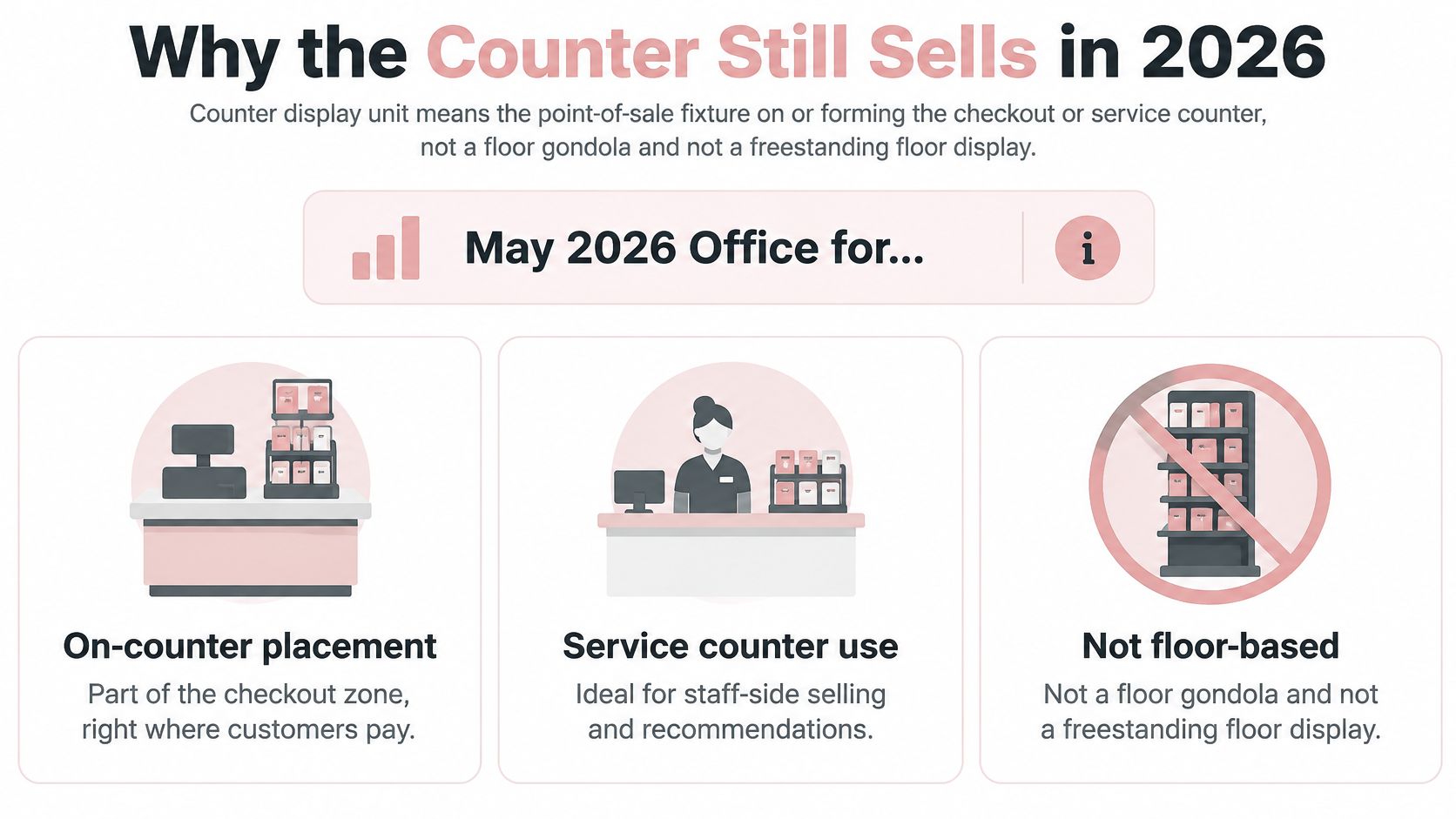
A counter display unit is the point-of-sale fixture that sits on, or forms part of, the checkout or service counter. It isn't a floor gondola and it isn't a freestanding floor display that shoppers walk around. Think of it as a waist-height shop window. People pause while paying, glance down and decide quickly, so the surface should show a few products they can see and handle rather than an entire range.
Say a small fashion shop has garment rails doing the main selling work. The counter doesn't need another clothing display. A compact tray of belts, care products or gift cards complements the rails, uses space beside the card reader and gives customers a simple add-on while they're already committing to pay. The same principle works for a craft shop with small packaged goods or a gift shop running a short promotion.
A long-established selling place
Counter merchandising belongs to a retail channel the Office for National Statistics has tracked through monthly series extending back to 1988. The organisation doesn't isolate counter fixtures as a separate category, but its long record confirms that in-store purchasing isn't a passing format. Online growth makes the remaining in-store moments more valuable, not less. You'll find broader context in these visual merchandising display principles, but the counter decision itself comes down to four choices. Choose the format, match it to product and traffic, respect the legal and accessible dimensions, then balance security against friction.
A counter display should sell one clear idea during payment, not try to reproduce a shelf in miniature.
Four Counter Display Unit Formats
Counter display formats compared
| Format | Best products | Customer access | Security | Typical use |
|---|---|---|---|---|
| Glass or glazed case | Jewellery, cosmetics, small electronics | View only unless staff opens it | High, lockable | Supervised service counters |
| Open-front tray or tiered riser | Confectionery, travel-size beauty, cards, batteries | Full self-serve | Low, relies on sightlines | Impulse goods beside the till |
| Branded counter or plinth | One hero range with printed graphics | Open top gives self-serve, closed top needs staff | Medium if weighted and staff-facing | Short promotions and supplier campaigns |
| Modular counter system | Mixed ranges that change weekly | Configurable bays | Medium, with optional lockable inserts | Independents that restock often |
Glass case and open tray
A glass or glazed case is a shop window you open on request. It suits jewellery, pricier cosmetics and small electronics because customers can inspect the finish and compare sizes while stock stays under staff control. The trade-off is speed. Every sale needs a key, an available member of staff and somewhere safe to place the item while payment continues. That's acceptable for a considered purchase, but it can frustrate someone buying a low-priced extra.
An open-front tray or tiered riser works like a sweet shop bowl. Customers pick up confectionery, batteries, cards or travel-size toiletries without asking. Tiers lift the back row into view, so a shallow unit can show several choices without becoming deep or cluttered. Security comes mainly from placement. If the cashier can't see into the tray, its convenience also makes it easy for stock to disappear unnoticed.
Branded plinth and modular system
A branded counter or printed plinth is a poster with a product on it. Use it for one hero range, a supplier launch or a seasonal offer that can be understood at a glance. Its graphics do the explaining, while the product sits on top or in a simple holder. Weight matters because a light printed unit can slide when customers lean on the counter. A staff-facing position and a stable base matter more than adding another small shelf.
A modular counter system is flat-pack shelving shrunk to counter scale. Individual bays, risers and inserts can be rearranged as the product mix changes. An independent shop might use open bays for cards one week, then fit a lockable insert for a smaller number of higher-risk items the next. Modularity costs more thought at the start because every bay still needs a defined job. Without that discipline, it quickly becomes a collection of leftover stock.
Practical rule: Don't mix jobs on one surface. Locking low-value chewing gum behind glass while leaving watches in an open tray gives you the inconvenience of the first format and the risk of the second.
Tick one primary format before you measure the counter. You can add an insert or a small secondary tray later, but the main choice determines how customers access stock, how staff restock it and how much of the transaction area you must protect.
Choosing by Product Space and Traffic
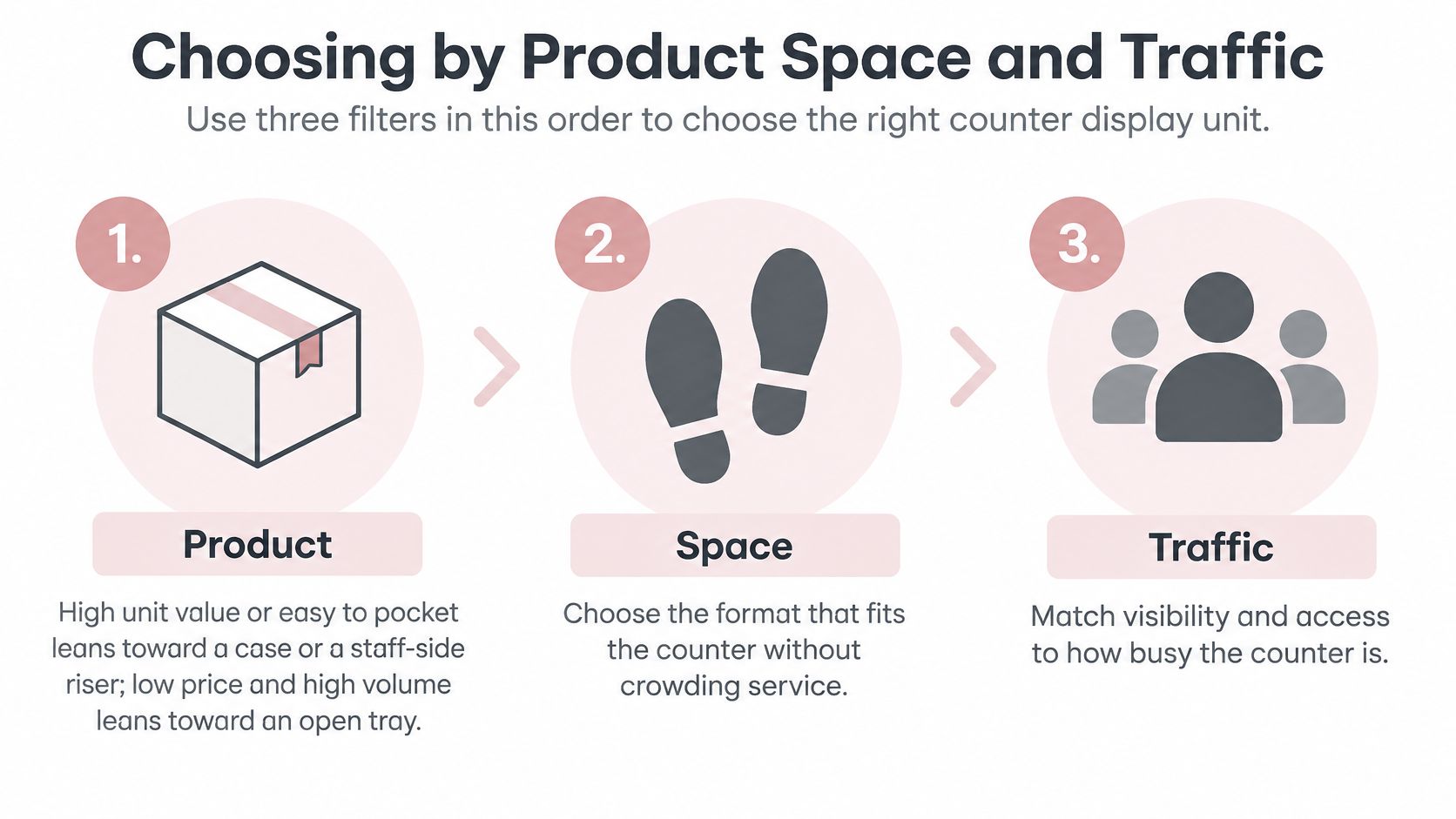
Work through three filters in order. Starting with appearance usually leads to the wrong answer because a handsome unit can still crowd the card reader or demand more staff attention than your queue allows.
Filter one product
Ask what happens if an item is picked up, damaged or taken. High unit value or a shape that's easy to pocket points towards a glazed case or a staff-side riser. Low price and high volume points towards an open tray that's no more than an arm's reach deep. Product size matters too. A narrow lipstick or battery pack can stand in tiers, while belts need a flat tray or hooks that stop them sliding into a heap.
For a boutique adding jewellery to an existing clothing offer, product choice and display security can't be separated. This jewelry buying advice for first-time resellers is useful background before you decide which pieces justify a lockable case and which lower-priced lines can sit in an open tester area.
Filter two counter space
Measure only the space that's spare after the till, card reader, bagging area and a clear place for customers to put a wallet or phone. Say a narrow till leaves only a 300-400 mm strip in a worked example. A single tier will serve you better than a deep cabinet that turns payment into a reach around a box. A wide service desk can take a modular run, but it still shouldn't cross the accessible transaction position or force staff to restock through the customer side.
Counter choice also interacts with the route shoppers take before they arrive there. These retail store layout best practices help you check that the queue forms where you expect it to, rather than approaching the unit from an unsupervised side.
Filter three traffic
A queue that backs up needs products readable in under five seconds, prices visible without picking items up and restocking from the staff side. A quiet boutique can use a branded plinth because customers may linger while staff wrap a purchase. In a convenience queue, a low riser for confectionery and batteries keeps the cashier visible. In a fashion shop, keep belts and small accessories light and open so the counter doesn't fight the garment rails for attention.
If more than one in five items on the unit needs a staff unlock during the peak hour, the format is too closed for that level of traffic.
Before ordering, mark four answers on paper.
- Primary product: Name the range the unit must sell first.
- Spare counter depth: Record the space left after payment equipment.
- Peak queue length: Note how long customers normally wait.
- Restocking owner: Confirm who fills it and from which side.
Heights Depths and Clearances That Work
Typical UK counter heights and clearances
| Situation | Height | Width or clearance | Depth or extra requirement |
|---|---|---|---|
| Lowered customer section | 750–800 mm above floor | About 900 mm transaction width | Knee recess about 700 mm high, 800 mm wide and 500 mm deep |
| Part of a shop checkout | 850 mm maximum for at least part of the counter | Card reader within easy reach | Avoid a deep top that forces a lean |
| External or forecourt unit | 1.5 m maximum height | At least 1.5 m clear footway | 100 mm tapping rail, stable, safe materials, high contrast |
The inclusive indoor counter
The Accessible Hillingdon Supplementary Planning Document supports an inclusive two-height approach. It recommends a lowered customer-facing section about 750–800 mm above finished floor level, with at least one accessible transaction position about 900 mm wide. It also identifies 850 mm as a suitable maximum height for at least part of a shop checkout or counter. This lets wheelchair users and people of short stature use the service point while leaving other parts at a comfortable working height for staff and standing customers.
For easier access, allow a knee recess of about 700 mm high, 800 mm wide and 500 mm deep, and put the card reader where customers can reach and read it without leaning across the counter. A deep top can leave a product visible but out of comfortable reach, while also placing the payment terminal too far away.
Keep display stock out of the accessible transaction position. Put the counter display unit to one side and check the layout from a seated eye level. If the unit hides the card reader screen or makes customers pass goods around it, it is taking up service space rather than spare space.
When a unit enters a pedestrian route
External promotions and forecourt displays need room for people who are passing by. Medway's display furniture guidance gives figures of 1.5 m maximum height, 1.5 m of clear footway and a 100 mm tapping rail for display furniture on a pedestrian route. A tapping rail at the base can help a visually impaired pedestrian detect the fixture with a cane.
Measure the unit's projection when loaded, not just the empty cabinet. Stock, hooks, baskets and promotional cards may extend beyond the frame. Check that the unit is stable, its edges are protected and its details contrast clearly with its surroundings before placing it outside.
Indoor counters do not need a tapping rail, but their transaction area must remain accessible. Set graphics and branding around those clearances, not across them. A large logo cannot make an unusable counter easier to reach.
Materials Durability and Useful Extras
Choose material by the damage it's likely to meet, not by a catalogue photograph. Counters collect keys, coins, wet umbrellas, coffee cups and repeated cleaning, often in the same hour.
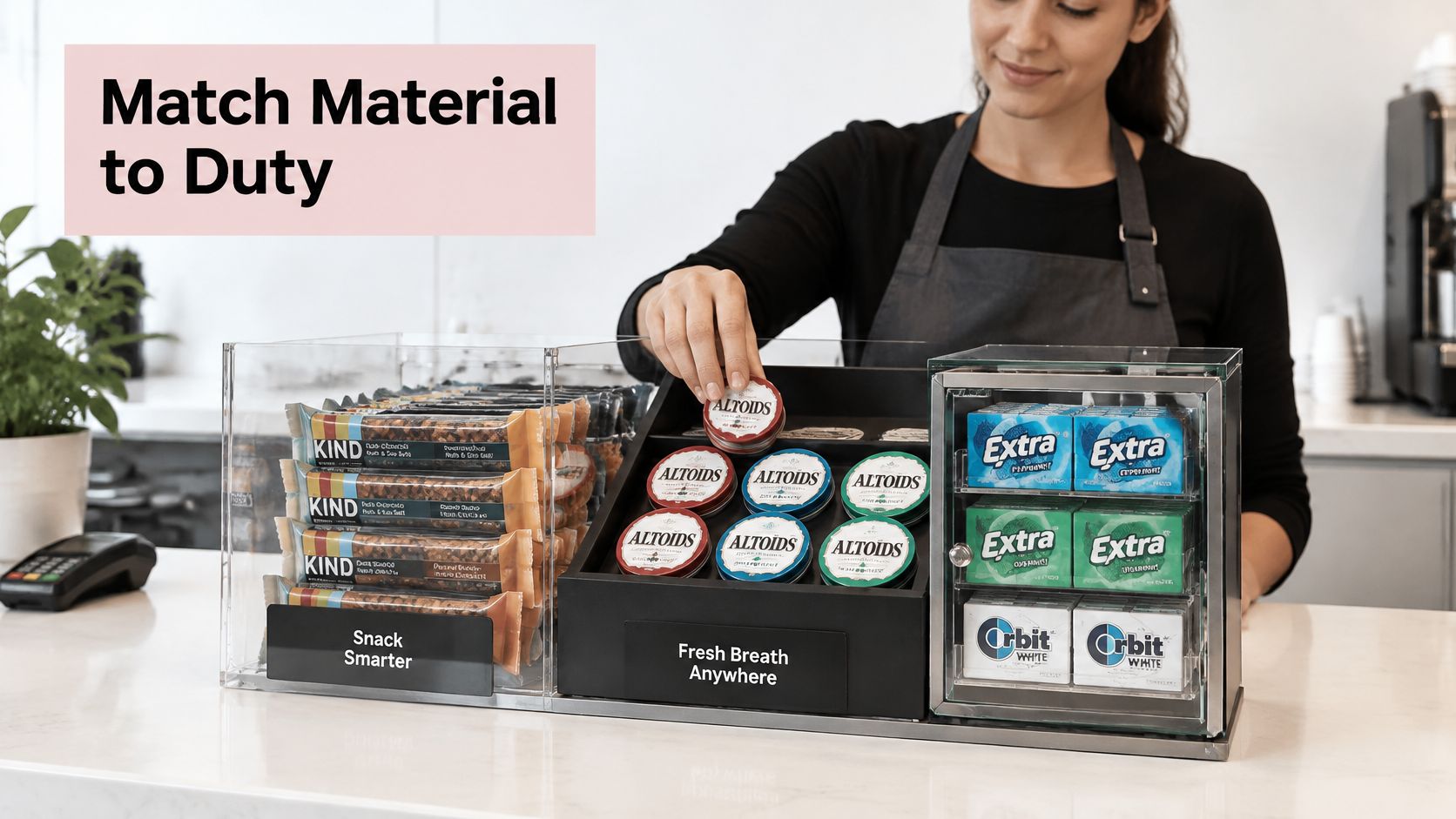
Acrylic and PETG give you a light, clear front for cosmetics, confectionery and small packaged products. They're easy to move during a reset, but sliding metal tins or gritty packaging across them can leave scratches. Glass stays clearer and feels more premium around jewellery, although it's heavier and needs polished, protected edges. Once a glass case is positioned, treat it as furniture rather than something staff should drag during every promotion.
Powder-coated steel and timber-effect panels tolerate knocks at a busy till and suit a permanent branded unit. Untreated MDF is less forgiving. A spilt drink can swell an exposed edge, after which the unit looks tired even when it's clean. Whatever the structure, colour should contrast with both the product and the counter edge. A pale soap bar on a pale tray is easy to miss, and a dark unit against a dark floor is harder for customers to judge at the edge.
Extras with one job each
- Tiered riser: Lifts the back row so customers don't have to move front stock. This guide to retail display risers covers how size and finish affect that choice.
- Header card: Carries one offer price or one short product claim.
- Lockable insert: Protects the few lines that justify staff help.
- Price holders and tagging pins: Keep prices attached to the right product during restocking.
- Non-slip mat: Stops an open tray creeping towards the customer or till.
Skip motorised or illuminated add-ons unless there's already a safe power point that doesn't intrude into the knee recess or create a trailing cable. A lit edge isn't useful if cleaning staff unplug it every night and nobody reconnects it correctly.
Any unit used outside must satisfy a stricter test. The Medway display furniture guidance requires furniture to be stable and secure, constructed from suitable safe materials and visually distinct, with a 100 mm tapping rail, a maximum 1.5 m height for freestanding items and at least 1.5 m of unobstructed footway. Finish with a simple durability check. Surfaces should wipe clean, trays should be replaceable and feet shouldn't mark the counter when the unit is lifted for cleaning.
Installation Maintenance and Customisation
Install in an order that protects access first and adds merchandise last.
- Measure before delivery: Confirm the spare counter depth, the 750-800 mm lowered section and the knee recess, then mark the card reader position on your plan.
- Secure the unit: Fix a non-freestanding unit to the counter where the design requires it. For a unit projecting into an outdoor route, check ballast or fixings and compare the loaded weight with the manufacturer's figure.
- Set the base: Fit non-slip mats before placing trays or inserts, so you aren't lifting a stocked unit to correct sliding.
- Run a sightline test: Stand where the cashier stands and confirm you can see every open tray and lockable compartment. Then stand on the customer side and check that prices are readable.
- Stock from the staff side: Arrange replenishment so customers never reach past the till and staff don't block the accessible transaction position while restocking.
Customise one element per refresh. Start with a colour that contrasts with the stock, then change the header for the current offer, then alter inserts for higher-risk lines. Changing all three at once makes it impossible to tell which alteration affected sales or created a queue.
A short weekly routine
Wipe contact surfaces, inspect feet for grit that could scuff the counter and replace cracked or cloudy trays before they make clean stock look old. Re-run the sightline test after every reset because a taller seasonal product can hide the tray behind it. Log damage with a date and a named owner. That turns repairs into scheduled work instead of another improvised fix during the Saturday rush.
Security Cost and a Realistic Payback
Maximum enclosure is not the sensible default. It can protect stock while removing the quick, self-serve decision that makes a counter display unit profitable.
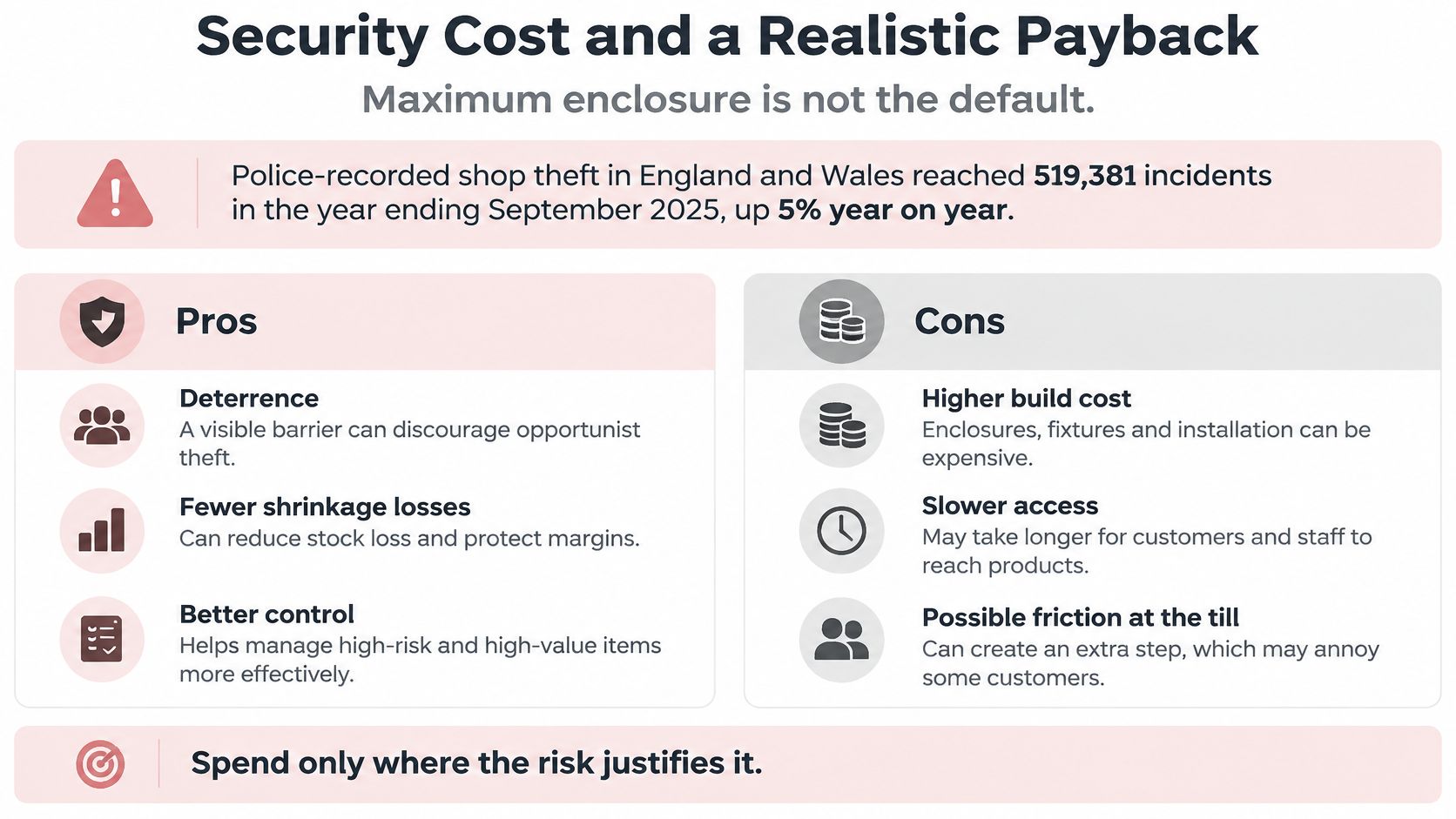
The Association of Convenience Stores report on shop theft states that police-recorded shop theft in England and Wales reached 519,381 incidents in the year ending September 2025, up 5% year on year. Convenience retailers reported more than 6.2 million theft incidents over the same period. The gap matters because a shop's daily experience can be much larger than the recorded-crime figure suggests.
Split products by risk
Keep low-value promotional stock in an open tray inside the cashier's sightline. The likely loss from an occasional missing item may be smaller than the sales you'd lose by making every customer ask for help. Put higher-risk lines on a shallow staff-facing riser or in one lockable compartment. Reserve a full glazed case for products whose value, size or resale appeal justifies slower access.
Height and depth affect security as much as a lock. A tall brand block can conceal hands and create a blind spot between cashier and customer. A deep tray lets items at the back disappear from view, while a shallow, well-lit riser keeps gaps obvious. If staff can't see an empty facing quickly, they can't tell whether the product sold, moved or was taken.
A lockable compartment also needs an operating rule. Staff should know where the key stays, who can open it and what happens when that person is serving someone else. These retail alarm installation considerations are useful when you're deciding whether display-level controls need support from wider shop security. For the locked portion itself, a purpose-built lockable glass cabinet is easier to manage than adding a makeshift lid to an open tray.
Work out payback from extra margin
Don't judge the unit by total counter sales because some customers would have bought those products from a shelf anyway. Track only the extra units sold because they sat on the counter, then subtract extra theft and staff time spent opening.
Say, in a simple example, a basic tray is quoted at £80 and it produces an extra £15 of margin a day. It covers its purchase price in about a week before theft losses. Say a larger branded or modular unit is quoted at £400 on the same margin. It needs about a month. Your own quotes may sit elsewhere, so reuse the calculation rather than treating those example figures as a price list.
Open for impulse, locked only for the lines that justify the friction.
Log incidents by product and position, then move or enclose the affected display before asking staff to confront anybody. Compare durability and replacement parts on a like-for-like basis, not just the cheapest printed finish. The cheapest unit isn't economical if it needs replacing after its trays crack or its lock begins sticking during the peak queue.
Layouts by Shop Type and Your Next Buy
A fashion or alterations counter works well with a shallow open tray for belts, socks and care products. Customers can touch those add-ons while the till and wrapping area stay clear. If garments need a counter presence nearby, our full size male hanging mannequin is suited to displaying T-shirts, jackets, dresses, sweaters and accessories on a counter or hanging for craft shows, photos or design. We also sell body forms, full mannequins, garment rails, dump bins and baskets, furniture and other retail display products.
A convenience or gift queue needs a two-tier open riser for confectionery and small packaged goods, with any higher-risk item in a single staff-side compartment. Customers can help themselves to the fast lines, while staff retain a clear view across the till. A card spinner creates a similar decision, and these greeting card display stands show how product density changes the space needed.
A beauty or jewellery service desk should keep valuable lines in a glazed case and place testers or low-price extras in a separate open zone. Browsing then doesn't require a key, but the stock that matters stays in staff sight. When you're deciding which extras genuinely belong beside a main purchase, exploring product relationships with ELECTE can help you examine which items customers commonly buy together.
Buy from measurements
- Measure the spare depth and protect the 750-800 mm accessible section.
- Match the format to the product, counter space and peak traffic.
- Order the unit that fits the measured counter, not the largest unit that looks good in a photograph.
Shortlist suppliers using those same checks. If we're on your list, contact us by phone on 01942 386640 or by email at sales@displayguru.co.uk for a quote based on your measurements.
Measure your counter, choose the format that fits your product and queue, and avoid paying for security your low-value impulse lines don't need. Display Guru supplies retail display products for counters and the wider shop floor, so send us your dimensions and product list and we'll help you shortlist a counter display unit that leaves payment clear and accessible.