




Clothes Rack White
You've found the right white clothes rack for a small bedroom, studio, or shop floor, but one question remains: will it still look composed once it carries winter coats, denim, or a week's laundry? A white finish can make a room feel lighter and help garments take centre stage, yet appearance alone won't tell you whether the frame will bend, mark easily, or occupy more floor space than expected.
The useful way to assess a clothes rack white is to treat it as a working fixture, not just a piece of furniture. Finish, tube diameter, base geometry, castors, load rating, and garment type all affect the result. The guide below connects those details to real merchandising jobs, home studios, compact flats, and retail stockrooms, so you can choose a rail that suits the work it needs to do.
What a White Clothes Rack Actually Does
A Saturday boutique rush exposes a weak garment rail quickly. Customers pull at heavy coats, staff move the fixture towards the mirror, and a narrow base begins to wobble under an uneven load. At home, the problem looks different. A renter may need somewhere to hang freshly washed clothes without filling a room with a folding airer or marking the wall.
A white clothes rack is a freestanding or wall-mounted tube-and-frame fixture with a white coating. It belongs to the wider UK hanger and rail ecosystem, alongside chrome rails, black rails, wooden valet stands, and built-in wardrobes. Its quiet job is to keep garments supported, visible, accessible, and separated from the floor.
That job changes with the setting. A drying rail needs airflow and easy access to damp clothing. A closet rail prioritises daily storage. A display rail must make garments easy to browse while remaining stable through repeated handling. Terms such as garment rail, display rail, drying rail, and closet rail describe similar shapes, but they answer different briefs.
Practical rule: Choose the rail for the heaviest garment and busiest movement it will face, not for the lightest outfit you'll hang on it.
A 19mm domestic tube may be perfectly sensible for shirts and T-shirts. It isn't automatically suitable for dense denim, costumes, or outerwear. If you're organising sewing projects, a resource such as Floriani U Design It clothes can help you think about how garments are arranged before you decide whether you need a simple line, a drying solution, or a stronger display fixture. For a broader explanation of portable formats, this guide to portable clothing racks is also useful.
Why Finish and Material Matter in the UK Market
The white surface is only the visible part of the buying decision. The material beneath it determines how the rack behaves when hangers slide across the tube, castors meet uneven flooring, or a stockroom becomes humid.
Powder-coated steel is the practical everyday option for many rails. The coating gives the frame a uniform finish and is generally more forgiving than a painted board surface during routine handling. Chromed steel provides a hard, wipeable exterior and can suit fitting rooms or rails that need quick cleaning after customer use. Epoxy-coated wire often appears on lighter portable units, while painted pine or beech brings warmth to a boutique, studio, or home interior, though timber can show knocks and scuffs more readily.
Moisture deserves direct attention in UK homes and stockrooms. A coated steel frame is usually a more sensible choice than an MDF-faced rail where damp air, wet clothing, or frequent cleaning is likely. That doesn't make any white rail waterproof. Joints, exposed edges, damaged coating, and low-quality hardware still need protection.
You'll encounter these finishes through mainstream home retailers, department stores, and specialist visual-merchandising suppliers. The same white appearance can therefore conceal very different construction standards. Read the substrate and coating description instead of treating “white” as a specification.
Common white rail finishes in the UK market
| Finish | Substrate | Durability | Best setting |
|---|---|---|---|
| Powder-coated white | Steel | Good for routine garment handling when the coating is intact | Home storage, studios, retail display |
| Chrome with white components | Steel and coated fittings | Wipeable, but visible damage can affect the appearance | Fitting areas and mobile retail use |
| Epoxy-coated white | Steel wire or light steel | Suitable for lighter, occasional use | Portable home storage |
| Painted white | Pine or beech | Warm appearance, but marks can be more visible | Boutiques, homes, photography and styling |
| White-faced board | MDF or composite panels | Vulnerable to moisture at edges and joints | Dry interiors with light use |
A specialist supplier's white garment rail range shows why finish should be considered alongside rail format, accessories, and intended use. A white rail can look calm in a photograph, but the right substrate determines whether that calm survives daily work.
Breaking Down Construction and Load Ratings
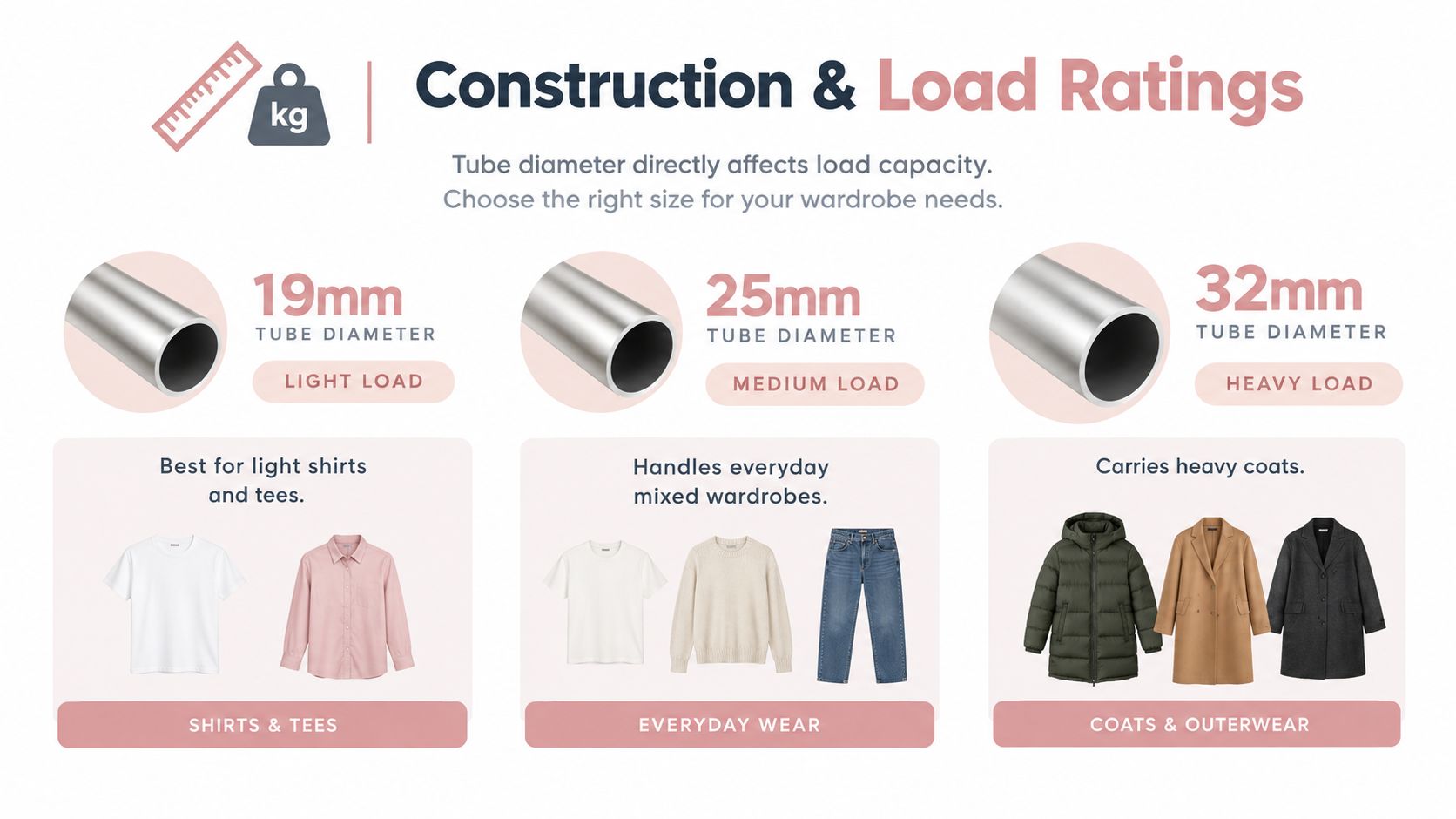
A white rack in a home studio may hold a small edit of garments, while the same-looking fixture on a shop floor may carry a full collection through repeated handling. Tube diameter gives the first clue about that difference. A 19mm tube generally suits lighter domestic storage, 25mm provides a stronger everyday option, and around 32mm industrial-grade steel tubing is commonly used for heavier retail and stockroom rails. Some commercial systems use larger sections for demanding display work.
Diameter alone does not decide performance. A larger tube can make the frame stiffer, but wall thickness, weld quality, base width, crossbars, castors, and weight distribution also affect stability. A long rail with a broad, well-supported base may handle garments more reliably than a shorter rail with thin tubing and weak joints.
What the rating tells you
In the UK, a commercial example of a heavy-duty white clothes rack uses 32mm industrial-grade steel tubing, references testing to BS EN 16121, and gives an evenly distributed rating of 160kg to 200kg (Displaysense heavy-duty rail specifications). The same comparison lists lighter domestic rails with 19mm to 25mm tubing and 30kg to 50kg ratings.
Use a load rating for a correctly assembled rail with weight spread across its hanging area. It does not mean every garment can be pushed into the centre. A balanced row of hangers places less stress on the frame than one dense, concentrated bundle.
Signs of an under-engineered frame
- Thin tube: It may flex across a long span once loaded.
- Narrow feet: A tall rack with limited lateral spread is easier to unsettle.
- Plastic feet and light castors: These may become weak points on hard floors or thresholds.
- Single-point T-joints: Check whether the upright and base depend on one small weld or a stronger connection.
- No crossbar: Long hanging spans have less support against sag and twisting.
For a practical explanation of commercial rail specifications, read this guide to heavy-duty rails. Tube diameter is a useful starting point, not a complete buying decision. Match it with the stated test standard, the expected garment weight, and the base's stability.
Retail Versus Domestic Rails at a Glance
A retail rail must withstand repeated handling. Staff load it, customers browse it, castors cross the shop floor, and the fixture may be restocked several times each day. A domestic rail has a quieter job, such as holding a selected wardrobe, a temporary outfit, or sewing garments between fittings.
The difference is easiest to see in the relationship between construction and use. As noted earlier, the heavy-duty retail example has 32mm industrial-grade steel tubing, references BS EN 16121, and carries an evenly distributed rating of 160kg to 200kg. The comparison places lighter domestic rails at 19mm to 25mm with 30kg to 50kg ratings. These figures describe different working demands, rather than interchangeable versions of the same fixture.
Retail vs Domestic White Clothes Rack Specifications
| Specification | Retail-grade rail | Domestic rail |
|---|---|---|
| Typical tube | Around 32mm industrial-grade steel in a heavy-duty example | Commonly 19mm to 25mm |
| Verified load range | 160kg to 200kg evenly distributed in the cited example | 30kg to 50kg in the cited comparison |
| Base requirement | Broad, stable geometry for dense hanging and movement | Smaller footprint for lighter storage |
| Castors | More suitable for repeated shop-floor movement when properly rated | Often intended for occasional repositioning |
| Standard reference | BS EN 16121 appears in the cited retail specification | May have less detailed commercial testing information |
| Replacement parts | More likely to be available from specialist suppliers | Often replaced as a complete unit |
| Best use | Stockrooms, boutiques, studios, frequent handling | Low-volume home storage and occasional use |
The practical choice follows the job. A fully stocked shop, costume store, or busy studio needs retail specification when people will move and handle the rail repeatedly. A domestic rail suits light loads and occasional repositioning, especially where a failure would not interrupt trading or put valuable garments at risk.
Load also affects presentation. A rail used for a compact edit can remain easy to browse, while a shop-floor rail may need a wider base and stronger components to support dense stock without becoming awkward to move. The fixture should match both the garments and the frequency of handling.
For formalwear being stored during a move, pack suits in wardrobe boxes may be more suitable than leaving everything on a mobile rail. A wardrobe box protects garments during transport, while a rail is designed for access, selection, and presentation.
Sizing Rails to Garment Type and Room
Rail length should follow garment mass and room geometry, not hanger count alone. UK merchandising guidance indicates that a 6ft rail can hold roughly 60 to 80 light garments, but only about 40 thick winter pieces. A 2ft rail may hold about 20 to 30 light items or around 15 thick garments (Displaysense capacity guidance).
That difference changes the buying decision. A dense row of wool coats needs more space between garments for browsing and more structural capacity than a rail of linen shirts. If the rail feels crowded, customers can't see silhouettes clearly, and the frame carries a concentrated, awkward load.
Match the span to the room
- Short rail: Useful for a narrow hall, a small dressing area, or a selected outfit edit.
- Middle-length rail: The most adaptable choice for a bedroom, home studio, or compact shop display.
- Long rail: Better suited to stockrooms, fitting areas, and collections that need separation by category.
Measure the full footprint, including the base and castors. Then check doorways, lift access, skirting boards, and the route from delivery point to final position. A rail that fits the wall may still fail at the doorway.
Height matters too. Adult garments need enough clearance to hang without touching the floor, while a lower presentation can make selected pieces easier to see in a boutique or studio. For dresses and long coats, measure from the hanging bar to the floor rather than relying on the advertised overall height.
Room check: Mark the rack's footprint on the floor with masking tape before ordering. Walk past it carrying a laundry basket or garment bag, then test whether doors and drawers still open fully.
Why White Works for Visual Merchandising
White isn't merely a safe colour. It can be a deliberate merchandising tool because it reduces competition between the fixture and the product. A colourful dress, textured knit, or sculptural jacket becomes the visual focus when the rail recedes into a pale interior.
That restraint is especially useful in concept stores, gallery-style boutiques, fashion studios, and product photography. A white rail coordinates with seasonal signage and props without imposing another strong colour family. It also makes a fixture easier to reuse when the product range changes.
The benefit is clearest when the collection carries visual variety. Group bright garments together and the rail supports the colour story. Arrange neutral garments by texture and the white frame keeps the composition quiet. For e-commerce photography, a clean rail can also reduce distractions around the garment, although the final image still depends on lighting, background, and camera angle.
Where white becomes demanding
White shows what darker finishes hide. Dust stands out in a window display, shoe brushes can leave marks, shopping bags can scuff lower sections, and raw indigo denim may transfer colour to an untreated or damaged surface. A white rail therefore rewards a consistent cleaning routine, particularly in environments where garments change often.
A black or darker rail may be more forgiving in a workwear shop, muddy entrance, or stockroom with rough handling. White is the stronger choice when garment colour, texture, and silhouette should dominate. For a fuller explanation of how fixture colour influences presentation, see this guide to retail colour psychology.
Styling a Rail for Shop Floors and Small Homes
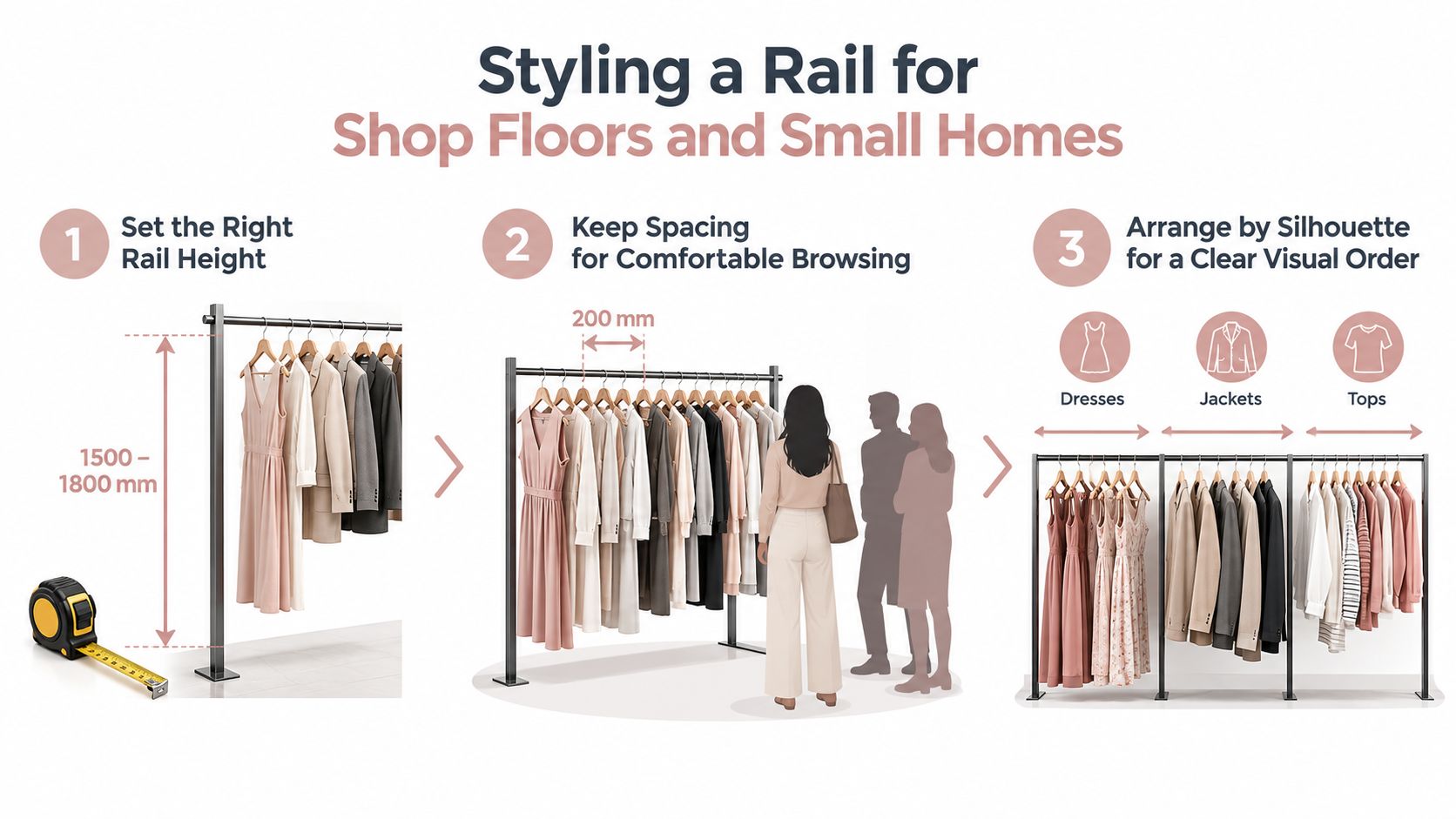
On a shop floor, the first impression comes from the space around the clothes, not just the garments themselves. A rail set at a comfortable adult browsing height lets customers scan the collection without stooping or reaching. Leave enough separation between hangers for sleeves, collars, and fabric textures to remain visible.
A simple boutique arrangement might place knitwear at one end, tops in the centre, and outerwear at the other. Another rail could group pieces by colour family, moving from pale neutrals into stronger shades. Both systems work because they give the eye a predictable path.
Browsing principle: If a customer has to push ten garments aside to understand the rail, the fixture is carrying too much visual information.
In a small home, use the same discipline on a smaller scale. A two-tier rail against a blank wall can hold current outfits above and shoes or folded accessories below. Keep the lower level clear enough to prevent hems brushing the floor. A single mirror angled towards daylight can make the area feel intentional without adding another bulky fixture.
Leave a clear walking route around the rack. In a bedroom nook, that may mean reducing the number of garments rather than choosing a longer rail. In a studio, it may mean placing the rack beside the cutting table, not between the table and the door. The most attractive arrangement is one that lets you remove, style, photograph, and return garments without dismantling the room.
For more ways to build a strong presentation without relying on a mannequin, read how to display clothes without a mannequin.
Keeping a White Rail Looking New
White racks don't need constant attention, but they do need the right attention. Most marks become harder to remove when dust, dye, and handling residue sit on the coating for too long. A short routine protects the finish and gives you an early warning when a joint, castor, or weld begins to loosen.
Start with a weekly pass using a clean microfibre cloth. Work along the horizontal tube, then wipe uprights, base bars, end stops, and castor housings. The lower sections deserve extra attention because shopping bags, shoes, garment covers, and floor dust reach them first.

A simple weekly routine
- Remove the garments: Cleaning around a full row of clothing leaves hidden dust and increases the risk of transferring moisture to fabric.
- Wipe the tubing: Use a dry or lightly damp microfibre cloth, then dry the surface.
- Check for denim transfer: Inspect the contact points where raw indigo jeans or dark garments rest against the rail.
- Test the movement: Roll each castor, engage each brake, and look for wobble when the rail is empty.
- Inspect the joints: Loose fasteners and creeping connections are easier to correct before the rail carries a full load.
Monthly, wash the frame with mild, pH-neutral soap diluted in water. Apply the solution to the cloth rather than soaking the rail, particularly around joints, threaded fittings, and castors. Rinse residue away with a clean damp cloth, then dry the entire frame thoroughly.
Avoid bleach, abrasive pads, scouring powders, and oil-based polishes. Bleach can affect coatings and nearby fabrics, abrasive tools can dull or scratch the surface, and oily products can leave a film that attracts dust or changes the finish's appearance. Test any new cleaner on a concealed area first, especially on painted timber or a rail with mixed materials.
Powder-coated steel still benefits from sensible placement. Keep the rack away from radiators and direct south-facing windows, where prolonged heat and ultraviolet exposure can gradually affect the surface. Damp rooms also call for ventilation and prompt drying of any condensation.
The buying checklist
Before ordering, confirm these points:
- Measure access: Check doors, stair turns, lift access, and the final room footprint.
- Match tube to clothing: Around 25mm suits lighter everyday garments, while around 32mm is associated with heavier commercial use in the cited UK specification.
- Check the stated rating: Add your realistic garment load and leave sensible headroom rather than treating the maximum as a target.
- Review the finish: Gloss can feel sharper under bright retail lighting, while matte white often sits more discretely in a warm home interior.
- Examine mobility: Decide whether you need lockable castors for changing displays or a fixed rail for a permanent arrangement.
- Confirm replacement parts: Specialist rails may offer compatible bars, extensions, or castors, which can be useful when a setup evolves.
The first decision to make is whether the rail must move. A mobile display needs dependable castors and brakes. A permanent rail can devote more of its design to anchoring and rigidity. Once that choice is clear, tube diameter, finish, length, and accessories become much easier to narrow down.
Display Guru supplies white garment rails, centre bars, height extensions, tailor dummies, and body forms for retail displays, sewing studios, costume work, and home organisation. Visit Display Guru to compare rail formats and choose a display setup that matches your garments, available space, and working routine.