

How to Start Clothing Line: A UK Guide to Launching Your Brand
Before you even think about fabric swatches or design sketches, the journey to launching a clothing line starts with a solid strategy. It's less about fleeting fashion ideas and more about deliberate, careful planning. This initial phase is all about defining your unique niche, getting to grips with your target customer, and building a business plan that actually works.
Building Your Brand’s Foundation
Laying the right groundwork is what separates a flash-in-the-pan trend from a brand with real staying power. The UK clothing market is an exciting place, but it's also incredibly crowded. A powerful brand foundation is your best tool for cutting through the noise. It all starts with deep, honest research and a crystal-clear strategy.
The UK clothing retail market is a massive space, projected to hit £67.8 billion in 2025. This is a significant comeback for a sector valued at £72.3 billion overall, which makes up about 2.8% of the UK's GDP. Even though the industry saw a 2.0% annual decline in the number of clothing retail businesses between 2020 and 2025 due to consolidation, the market's growth shows it's resilient and full of opportunity for anyone coming in with a smart plan.
This visual breaks down the process, moving from initial research and strategy to creating a solid plan for your business.
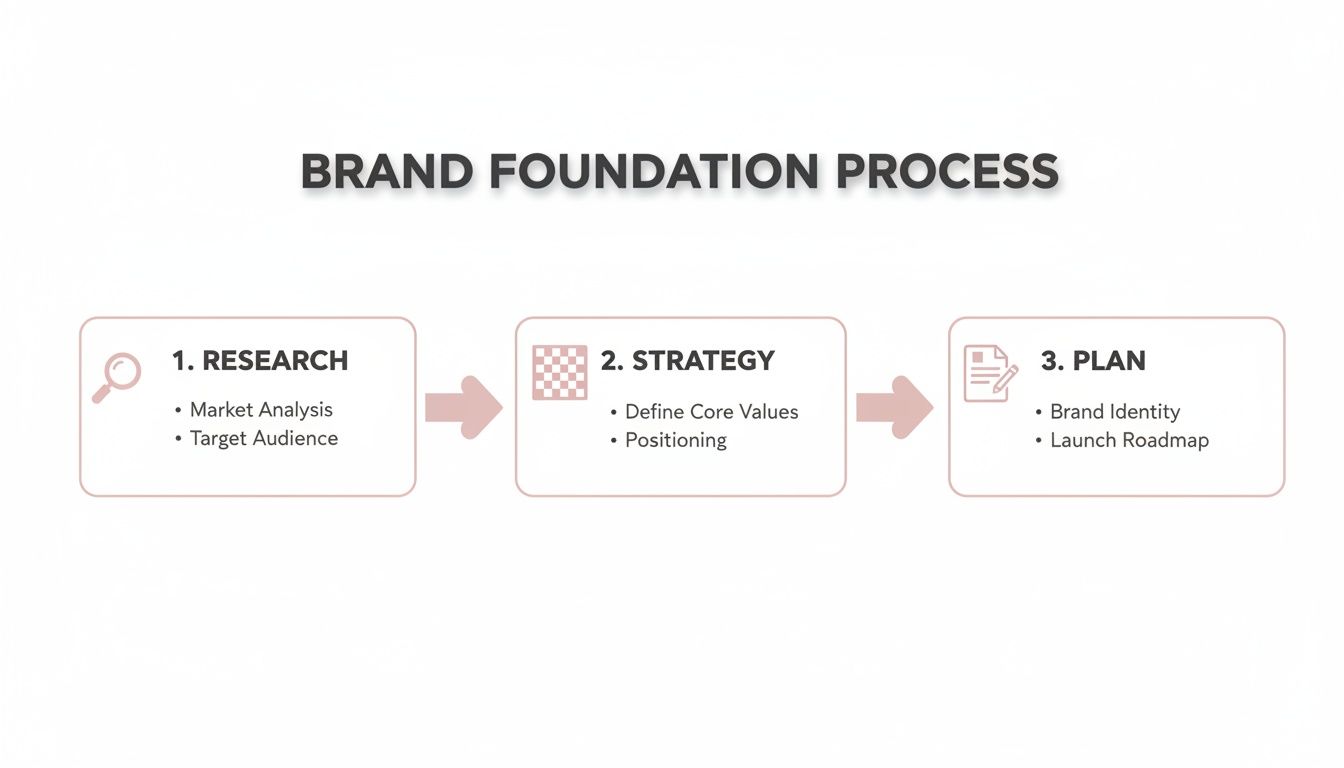
It’s a great reminder that a successful brand isn't just built on good design. You need a structured approach where every step logically follows the last, ensuring your launch is built on strategy, not just hope.
Define Your Niche and Audience
The first question you should ask isn't "what should I sell?" but rather, "who am I selling to?" A vague concept like "cool t-shirts" is a surefire way to get lost. You need to carve out a very specific space for yourself. Who is your ideal customer? Go deeper than just basic demographics.
- Psychographics: What do they care about? Think about their values, hobbies, and aspirations. Are you targeting eco-conscious city dwellers, lovers of retro gaming, or minimalist fitness buffs?
- Pain Points: What's missing for them in the current market? Maybe they can't find durable workwear with a modern cut, or ethically produced children's clothes in neutral colours.
Before a single design is sketched, you have to know exactly who you're making clothes for. It’s worth learning how to properly identify your target audience to give your brand a fighting chance. This deep understanding is what will allow you to create products and a brand story that genuinely connect with people.
Analyse the Market and Find Your Edge
Once you have your niche dialled in, it’s time for a bit of detective work on your competitors. Take a close look at the brands already talking to your target audience. What are they getting right? And more importantly, where are they falling short? This analysis is crucial for defining your Unique Selling Proposition (USP)—that one thing that truly sets you apart.
Your USP could be anything from:
- Unmatched Quality: Using premium fabrics or superior construction methods.
- Sustainability: Offering a completely transparent and ethical supply chain.
- Inclusivity: Providing a much wider range of sizes than your competitors.
- A Unique Aesthetic: A signature design style that nobody else is doing.
Your USP is your promise to your customer. It’s the reason they should choose you over the countless other options out there. It needs to be clear, compelling, and reflected in everything you do.
Create a Realistic Business Plan
Think of your business plan as your roadmap. It’s the document that translates your creative vision into an actionable strategy, guiding your decisions and keeping you from getting side-tracked. It doesn’t need to be a 100-page epic, but it absolutely must cover the essentials.
Here are the key things to include:
- Mission and Vision: A clear statement spelling out your brand's purpose and where you see it going in the long term.
- Product Lineup: An outline of the first collection you plan to launch.
- Financial Projections: A realistic budget covering start-up costs, production, and marketing, plus a pricing strategy that ensures you'll actually make a profit.
- Sales and Marketing Strategy: Your game plan for reaching your target audience and driving sales, covering everything from your e-commerce site to your social media channels.
This foundational work is, without a doubt, the most important part of starting a clothing line. Taking the time to build this strategic base will make every step that follows—from design to launch—more focused, efficient, and ultimately, far more likely to succeed.
From Design Concept to Physical Sample
This is where the magic really happens. Your sketches and mood boards are about to become something real—a piece of clothing someone can actually wear. Turning an idea into a tangible garment is a hands-on, meticulous process. It’s the point where creative vision meets the technical, practical world of fashion production, and honestly, getting this stage right is make-or-break.
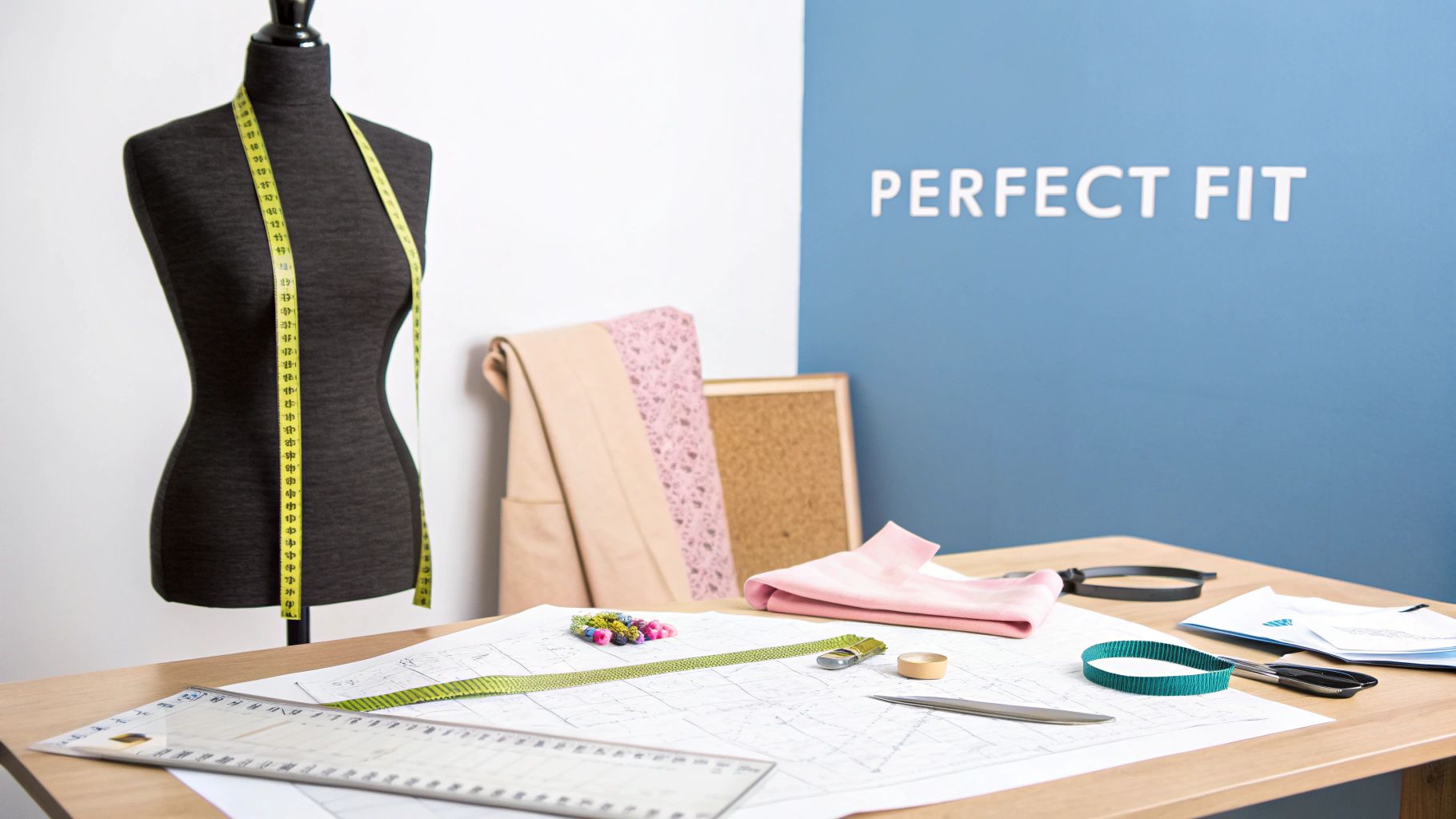
This pre-production phase isn't a single step; it's a journey. You’ll move from technical drawings to pattern cutting and through several rounds of samples. Each stage is built on the last, all with the goal of making sure the final product is a perfect match for what you imagined in terms of fit, quality, and feel.
Creating the Technical Blueprint
First things first, your beautiful design sketches need to be translated into a universal language that pattern cutters and factories understand. That language is the tech pack. Think of it as the ultimate instruction manual for your garment. It’s a comprehensive document that leaves absolutely no room for interpretation.
A solid tech pack is non-negotiable and must include:
- Technical Drawings: Clean, flat sketches of the garment from every angle—front, back, and side.
- Measurement Specs: A detailed size chart with specific points of measurement, like the chest width or inside leg length, for every size you intend to sell.
- Construction Details: Specific instructions on the type of stitching, seam finishes, and any complex techniques needed.
- Bill of Materials (BOM): A complete list of every single component, from the exact fabric and thread colour to the zips, buttons, and labels.
A vague tech pack is a recipe for disaster, leading to production errors, wasted materials, and a lot of back-and-forth. Putting in the effort here will save you a world of headaches (and money) down the line.
From Pattern to First Prototype
With your tech pack finalised, the next job is creating the pattern. This is the paper or card template used to cut the fabric pieces for your design. Whether you work with a freelance pattern cutter or a full-service manufacturer, this is a highly skilled craft that fundamentally determines the garment's structure and how it fits.
Once that pattern is ready, it's time to create the first prototype (or first sample). This is your first real look at the design in 3D. Don’t expect perfection just yet! The goal of this initial sample is simply to test the pattern and construction. It’s your starting block, not the finished article.
The Make-or-Break Role of Fittings and Sizing
Now comes the crucial part: perfecting the fit. The fitting process is all about adjusting the sample until its shape, drape, and comfort are exactly right. This means putting it on a fit model or, far more practically for a new brand, a professional tailor's dummy.
Using a mannequin is essential for achieving consistent sizing across your entire collection.
A proper tailor’s dummy, or body form, gives you a standardised shape to work from, letting you assess the fit without any bias. During a fitting, you’ll:
- Check the overall balance and proportions.
- Pin and chalk any areas needing adjustment, like a gaping neckline or a twisted seam.
- Make sure the garment hangs beautifully and allows for natural movement.
I’ve seen so many startups make the mistake of fitting clothes on themselves or a friend to save money. This is a false economy. It inevitably leads to inconsistent sizing because every human body is unique. A professional mannequin ensures your size 12 is always a size 12, which is absolutely vital for building customer loyalty and minimising returns.
Knowing how to measure correctly is a core skill here. If you need a refresher, check out our guide on how to take body measurements for clothes. This knowledge is gold when creating your tech pack and checking your samples.
To keep everything on track, a clear checklist is your best friend.
Essential Pre-Production Checklist
| Stage | Key Action | Essential Tool/Document |
|---|---|---|
| 1. Design Finalisation | Finalise sketches and design details. | Sketchbook, Mood Board |
| 2. Tech Pack Creation | Create a detailed blueprint for the factory. | Tech Pack Template, Spec Sheet |
| 3. Pattern Drafting | Develop the first paper or digital pattern. | Pattern Paper, CAD Software |
| 4. First Sample (Prototype) | Sew the initial garment for review. | Sewing Machine, Fabric |
| 5. Initial Fitting | Assess fit and proportions on a mannequin. | Tailor's Dummy, Pins, Chalk |
| 6. Revisions & 2nd Sample | Adjust the pattern and create a revised sample. | Amended Tech Pack, Notes |
| 7. Final Fitting | Approve the final sample for production. | The 'Golden Sample' Itself |
This checklist helps ensure no critical step is missed as you move toward production.
Refining to the ‘Golden Sample’
Based on what you learned from that first fitting, you’ll make changes to the pattern and create a second sample. This cycle of fitting, tweaking, and re-sampling can happen two, three, or even more times. With each iteration, you get closer to the perfect product.
The final, approved version has a special name: the 'golden sample' or pre-production sample. This is the gold standard—the benchmark for fit, quality, and finish that your manufacturer will use to produce your entire order. You need to be 100% happy with it before signing off, because every single garment in your production run will be an exact copy.
This meticulous journey from idea to approved sample sets the foundation for your entire brand. By giving each step the attention it deserves, you position your clothing line for a successful launch with products that look and feel just as you envisioned.
Sourcing Fabrics and Finding Manufacturers
With a perfected 'golden sample' in hand, you're standing at a critical crossroads: choosing your production partners. This isn't just about getting your clothes made; this decision will fundamentally shape the quality of your products, your profit margins, and your brand's ability to grow.
It's a classic dilemma for any new clothing line—do you stay local for control, or go overseas for better costs? Let's get into it.
The UK's fashion and textile industry is a powerhouse. It supports around 1.3 million jobs and pumps an incredible £62 billion into the national economy every year. For a new brand, this means you're not starting in a vacuum; you're entering a rich ecosystem of skilled suppliers and manufacturers right on your doorstep.
This deep industry network gives UK-based entrepreneurs a massive head start when it comes to finding local partners with the right expertise.
UK vs Overseas Manufacturing: A Realistic Look
Deciding where your garments will be made is one of the most significant strategic moves you'll make. There's no single right answer here. The best choice is the one that aligns with your brand's values, your budget, and what you can realistically manage.
Let's break down the real-world pros and cons you'll be weighing up.
Manufacturing in the UK:
- The Upside: You get much faster turnaround times, lower shipping costs, and the ability to have actual face-to-face conversations. Quality control is infinitely simpler, and that "Made in Britain" tag can be a seriously powerful marketing tool for the right brand.
- The Downside: The main hurdle is cost. Labour and operational expenses are significantly higher, which can put a real squeeze on your profit margins when you're just starting out.
Manufacturing Overseas (e.g., Portugal, Turkey, Asia):
- The Upside: The big draw is a lower cost-per-unit, which means healthier margins or more competitive retail prices. You also get access to a massive range of fabric options and highly specialised machinery that might not be available locally.
- The Downside: This route comes with its own headaches. You'll likely face communication barriers, much longer lead times for shipping, and the headache of navigating import duties and taxes. Keeping an eye on quality is tougher, often requiring expensive visits or hiring a third-party inspection service.
For most new brands, starting with a UK manufacturer is the safer bet. The value of being able to pop over to the factory, sort out issues in person, and build a strong relationship can't be overstated in those early days.
How to Find and Vet Potential Factories
Finding the right factory isn't about spamming a generic email to a long list of suppliers. It's about a targeted search for a partner who genuinely gets your product, can meet your quality standards, and is actually willing to work with a new business.
Start by looking for manufacturers who specialise in what you're making. A factory that churns out heavyweight denim jeans is not going to be the right fit for your delicate silk blouses. Similarly, if you're creating formalwear, you need a supplier with a deft hand for specific textiles. For a deeper dive into materials, our guide on the best fabrics for suits explains the properties of different textiles and why they matter.
Here’s a practical checklist for vetting potential partners:
- Ask for Their Portfolio: Before anything else, request samples of garments they’ve produced for other brands. It’s the fastest way to see if their quality is up to your standards.
- Enquire About Their Clients: They might not be able to name names due to NDAs, but they should be able to tell you if they work with brands of a similar size and quality to yours. This tells you if you're in the right ballpark.
- Nail Down Communication: How do they prefer to communicate? Will you have a dedicated contact? Clear, consistent communication is absolutely non-negotiable.
- Visit the Factory: If you can, always go in person. There is no substitute for seeing the operation with your own eyes, meeting the team, and getting a feel for their standards and working conditions.
Navigating Minimum Order Quantities
One of the first brick walls many new designers run into is the Minimum Order Quantity (MOQ). This is the smallest number of items a factory will agree to produce in a single run. For larger factories, this can be hundreds or even thousands of pieces per style—completely out of reach for a brand just finding its feet.
Don’t let this discourage you. Plenty of smaller UK factories specialise in working with start-ups and are far more flexible.
When you reach out, be completely transparent. Explain that you're a new brand looking to place a small initial order and that your goal is to build a long-term partnership. You could also try to negotiate. Ask if they’d consider a lower MOQ on your first run in exchange for a slightly higher price per unit. A good partner will recognise your potential and be willing to grow with you.
6. Shape Your Brand Identity and Build Your Online Store
A great product is just the start. To truly succeed, you need a brand that people connect with. This is the moment you transition from simply making clothes to building a brand—crafting an identity that tells a story and truly speaks to your ideal customer.
Think of this identity as your business’s personality. It’s the sum of your name, logo, colour scheme, and the narrative you share, all working in harmony to make your brand instantly recognisable and stand out from the crowd.
Crafting a Brand That Sticks
Your brand identity is the visual and emotional language you'll use to talk to your customers. It's your first impression, and you only get one shot at it. A strong identity doesn't just look good; it builds trust, creates loyalty, and turns casual buyers into genuine advocates for your brand.
Let’s break down the core elements you need to define:
- Brand Name: Aim for a name that's memorable, easy to spell, and hints at what you're all about. Before you fall in love with it, do your homework. Check if the name is free to use as a UK trademark, website domain, and on your chosen social media platforms.
- Logo Design: Your logo needs to be simple, versatile, and immediately identifiable. It has to look just as good on a tiny woven label as it does on a massive website banner. This is a critical asset, so seriously consider hiring a professional designer.
- Colour Palette & Fonts: Choose a core colour palette and a couple of fonts that capture your brand's personality. Are you bold and edgy, or more minimalist and serene? Your choices here will set the tone for everything.
Your brand story is the soul of your business—the 'why' behind it all. It’s the spark that led you to start, what your clothes represent, and the community you want to build. Weave this story into your 'About Us' page, your social media posts, and even your packaging to forge a real connection.
Bringing these visual elements together consistently is key. It's a good idea to check out some professional fashion design portfolio examples to see how the experts create a cohesive and compelling brand vision.
Building Your Digital Flagship
These days, your online store isn’t just a place to sell clothes—it's your digital storefront, the very centre of your brand's universe. The experience, from the moment someone lands on your homepage to the final click of their purchase, must be absolutely seamless.
The move to online shopping is no longer a trend; it's the standard. In the UK, e-commerce sales for textiles, clothing, and footwear are on track to hit £21.01 billion in 2025. Even more telling is that by 2026, online channels are expected to account for a staggering 60% of all apparel sales. This makes your online store your single most important asset.
Choosing the Right E-commerce Platform
Picking the right platform to build your store is one of the most important decisions you'll make early on. You need a solution that's powerful, easy for you to manage, and capable of growing with your business.
- Shopify: For good reason, Shopify is the go-to for most new e-commerce brands. It’s incredibly user-friendly and comes packed with beautiful, mobile-ready themes and a massive app store. It's a fantastic all-in-one solution that lets you get up and running quickly with powerful tools.
- WooCommerce: If you’re familiar with WordPress, WooCommerce is a brilliant, free plugin that turns your site into a powerful online shop. It offers endless flexibility, but be warned—it requires more technical know-how to set up and maintain. It's a solid choice if you already have a WordPress site or need very specific custom features.
For most new clothing brands, Shopify's ease of use and dedicated support make it the clear winner. It frees you up to focus on your products and marketing instead of getting bogged down in website maintenance.
Designing a Website That Actually Sells
Once you've settled on a platform, it’s time to design an experience that turns browsers into buyers. This is about much more than just a pretty layout.
Your website absolutely must have:
- High-Quality Product Photography: Your customers can't touch or feel the fabric, so your photos have to do all the heavy lifting. Invest in professional shots that show your garments from multiple angles, on a model, and with close-ups that highlight the texture and details.
- Compelling Product Descriptions: Don't just list the facts. Tell a story about each piece. Describe the fit, how the fabric feels against the skin, and how wearing it will make your customer feel. A detailed size guide with UK measurements is non-negotiable—it's your best defence against returns.
- A Frictionless Checkout Process: A clunky or long checkout is the number one killer of sales. Keep it simple, offer multiple payment options (like Apple Pay and PayPal), and be upfront about shipping costs right from the start. No nasty surprises.
Your online store is the engine of your business. By thoughtfully crafting a strong brand identity and building a user-friendly, visually stunning website, you're setting the perfect stage for a successful launch.
Launching and Marketing Your Collection
So, you've approved the final samples and your online store is ready to go. This is where the real fun begins. Launching your collection isn’t just about flipping a switch and hoping for the best; it's a carefully planned campaign to build excitement, drive traffic, and turn all that interest into actual sales. A strong launch really does set the tone for your brand's future.
This final push is a mix of smart pre-launch tactics and a solid marketing plan for after you go live. You need to make some noise before the doors open, and then keep that energy going to build a community of loyal customers who can’t wait to see what you do next.
Building Pre-Launch Hype
The most successful launches I've seen all started weeks, sometimes months, before launch day. The goal is to create a genuine sense of anticipation. You want an audience ready and waiting to buy the moment your collection drops. A quiet launch is a massive missed opportunity.
Here’s a simple checklist to get you started:
- Social Media Teasers: Start dropping behind-the-scenes content on Instagram and TikTok. Think close-ups of fabric textures, sneak peeks of a sleeve or a neckline, and countdowns. You want to build curiosity without giving everything away.
- Email List Building: Get a "coming soon" landing page up on your website with a simple email sign-up form. Offer an exclusive launch-day discount or early access to everyone who subscribes. This list will be your most powerful marketing tool, trust me.
- Influencer Outreach: Find a handful of UK-based micro-influencers whose style genuinely fits your brand. Don't just go for big numbers. Send them a gifted piece before the launch and arrange for them to post on or just before your official opening day.
A classic rookie mistake is waiting until you're live to start marketing. Your launch day should be the climax of a conversation you've already started, not the beginning of one. Building an email list of just 100 engaged subscribers before you open can make a monumental difference to your initial sales.
The Launch Day Push
When launch day arrives, your entire focus shifts to maximising visibility and making it incredibly easy for people to buy. All your pre-launch work has been leading to this moment. Double-check that your website works perfectly, your inventory is loaded, and your messaging is consistent everywhere.
Go live with a coordinated blast across all your channels. Announce that the store is officially open on social media, and crucially, send a dedicated email to your subscriber list with their exclusive offer. This direct line to your most engaged followers often drives the highest initial conversion rates. As you gear up, it’s worth looking into proven DTC marketing strategies to make sure your message hits home and secures those vital first sales.
Sustaining Momentum Post-Launch
A big launch is fantastic, but the real test is turning that initial buzz into sustainable growth. This means you need a consistent, multi-channel marketing effort that focuses on finding new customers while keeping the ones you have happy.
Your ongoing strategy should include:
- Content Creation: Keep sharing high-quality content. This means professional product shots, user-generated content from your first customers (ask for it!), and styling videos that show your clothes in real-world situations.
- Paid Advertising: Once you have some sales data, you can start experimenting with targeted ads on platforms like Meta (Facebook and Instagram). Start with a small budget and promote your bestselling items to audiences that look like your initial buyers.
- Customer Retention: Keep in touch with your customers through email. Let them know about new arrivals, offer loyalty rewards, and ask for their feedback. Making them feel like part of your brand's journey is key to getting them to buy again.
Choosing where to focus your marketing budget can feel overwhelming at first. The right channels depend entirely on your target audience and budget.
Launch Marketing Channel Comparison
| Channel | Typical Cost | Primary Audience | Key Benefit |
|---|---|---|---|
| Email Marketing | Low | Your most engaged followers | High conversion rates and direct communication |
| Instagram/TikTok | Low to Medium | Younger, trend-focused consumers | Strong for visual storytelling and community building |
| Meta Ads (FB/IG) | Medium to High | Highly specific, targeted demographics | Scalable and effective for driving direct sales |
| Influencer Marketing | Varies Widely | Niche, style-specific communities | Builds authenticity and social proof quickly |
Ultimately, a mix of these channels will likely yield the best results. Start small, see what works, and reinvest in the channels that bring you the most valuable customers.
The Power of Visual Merchandising
Finally, don't ever underestimate how you present your products. Visual merchandising—the art of displaying your collection to attract customers—is just as important online as it is in a physical shop. For a brilliant deep dive, Display Guru has an excellent guide explaining what is visual merchandising in retail.
In practice, this means organising your online store logically, creating beautiful collection pages, and making sure your product photography is cohesive and aspirational. If you ever do a pop-up shop or a market stall, the same rules apply. The way you arrange your clothes on a rail can genuinely be the difference between someone just browsing and someone making a purchase.
Got Questions? Let's Talk Specifics
Jumping into the fashion world brings up a lot of practical questions. We get it. Here are some straightforward answers to the queries we hear most often from new brand owners, helping you clear those early hurdles with a bit more confidence.
How Much Money Do I Realistically Need to Start a Small Clothing Line?
This is the big one, isn't it? The truth is, the investment can swing wildly, but a realistic starting budget for a small, focused collection in the UK typically falls somewhere between £5,000 and £15,000.
That figure should give you enough runway for initial designs and samples, a small first production run (hitting those minimum order quantities), getting a website built, and covering branding essentials like your logo. It also leaves a little for that crucial initial marketing push.
While you could start for less with a print-on-demand setup, the £5k-£15k range is a solid benchmark for a proper cut-and-sew line. Whatever your number, build a detailed budget and—this is key—add a contingency fund of at least 15-20%. Trust me, unexpected costs always pop up.
Do I Need to Know How to Sew or Draw?
Not necessarily, but it gives you a massive advantage. If your strength is the vision but you lack the technical skills, you just need to be prepared to hire for it. A good technical designer or pattern maker can translate your ideas into the professional sketches and tech packs that manufacturers need.
That said, even a basic understanding of garment construction and fabrics is invaluable. It helps you talk to your production team more effectively, make smarter decisions on the fly, and keep a close eye on quality. It's not a deal-breaker, but it will absolutely save you time, money, and a fair bit of frustration down the line.
Having a foundational knowledge of how clothes are made allows you to spot a potential issue with a sample before it becomes a costly, production-wide problem. It’s all about speaking the same language as your manufacturer.
Should I Manufacture My Clothes in the UK or Overseas?
This decision comes down to your brand’s priorities: cost, speed, or a 'Made in Britain' story.
Manufacturing here in the UK means lower shipping costs, much faster turnarounds, and easier communication. The quality control is also far more hands-on. Plus, that ‘Made in Britain’ tag carries real weight with customers. The main drawback? It's almost always more expensive.
Looking overseas to places like Portugal, Turkey, or Asia can bring your production costs way down. But that comes with its own set of challenges—think potential language barriers, much longer lead times, import duties, and the simple difficulty of overseeing quality from thousands of miles away. For most new brands, starting with a UK manufacturer is often the less risky path for a first collection.
What Are the Most Important Legal Steps to Take?
Don't skip this part. Getting your legal house in order from day one is non-negotiable. Here are the essentials:
- Register Your Business: You'll need to decide whether to be a sole trader or a limited company. A limited company is usually the recommended route as it creates a legal wall between your personal and business finances.
- Trademark Your Brand: Protect your name and logo. Trademarking stops anyone else from using them and is a crucial part of building a valuable brand.
- Get Your Policies in Order: Make sure your website has crystal-clear terms and conditions, a privacy policy, and a returns policy that all comply with UK consumer law.
- Understand VAT: Once your turnover hits the government's threshold, you must register for VAT. It's well worth spending a bit of money on a small business accountant to get this right.
Getting a handle on your stock is another critical early step. For more on that, take a look at our article covering the best practices for inventory management to keep your operation running like clockwork.
At Display Guru, we provide the professional-grade tools you need to bring your fashion vision to life. From tailor's dummies for perfect fittings to durable garment rails for pop-ups and retail displays, our products are designed to support your brand at every stage of its journey.
Shop our collection of professional display equipment at Display Guru