



Heavy Duty Clothes Hanger: The Ultimate Selection Guide
Adult heavy duty clothes hangers typically support 3 kg to 5 kg, and their real load limit depends more on shoulder geometry and hook stiffness than on material thickness alone. That range is usually enough for suits, jackets and many coats, provided the hanger and rail are designed as one system.
You're probably dealing with a familiar problem. A structured jacket arrives on the shop floor with a shoulder dent, a winter coat pulls a hook out of alignment, or a crowded rail starts to bow before the garments look properly presented. The hanger may appear substantial, yet the failure begins at a narrow hook, a weak shoulder transition or an overloaded rail.
Professionals rarely lose garments because they chose the wrong colour or finish. They lose presentation quality because they judged strength by appearance rather than by load path, garment shape and working environment. A dependable heavy duty clothes hanger protects the garment, supports efficient handling and keeps the display system stable.
Why Heavy Duty Clothes Hangers Matter
A flimsy hanger can damage a garment without breaking. A narrow shoulder presses into the fabric, a smooth surface lets a jacket slide sideways, and a flexible hook gradually twists when staff repeatedly lift garments from a busy rail. By the time someone notices the problem, the item may already need steaming, reshaping or replacement.
That risk matters across retail, tailoring and storage. In a boutique, a slipping blazer looks poorly merchandised and forces staff to reset the rail. In a tailoring room, the wrong shoulder curve can distort a fitting before the next alteration. In a stockroom, repeated compression and overcrowding leave marks that aren't visible until a customer or client examines the garment closely.
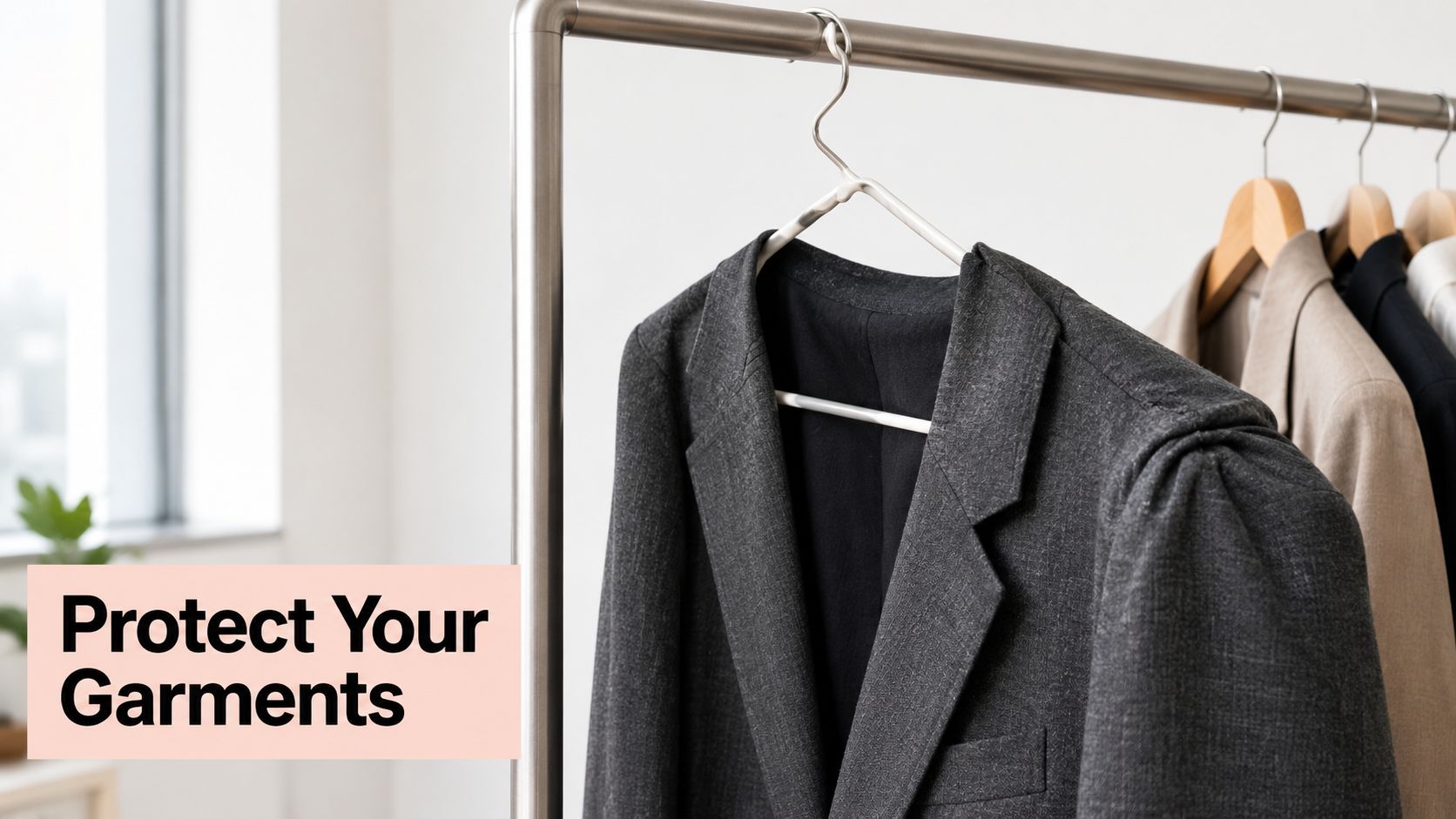
Strength affects presentation as well as safety
The UK market has substantial commercial demand behind it. A study of UK clothing use estimated 954.6 million plastic hangers were used annually in 2019, including 82.6 million sent out with online clothing orders. It also found that 60% of clothing unit sales were associated with a plastic hanger and that 16% were used solely for transporting clothing. Those figures show why hanger selection extends beyond the wardrobe. Logistics, retail presentation and repeated commercial handling all place different demands on the product. The Northumbria University hanger usage report provides the underlying UK context.
The practical consequence is straightforward. A hanger used for a single short delivery doesn't need the same specification as one that supports a wool coat through repeated customer handling, steaming, re-racking and storage. Commercial users should assess service life, not just the price per unit.
Practical rule: If a garment is expensive, structured, heavy or handled frequently, choose the hanger by the garment's load and shoulder shape, then check the rail separately.
A good display also needs visual consistency. Uniform hanger width keeps garments aligned, while a stable shoulder profile prevents the uneven dips and slumps that make a rail look overfilled. Guidance on visual merchandising displays is useful here because the hanger is part of the customer-facing presentation, not merely an accessory behind the garment.
Understanding Hanger Materials and Construction
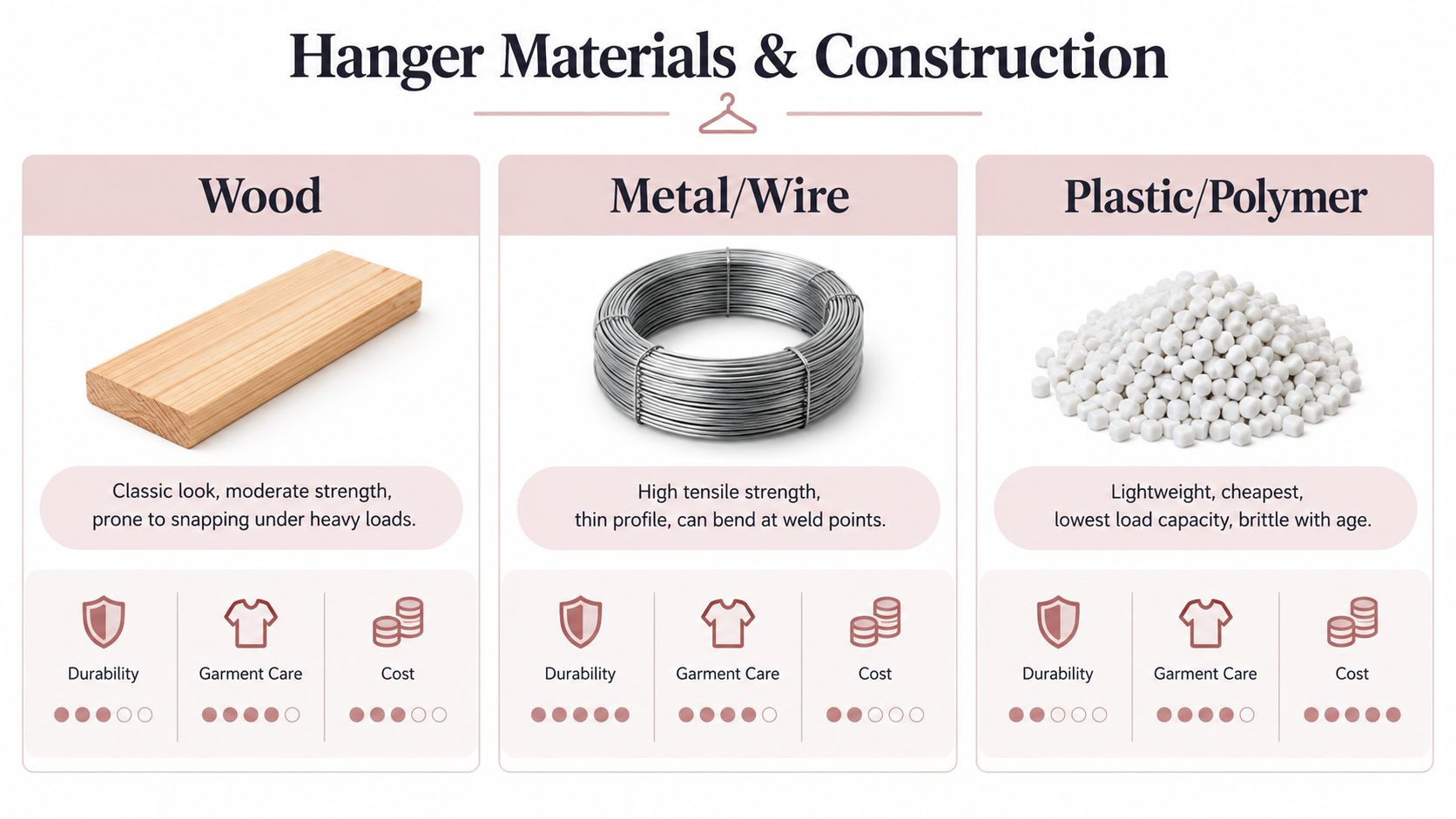
A hanger's material sets the starting point, but the load-bearing result comes from construction. A dense material can fail at a weak joint, while a lighter polymer may perform well with a shaped shoulder and reinforced hook. Trace the load path from the garment into the shoulders, through the central body, up the hook neck and onto the rail. Every connection can limit the system.
What each material does well
Solid wood gives premium displays a substantial appearance and usually provides a broad shoulder profile. It works well for suits, jackets and garments where shape retention matters. Bulk is the main trade-off. Quality also varies, and drilled joints or poorly secured hooks can crack or loosen under repeated use.
Metal and wire create a slim structure with useful strength when the shoulder is broad and the hook is properly formed or welded. Inspect bends, welds and thin sections first. These areas can deform under side loading. A metal hanger may carry vertical weight successfully yet twist when staff pull one garment from a crowded rail.
Virgin plastic is easy to mould, clean and colour-match. It suits general retail use, although brittle formulations become less tolerant of age, temperature changes and repeated flexing. Wall thickness alone does not establish capacity. A shallow shoulder can concentrate pressure, and a flexible hook neck can fail before the body shows damage.
Recycled plastic reduces reliance on virgin feedstock while retaining the practical benefits of moulded construction. Product claims about emissions reductions or recycled content are specific to the item being sold, not guarantees of strength or service life. Ask the supplier for supporting evidence, test conditions and load information. The recycled and cardboard hanger options discussed by Art Packaging show why environmental credentials should be reviewed alongside construction and end-of-life handling.
Engineered cardboard can suit selected retail and transport applications. Its lower weight may support simpler recovery, but moisture, compression and repeated handling require testing. Thick board does not automatically make it suitable for wet environments, dense outerwear or long-term storage.
Geometry beats thickness
Shoulder curvature, hook geometry and rail contact often determine practical performance more than material thickness. A wide shoulder spreads garment pressure, while a non-slip finish limits lateral movement. The hook must remain centred under load, clear the rail without binding and resist twisting when garments are removed from a tightly packed row. UK hanger listings on Amazon show the range of advertised constructions and ratings, but those figures need checking against the complete hanger and rail setup.
The rail sets another limit. A strong hanger does not solve a rail that bends, pulls from its brackets or becomes unstable as garments accumulate. Check the rail span, bracket spacing and fixing method before specifying a higher-capacity hanger.
For a premium dark display, a black wood hanger can provide a stronger visual cue than thin wire, provided the finish does not distract from hook construction or shoulder support. Guidance on black wood hangers is useful when appearance and garment structure must work together.
Matching Hanger Specifications to Garment Types
Start with the garment, not the hanger material. Place the jacket, coat, dress or shirt on a sample hanger and inspect three points: where the shoulder seam sits, whether the fabric slips, and whether the hook remains centred when the garment is fully loaded.
Choose by shoulder architecture
A blouse or fine knit normally needs a smooth shoulder with enough curvature to avoid sharp pressure marks. A flocked or velvet surface can help prevent narrow straps from sliding, but staff must remove garments carefully because a high-friction finish doesn't release fabric as easily as polished plastic.
A structured jacket needs broader support under the shoulder seam and a firm central body. If the shoulder collapses inward, the jacket will develop a visible sag even when the hook and rail remain intact. For padded shoulders, the hanger should follow the garment's natural line rather than forcing the fabric over a narrow apex.
Outerwear demands the most honest assessment. A wool coat, padded jacket or heavy costume piece may remain within the hanger's stated capacity but still overload a weak hook or pull the garment into a distorted shape. Test the complete garment on the actual hanger before ordering a large quantity.
Match the accessory function
Trousers, skirts and coordinated sets need more than a shoulder shape. A trouser bar or clip attachment should hold the lower garment without creating a sharp pressure point, and its finish should resist transfer onto light fabrics. For combined displays, a dedicated hanger for pants can be more practical than forcing trousers onto a jacket hanger.
Use this selection sequence:
- Measure the garment's shoulder span. The hanger should support the shoulder seam without extending far beyond it or ending inside the sleeve head.
- Check the hook neck. Load the hanger with the heaviest representative garment and watch for twisting, tilting or visible flex.
- Inspect contact surfaces. Choose flocking, rubberised sections, smooth wood or clips according to fabric sensitivity and slip risk.
- Test removal. Staff should be able to lift one garment without dragging neighbouring pieces off the rail.
- Assess the complete outfit. A jacket and trousers may need a coordinated hanger system rather than one overloaded shoulder hanger.
Tailors usually prioritise shape retention and stable positioning during fitting. Retail teams may prioritise quick handling, consistent appearance and easy cleaning. A storage operator may favour broad support and moisture tolerance over a polished finish. The correct heavy duty clothes hanger is the one that performs under the actual handling routine, not the one with the most impressive product photograph.
Comparing Load Capacity and Structural Limits
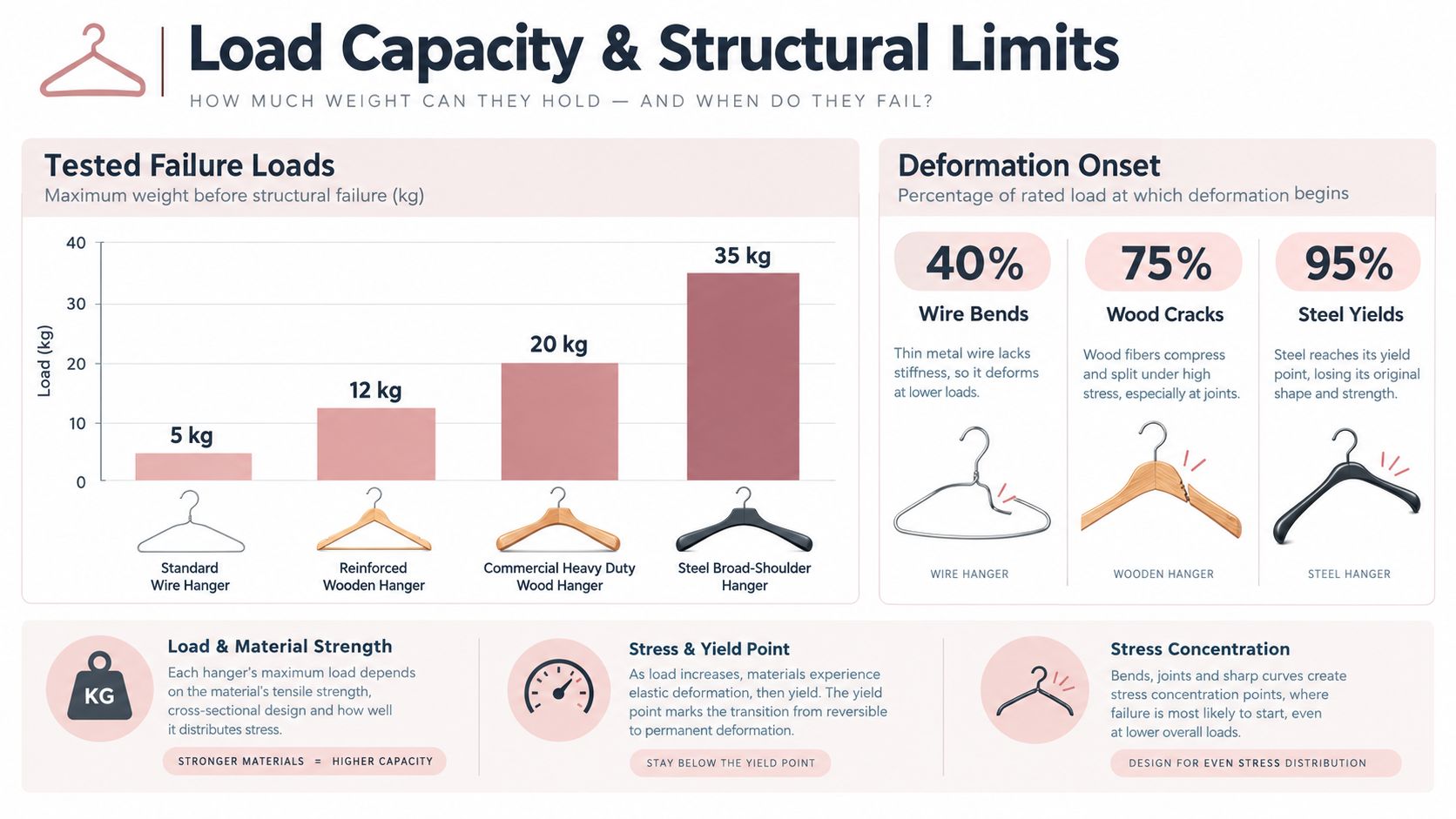
A heavy duty clothes hanger can look strong on the rail and still fail at its hook or shoulder joint. The load travels from the garment into the shoulder arms, through the central body and hook neck, and finally into the rail, brackets and base. Each connection changes how safely the system carries weight.
Hook geometry often sets the practical limit. A narrow hook opening can spread or disengage under load, while a stiff hook may transfer concentrated force into a thin rail. A wide shoulder supports the garment more effectively, but it also increases contact and can reduce the usable rail length. Material thickness alone does not show how the complete system will perform.
Where common failures begin
| Component | Typical warning sign | Likely consequence |
|---|---|---|
| Shoulder arms | Sagging or inward flex | Shoulder dents and poor garment alignment |
| Hook neck | Tilting or rotation | Garments slide, face sideways or fall |
| Hook opening | Spreading under load | Hanger disengages from the rail |
| Rail tube | Bowing between supports | Uneven load distribution and instability |
| Wheel or base | Movement under a loaded rail | The display becomes difficult to control |
UK hanger listings show advertised capacities from 3 kg to 5 kg, including a 4.5 kg velvet hanger and a 5 kg solid wood hanger. These are product ratings, not safe working limits for every garment or display. The UK hanger listings used for these examples also illustrate why similar materials can receive different ratings. Hook construction, shoulder width, joint strength and the test method all affect the result.
A practical check is to calculate the combined garment load before selecting the hanger. Twenty wool coats at 2.5 kg each create a 50 kg rail load before staff handling forces are added. The rail must carry that mass between its supports, while the hangers must prevent twisting, hook deformation and uneven spacing.
The rail sets the system limit
UK product listings describe rail capacities from 20 kg for pull-down wardrobe rails through 50 kg, 100 kg and 110 kg for reinforced steel garment rails. A hanger can meet its own rating while the installation remains unsuitable because the rail, brackets, wheels or joints cannot carry the combined load. This UK rail listing demonstrates the range of capacities available.
A display system is only as dependable as its weakest load-bearing connection.
Count garments, estimate their mass conservatively and check support spacing. Keep dense runs of coats away from one end of a mobile rail. Tube diameter alone does not establish capacity, so compare the supplier's rating with the full rail configuration, wheel design and floor conditions. Guidance on strong clothing rails helps when hangers must perform within a reinforced display system rather than as standalone products.
Evaluating Durability and Maintenance Requirements
A durable hanger should survive the routine, not just the showroom test. Retail staff pull garments sideways, lift several items at once and return pieces quickly. Tailors pin, remove and reposition garments repeatedly. Laundry and storage environments introduce moisture, cleaning agents and temperature changes that can expose weak finishes.
Inspect construction before purchase. Look at whether the hook is securely fixed, whether a metal joint is cleanly formed, whether the shoulder has a continuous curve and whether the surface coating feels even. On wood, check for rough edges and splits around the hook. On plastic, flex the hanger gently and look for whitening or stress marks. On flocked surfaces, rub a clean light-coloured cloth across an unused sample to check for loose transfer before placing it against pale garments.
Build a simple inspection routine
- At delivery: Sample hangers from different cartons and compare their hooks, shoulder alignment and finish.
- During use: Remove any hanger that tilts, cracks, develops a sharp edge or sheds coating.
- After cleaning: Check whether disinfectant or detergent has dulled the surface or weakened adhesive areas.
- During seasonal changes: Reassess hangers used for heavier outerwear before moving the garments onto the rail.
- At replacement: Record why units failed, rather than replacing them blindly with the same specification.
Moisture tolerance also affects material choice. Metal can corrode at exposed joints, wood can absorb humidity, and cardboard can lose stiffness when wet. Plastic may handle wiping well, but that doesn't make every plastic formulation suitable for heat, prolonged sunlight or aggressive cleaning.
Maintenance should protect both the hanger and the garment. Use a soft cloth for finished wood, avoid saturating porous surfaces and follow the manufacturer's cleaning instructions for flocked or rubberised coatings. Don't stack damp garments on hangers and then blame the hanger when odour, staining or deformation appears.
The lowest unit price often hides a higher replacement burden. A more durable hanger may cost more initially, but it can reduce garment rework, rail disruption and visual inconsistency. Assess total operating cost through failure frequency, cleaning compatibility, garment protection and handling speed, not purchase price alone.
Retail, Tailoring and Storage Use Cases
A boutique, a tailoring studio and a stockroom can all need a heavy duty clothes hanger, but they don't need the same design. The garment, handling pattern and supporting rail determine the useful specification.
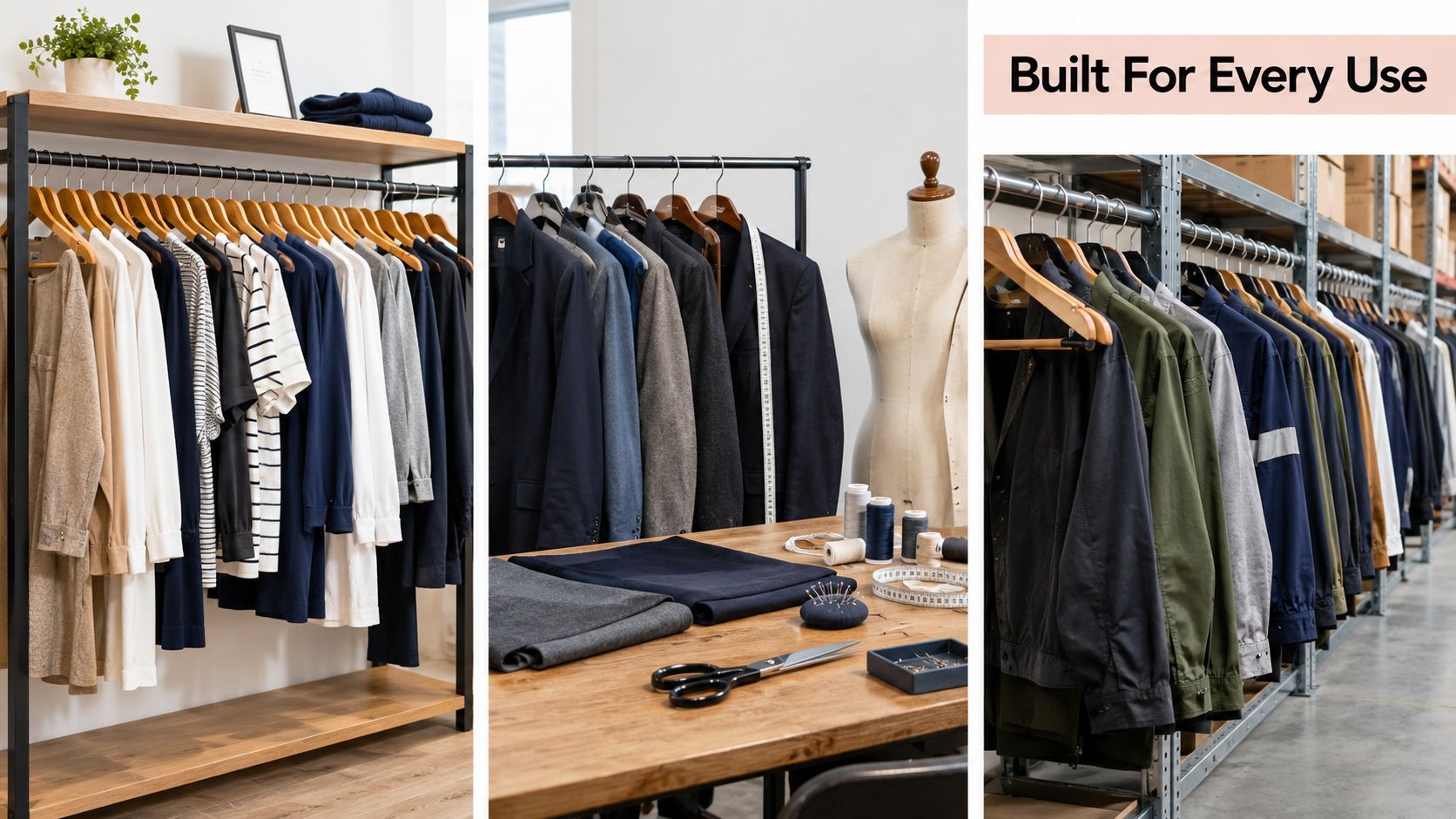
Retail displays
Retail presentation benefits from consistent shoulder lines, a controlled finish and easy garment removal. Velvet or rubberised contact points can stop thin straps and slippery fabrics moving, while wood can add visual weight to tailoring and premium outerwear. The trade-off is handling speed. High-friction surfaces protect against slipping but may require staff to lift garments carefully rather than slide them along the rail.
A shop displaying coats should test the full rail while it's loaded, not only the individual hanger. If staff need to move the entire display during cleaning or a floor change, wheels, joints and the rail base become part of the selection decision. A heavy duty clothing rack can be assessed as a complete system when individual hangers aren't enough for the merchandise volume.
Tailoring and costume work
A tailor needs a hanger that preserves the intended line while a garment is waiting for a fitting or alteration. Broad, shaped shoulders help support jackets and structured dresses, while a smooth surface may be preferable when staff must remove and reposition garments frequently. Pinning should happen on an appropriate form or work surface, not by forcing pins into a hanger that wasn't designed for it.
Costume teams face additional variation. A single rail may hold light stage garments, layered costumes and heavily embellished pieces, so the team should separate categories rather than selecting one universal hanger. Heavy pieces require a clear route from shoulder to hook and from hook to rail, with enough clearance to prevent neighbouring costumes from compressing the fabric.
A storage project may also benefit from planning the surrounding wardrobe rather than focusing only on the hanger. Advice on how to maximise bedroom storage space is relevant where available rail height, garment length and access space limit the practical arrangement.
The following video offers a visual reference for garment display and hanging systems. Use it alongside the specifications for the actual products under consideration, rather than treating a demonstration as a load test.
Storage and logistics
Long-term storage prioritises stable support, low slip risk and protection from pressure marks. Leave enough room for garments to hang naturally, avoid forcing bulky items onto narrow shoulders and inspect the rail after loading. For online fulfilment, a lighter recyclable option may suit short transport use, while a reusable commercial hanger makes more sense when the garment returns to a store, fitting room or laundry workflow.
The UK supply chain already includes significant reuse and recycling activity. An industry article reported a domestic garment hanger market worth around £110 million, while Mainetti was reported to produce around 100 million hangers annually and recycle around 250 million at its Chester facility. Those figures indicate a mature supply chain, but they don't remove the need to ask how a selected hanger will be collected, reused or processed at the end of service. The Manufacturer's report on Mainetti provides that industry context.
Making Your Heavy Duty Clothes Hanger Decision
A retailer choosing hangers for jackets should begin with shoulder support, hook stiffness and rail capacity. A dressmaker storing fittings may give more weight to shape retention and easy repositioning. A stockroom handling mixed outerwear needs a repeatable test that exposes weak hooks and overloaded rails before the garments reach customers.
Use this decision sequence:
- Define the heaviest garment. Test the hanger with the actual coat, jacket or costume piece, not an empty sample.
- Check the shoulder line. Look for full support beneath the seam without a sharp contact point.
- Load the hook gradually. Watch for twisting, spreading or loss of centre alignment.
- Verify the rail rating. Compare the combined garment load with the rail, brackets, wheels and support points.
- Test the workflow. Staff should be able to remove, replace and clean garments without damaging the finish.
- Review the end of life. Ask whether the material can be reused, repaired, collected or recycled through your supply chain.
Don't accept “heavy duty” as a sufficient specification. Ask for the tested load, the failure point, the material composition, the hook construction and the conditions behind the rating. If the supplier can't explain how the hanger performs under repeated handling, treat the marketing label cautiously.
For most professional buyers, the right choice is a matched system rather than a single universal hanger. Select the shoulder geometry for the garment, the hook for the handling routine and the rail for the combined load. That approach protects presentation quality while reducing the risk of deformation, slippage and premature replacement.
Display Guru supplies tailor dummies, body forms, garment rails and display equipment for professional fitting, retail presentation and garment storage. Review the available Display Guru range when you're matching heavy duty hangers with a suitable rail, mannequin or studio setup, and contact the team for help choosing equipment for your working environment.