



Dress Rails for Sale: A Practical Buyer's Guide
Scrolling through dress rails for sale can leave you with more tabs open and less confidence than when you started. One listing promises heavy-duty strength, another focuses on a low price, and a third looks perfect until you notice that its base will block the aisle or its rail is too short for your longest garments.
A reliable choice starts with the space and stock, not the product photograph. You need to match stock weight, available footprint, mobility, and finish to the room you're fitting out. The same rail that works neatly in a home sewing studio may wobble under outerwear in a stockroom, while a sturdy retail rail can be unnecessarily bulky in a narrow tailoring room.
What to Think About Before You Start Shopping
Start with the room. Measure the wall or floor bay where the rail will stand, then check the route from delivery entrance to final position. UK shops often have tight doorways, uneven thresholds, narrow staircases, and mixed flooring, so a rail that fits the sales floor may still be difficult to get into place.
Check ceiling height before choosing an adjustable or two-tier model. Taller rails can be useful for long dresses, but they become awkward beneath low ceilings or sprinkler systems. Door clearance matters too, particularly if the rail will be moved between a stockroom and shop floor.
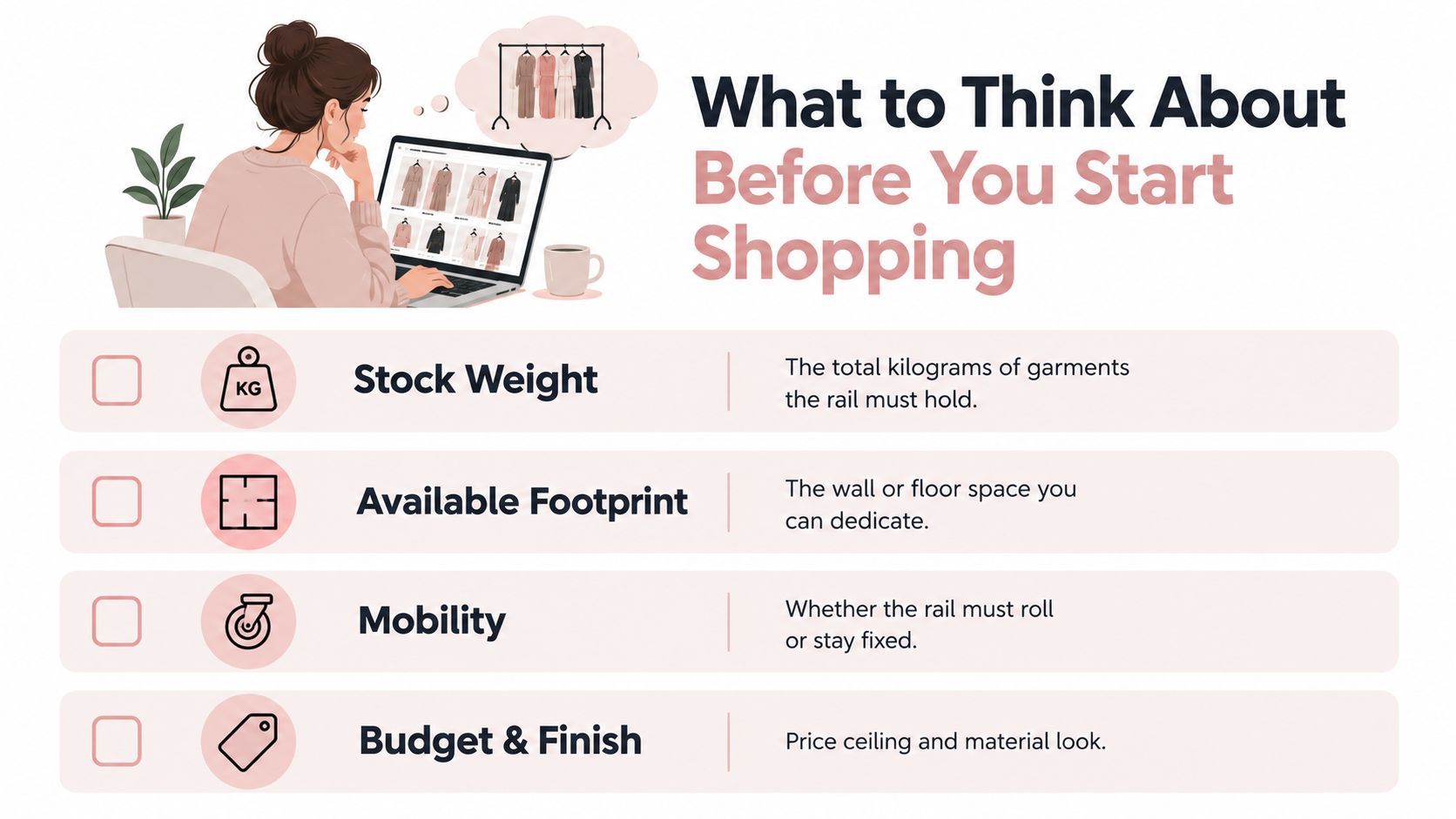
The first filter should be four practical questions:
- Stock weight: Will the rail carry light tops, dense denim, winter outerwear, costumes, or formal gowns?
- Available footprint: How much floor or wall space can you give it without narrowing customer routes?
- Mobility: Does it need to roll for cleaning, deliveries, and pop-up changes, or should it remain fixed?
- Budget and finish: Does the rail need to blend into a polished boutique, a workshop, a bedroom, or a temporary event space?
Don't choose the rail length first. Hangers need room to sit without crushing sleeves, and staff need clearance to pull garments out without catching neighbouring stock. A long rail with tightly packed clothing can be less usable than a shorter rail with sensible hanger spacing.
Practical rule: Write down the heaviest garment, longest garment, narrowest access point, and most delicate floor surface before you shortlist a rail.
For a useful local buying perspective, compare the practical questions raised in this guide with clothes rails near me. Keep a running shortlist as you assess width, base design, tube construction, and finish. That approach is faster than restarting your search every time a promising listing fails one basic room check.
Main Types of Dress Rails and Where Each One Works Best
A straight rail remains the dependable choice for a stockroom, alteration studio, or single-brand pop-up. It gives staff a clear run of garments, is simple to load, and usually makes the best use of a rectangular wall. Choose a fixed-width version where the layout rarely changes. An adjustable model is more useful in a studio or event space that is re-merchandised frequently.
Wall-mounted rails suit narrow corridors, vintage boutiques, and rooms with low shelving beneath the hanging area. They free floor space, but the wall and fixings become part of the load-bearing system. A plasterboard partition, solid brick wall, and dot-and-dab construction need different fixing methods, so the rail should never be specified without checking the substrate.
Two-tier rails increase hanging density by using upper and lower bars. They work particularly well for shorter garments, folded-to-hanging stock, children's clothing, denim, and back-of-house sorting. They're less suitable for long dresses unless the upper bar is high enough and the lower level doesn't interfere with hems.
Revolving rails make sense where customers need to browse around a compact display. They suit small showrooms and visual merchandising drops, especially when presenting a curated selection rather than a long linear run. Their footprint can be efficient, but the rotating mechanism adds another component that needs careful checking.
| Rail Type | Best-Fit UK Space | Typical Use |
|---|---|---|
| Straight rail | Stockroom, boutique wall, single-brand pop-up | General hanging and organised back-of-house storage |
| Adjustable rail | Tailoring studio, event space, changing retail layout | Reconfigured displays and varying garment groups |
| Wall-mounted rail | Narrow boutique, corridor, room above shelving | Floor-saving display and selected product presentation |
| Two-tier rail | Compact stockroom, denim display, children's area | Higher hanging density for shorter garments |
| Revolving rail | Small showroom, compact boutique, merchandising feature | Browsing and rotating a focused product selection |
A rail also affects photography and presentation. If garments are being photographed for online listings, consistent spacing, uncluttered backgrounds, and controlled styling matter as much as the frame itself. This practical guide to lighting and styling for listings is useful when the same rail serves both merchandising and content production.
Review the available clothes rail range only after deciding which format fits the room. A product catalogue is easier to use when you already know whether you need a straight, wall-mounted, double, or revolving solution.
Load Capacity, Sizing, and How Much a Rail Can Really Hold
The load figure buyers should look for is uniformly distributed load, or UDL. It describes the weight a rail can carry when garments are spread reasonably evenly along the hanging bars. It doesn't mean the same rail will behave safely when every heavy coat is pushed to one end.
UK commercial garment rails are commonly built around 32mm steel tube, with common heavy-duty units rated at 100kg UDL. Reinforced or two-tier designs can reach 160kg UDL or more when the load is spread evenly across both bars, as described in this heavy-duty clothes rail specification guide.
That distinction matters in daily use. A rail carrying balanced shirts may perform comfortably, while a rail carrying dense coats, denim, or stage costumes concentrated at one end can deflect and place extra stress on the base and castors. Treat the published rating as a configuration limit, not an invitation to create a single heavy cluster.
Match width to the stock
Common UK options run from roughly 915mm to 1830mm, with many suppliers also describing rails in the range of 2ft to 6ft. Width alone doesn't tell you how many garments will fit. Hanger shape, sleeve bulk, garment length, and the need to browse without snagging all affect usable capacity.
A narrow rail may suit a tailoring studio where staff handle garments individually. A wider frame can work in a stockroom, but only if the floor plan allows staff to stand in front of it and remove stock safely. Long unsupported spans deserve particular attention to tube gauge, centre support, and the manufacturer's tested configuration.
| Rail Class | UDL Rating | Tube Gauge | Suitable Stock |
|---|---|---|---|
| Commercial straight rail | 100kg UDL | Around 32mm steel tube | General retail stock when distributed evenly |
| Reinforced or two-tier rail | 160kg UDL or more | Around 32mm steel tube with reinforced design | Dense stock, heavier garments, or higher-volume hanging |
| Light domestic rail | Confirm with supplier | Varies | Light wardrobe use only, unless a tested commercial rating is provided |
Don't rely on a nominal width if the listing doesn't state its load rating, tube construction, or intended configuration. For a fuller comparison of construction details, use this guide to strong clothing rails as a reference point while checking each supplier's own specification.
The rail should also be loaded gradually. Place heavier garments across the frame rather than at one end, keep the heaviest pieces near the strongest supported areas, and inspect for movement after loading. If the bar bows, the feet rock, or castors twist under movement, remove stock immediately and reassess the rail rather than treating the problem as cosmetic.
Materials, Finishes, and How They Hold Up Over Time
Finish affects more than colour. It determines how visible fingerprints are, how easily the frame shows scuffs, and whether the rail looks appropriate beside timber shelving, painted walls, or polished display fixtures.
Chrome-plated steel gives a bright retail appearance and works well in clean, dry shopfronts. It can show water spots and fingerprints, so it needs regular wiping in studios where staff handle the frame often. Chrome also makes scratches and damaged plating easy to see.
Powder-coated steel is available in finishes such as white, black, and anthracite. It gives a more muted appearance and can disguise small marks better than a bright plated surface. Inspect welds, joints, and coating continuity carefully on low-cost imports, because chipping at connection points can expose the underlying metal.
Black, satin, and brushed metal finishes suit contemporary boutiques where the rail forms part of the visual language. They can look more intentional than a bright chrome frame, particularly beside dark shelving or neutral walls. The trade-off is that premium appearance often comes with a higher purchase price and more demanding expectations around finish consistency.
Solid timber works in heritage boutiques, home dressing rooms, and sewing studios where the rail needs to feel like furniture. It brings warmth that steel can't provide, but timber needs suitable care and shouldn't be placed against persistently damp walls. Mixed timber-and-metal designs can soften an industrial interior while retaining a practical hanging bar.
| Finish | Durability | Best For | Aesthetic | 3-Year Cost |
|---|---|---|---|---|
| Chrome-plated steel | Good in dry, maintained spaces | Bright retail displays | Reflective and clean | Depends on plating quality and maintenance |
| Powder-coated steel | Practical for frequent commercial use | Stockrooms, boutiques, mobile displays | Controlled and versatile | Often predictable when coating and joints are sound |
| Black or satin metal | Strong visual presence with suitable care | Contemporary shops and studios | Matte or understated | Higher finish cost may be justified for visible displays |
| Solid timber | Durable when kept dry and maintained | Heritage interiors and home studios | Warm and furniture-like | Includes ongoing care as well as purchase price |
| Mixed timber and metal | Depends on both materials and joints | Branded or design-led interiors | Balanced and decorative | Evaluate every component, not only the visible bar |
Avoid making a three-year cost promise from the ticket price alone. A cheaper rail can become expensive if it wobbles, chips, damages garments, or needs replacing, while a well-built frame can justify a higher initial outlay through continued service. The chrome clothes rail guide provides a useful comparison point for buyers considering a bright plated finish.
Bases, Castors, Wall Fixings, and Day-to-Day Care
The base decides whether a rail feels dependable when it is loaded, moved, or placed close to customers. A flat plate base suits a permanent shopfloor run because it keeps the support close to the floor. An H-frame stand works well for a freestanding central display, where balanced weight matters from both sides.
Fishtail feet create a broad stance and are useful where stability matters more than compact castors. They can be a sensible choice beside a wall or in a narrow aisle, provided the foot doesn't project into the customer route. Lockable castors suit pop-ups, stockrooms, and shops that need to move displays for cleaning or seasonal changes.
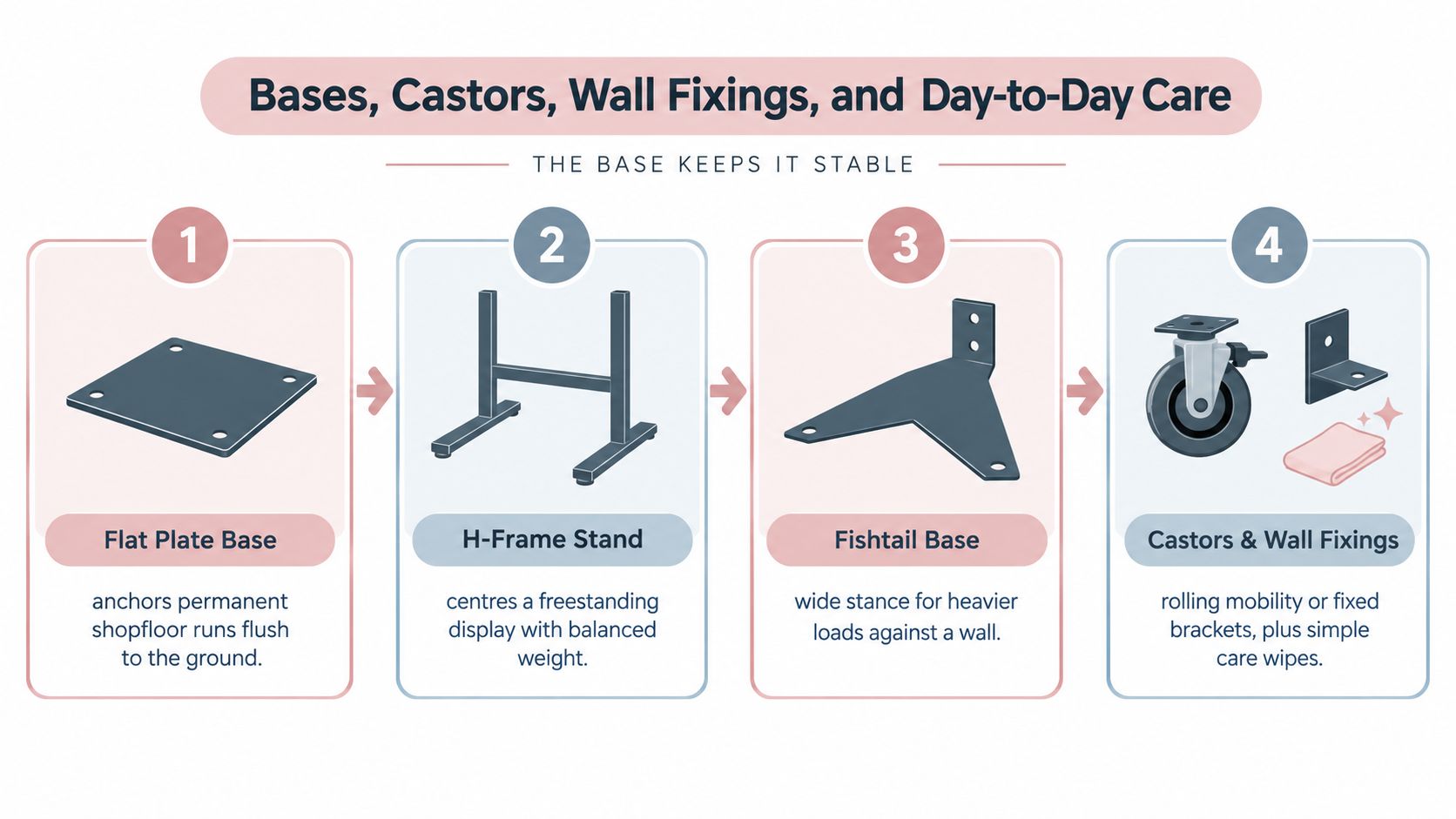
Castor size matters on uneven flooring. UK suppliers commonly specify castors in the range of 50mm to 75mm, while extension bars are often available from 300mm to 600mm, as outlined in this guide to retail garment rails. Small, low-quality wheels can catch on thresholds and stone floors, turning a supposedly mobile rail into an unstable one.
Wall-mounted rails need fixings selected for the actual wall. Use suitable anchors and screws for solid brick, plasterboard, or dot-and-dab construction, and don't assume a general-purpose plug can carry a loaded garment rail. If the wall feels hollow, crumbles during drilling, or has hidden services, get the fixing method checked before loading it.
A simple care routine prevents many failures:
- Weekly cleaning: Wipe the bar, joints, feet, and castors to remove dust and transfer marks.
- Quarterly checks: Test castor locks, wheel movement, and frame stability.
- Annual tightening: Re-tension grub screws and inspect tube joints.
- Immediate replacement: Remove any bent foot, cracked wheel, or visibly distorted bar from service.
This clothes rail with wheels category is useful for comparing mobile configurations, but the floor condition and lock quality still need checking in person.
Never push a rail with one heavy cluster at the end. Move it slowly, keep the load balanced, and lock the castors once the rail reaches its display position.
Matching Rails to Retail, Tailoring, and Home Setups
The right rail depends on the room's job. A high-street shop needs a stable customer-facing fixture that can cope with repeated browsing, while a tailoring studio needs access for pinning, fitting, and moving garments around a worktable.
Retail shops
A straight chrome or black rail with a flat base suits a conventional wall run. A commercial rating around 100kg UDL can be appropriate where stock is spread evenly, although the actual requirement depends on the garment mix and frame configuration. Two matching rails can create a stronger visual rhythm than one oversized unit, while leaving a clear break for signage or a feature display.
For a compact boutique, a revolving rail can make better use of a central position. Customers can browse around it, and the retailer can present a smaller edited collection without filling the room with long runs. It isn't the right choice for dense back-of-house storage where fast access and maximum linear capacity matter more than rotation.
Tailoring and costume work
Tailoring studios benefit from adjustable rails that can be set at a practical working height. Staff often need to compare garments with mannequins, dress forms, cutting tables, and clients, so a tall retail fixture may get in the way. A wall-mounted rail can free valuable floor area, particularly above low storage or along a narrow side wall.
Costume departments and theatre teams need to think beyond average clothing. Dense fabrics, layered costumes, and accessories can create concentrated loads, so reinforced construction and careful distribution matter more than a fashionable finish. A double rail can separate ready-to-wear pieces from fittings, but long costumes need sufficient vertical clearance.
Home sewing rooms
A compact straight rail suits a bedroom, spare room, or home studio where the user wants frequently worn or newly made garments in view. A two-tier format can increase capacity in a small footprint, but it works best when the lower garments are short enough to avoid dragging on the floor.
Home users should avoid selecting a commercial-looking rail just because it photographs well. Measure skirting boards, doors, radiators, and walkways first. A slightly narrower frame that can be reached from both sides is often more useful than a larger rail pushed against furniture.
Display Guru offers white garment rails, heavy-duty clothes rails, and two-tier double garment rails, along with height extension poles and centre bars for taller or double-tier arrangements. Those options are relevant to sewing professionals, retailers, and home studios that need to adapt the hanging setup as garment lengths change.
Price Bands, UK Market Reality, and Total Cost of Ownership
Price comparisons are difficult because dress rails for sale often look similar while differing substantially in tube construction, welding, castors, base geometry, and tested load rating. A low-priced domestic frame can be perfectly adequate for light wardrobe use, but it shouldn't be treated as a commercial rail just because the photograph shows a full row of clothing.
One UK market estimate placed the average Amazon United Kingdom listing price for clothes rails at £20.96, alongside an estimated annual market value of £3.2 million. The same research estimated 4.3 million searches for the term clothes rail over the previous twelve months and annual sales of 125,000 to 150,000 units, showing why buyers encounter such a broad range of listings. See the UK clothes rail market report for the underlying figures and its discussion of seasonal demand.
The useful question isn't “Which rail is cheapest?” It's “What does this rail need to survive?” A domestic frame may suit occasional home use. A mid-range commercial rail can be more appropriate for regular shop handling. A reinforced system earns consideration where stock is dense, movement is frequent, or a failure would interrupt trading.
| Price Band | Typical UDL | Tube Gauge | Finish Options | Expected Life |
|---|---|---|---|---|
| Entry-level listing | Often unclear, verify before buying | Often unclear | Basic plated or painted finish | Depends heavily on loading and handling |
| Commercial mid-market | Confirm the tested rating | Commonly steel commercial tubing | Chrome, powder-coated, black, or white | Suitable for regular use when maintained |
| Heavy-duty system | Higher tested rating or reinforced configuration | Commercial tube with stronger supports | Durable coated or plated finishes | Intended for demanding stockroom, retail, or studio use |
Total cost includes more than replacement. A sagging rail can damage garments, slow staff down, and force a display reset. Worn castors can make a mobile fixture unsafe, while chipped coating can make a customer-facing display look neglected.
Ask the supplier for the tested UDL, tube specification, base details, castor rating where relevant, replacement parts, and warranty terms. If those details are missing, treat the listing as an uncertain purchase rather than filling the gaps with assumptions.
Buying Checklist and Where the Category Is Heading Next
Use this checklist while viewing any listing. If a supplier can't answer one of the questions, mark it for clarification rather than assuming the most favourable answer.
- Width: Does the rail fit the bay, doorway, and garment lengths without obstructing access?
- UDL: Is the uniform distributed load rating stated, and does it suit the heaviest stock?
- Base type: Do you need a flat plate, H-frame, fishtail feet, or lockable castors?
- Finish: Will chrome, white, black, timber, or a mixed finish sit comfortably with the surrounding display?
- Mobility: Should the rail roll for cleaning and reconfiguration, or remain fixed?
- Warranty: Does the supplier explain coverage, exclusions, and replacement parts?
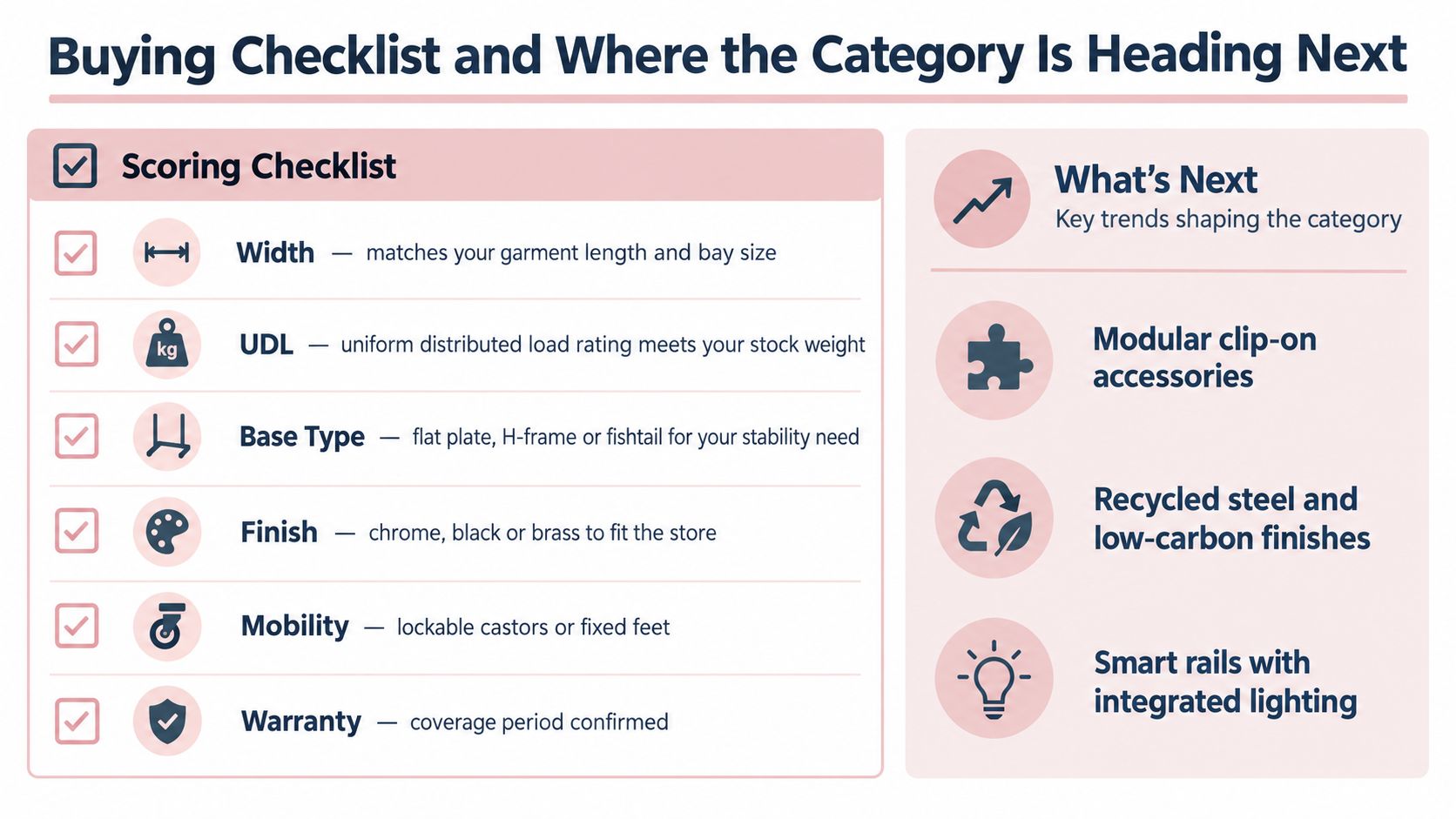
The category is moving beyond a basic bar on two feet. UK suppliers increasingly present modular rails, adjustable systems, mixed materials, and display accessories that let retailers reconfigure layouts rather than replace the whole fixture. Sustainability also affects the decision, with options such as recycled steel and FSC-certified timber appearing alongside conventional frames, as discussed in this UK garment rail industry overview.
Premium retail rails may also incorporate lighting, signage channels, or clip-on accessories. Those features matter when the rail becomes part of a branded display, but they shouldn't distract from structural basics. A flexible system is only useful if its base remains stable, its load rating is clear, and its components can be maintained.
Choose the rail that can cope with your heaviest realistic stock, fit your actual floor plan, and adapt to the way your team works. For help selecting garment rails, tailoring equipment, and display fixtures for a boutique, studio, pop-up, or home sewing room, visit Display Guru and compare the relevant rail formats before you place an order. Their catalogue includes heavy-duty and two-tier garment rail options, with support available if you need to clarify the setup.