



Display Counters for Shops How to Choose and Style
You've opened the shop early, switched on the lights and arranged the products, but one decision still feels awkward. The counter needs to take payment, answer questions, hold stock and make the right products look tempting. At the same time, it can't block the entrance, make the shop feel guarded or leave some customers struggling to use the service point.
A well-chosen counter does more than fill an empty area. It guides the shopper from the window to the entrance, from browsing to conversation, and from product selection to payment. This guide is for independent retailers, boutiques, sewing shops, craft businesses, convenience stores and service-led premises that want their display counters for shops to support both presentation and practical work.
Why Your Counter Shapes the Whole Shopping Trip
A shopper notices your shop before entering. The window establishes the first impression, the doorway confirms whether the space feels inviting, and the fixtures then determine how confidently that shopper moves around. By the time they reach the counter, they've already formed an opinion about your products, organisation and level of service.
Consider a small skincare boutique. A customer sees a carefully arranged window, enters beside a clear product display and follows a natural line towards a timber counter. The counter presents a few featured products at hand height, leaves the staff member visible and offers a comfortable place to ask about ingredients. Nothing forces the customer forward, but every element makes the next step obvious.

Follow the visual sequence
The counter should belong to the same visual story as the shopfront. A bright, open unit may suit a craft shop where customers need to handle materials, while a glazed counter may suit jewellery or small high-value goods. A fashion boutique might use a compact till counter near the exit and a separate lower display surface deeper inside the shop.
The key question isn't “Which counter looks attractive?” It's “What should the customer understand and do at this point in the journey?”
- At the entrance, keep the view open and make the first product zone easy to read.
- In the selling area, use a counter to group related products, demonstrate an item or support a consultation.
- At checkout, provide a clear service point without turning payment into a physical barrier.
Your wider retail store layout guidance should therefore come before a final counter purchase. Measure how people enter, pause, turn and queue, rather than choosing a unit from a catalogue in isolation.
Judge the counter by its commercial job
A counter can encourage browsing, support a conversation, conceal working materials and give the shop a recognisable finish. It can also create problems if it narrows the route, hides staff from view or places popular products behind a barrier.
Start with the customer journey, then decide between open, glazed, lockable, service and modular formats. After that, consider height, depth, materials, lighting, storage and accessibility. This order prevents a common mistake, choosing a beautiful counter that doesn't fit the way your team serves customers.
What Display Counters Actually Do in Modern Shops
A shop counter is part furniture, part presentation device and part operational workstation. It may hold a till, display products, support wrapping, store tools and create the point where a browsing visit becomes a sale. Treating it as only a desk usually produces a unit that works for staff but says very little to customers.
The commercial role of shop display has deep UK roots. The opening of Regent Street in London in 1825 helped establish the practice of presenting merchandise through windows before customers entered a shop. The Greater London Authority's account of Regent Street's retail history describes the street as giving birth to what is now called visual merchandising, with retailers competing to showcase new and exotic imported goods.
That shift changed the counter's place in the shop. Products no longer had to remain stored behind a sales desk until a customer asked for them. Retailers could stage merchandise, signal quality and invite browsing before a sales conversation began.
A counter is a small stage
Think of the top as the stage, the front as the message and the inside as the working area. A skincare shop may place a small hero product and tester on the top, use the front to reinforce its colour palette, and keep bags, tissue and replenishment stock inside. A sewing retailer may use the counter to present a mannequin torso, thread collections or a project sample while storing packaging and tools below.
The counter also needs to protect the rhythm of service. Staff should be able to reach the till, wrap products, retrieve stock and speak with customers without repeatedly crossing the shop floor. Customers should be able to see enough activity to feel helped, but not so much clutter that the counter resembles a storeroom.
UK retailers historically treated display as a deliberate commercial activity. Research into London's West End retailers found that high-medium-end stores allocated approximately 0.19% to 0.21% of aggregate net sales to display between 1936 and 1938, while medium-low-end stores allocated 0.49% to 0.78%, as documented in research on display expenditure in British retail. The figures concern display broadly, not counters alone, but they show that presentation was managed as an identifiable business investment.
Practical rule: If a counter improves presentation but slows service, it isn't doing its complete job.
Connect presentation with systems
The physical counter and the digital till should support the same service experience. A retailer comparing retail POS platforms may need to consider receipt handling, stock visibility and payment workflow alongside the counter's cable routes and storage. A unit with no provision for terminals or wiring can look tidy on delivery day and become messy as soon as the shop is operating.
Use your visual merchandising guidelines to decide what belongs on top, what belongs behind glazing and what should stay out of sight. The strongest counters don't compete with the merchandise. They give the merchandise a credible setting and give staff a reliable place to serve.
Main Types of Shop Counters Compared
A customer may first notice a product through the window, handle it at an open counter, ask a question at the service point and finish at the till. Each counter type shapes one part of that journey. An open unit invites touch and conversation, while a glazed counter keeps small products visible without leaving them exposed. A lockable design gives stronger protection, although too much enclosure can make ordinary service feel guarded.
Use the table as a first filter, then test each option against your products, staff routine and floor plan.
Shop Counter Types by Visibility and Security
| Counter type | Best for | Visibility | Security level |
|---|---|---|---|
| Open serve-over counter | Bakeries, craft shops and product demonstrations | Very high, customers can see and often handle goods | Low |
| Full-vision glazed counter | Jewellery, cosmetics and small collectables | High, with products visible behind glass | Medium |
| Lockable high-value counter | Compact, valuable or easily removed products | High for selected items, limited for the rest | High |
| Till and service counter | Payment, consultations, collections and wrapping | Moderate, depending on the top and front design | Moderate |
| Mobile modular counter | Pop-ups, changing layouts and growing shops | Adjustable, based on configuration | Variable |
Match enclosure to the product
A bakery counter often works best when customers can see the range and make a quick choice. An open or lightly glazed format supports that pace. Jewellery usually needs glazing, lockable access and controlled lighting. Glass protects stock while introducing reflections and a physical boundary, so keep the staff side welcoming and make conversation easy. For enclosed product presentation, see our guide to display cabinets for shops.
A fashion boutique may not need a large enclosed counter. A compact till unit can manage payment and packaging, while garment rails and body forms carry the main visual message. Display Guru supplies retail display equipment, including countertop display solutions and body-form mannequins that can present clothing or accessories beside a counter.
A convenience shop needs a different balance. Staff require clear sightlines across the sales floor, secure storage for selected products and enough working space for payment and collection. A deep, solid front may provide useful storage, yet it can hide activity and make the till feel defensive. Leave a clear, usable service position for customers who need more time, lower reach or a quieter interaction.
Security shouldn't erase welcome
UK retailers face pressure from theft, abuse and violence, so counter design must support staff without turning the shop into a barrier. Police recorded 516,971 shop-theft offences in the year ending December 2024, an annual increase of 20%, according to the UK Government retail crime factsheet. The same source reports that the Association of Convenience Stores estimated 1.2 million incidents of verbal abuse and around 59,000 incidents of violence in the convenience sector.
Use proportionate protection. Keep valuable products in controlled zones, preserve staff escape routes and avoid tall units that remove visibility. A lockable section within a mostly open counter can protect sensitive stock without making customers request access to ordinary merchandise.
Before choosing a style, compare two counter types against product risk, staff movement, customer reach, queue flow and the tone you want the shop to communicate. A mobile modular unit can also support pop-ups, layout changes and future expansion, reducing the need to replace the whole counter when the shop develops. The strongest solution is often a combination of open, glazed and service-led units rather than one repeated design.
Materials Finishes and Build Quality Explained
Materials change how a counter looks on opening day, but construction determines how it behaves after months of tills, bags, deliveries, cleaning and customer contact. A premium finish won't compensate for a weak base, awkward cable access or an edge that chips at the busiest corner.
Start with the working surface
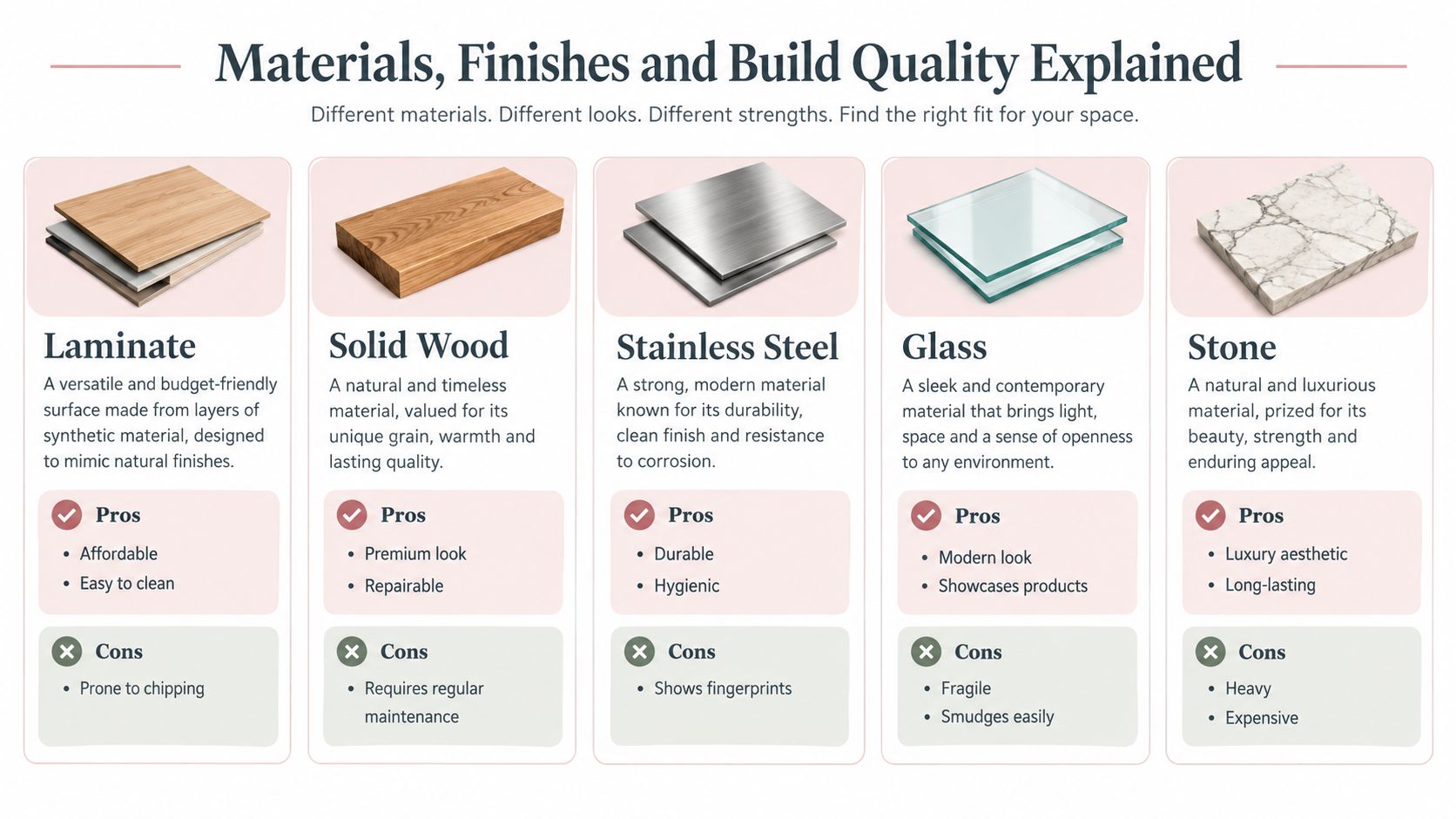
Laminate suits retailers that need a broad choice of colours and straightforward cleaning. It can work well for a till counter, but inspect exposed edges and corners because damaged laminate may be difficult to repair invisibly.
Solid wood gives a warmer, more individual appearance and can often be repaired or refinished. It needs a maintenance routine, particularly around areas where moisture, adhesive residue or repeated contact can dull the surface. Veneer can deliver a timber appearance with less material, but the quality of the substrate and edge treatment matters.
Stainless steel makes sense in environments where hygiene and durability come first. It is practical for food-related service, although fingerprints and fine marks will show more readily. Glass gives products presence and allows customers to see into a display without opening it. It also demands regular cleaning, and its weight and fragility affect how easily the unit can be moved.
Stone or solid-surface tops can create a luxury impression and withstand demanding use, but they add weight and cost. They're most useful when the counter is intended to stay in one position and the structure below can support the load.
Inspect the details people touch
Run your hand along the customer-facing edge. Look for a comfortable profile rather than a sharp corner, especially where customers may lean while signing, asking questions or collecting goods. Check the staff side for enough legroom, sensible drawer positions and a surface that can be cleaned without moving every item.
Then inspect the less glamorous parts:
- Cable routes: Terminals, tills, printers and chargers should connect without wires crossing customer-facing surfaces.
- Access panels: Staff need to reach power and equipment without dismantling the counter.
- Shelving: Adjustable shelves allow the storage area to change as packaging and product sizes change.
- Base protection: The lower edge should cope with shoes, baskets, trolleys and routine mopping.
- Lighting access: Integrated strips or spotlights should be replaceable and positioned to avoid glare on glass.
The accompanying video can help you think about how display fixtures function within a retail environment.
Choose the finish your staff can maintain
A counter that needs constant polishing may look excellent in photographs and frustrate a busy team. A slightly less delicate finish can create a better customer experience if staff can keep it clean, uncluttered and ready for service.
For a sewing shop, a repairable timber or durable laminate top may support measuring, fitting conversations and product handling. For a boutique, timber veneer with glass inserts can soften the checkout area while keeping selected accessories visible. For a convenience shop, wipe-clean surfaces and protected corners usually matter more than a decorative finish.
Ask the supplier for cleaning guidance, replacement-part availability and the weight of the complete unit. Build quality includes what happens when a hinge fails, a shelf needs changing or the layout has to move.
Sizing Placement and Accessible Counter Design
A counter can be attractive and still exclude customers if every service point is high, deep or difficult to approach. Design the unit around more than one way of standing, reaching, paying and speaking.
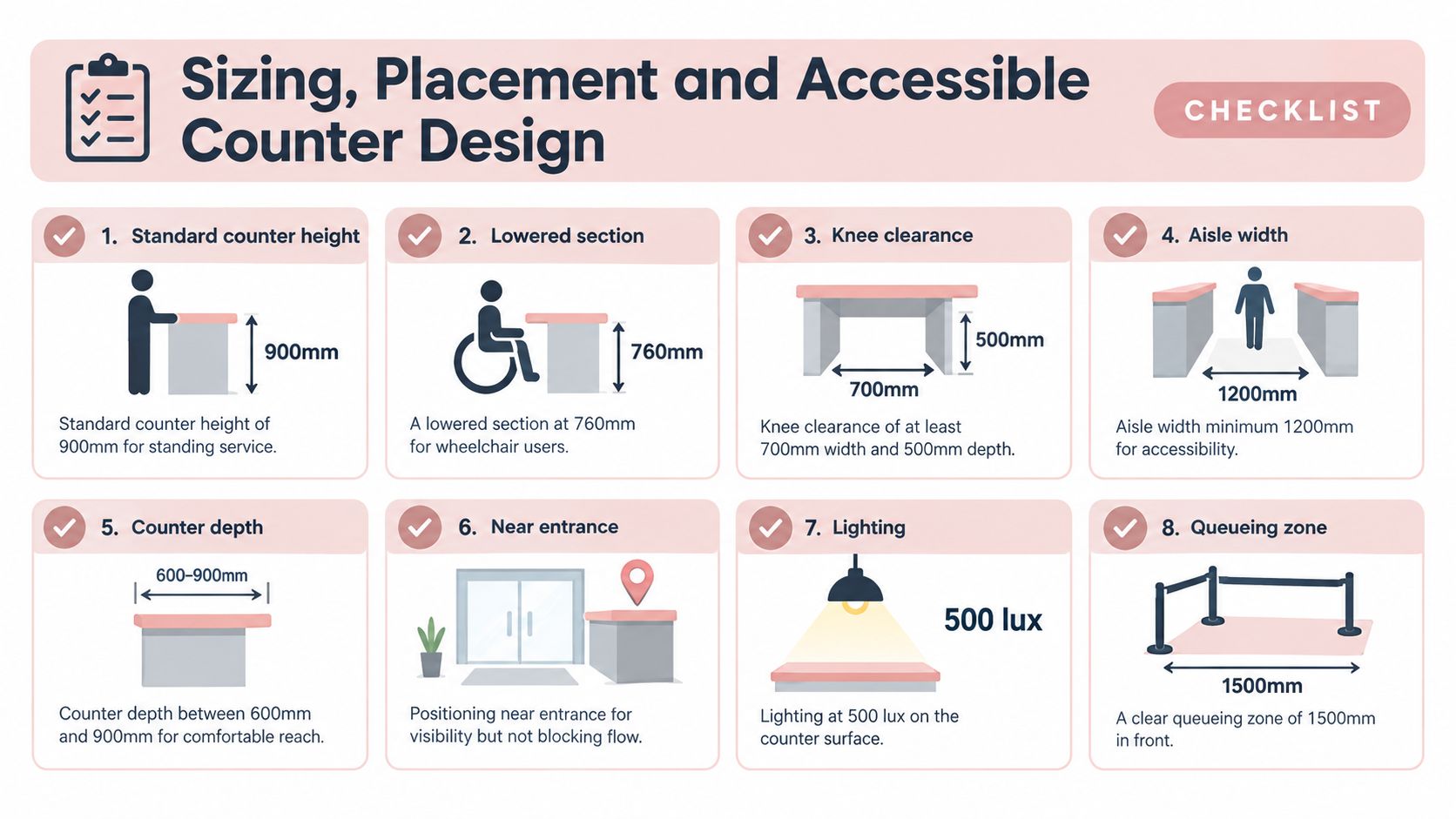
For UK shop display or service counters, provide a lowered customer-facing section at approximately 750 to 800 mm above finished floor level, with unobstructed knee clearance. Inclusive-design guidance specifies a knee recess of at least 700 mm high, 800 mm wide and 500 mm deep, as set out in UK guidance on accessible shop and service counters.
Plan two service levels
A primarily standing-height worktop can suit staff workflow, but it shouldn't be the only option for customers. Access audits commonly record standard till and service counters around 85 to 97 cm high, while lowered sections may be approximately 66 cm, according to AccessAble's audit of Marks & Spencer Charlton. The range makes the practical point clear, one conventional height won't serve everyone equally.
Include at least one clearly identifiable accessible position. For checkout planning, provide approximately 900 mm of clear width at an accessible position, keep the knee space free and place the card reader where a customer can reach and read it without stretching over a deep top.
Don't use the lowered section as a storage shelf. A customer should recognise it as part of the service counter, not discover it only after asking for help.
Place the unit without trapping the route
Positioning depends on the shop format. A counter near the entrance can make staff visible and support quick service, but it mustn't narrow the doorway or make incoming shoppers feel watched. A counter at the rear can pull customers through the shop, although staff need clear sightlines and a workable route to the till.
Mark the counter footprint on the floor with tape before ordering. Add the likely queue, open drawers, staff movement and the space needed for a wheelchair user to approach. Include space for customers who are browsing nearby rather than only the person currently paying.
A quiet, non-reflective backdrop helps with face-to-face service. The AccessAble audit notes that windows, screens, glazed surfaces or mirrors behind a till can impair lip-reading, so avoid placing a conversation point directly in front of visual noise where possible.
For broader planning, these sizing chart tips for stores offer a useful reminder to make measurements clear and usable. You can also review retail counter planning guidance before finalising the footprint.
Access check: Approach the counter from the customer route, not only from the staff side. If a display, bin or queue barrier blocks the approach, the accessible dimension on the drawing won't solve the real problem.
How to Choose a Counter That Grows With You
The best counter for a small shop isn't necessarily the largest or most permanent one. Independent retailers change their ranges, add click-and-collect, introduce repairs, adjust staffing and use the same surface for packing, returns and consultations. A counter should accommodate those changes instead of making each new service feel like a workaround.
Compare a fixed bespoke unit with a modular design against the way your business may operate. The UK retail-crime benchmark from the British Retail Consortium put total retail-crime costs at £4.2 billion in 2023/24, including £1.8 billion spent on prevention. That pressure makes adaptable, proportionate investment worth considering, particularly when a future refit could otherwise require replacing a substantial fixture.
Use a practical buying test
Ask the supplier:
- Can the layout reverse if the till or entrance changes?
- Are shelves adjustable, and can you order replacements?
- Does the unit arrive in sections that can pass through the shop door?
- Can staff reach sockets, printers and payment equipment safely?
- Does the counter include lockable storage without hiding the entire display?
- Can damaged panels, hinges or trims be replaced?
- Could the materials be reused in another layout or sold on later?
A boutique may prioritise a refined finish and a compact till zone. A sewing shop may need working depth, visible samples and storage for fitting equipment. A convenience shop may value sightlines, secure sections and fast cleaning. A service counter may need privacy for consultations without blocking the public route.
Style the counter with restraint
Keep one clear hero zone on top. Place related add-on products beside the service point, but leave enough empty surface for payment, wrapping and conversation. Inside the counter, group stock by task, not by whatever fits the shelf. Bags, receipt rolls and frequently used tools should be immediately reachable, while reserve stock can sit elsewhere.
An integrated display system can help coordinate fixtures when your shop needs a consistent structure across counters, rails and product zones. The principle is simple: the counter should make the next action easier for the customer and the staff member.
Before installation, check the floor route, position the lighting, test the card reader from the accessible section and ask staff to rehearse opening, serving, wrapping and closing. A counter earns its place when it presents products, protects people, supports efficient work and remains useful after the shop changes.
Display Guru supplies display equipment for retailers, sewing professionals and visual merchandisers, including countertop display solutions and body forms for presenting garments and accessories. Visit Display Guru to explore options for building a counter area that supports both customer flow and product presentation.