


Dark Wood Hangers Buying and Care Guide for Lasting Style
A good coat can lose its line in a week if it lives on the wrong hanger. You've probably seen it. The shoulder points start to dip, the collar twists slightly, and a jacket that looked crisp on the fitting stand begins to look tired before it's even worn. In a shop, that can make good stock look ordinary. At home, it can make careful sewing feel under-finished.
That's why dark wood hangers deserve more attention than they usually get. They aren't just a storage choice. They're part support, part display prop, and part finishing tool. A solid hanger helps a jacket hold its shape. A well-chosen dark finish can make a rail look calmer, richer, and more deliberate. In the right setting, the hanger becomes the quiet frame around the garment.
For retailers, tailors, and home sewers, that matters more than it sounds. The UK clothing market still uses hangers at enormous scale. Northumbria University found 954.6 million plastic hangers were used per year in the UK clothing market, with 82.6 million sent out in online clothing orders, and 60% of clothing unit sales associated with a plastic hanger in that research on hanger usage in the UK clothing market. Against that backdrop, dark wood hangers sit in a smaller, more selective part of the market, used when shape, durability, and presentation matter more than simple throughput.
Introduction to Dark Wood Hangers and Their Appeal
A tweed blazer tells the story quickly. Hang it on a narrow plastic hanger and the cloth slumps at the sleeve head, the lapel rolls awkwardly, and the whole piece looks as though it's waiting to be marked down. Hang the same blazer on a broad dark wooden hanger and the shoulders sit where the tailor intended, the collar stays lifted, and the garment looks ready to be tried on.
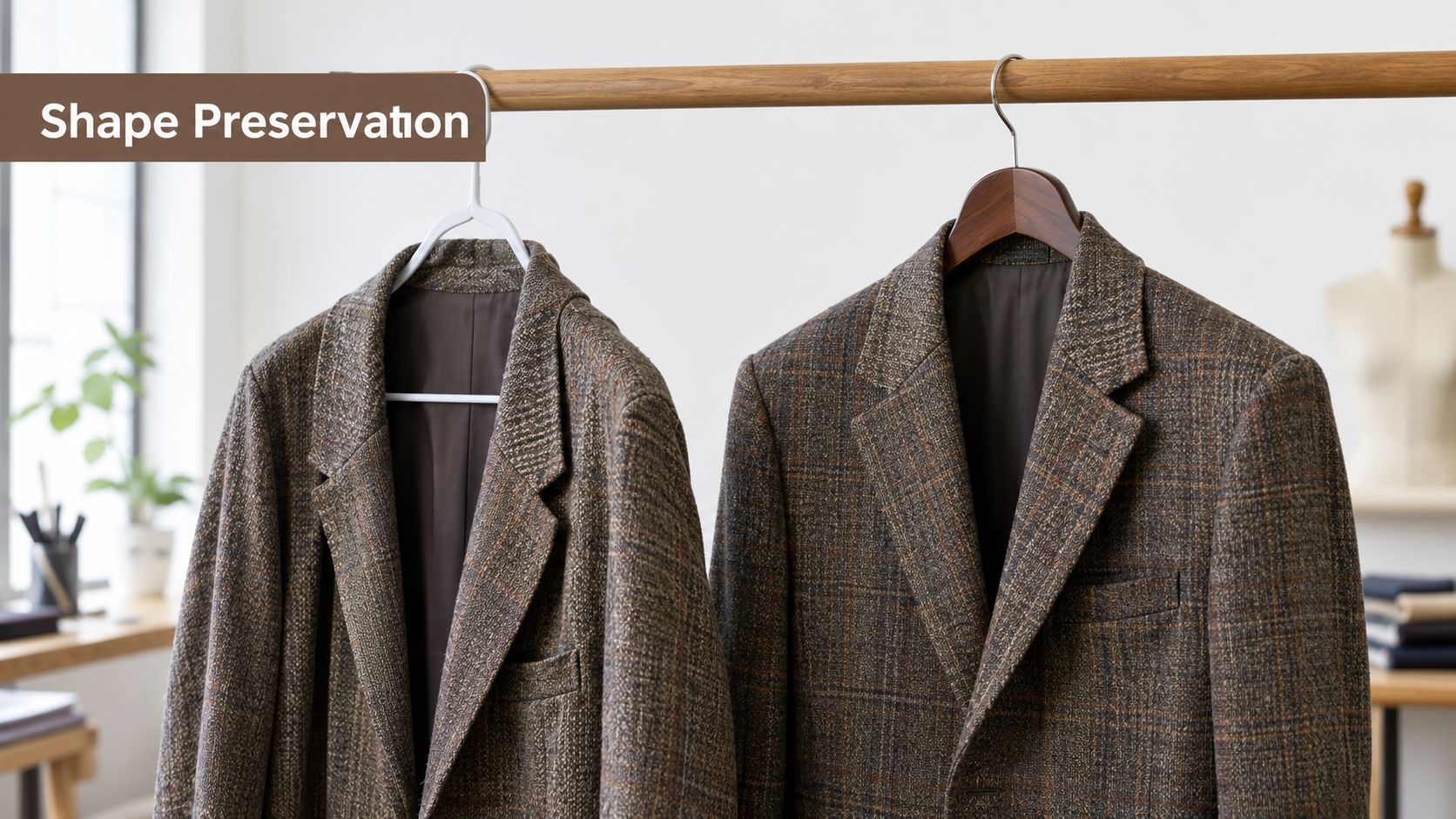
That difference isn't only visual. It affects how customers judge quality, how garments recover between wears, and how much reshaping work you create for yourself. If you run a boutique, a neat line of matching dark wood hangers signals care before a customer even touches the clothes. If you sew at home, it helps finished garments look worthy of the time you've invested in fitting, pressing, and construction.
Why the dark finish changes the feel
Dark wood has a particular presence. It tends to make pale linens look brighter, black tailoring look denser, and textured cloth such as flannel, wool crepe, or brushed cotton look more expensive. It acts a little like a good picture frame. The frame shouldn't steal attention, but it should help the eye take the subject seriously.
That said, dark wood hangers aren't automatically right for every rail or every room. Their strength lies in combining three jobs:
- Shape support for jackets, coats, knitwear, and trousers
- Visual consistency across a wardrobe, rail, or fitting area
- Material presence that feels more considered than disposable options
Practical rule: If a garment has structure in the shoulder, collar, or waistband, the hanger is part of the garment's care routine, not an accessory.
Who benefits most from using them
Some readers need dark wood hangers for presentation. Others need them for protection. Often it's both.
- Boutique owners use them to create a uniform, premium-looking rail.
- Tailors and dressmakers use them to support finished garments between fittings.
- Home sewers use them to stop handmade pieces from looking limp in the wardrobe.
- Studios and costume departments use them where garments move between storage, steaming, fittings, and display.
Dark wood hangers make the most sense when the garment itself has value, whether that value is financial, sentimental, or the number of hours it took to make properly.
Understanding Wood Types and Dark Finishes Explained
Not all dark wood hangers are made from dark wood. That's the first point to get straight. Some are naturally dark timbers. Others are lighter woods that have been stained and sealed. Others still are painted to imitate a darker, richer look.
Common woods you'll meet
Think of hanger wood the way you'd think about suiting cloth. Two jackets may look similar from a distance, but the hand, weight, and behaviour tell you what they really are.
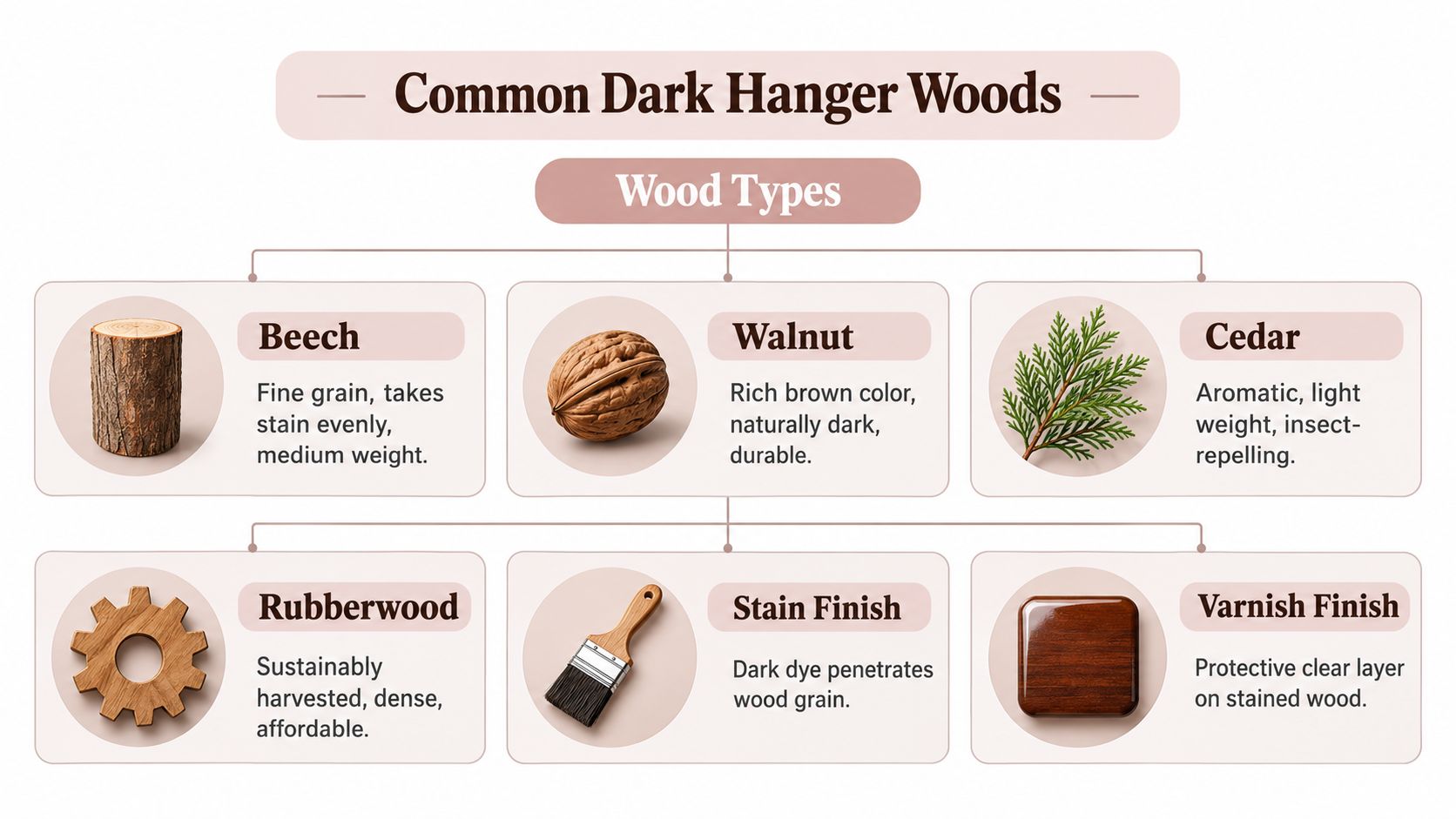
- Beech often has a fine, even grain and usually takes stain well. That makes it useful when a maker wants a consistent dark finish.
- Walnut is known for its naturally rich brown tone, so the depth of colour can look more inherent to the material.
- Cedar is usually lighter in feel and often chosen by buyers who like its aromatic character.
- Rubberwood is commonly used where buyers want a dense wood at a more accessible price point.
If you'd like a parallel from another part of wood finishing, studies in tone and grain used for professional dark walnut floor finishes can help you see how stain depth, grain pattern, and topcoat sheen change the final look of wood surfaces. The same visual principles carry over to hangers, just on a smaller scale.
Stained, varnished, or painted
A dark hanger's colour usually comes from one of three routes.
Solid dark timber
This is the simplest to understand. The wood itself carries much of the tone. Minor scratches may be less visually abrupt because the colour isn't only sitting on the surface.
Stained wood with a clear coat
This is common and often practical. A lighter timber is darkened with stain, then protected with varnish or another sealing layer. If the stain is applied evenly and the topcoat is sound, the result can look polished and warm rather than flat.
Painted dark finish
Paint covers the grain more fully. That can be useful if you want a cleaner, more uniform appearance, though it won't give the same open-grain warmth as stained timber.
Dark colour and real wood grain aren't the same thing. A hanger can look dark without looking woody, and that distinction matters if you care about warmth, touch, or how wear will show over time.
What buyers often miss
The practical question isn't only “Is it dark?” It's “What is making it dark?”
That matters because UK product listings often focus on boutique appearance and FSC mentions but leave out the buyer's everyday questions: whether the hanger is solid wood or coated, how the finish copes with regular handling, and what that coating means at end of life. The gap is visible across UK wooden hanger retail listings, where finish and presentation are commonly foregrounded more than material explanation.
If you're comparing options, it helps to read a darker hanger the way you'd read fabric composition. Surface appearance is only the first clue. For a related comparison of finishes and styling direction, this guide to black wood hangers is useful when you're deciding between stained dark brown and a more graphic black look.
Durability Weight Capacity and Everyday Performance
A dark wood hanger proves itself on a busy rail at the awkward moment. A wool coat is lifted off, put back quickly, turned to check the lining, then steamed and rehung. If the hanger twists, the hook wobbles, or the shoulders bow, the problem shows up on the garment before it shows up in the wood.
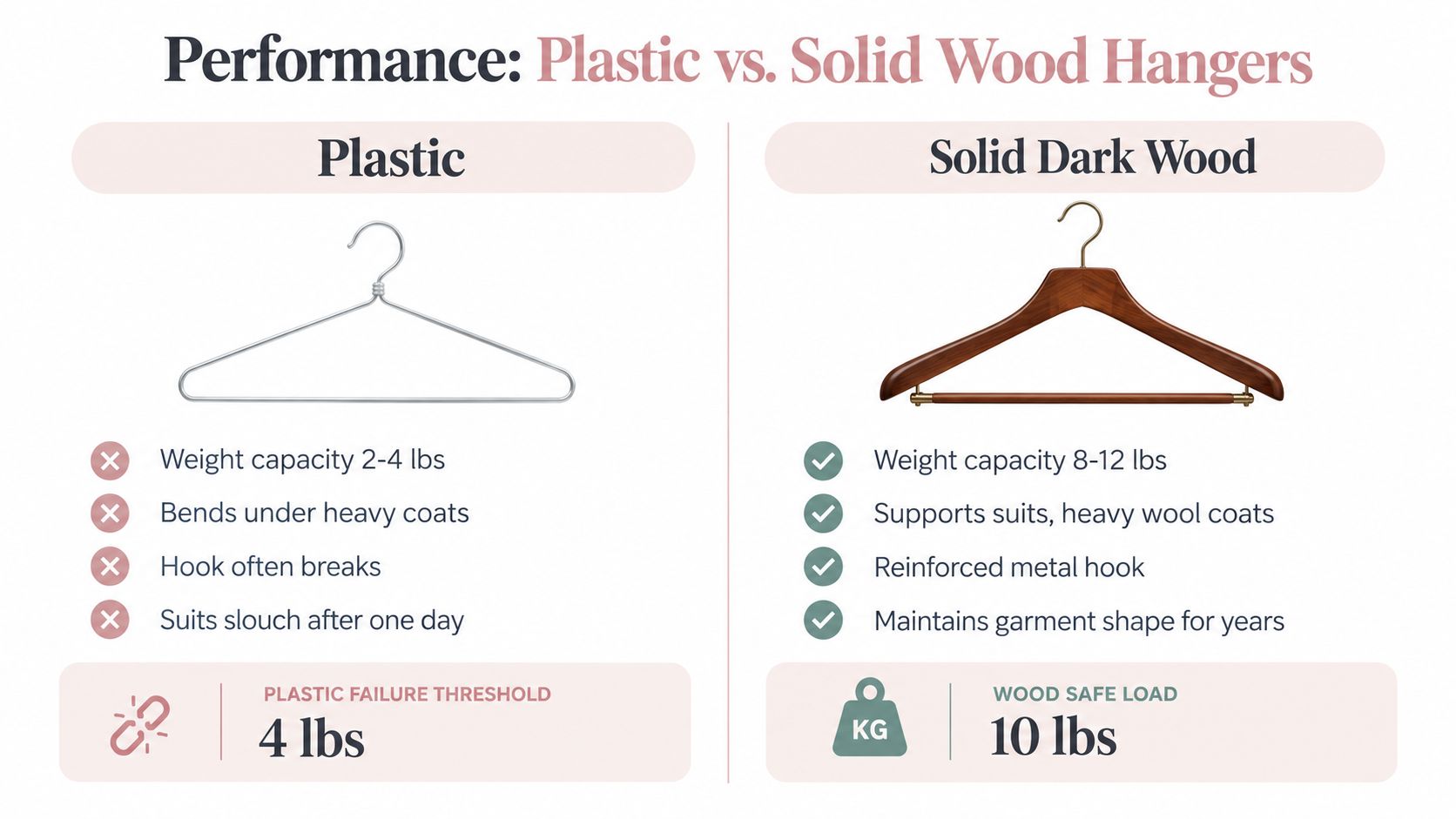
That is why durability is not only a storage question. It is a display and garment-care question too. In a shop, a hanger has to keep a jacket standing properly on the rail so the cut reads clearly. At home, it has to hold shape between wears so the shoulder line, drape, and finish of the garment stay calm rather than slumped or stressed.
What strength looks like in practice
For a structured blazer, carrying the weight is only part of the job. The hanger also needs enough body across the shoulder span to stop the cloth sinking inward. A weak hanger works like a flimsy dress form. It holds the item up, but it does not support the shape you are trying to preserve.
Good everyday performance usually comes from a few practical details:
- Broader shoulder ends spread the load of coats and jackets more evenly.
- A contoured profile gives knitwear and softer cloth a gentler resting place, which helps reduce shoulder bumps.
- A firmly fixed metal hook stands up better to repeated lifting, turning, and rehanging on sales rails or wardrobe poles.
- A well-sealed finish is less likely to chip, scratch, or develop rough patches that can snag delicate fabric.
Thickness matters as well. Two dark wood hangers can look similar from the front, yet the slightly fuller one often does a far better job with suiting, outerwear, and garments that are steamed often. The extra material acts like better scaffolding inside the clothes.
The hidden issue of moisture
Wood keeps adjusting to its surroundings. It is a natural material, not a cast plastic shape. So a hanger that starts straight and balanced can slowly shift if it has been poorly dried, badly stored, or finished without enough protection.
For shop owners, that may show up as hooks loosening, trouser bars creeping out of line, or hangers that no longer sit evenly across a rail. For home sewers and careful dressers, the clue is often subtler. One shoulder starts sitting higher than the other, or a once-flat hanger begins to rock slightly when laid on a table.
A wooden hanger does not have to snap to fail. If it warps enough to distort the garment, it is no longer doing its job.
The dark finish plays a part here. A sound stain-and-topcoat or painted finish is not just there for colour. It also helps the wood cope better with handling, light abrasion, and day-to-day changes in air conditions. Poor finishing tends to show up first at touch points such as the shoulder edge, the hook entry, and the trouser bar.
When dark wood earns its keep
Dark wood hangers make the most sense where the hanger is doing real support work. Tailoring, coats, wool skirts, heavier dresses, lined trousers, and garments you steam and rehang regularly all benefit from a hanger with more strength and a more stable shoulder line.
They are less forgiving in rough back-room use where stock is packed tightly, knocked together, or treated as temporary transit. Dark finishes can reveal dust, scratches, and batch variation more clearly under bright retail lighting, so the hanger choice should match the pace and discipline of the space.
If your rail carries heavier garments every day, it helps to compare heavy-duty hanger options for coats and tailoring with standard wooden profiles instead of treating all dark wood hangers as equal. The right one protects the garment, presents it better, and lasts longer under real use.
Choosing the Right Size and Shape for Every Garment
A good hanger should disappear into the garment. You notice the coat, not the support. When the size is wrong, though, the problems show immediately. Shoulder points jut out beyond the sleeve head, straps slide inward, collars buckle, or the whole rail looks cramped and uneven.
Start with the garment's structure
The right shape depends less on category labels and more on what part of the garment needs support.
| Garment Type | Recommended Hanger Width and Profile | Key Feature to Look For |
|---|---|---|
| Tailored jacket or blazer | Width close to the actual shoulder line, with a shaped or contoured profile | Broad shoulder support |
| Coat | Wider profile with more depth through the shoulder | Sturdy body and firm hook |
| Shirt or blouse | Slimmer profile that still matches shoulder width | Smooth finish and balanced curve |
| Trousers | Jacket hanger with trouser bar, or dedicated trouser hanger | Bar or grip that avoids deep creasing |
| Dress with straps | Moderate width with secure notches or a shape that prevents slipping | Strap security |
| Knitwear | Supportive shoulder shape, not too narrow | Gentle contour to reduce bumps |
| Children's wear | Scaled-down width that matches the garment | Proportionate size |
| Oversized tailoring | Slightly fuller span without pushing beyond the sleeve head | Stability without overhang |
A quick test helps. Hold the hanger inside the garment and check whether the shoulder ends stop where the garment's own shoulder line stops. If the hanger extends too far, it can distort the sleeve head. If it stops too short, the cloth collapses.
Width matters more than people expect
Many people buy one hanger size for everything because it looks tidy. Tidy, yes. Helpful, not always. A cropped jacket, a man's overcoat, and a bias-cut camisole won't all behave well on the same frame.
For home sewers, this matters during finishing. You may press a neckline beautifully, then lose that neat line by storing the garment on a hanger that's too narrow. For retailers, poor width choice leads to rails that look sloppy even when the stock is good.
Trouser bars, clips, and paired sets
A dark wood hanger becomes much more useful when it handles a full outfit. A jacket hanger with a trouser bar can keep a suit together, reduce rummaging, and help the rail read as coordinated. If you're comparing options for suiting and separates, this guide to wooden coat hangers for trousers shows the sort of configurations worth looking for.
If the hanger leaves a mark, pulls a strap, or changes the shoulder line, it isn't the right shape, even if it looks smart on the rail.
One practical note for display work. If you use mannequins, body forms, or garment rails for photography and fittings, keep the hanger profile visually in step with the rest of the presentation. A delicate blouse on a heavy coat hanger can look as awkward off-body as it would on the wrong mannequin.
Styling and Visual Merchandising with Dark Wood Hangers
Uniform hangers can calm a rail faster than almost any other display change. Mixed colours and mixed materials create visual noise. Matching dark wood hangers bring rhythm. They tell the eye where to rest, which means the garments themselves stand forward more clearly.

Where dark wood works especially well
Dark wood hangers tend to suit spaces that want warmth rather than starkness. In a boutique with cream walls, oak flooring, brass details, or textured fabrics, they help the display feel grounded. In a home wardrobe, they can make a small run of handmade or carefully chosen garments feel edited rather than crowded.
They're especially effective with:
- Light garments because the contrast sharpens the outline
- Neutral and monochrome rails where wood adds warmth
- Tailoring and outerwear because substance in the hanger matches substance in the garment
- Studio presentation where garments move between fitting, steaming, and photographing
When they can work against you
Dark finishes are handsome, but they're not invisible. Under strong retail lighting, dark varnished hangers may show dust, surface scratches, and slight colour variation more readily than some lighter or black-painted alternatives. That doesn't make them a poor choice. It means the rail has to be maintained with the same discipline you'd give polished shoes in a window display.
A useful approach is to decide what story the rail is telling.
For a classic boutique mood
Use dark wood with wool, denim, twill, silk, and soft neutrals. Keep the hanger line even. Face hooks one way. Let the wood echo tables, shelving, or floor tone.
For a modern graphic look
Dark brown may compete with very stark interiors. In those settings, black can look cleaner and more architectural, while natural wood can feel lighter and less formal.
A hanger should support the brand language of the shop. If the garment says “quiet luxury” and the rail says “spare parts cupboard”, customers notice the mismatch.
For merchandising teams working across rails, forms, and shop-floor layouts, practical display principles matter as much as product choice. These visual merchandising guidelines are useful if you want hanger choice to fit into a wider display system instead of being treated as an isolated buying decision.
How to Care for Dark Wood Hangers and Preserve the Finish
A dark wood hanger usually starts looking tired in ordinary ways. Dust settles along the shoulder line. A little rail rub turns the edge dull. A damp stockroom or spare room leaves the wood feeling slightly rough or swollen. None of that sounds dramatic, but on a shop rail or in a carefully kept wardrobe, those small changes affect both presentation and garment support.
Regular care keeps the hanger doing its real job. It protects the finish you see, and it helps the wood stay stable enough to support the clothing hanging from it. That matters in retail, where the hanger is part of the display, and at home, where it helps a jacket, dress, or shirt keep its shape between wears.
A simple care routine that lasts
Treat dark wood the way you would treat a polished worktable in a sewing room. Clean it gently, keep it dry, and do not wait for visible damage before paying attention.
- Dust with a soft cloth. Dry is usually enough. If needed, use a barely damp cloth, then wipe the hanger dry straight away. Dark finishes show surface dust quickly, so light, frequent cleaning works better than occasional heavy scrubbing.
- Remove marks carefully. Shop-floor residue, makeup transfer, or wardrobe grime should be wiped off with a mild cleaner on a cloth, not sprayed directly onto the wood.
- Check the hook and neck joint. Give each busy hanger a quick hand check now and then. If the hook loosens, retire that hanger from active use before it twists on the rail or drops a garment.
- Separate damaged pieces early. One scratched or sticky hanger can mark neighbouring hangers and make a full rail look neglected.
The room affects the hanger
Wood responds to its surroundings much like fabric does. Leave wool in a damp space and it will not feel the same as wool stored in a clean, stable room. Dark wood hangers behave in a similar way. If they live in a humid back room, an unheated loft, or a wardrobe beside strong heat, the finish and the timber both have more work to do.
That is why storage conditions matter as much as wiping and polishing. A stable room helps the hanger stay smooth, true, and kinder to clothing. Repeated swings between dry heat and damp chill can slowly encourage slight movement, roughness, or finish stress, especially on lower-cost hangers with thinner coatings.
Mistakes that shorten the life of the finish
A few habits cause trouble faster than people expect:
- Harsh sprays and solvent-heavy cleaners can dull the surface or leave patchy shine.
- Direct sunlight can change colour unevenly, especially if one side of the rail gets the light every day.
- Overpacked rails create constant wood-on-wood rubbing, which scuffs edges and shoulders.
- Damp storage areas can leave the hanger swollen, slightly tacky, or less stable under a garment's weight.
For home sewers, the principle is the same as caring for other wooden tools and storage pieces. A well-made wooden sewing box lasts longer when it is kept clean, dry, and away from abrupt changes in temperature. Hangers respond to the same kind of steady treatment.
Store wooden hangers where you would trust fabric to stay fresh. If the room feels damp, stale, or sharply changeable, the wood is under strain too.
Final Thoughts on Selecting Dark Wood Hangers with Confidence
A dark wood hanger does more than hold a garment off the floor. It supports the cut, protects the shoulder line, contributes to the mood of the rail, and affects whether clothing looks cared for or merely stored. That's why it helps to judge hangers as working tools, not afterthoughts.
The buying decision becomes easier when you check four things together. First, the wood and finish. Is the darkness coming from the timber, a stain, or paint? Second, the shape. Does it suit tailoring, shirts, dresses, or trousers? Third, the construction. Does the hook feel secure and the shoulder profile supportive? Fourth, the setting. Will the hanger live in a heated wardrobe, an unheated stock space, a guest room, or a busy retail rail?
A practical shortlist before you buy
- Match the hanger to the garment: Broad shoulders for coats and jackets, slimmer profiles for lighter pieces.
- Inspect the finish: Ask whether it is stained, varnished, painted, or naturally dark timber.
- Think about upkeep: Dark finishes can look refined, but they also show dust and scratches more readily in some spaces.
- Check environmental fit: Wooden hangers do better when the space isn't swinging between dry heat and damp chill.
- Buy for the actual job: A shop rail, a tailoring studio, and a home wardrobe don't all need the same specification.
For readers sourcing display tools as part of a broader setup, Display Guru offers wooden hanger options alongside tailor dummies, body forms, and garment rails, which can be useful when you want your storage and presentation tools to work together rather than as separate purchases.
Confidence comes when you stop asking, “Do these hangers look nice?” and start asking, “Do these hangers help my garments look and behave properly?” That question usually leads to better choices. And better choices keep clothing sharper, rails calmer, and wardrobes more satisfying to open.
If you're refining a rail, fitting area, or sewing studio, Display Guru offers practical display equipment including wooden hangers, garment rails, and tailor dummies that suit the kind of considered garment care covered here. It's a useful place to compare tools when you want storage, presentation, and fitting equipment to feel consistent across the whole space.