



Clothes Rail for Kids: A 2026 Sizing Guide
The UK childrenswear market was projected to remain broadly flat at £7.85 billion in 2025, according to Mintel's UK Childrenswear Market Report. Yet choosing somewhere to hang those clothes comes down to much smaller details: a child's shoulder height, the length of a coat and whether the frame stays secure when pulled.
A clothes rail for kids should make dressing easier without becoming a climbing frame. Start with the child and the garments, then check the structure. A miniature rail isn't automatically a safe rail, and a generous hanging-load rating doesn't prove that it won't tip.
Clothes Rail Heights Widths and Loads by Age
Use age to organise your buying brief, not to prescribe dimensions. Children of the same age differ in reach, and a rail full of shirts needs a different arrangement from one holding long costumes. The practical starting point is the intended user's shoulder and the actual clothes you want to hang.
Planning sizes for a clothes rail for kids
| Age or setting | Typical stature | Useful width | Planning load |
|---|---|---|---|
| Nursery, under 2 | Measure the child; adult-managed storage | Enough for the selected daily garments | Weigh the intended clothes; stay within the maker's rating |
| Ages 3–4 | Measure standing shoulder height | Fit the everyday wardrobe without compressed sleeves | Include garments and hangers in the planned load |
| Ages 5–7 | Measure standing shoulder height | Allow room for uniform and outerwear separately | Check the complete uniform and coat load |
| Ages 8–10 | Measure standing shoulder height | Fit larger hangers without crowding | Include heavier coats and any approved accessories |
| Shared bedroom | Size to the older child, with accessible provision for the younger child | Add width, do not raise the bar | Assess the combined wardrobe against the maker's rating |
| Retail children's bay | Staff reach, not child climb | Match the stock allocation and available floor footprint | Maker's rated load |
These are buying rules, not certified size standards. There's no defensible universal kilogram allowance based only on a child's age. A lightweight summer wardrobe and a collection of winter coats can occupy similar widths but place quite different demands on the frame.
Set height from the shoulder and hem
Have the child stand naturally in the place where they'll use the rail. Measure from the floor to their shoulder with a tape measure, then use that as the starting bar position. They should be able to lift a hanger clear without stretching onto their toes or stepping on the base.
Next, put the longest garment on its intended hanger. Measure from the hanger's contact point to the hem and check that it clears both the floor and any lower shelf. Don't measure the garment alone, because the hanger changes the required hanging drop.
If shoulder-level access and hem clearance can't both be achieved, change the arrangement. Keep long dresses on an adult-managed rail, or give them a separate hanging position rather than raising every garment beyond the child's reach.
Practical rule: A reachable bar and a clear hem must work together. Neither measurement is useful on its own.
Buy width before unnecessary height
Lay out the intended hangers along a temporary pole or existing rail. Leave enough space to remove a shirt without dragging its neighbours along. Padded coats, gathered skirts and costume sleeves need more breathing room than flat shirts.
For siblings, don't assume that matching the older child's shoulder makes the same bar accessible to the younger child. Add a separate lower position or allocate accessible garments along a suitable lower bar.
A dressmaker can use an adjustable child dress form to assess garment shape, but that doesn't establish the wearer's comfortable reach. Measure the child separately, record the required hanging drop and reject a rail whose lowest stable setting still sits above the intended user's shoulder.
Why a Kids Rail Beats a Drawer
A rail's first job is to show what's ready to wear. Say a parent is sorting school clothes after washing: a hanging shirt reveals a worn cuff, trousers show their length, and an empty hanger makes a missing item obvious. In a crowded drawer or bag, those checks take more handling.
An everyday uniform arrangement makes that visibility useful.
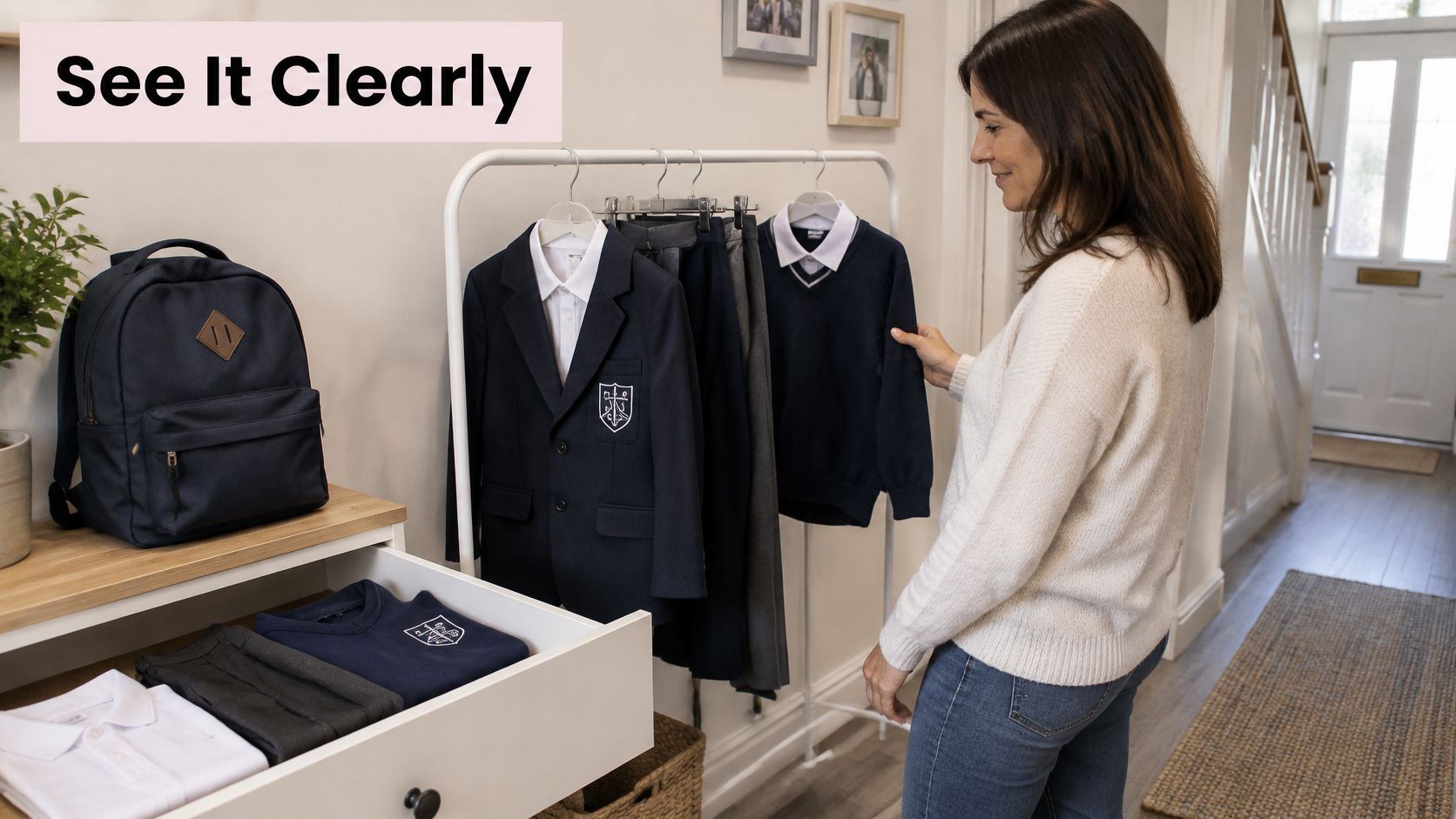
In a 2020 survey of around 1,000 UK parents, The Children's Society found that families with children in state-maintained schools spent an average of £315 annually on uniform for each primary-school child and £337 for each secondary-school child. Keeping usable garments visible won't remove that expense, but it helps a parent check what's already available before buying replacements.
Visibility needs a manageable wardrobe
A child-scale rail is a hanging bar matched to reach and garment length, not just a smaller adult shop fixture. It works best when the child can recognise the choices and slide the hangers independently, rather than face a tightly packed wall of fabric.
- Ready to wear: Keep clean, current-size clothes together.
- Needs attention: Remove garments awaiting repairs or washing.
- Ready to pass on: Separate outgrown pieces before they disappear behind newer clothes.
Drawers still suit socks, underwear and folded knitwear. The useful distinction is between clothes that benefit from hanging and items that are easier to manage in compartments, as this guide to clothes rail storage explores.
This video offers another visual reference for the topic.
Before choosing the furniture, note who will lift the hangers and which coat or dress needs the longest clear drop. Those answers are more useful than the product's age label alone.
Stability Checks and Failure Signs
Pulling, leaning and climbing are foreseeable risks, not reasons to assume a child will always use furniture as instructed. A low, lightweight rail can still overturn. Keep children away while an adult assembles and checks it, and never ask a child to demonstrate whether it survives a climb.
GOV.UK's consumer product safety advice recommends attaching heavy furniture to the wall to prevent tipping. For a bedroom rail, look for a suitable anti-tip restraint or an anchoring arrangement supported by the manufacturer's instructions, with fixings selected for the actual wall construction.
Separate hanging strength from tip resistance
A maximum hanging load tells you what the manufacturer permits the bar and structure to carry under specified conditions. It doesn't automatically tell you how the rail behaves when someone pulls sideways.
Think of the base edge as a pivot. A sideways tug high on the frame can lift the opposite feet; a broader footprint and lower centre of mass help resist that movement. The position of the clothes matters too, particularly when a user pushes everything towards one end.
Ask the supplier for clear answers about:
- Base footprint: The full depth and width, including projecting feet.
- Loaded stability: How the intended configuration has been assessed against overturning.
- Castor locks: Which movements they restrain and how they're engaged.
- Rated load: Whether limits apply to each bar, the whole frame or accessories.
- Anchoring: Where the restraint attaches and what installation instructions accompany it.
A heavy-duty clothing rack may offer useful load capacity, but its description isn't a substitute for evidence about child-accessible use.
Use the visual checklist alongside the written instructions.
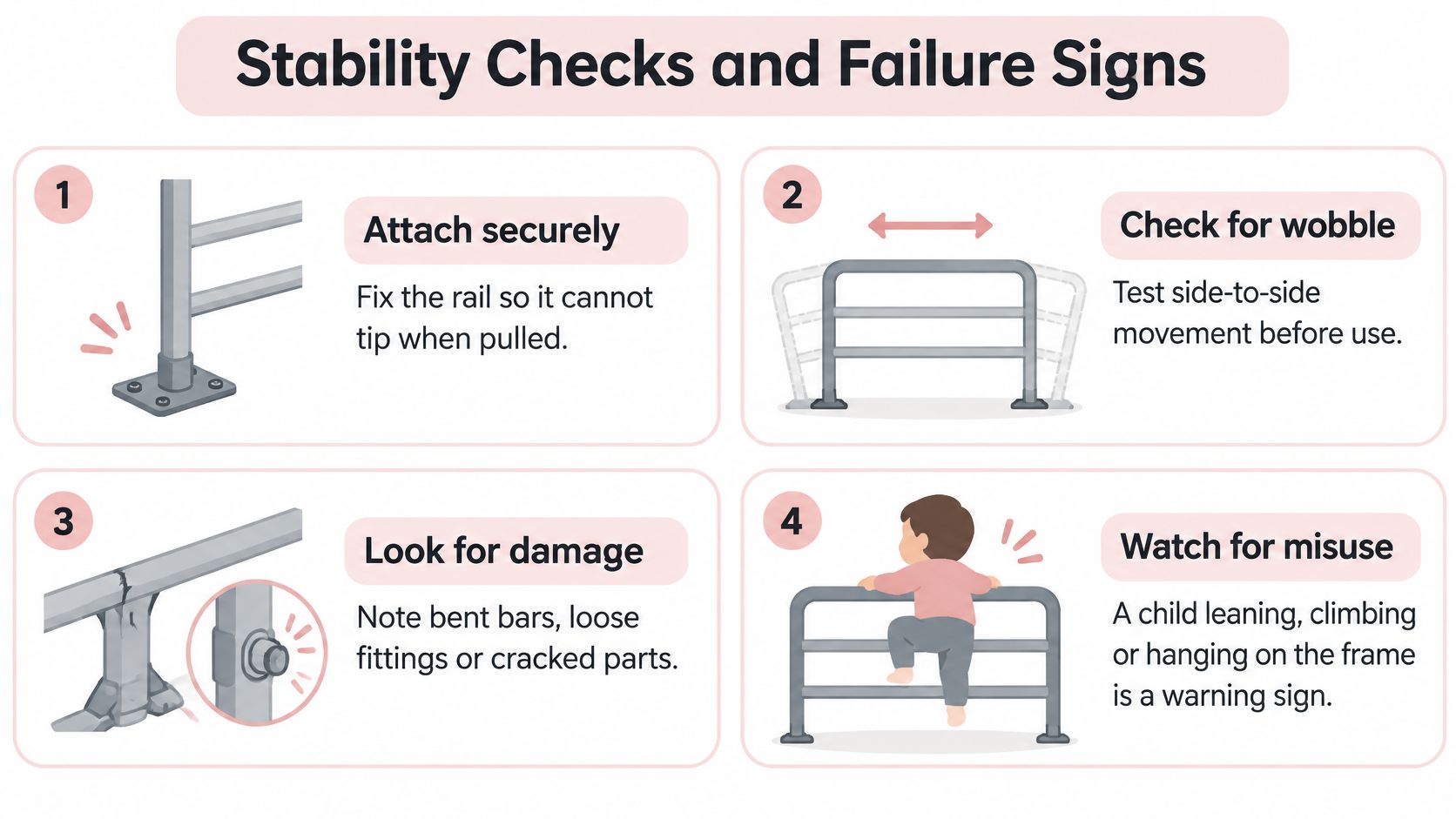
Inspect without improvising a destructive test
With the empty frame assembled and secured, inspect its joints and feet. Follow the manufacturer's checking procedure, then add the intended clothing gradually while an adult watches for movement. Don't hang body weight from the bar or invent a pull-force test.
| Wrong assumption | Visible warning | What to do |
|---|---|---|
| A short frame cannot tip | A foot lifts or the frame rocks as clothes move | Stop using it and resolve the installation or return it |
| Tight adjustment knobs always hold | The bar creeps down under clothing | Unload it and inspect the locking mechanism |
| Wheels make any position usable | The rail rolls or swivels when accessed | Check locks and the floor surface |
| A complete-looking frame is undamaged | Bent tubing, cracked joints or loose fittings | Remove it from use |
| More weight at the bottom fixes everything | The base still shifts or the restraint loosens | Don't add improvised ballast; obtain a suitable solution |
Keep heavy garments low where the design permits, and keep beds, toy boxes and other stepping points away. Don't position the frame against a radiator or where a door can strike it.
A rail that feels steady during ordinary hanging has not thereby been proved safe against climbing.
If the supplier can't explain the permitted load and installation method, don't choose it for a child-accessible room. Missing instructions and unexplained movement are reasons to stop, not invitations to experiment.
Frames Materials and How They Adjust
Choose the format by its weakest point in your room. A telescopic mechanism is useful only if it locks securely, while a folding frame is useful only if its deployed footprint suits the available space. Buying the tallest option can add adjustment you never need and make the intended setup harder to control.
Rail formats and where each one fails
| Format | Best for | Adjustment | Main limit |
|---|---|---|---|
| Fixed low rail | Nursery and toddler room | None, fixed height | Becomes unsuitable when reach or garment length changes |
| Telescopic height rail | Bedroom use within the maker's intended age range | Bar rises through the available settings | Weak or damaged locks can slip |
| Double bar | Separating mixed hems and coats | High bar plus low bar | Upper bar can invite climbing |
| Folding portable | Costume room, pop-up or spare room | Collapses for storage | Check deployed base width and its own load rating |
| Wall-anchored rail | Daily child use | Fixed or limited adjustment | Needs suitable wall construction and fixings |
| Shop rail on castors | Children's retail bay | Height set by staff where adjustable | Castors must lock; respect the rated load |
A fixed frame avoids adjustment hardware, but you can't lower it when a younger sibling takes over. A telescopic frame offers flexibility, although accessible knobs and exposed sliding joints need careful inspection.
A double rail can separate short garments from longer ones, provided the lower bar doesn't obstruct the longer hems. Portable frames suit changing layouts, but folding does not necessarily mean low capacity or poor stability: compare the actual specification rather than assuming either.
Inspect the finish and moving parts
FIRA's children's furniture standards guidance identifies ages 3–12 as a distinct safety category and covers issues including materials, edges, tubular components, squeeze points and test documentation. The relevant assessment must match the product's intended use, rather than rely on an adult-furniture description.
For tubular steel, inspect welds, protected ends and the continuity of the finish. Powder coating and plated finishes both need checking for damage; don't assume a finish name guarantees resistance to chips or moisture. Timber needs smooth surfaces and rounded accessible corners, with no splits around fasteners.
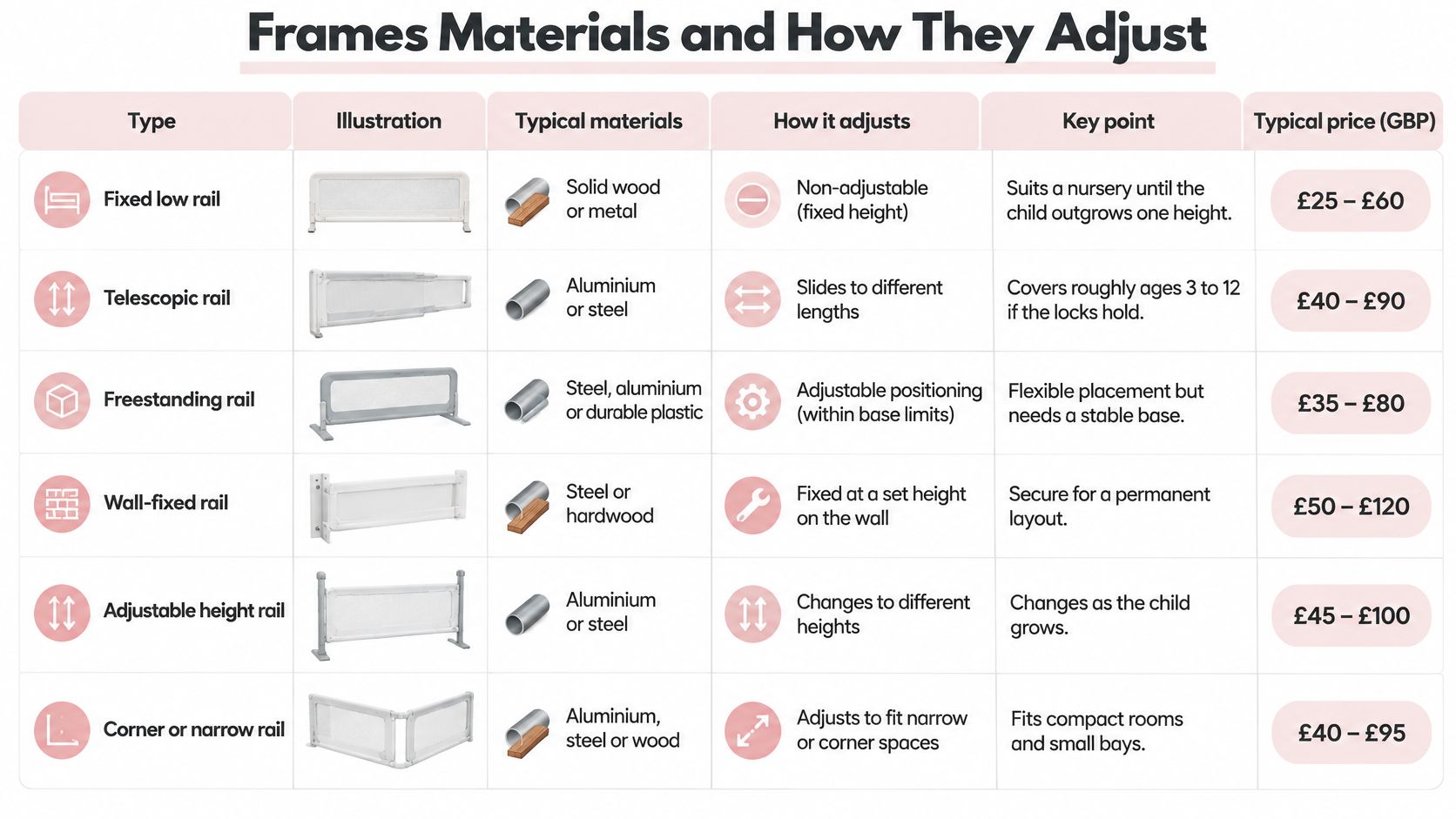
The following visual accompanies the format comparison.
Check what adjustment exposes
Watch where the inner and outer tubes meet. Fingers shouldn't enter a closing gap during adjustment, and protruding hooks shouldn't sit where a child turns their face towards them. Make height changes with the rail unloaded unless its instructions expressly permit otherwise.
For schools, shops and costume departments, keep the supplier's conformity evidence with the assembly instructions. Check that the paperwork identifies the actual product and states its intended users, inspection points and installation requirements.
Choose a fixed bedroom arrangement for a fixed daily task, or a properly specified portable arrangement for changing professional layouts. Adjustment is a function, not a safety credential.
From Nursery Corners to Shop Bays
The same hanging principle serves very different users. What changes is who reaches the bar, how garments are selected and whether the rail stays in one place. Set those responsibilities before arranging the clothes.
A nursery corner and a family bedroom
In a nursery, treat the rail as adult-managed storage, even when the clothes and frame are small. Hang the selected sleepsuits and outdoor layers where the adult can retrieve them comfortably. Keep the installation away from the cot and any furniture a toddler could use as a step.
A nursery arrangement can combine hanging and separate low-level storage.
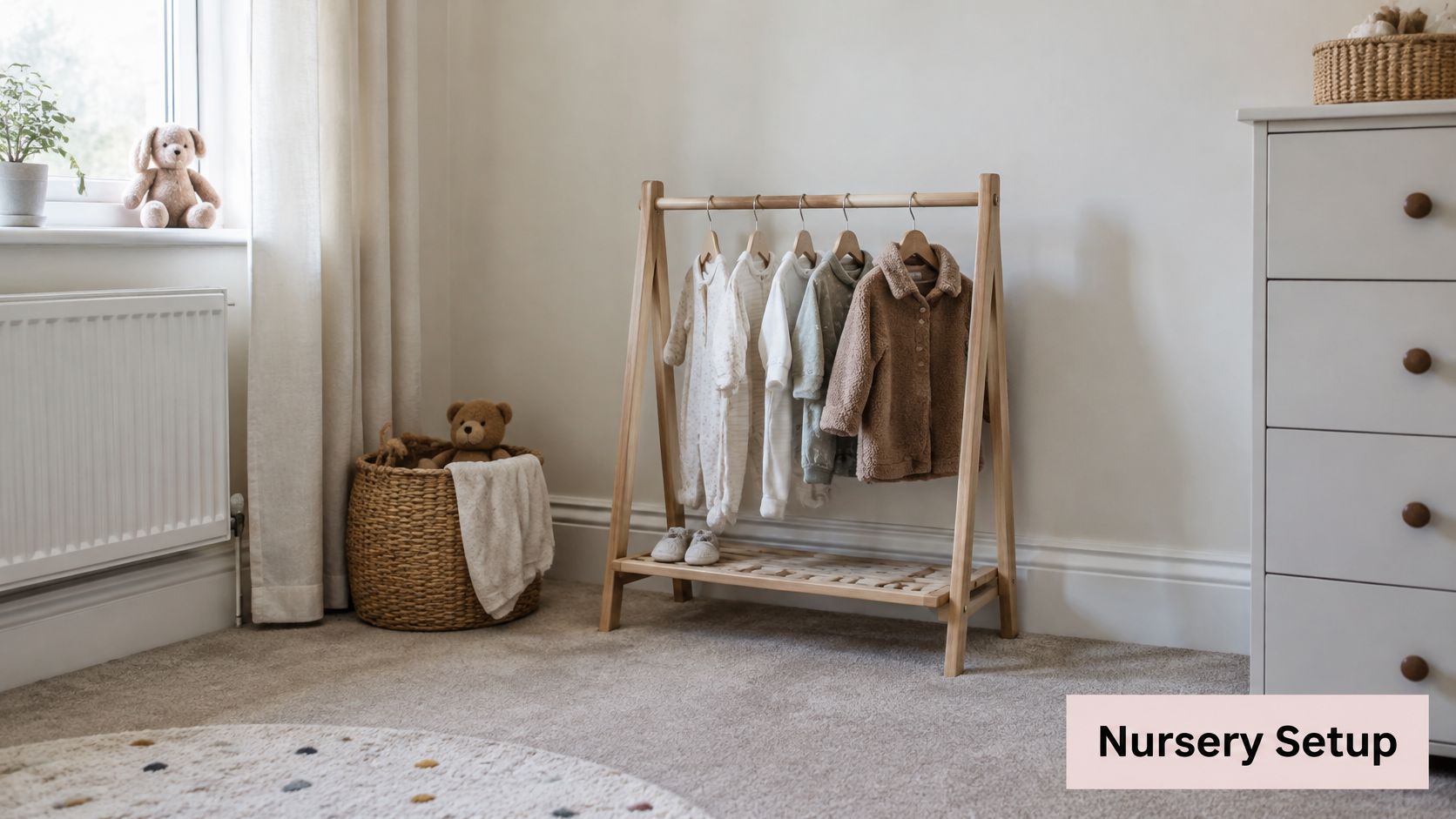
In a family bedroom, arrange the clothes in the order the child recognises: uniform together, leisure clothes together, then outerwear where appropriate. Keep sports bags in their own storage position rather than suspending their concentrated weight from a convenient end post.
Don't let decorative baskets obscure a restraint or prevent an adult inspecting the base. Storage only helps if it leaves the furniture's working parts accessible.
A uniform exchange and a children's shop
For a school exchange, make selection easy from the aisle. Use clear size dividers, show garment labels where possible and leave room to remove an item without dislodging neighbouring hangers. Inspect donated garments before they reach the display.
Approximately 1.4 million wearable school-uniform items are disposed of annually in the UK, representing more than 350 tonnes of plastic, according to figures reported by BBC Newsround. A well-arranged exchange rail gives families a practical way to inspect reusable clothing, although the rail itself doesn't guarantee that garments will be reused.
Make the useful garment easy to find, not merely easy to donate.
A shop bay has a different task: presenting stock while staff control replenishment. Keep the browsing area clear, avoid arrangements that encourage children to climb for a display garment, and bring higher items down for customers. A children's fashion mannequin can show an outfit without requiring every component to hang at browsing height.
Give each setting a clear operating rule:
- Nursery: Adults hang and remove clothing.
- Bedroom: The child handles reachable daily garments with suitable supervision.
- Uniform exchange: Organisers replenish the rail; families select from accessible stock.
- Shop bay: Staff handle raised displays and move the fixture.
The best arrangement makes those roles obvious without expecting a child to interpret a warning label.
Choose the Rail for Your Room
Buy the rail that meets the room's working requirements, not the one with the largest advertised capacity. A compact bedroom, a costume store and a retail bay need different footprints and access arrangements. Write down the intended users and wardrobe before comparing products.
Make the buying decision in order
- Measure the user and garments. Record comfortable hanger-lifting height and the longest hanging drop. If the requirements conflict, separate adult-managed garments from the child's daily selection.
- Choose the format. Reject designs whose limitations match the room's likely use, such as a folding joint in an arrangement that needs permanent daily access.
- Get the specification in writing. Confirm the installation requirements, permitted load and accessory compatibility before ordering.
- Plan the inspection. Decide who will check fittings after assembly, after relocation and when the wardrobe changes.
A guide to choosing a small clothes rail can help when floor space is tight, but measure the entire base rather than just the hanging bar. Leave a usable route around the fixture and space to lift clothing off it.
Recommended specs for a clothes rail for kids
| Spec | Recommended value | Why it matters |
|---|---|---|
| Hanging bar height | Near the user's shoulder, checked through actual use | Child lifts hangers without climbing |
| Floor clearance | Hems clear the floor and any shelf | Stops garments dragging or bunching |
| Anchoring | Suitable wall fixing or documented, tested anti-tip design | Addresses overturning risk |
| Castors | Lockable and locked during stationary use | Restrains unwanted movement |
| Tube ends | Capped or otherwise protected | Avoids exposed edges and snags |
| Hook height | Positioned outside likely head and eye contact paths | Reduces contact injury risk |
| Maximum load | Written rating sufficient for the intended wardrobe and approved accessories | Keeps use within the manufacturer's limits |
Keep tomorrow's storage out of today's way
Seasonal overflow can turn an accessible rail into an overcrowded one. For a separate rotation routine, the guide to organize kids' seasonal clothes with InchBug offers a useful companion to planning the everyday hanging space. Keep stored clothing clearly identified so it doesn't drift back onto the working rail without a fit check.
For a staff-managed children's retail bay, school exchange or studio, we sell shopfitting garment rails in white and black, along with accessories, dump bins and baskets. Confirm the chosen model's finish, accessory compatibility and suitability for your intended arrangement with our team before ordering; a shopfitting product isn't automatically approved for unsupervised bedroom use.
Reassess the arrangement when the child grows, the longest garment changes or heavier clothing replaces the current wardrobe. If the child must climb to reach a hanger, the rail is the wrong height.
At Display Guru, we offer white and black shopfitting garment rails, accessories, body forms and retail display equipment for organising and presenting children's clothing. Bring your available footprint, required hanging drop and intended wardrobe to our team so you can compare suitable options before ordering.