




Clothes Rail Wooden Guide for Home and Retail
The UK generated approximately 1.45 million tonnes of used textiles in 2022, according to WRAP figures summarised in evidence published by Parliament. A wooden clothes rail won't solve that problem, but it can give garments somewhere useful to go before they become unwanted clutter: a place for inspection, repair, fitting and another wear. The important purchase isn't the prettiest frame. It's the frame that carries your actual workload safely.
Why Wooden Clothes Rails Matter in 2026
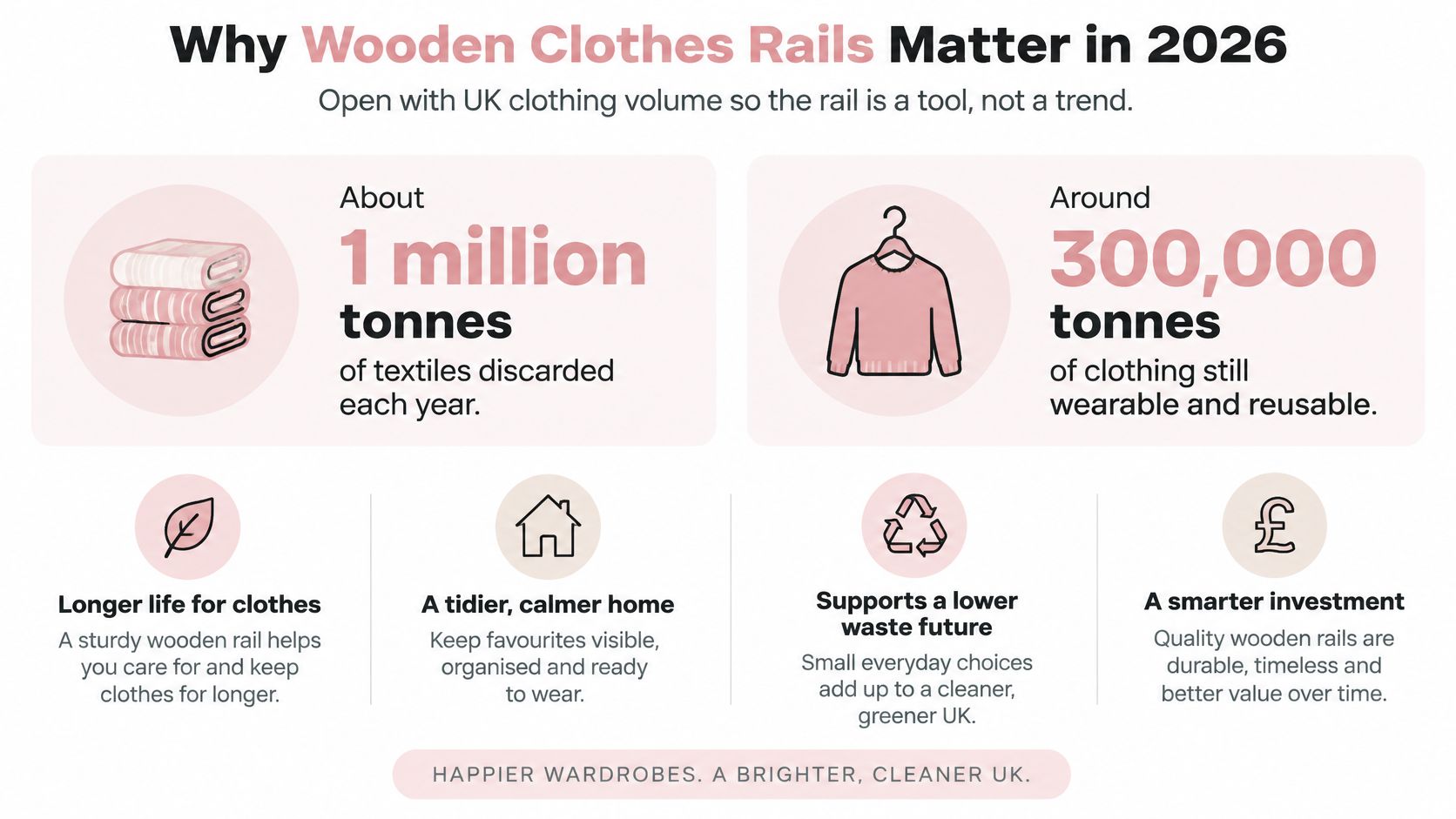
A UK Parliament inquiry reported approximately 1 million tonnes of textiles discarded annually, with around 300,000 tonnes of clothing entering household bins each year, in its report on clothing consumption and sustainability. These are historical figures, not a current-year forecast, but they explain why accessible garment storage deserves more thought than matching a bedroom colour scheme.
Take a typical sewing room. A jacket needs its lining repaired, a dress awaits a fitting, and finished trousers are folded beneath pattern pieces. Put everything on the same crowded chair and the next job becomes finding the garment rather than working on it.
A working frame rather than extra furniture
A wooden clothes rail consists of uprights, a hanging bar and supporting feet or a base, sometimes with a lower shelf. Its useful job is to keep suitable garments extended, visible and reachable. Think of a set table against a stuffed drawer: you can see what's available without disturbing everything around it.
The distinction matters to home sewists, tailors, visual merchandisers and costume teams. A rail can hold an active collection, but it shouldn't become an excuse to hang every garment you own, including heavy knitwear that's better folded.
The practical benefits are easier to judge when storage, access and garment use are considered together.
Working principle: Buy enough accessible hanging space for the work in progress, not enough bar length to hide an unfinished sorting job.
For retail use, apply the same discipline through sensible visual merchandising guidelines: customers need to distinguish garments and remove them comfortably. Wood earns its place where that workflow suits the room, but metal or plastic can be the better material for a different workload.
Wood Against Metal and Plastic
Wooden, metal and plastic clothes rails compared
| Rail type | Strengths | Weak points | Best setting |
|---|---|---|---|
| Solid timber frame | Warm appearance, repairable construction, relatively quiet under hangers | Can swell, dent or split; capacity relies on joints and span | Home sewing, boutiques, costume rooms |
| Powder-coated steel | Suitable for high-capacity designs, slim uprights, easy to wipe | Coating chips can expose steel to rust; feet may mark pale floors | Retail floors and stock rooms |
| Chrome or tubular metal | Bright finish, narrow-profile options, familiar shopfitting appearance | Shows fingerprints; damaged plating can pit in damp conditions | High-street visual merchandising |
| Moulded plastic or resin | Lightweight, coloured options, straightforward to move | Light frames can flex under coats; structural repairs are difficult | Children's clothes and light craft displays |
Read this table as a material shortlist, not a ranking of load ratings. A well-braced timber frame may outperform a poorly connected metal one. Neither a metallic finish nor a thick-looking wooden bar proves that the complete assembly is suitable for your garments.
Where timber earns its place
Solid wood suits a fitting studio where people work close to the rail and the frame remains on view. A sealed, smooth bar feels appropriate beside pale floors and a cutting table, while accessible mechanical joints can sometimes be tightened or repaired.
The compromise is bulk. Timber uprights and feet may occupy more space than a comparable steel design, and decorative frames often sacrifice bracing for a cleaner silhouette. Wood loses when the workload is a dense run of winter coats and the seller supplies appearance photographs instead of a credible capacity specification.
Powder-coated steel is a practical choice for frequent stock changes and wipe-down cleaning. Choose it for the busiest shop-floor work where a suitably rated frame is available. It loses its advantage when chipped coating is ignored, exposed steel stays damp, or hard feet damage a finished floor.
Bright finishes and lightweight frames
Chrome works particularly well when the rail should visually recede behind the clothing. It's familiar in shopfitting, but the word chrome describes the finish, not the engineering underneath it. The chrome clothes rail guide is useful when comparing that display approach with a warmer timber frame.
Chrome loses in persistently damp spaces, particularly where plating has already deteriorated. Coated metal may be a better starting point for a humid utility room, provided its joints, fasteners and coating are suitable too.
Moulded plastic makes sense for light children's garments and craft displays that need moving frequently. Check colourfastness rather than assuming every coloured resin tolerates strong daylight. Plastic loses when heavy coats cause visible flex or a cracked connector turns an otherwise usable frame into waste.
Match the material to your heaviest working collection, not the emptiest styled photograph.
For a pop-up market, portability may outweigh appearance. Consider how you'll transport the frame, whether it dismantles without damaging its joints, and whether you can move it unloaded without dragging the feet.
Timbers Finishes and What Holds Weight
Timbers and boards for a clothes rail
| Timber or board | Character | Moisture and wear | Sensible role |
|---|---|---|---|
| Oak | Dense hardwood that changes colour with light exposure | Durable when appropriately sealed; heavy to move | Uprights and bases |
| Beech | Pale, even-textured furniture timber | Hard-wearing; dimensional movement needs controlling | Properly designed bars, shelves and round bases |
| Ash | Tough timber with some flexibility | Useful shock resistance; protect exposed end grain | Curved or shaped parts |
| Pine or spruce | Light, inexpensive, often knotty | Dents readily; resin can affect finishes | Rated, modest-load decorative frames |
| Veneered MDF or chipboard | Smooth faces suitable for paint or veneer | Vulnerable edges; wet or damaged screw beds lose holding strength | Designed shelves or panels, not a substitute hanging bar |
Species helps narrow the shortlist, but it doesn't determine the strength of the finished rail. For a broader explanation of grain, appearance and durability, Tyner Furniture's guide helps readers compare wood types for furniture. Use that knowledge alongside the actual frame specification.
This comparison highlights familiar choices, rather than certifying either timber for a particular load.
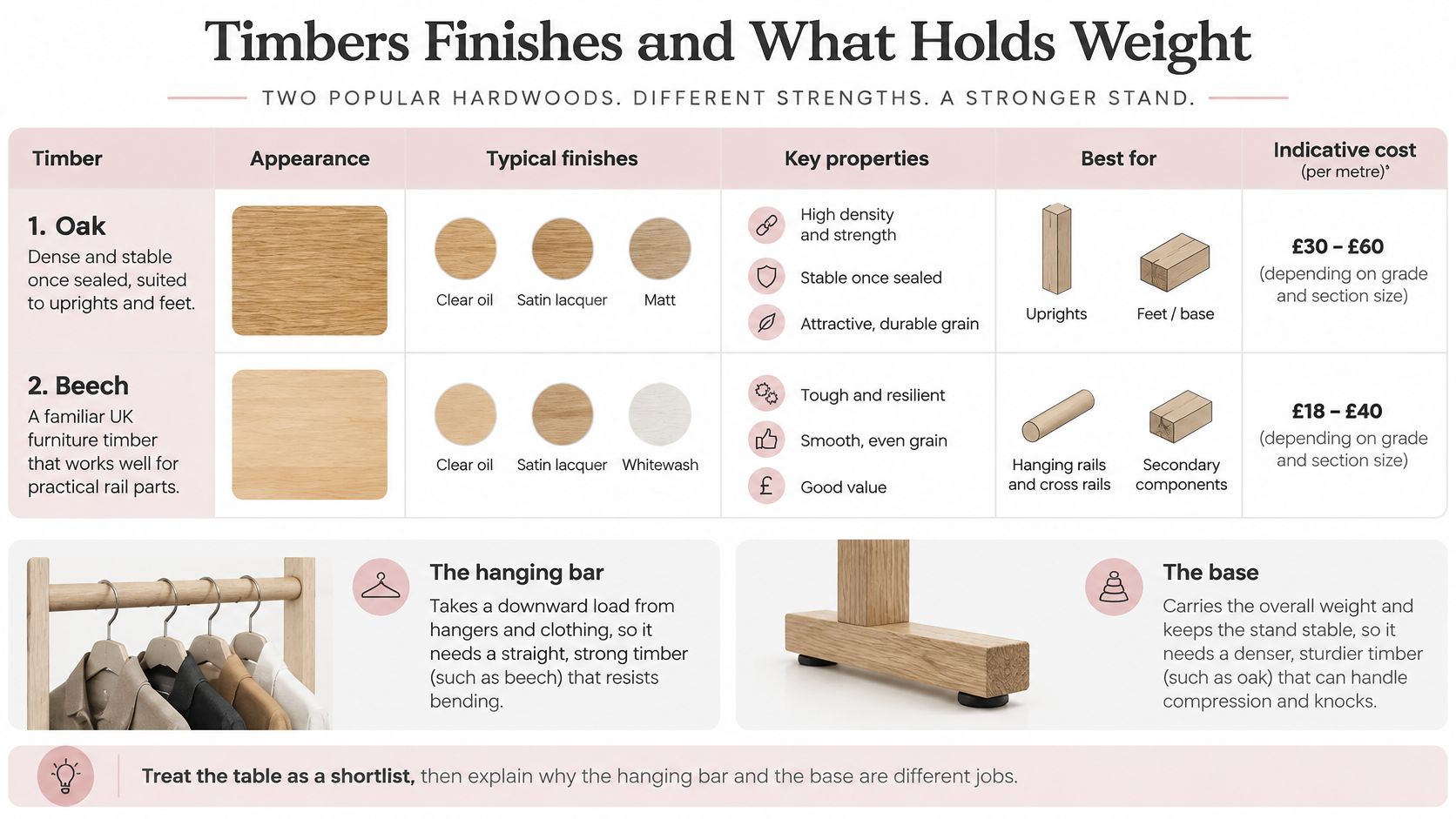
The bar and base do different jobs
The hanging bar resists bending between its supports. Straight grain, sound timber and secure connections matter more here than an attractive knot pattern. A deep knot or split near a fixing deserves attention, even if the surrounding finish looks immaculate.
The base must resist movement and keep the uprights aligned. Oak's weight can be useful in feet, while beech offers a smooth, even surface for machined parts. Ash suits shaped components, but its flexibility doesn't excuse inadequate bracing.
Sheet materials need a different approach. A veneered shelf can be perfectly serviceable when properly supported, yet its smooth face tells you little about the screw holding at an exposed edge. Don't mistake wood-effect wrapping for solid timber.
For a visual accompaniment to assessing wooden construction, use the following video alongside a close inspection of the actual product.
Choose the finish for contact and maintenance
Hardwax oil can often be refreshed locally, which suits an owner willing to maintain contact areas. Lacquer generally offers a harder surface against hanger rub, but an invisible patch repair can be harder to achieve. Paint makes economical timber look tidy, although an opaque coating can conceal defects.
- Inspect the ends: Look for open splits, rough end grain and checks extending towards fixings.
- Identify the connection: Bolts, dowels and glued joints require different repair methods. Don't glue a knock-down joint that must remain removable.
- Confirm the bar construction: Establish whether it's solid timber, laminated timber or a wrapped tube.
No finish makes wood immune to heat or moisture. Sealing slows moisture exchange; it doesn't turn a wooden rail into bathroom equipment.
Safe Working Load and Tipping Risk
Timber thickness is not a load rating. The HSE guidance on storing timber and board materials says storage systems should be fit for purpose and display their safe working load with any required load arrangement. That guidance isn't a clothes-rail certification standard, but its storage principles provide a sound basis for evaluating a professional hanging frame.
For a clothes rail, a useful specification identifies the maximum supported mass and the arrangement that rating assumes. It should make clear whether shelves share that allowance and whether the frame needs particular assembly, flooring or anchoring conditions.
Check the specification before loading
Start with the complete system, not the bar alone.
- Establish the working load: Weigh a representative garment collection using a luggage scale or suitable platform scale, then include the hangers and anything stored on the frame.
- Keep a reserve: Don't plan everyday use at the published limit. Allow room for heavier substitutions and changes in the working collection.
- Follow the load arrangement: Spread garments as specified, loading gradually rather than dropping a heavy bundle onto the centre.
- Check the floor: All intended feet should bear properly on an even, stable surface.
Where the manufacturer permits it, place heavier pieces nearer the bar supports rather than concentrating them mid-span. That reduces bending demand on the unsupported centre, but it doesn't increase the published rating.
The checklist below summarises general storage principles. Its racking illustration should not be read as a test certificate for a garment rail.
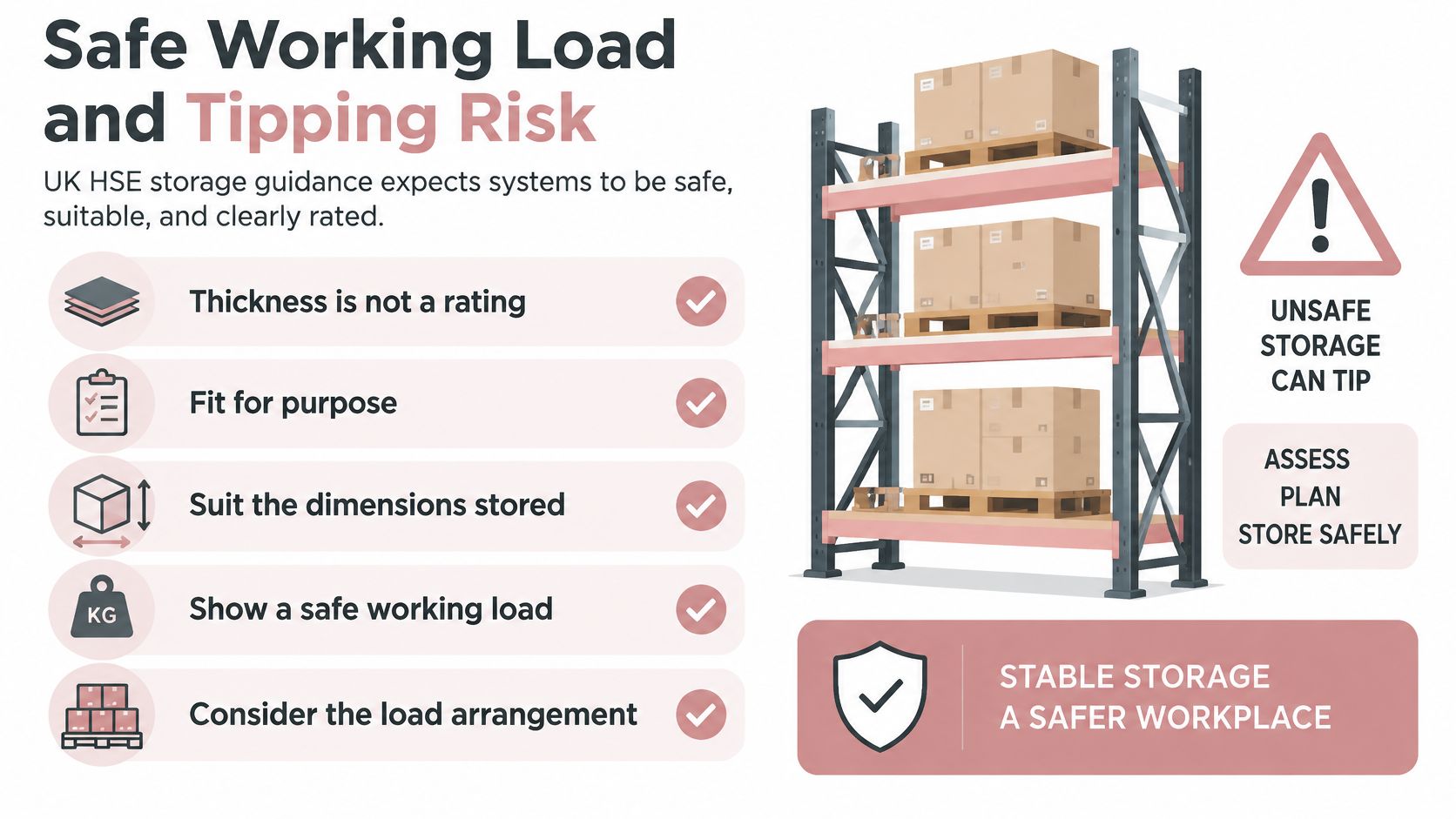
Separate carrying capacity from stability
A coat pulls downwards. A customer tugging a tightly packed group of hangers also pulls sideways, and a frame can overturn without exceeding its vertical load allowance.
Base width, load height and the direction of that pull all matter. A tall double rail isn't automatically unsafe, but its upper collection can create a less forgiving arrangement than a lower, wide-based frame. Neither design makes an uneven floor acceptable.
The HSE guide to the safe stacking of timber and board materials reinforces the broader need to treat timber storage as a safety issue rather than a styling exercise. For movable garment displays, inspect after relocation or impact, particularly where layouts change frequently.
Stop using a rail if its feet rock, structural joints rotate under ordinary hand pressure, the bar remains bent after unloading, or timber splits around fasteners. Don't prove stability by deliberately yanking a loaded frame towards yourself.
Safety distinction: A frame that holds the weight while untouched may still be unsuitable for the way people remove clothing.
For demanding retail work, compare a rated timber option with a heavy-duty clothing rack. The useful comparison is the documented load arrangement and stable footprint, not the adjective heavy-duty.
Fitting a Rail into a Small UK Room
Storage demand is a reason to measure carefully, not permission to fill every gap. A 2025 UK household-storage survey reported that 50.3% of consumers had purchased household-storage products during the previous twelve months, according to GlobalData's UK home-category report.
A search for clothes rail wooden options can make an open frame look almost weightless. In use, the garments occupy more depth than the feet, and the person removing them needs space too. Mark the proposed footprint with masking tape, then hold your widest hanger at the intended bar position.
Beside a bed or cutting table
Measure the loaded envelope, not just the bare frame. Jacket sleeves and full skirts can extend beyond the base, especially when hangers turn.
Beside a bed, check that bedding won't catch hooks or brush against garments. Beside a cutting table, keep the working edge available for fabric handling rather than forcing yourself to reach around hanging sleeves.
Room measurements to check before fitting a rail
| Measure | Why it matters |
|---|---|
| Floor depth beside a bed or cutting table | Hangers must clear the mattress or table edge when a garment is pulled out |
| Bar height above floor for long dresses and costumes | Hems must stay off the ground |
| Aisle clearance in a hall, understairs run or shop back room | The walking line stays free of projecting hems and door swings |
| Distance from radiators and bright windows | Reduces exposure to heat and sunlight that can affect timber and cloth |
Long garments and narrow circulation routes
For dresses and costumes, measure from the garment's suspension point on its actual hanger to the hem. Compare that with the available drop below the bar, allowing for any shelf underneath. A tall external measurement doesn't guarantee useful hanging height.
In a hall or understairs run, open every nearby door before approving the position. Check whether someone carrying a laundry basket can pass without catching sleeves. A lower single rail is often easier to accommodate than a double arrangement, but only a suitable, stable frame belongs in that space.
A shop back room can accept a deeper frame where the working aisle remains unobstructed. Put transfer garments on the side staff can reach without stepping into a doorway or squeezing behind another fixture.
- Footprint: Include feet, projecting clothing and any shelf.
- Bar height: Check the longest actual garment.
- Access clearance: Allow for turning hangers and opening doors.
- Removal direction: Consider where a heavy garment will be pulled from.
Compare small clothes rail layouts against those checks. A frame is only space-saving if you can still use the room around it.
A Mend Fit Wear and Donate Workflow
Research commissioned by The National Lottery Community Fund found that 32% of UK adults had thrown away brand-new clothes in the previous year, representing an estimated 1.4 billion items. More hanging space alone doesn't change that behaviour. An open rail becomes useful when each garment has a next action.
Arrange the work from left to right, but don't treat the divisions as permanent equal shares. A busy alterations week needs more fitting space than a week spent clearing completed work.
Give every garment a destination
- To mend: Attach a paper tag describing the fault, such as loose lining at cuff or missing waistband fastening. Keep pins secured rather than leaving exposed points in a shared handling area.
- To fit: Group garments by wearer or production, with fitting notes attached to the hanger. Leave room to lift out the complete outfit without dragging neighbouring pieces.
- Ready to wear: Admit only finished garments. Remove temporary tacking, check closures and return borrowed accessories before moving the hanger into this zone.
- To donate or resell: Separate clean, usable items from pieces needing repair. Move them onwards rather than allowing this end to become indefinite storage.
A visible, uncluttered arrangement makes those decisions easier to maintain.

Make inspection easy
Space garments so you can see their fronts and lift a sleeve without wrestling a packed row. Missing buttons, strained seams and snagged linings are much easier to assess when you can handle the piece properly.
A tailor can reserve a clear central working gap for the current fitting. A costume team can organise by performer and change sequence instead, while a boutique should keep outgoing transfers away from the customer-facing display.
Protect delicate fabric with shaped hangers that support it correctly and padded clips where appropriate. Keep lace and loose weaves away from rough timber edges. Beaded garments, leather and damp clothing need particular attention to support and mass; don't assume the same hanger or allocation suits every piece.
Open storage encourages use only when someone keeps the categories moving. An attractively arranged backlog is still a backlog.
Finish each working session by moving completed items out of the repair zone and identifying the next task. That small habit makes the rail a production tool rather than a more visible wardrobe.
Cleaning Sealing and Protecting Garments
Start routine care with the rail unloaded. Dust using a soft, dry cloth, including the underside of the bar and the joints where lint collects. Grit trapped beneath hanger hooks can abrade the finish as garments move.
Wipe spills promptly with a lightly dampened cloth, then dry the surface. Don't soak exposed end grain or spray cleaner directly into joints. For oily marks, use a cleaner compatible with the existing finish rather than reaching immediately for a strong solvent.
Refresh the surface without hiding damage
When the heating season changes, inspect mechanical fixings and tighten only as the assembly requires. Overtightening can crush timber fibres or strip a screw bed; it's not a cure for a joint that no longer holds.
Refresh an oiled contact area with a compatible maintenance product after cleaning and preparation. Don't lacquer over dirt, wax or unidentified oil. Let any treatment cure fully before returning clothing.
- Protect the floor: Use suitable pads beneath sound, level feet, not as a disguise for a rocking base.
- Inspect contact points: Check bar ends for splinters and hanger paths for grooves or exposed timber.
- Separate abrasive details: Turn zips, hooks and embellished surfaces away from neighbouring delicate fabric.
Choose hangers that support the garment's shoulder shape without projecting beyond it. Fold heavy knitwear where hanging would stretch it.
Keep garment care separate from wood care
The cleaning method belongs to the garment's fibre, construction and care label. For a useful explanation of professional wet and dry cleaning choices, CleanOnline, North York's Premium Dry Cleaners, offers garment cleaning guidance for Toronto households; the location doesn't change the need to assess the garment itself.
A garment rack with a cover can help protect stored work from settling dust, but only cover dry garments. Keep baskets and decorative objects clear of inspection points so they don't conceal a damaged foot or worn connection.
Choose Your Rail Before You Buy
- Define the collection. List what the rail must hold during the busiest working period, including hangers, accessories and shelf contents.
- Demand a usable specification. Confirm the safe working load and its permitted arrangement before committing to the frame.
- Choose the material for the job. Favour sound timber for a visible fitting space, appropriately rated steel for intensive stock handling, and light plastic for very light displays.
- Verify the construction. Identify the bar material, joint type, base dimensions and finish rather than relying on a wood-effect photograph.
- Approve the position. Check garment drop, access and door movement with the proposed collection in mind. Resolve floor defects instead of expecting a different frame to compensate.
- Separate fitting from holding. Use a pin-friendly body form for alteration work rather than trying to judge garment balance on a hanger.
- Commission it carefully. Assemble as intended, introduce the collection progressively and inspect connections during initial use.
Our shopfitting garment rails are offered in white and black. For a separate tailor-dummy setup, our durable wooden tripod stands come in black, light, white, dark, red, silver and gold finishes; these support the dummy, not a hanging rail.
Display Guru offers garment rails, tailor dummies and body forms for organising clothing, carrying out alterations and presenting finished work. Visit Display Guru with your room measurements and working collection in mind, and choose equipment that supports the task rather than just completing the photograph.