

Visual Merchandising London: A Guide to Retail Display
UK retail sales were 1.8% higher in June 2025 than in January 2024, according to CBRE's UK real-estate market review. That's a useful starting point for visual merchandising in London: growth across retail doesn't tell an individual shop whether its window persuades passing shoppers to enter, or whether its interior helps them buy.
A successful display needs a more specific brief than “attract attention”. It should suit the location, the shopper's available time and the practical journey from pavement to payment. The commercial test isn't whether people notice it, but whether the right customers can understand, reach and purchase the products.
What Visual Merchandising Means in London
London shop windows have long done a basic commercial job: showing goods before asking customers to step inside. That tradition matters because it defines visual merchandising as a selling discipline, not decoration. The window opens the conversation. The store floor continues it. When the two send different messages, shoppers must solve the gap themselves, and many will keep walking.
For a tailor, designer or dressmaker, the practical question is what a passer-by can recognise without assistance. A mannequin can communicate the silhouette of a complete outfit. A body form can isolate the cut of a jacket, while a coordinated rail can show the available colour family. The choice depends on the display task: show the whole look, explain the garment structure, or make a range easy to scan.
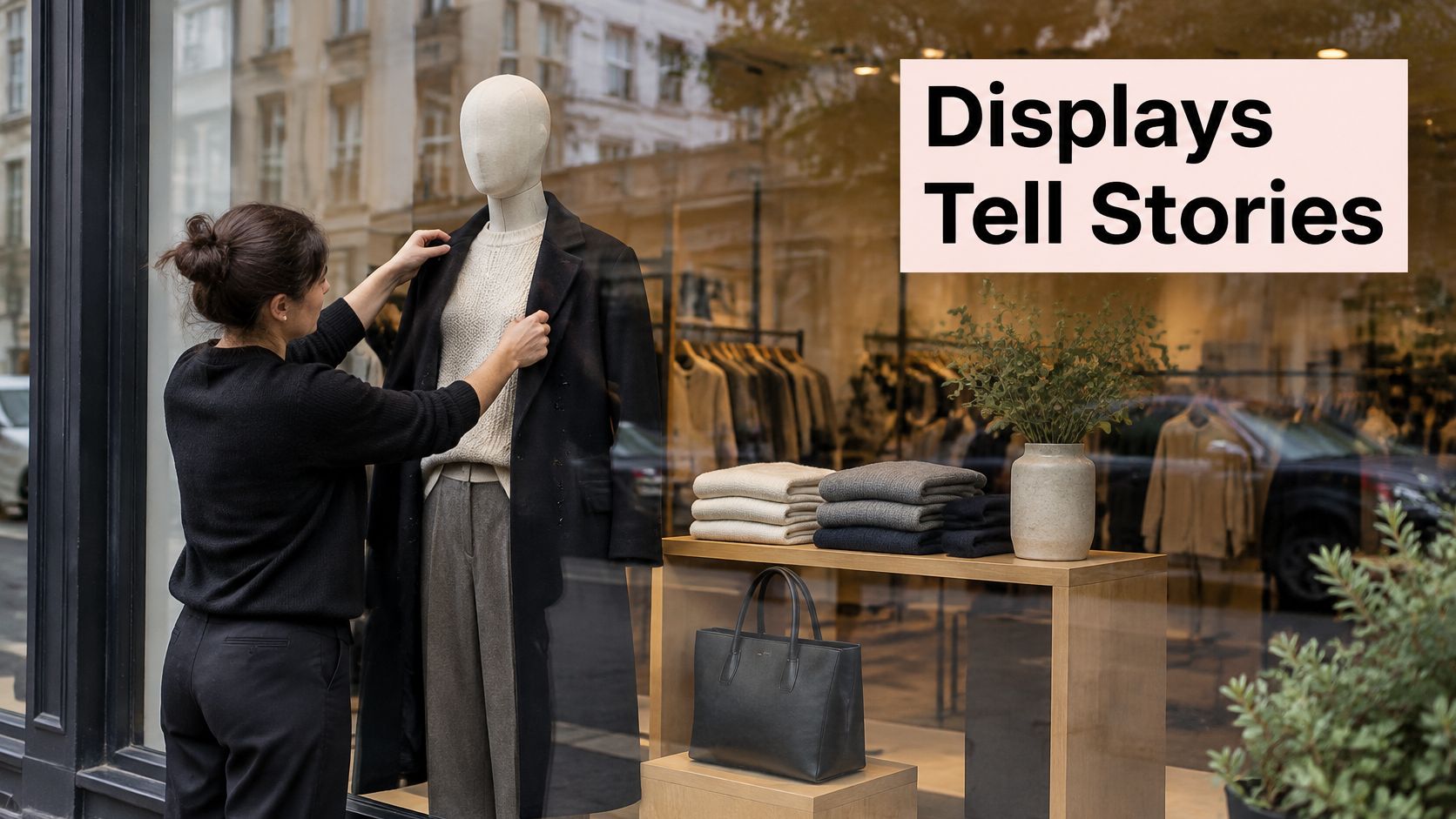
Practical rule: Choose the merchandise the customer should remember, then remove anything that competes with it.
Behind the display, identification matters too. In a shared sewing studio or a preparation area handling similar garments, resources such as Quote My Wall's Name labels can help organise personally owned clothing. Keep those operational labels separate from customer-facing product information, because staff clarity and shopper clarity are different jobs.
A reusable definition needs three connected elements:
- Location and traffic: Who encounters the shop, and with what intention?
- Store environment: What can the space communicate clearly?
- Shopper's path: What should the customer do after noticing the merchandise?
These elements also suggest a simple measurement route. Count how many people stop at the window, how many ask for or handle the featured item, and how many buy it. That turns display work from a matter of taste into a test of conversion. An attractive composition answers the visual question. A commercially useful composition answers the next-action question as well.
London Store Settings and Their Display Priorities
London isn't a single retail environment. A flagship window, a neighbourhood dress shop and a temporary selling space shouldn't start with the same fixture plan.
Use the comparison below as a planning hypothesis, not a substitute for observing the actual frontage. The traffic descriptions indicate the patterns to investigate at each setting, rather than guaranteed conditions.
London store settings and display priorities
| Store setting | Typical traffic pattern | Display priority | Fixture choice |
|---|---|---|---|
| Flagship on Oxford Street or Regent Street | Constant high volume with event peaks | Brand theatre and feature windows | Full-size mannequins and modular rails |
| Neighbourhood high street shop | Steady local trade with repeat visits | One clear window message and easy restocking | Half body forms and wall-mounted rails |
| Shopping centre unit | Dense multi-store journeys and sightline competition | Wayfinding and a strong front-of-shop focus | Compact body forms and dump bins |
| Temporary pop-up | Short, event-driven bursts of visitors | Fast set-up and a clear product story | Lightweight modular fixtures and tripod-stand forms |
Flagships can separate theatrical presentation from practical selection. Give the window a recognisable visual proposition, then make the featured products straightforward to locate inside. Modular rails are useful when the entrance presentation needs to change without rebuilding the entire installation.
For a neighbourhood shop, start with relevance rather than spectacle. Say a dressmaker wants to promote occasionwear alterations: a carefully fitted garment and a clear service message make a more coherent proposition than an unrelated collection of props. Wall-mounted rails can leave the selling floor available for consultation and fitting.
Match the fixture to the customer journey
A shopping centre unit needs a front-of-shop arrangement that remains understandable from an angled approach. Check whether shoppers can distinguish the entrance, the featured category and the route further inside. A dump bin suits merchandise customers can browse without careful presentation, but it shouldn't interrupt the intended route.
A pop-up needs a different discipline: rehearse assembly, pack-down and replenishment before opening. Select fixtures by their packed dimensions, stability and installation requirements, not appearance alone. Use these retail store layout principles to translate the fixture choice into a workable floor plan.
The regional context reinforces the need for local observation: London was the only region to record an increase in November 2025 retail footfall, rising 3% compared with November 2024, while UK footfall fell 3% year on year, according to the ONS retail footfall dataset.
If artwork forms part of the interior, include inspection and care in the operating plan. Colorado Art Services' guidance on maintaining art in commercial spaces is a relevant resource for that separate maintenance task.
Before approving a design, ask: Which setting describes this site? What traffic pattern have staff observed? Which fixture decision should change as a result?
Trading Periods and Event-Led Display Planning
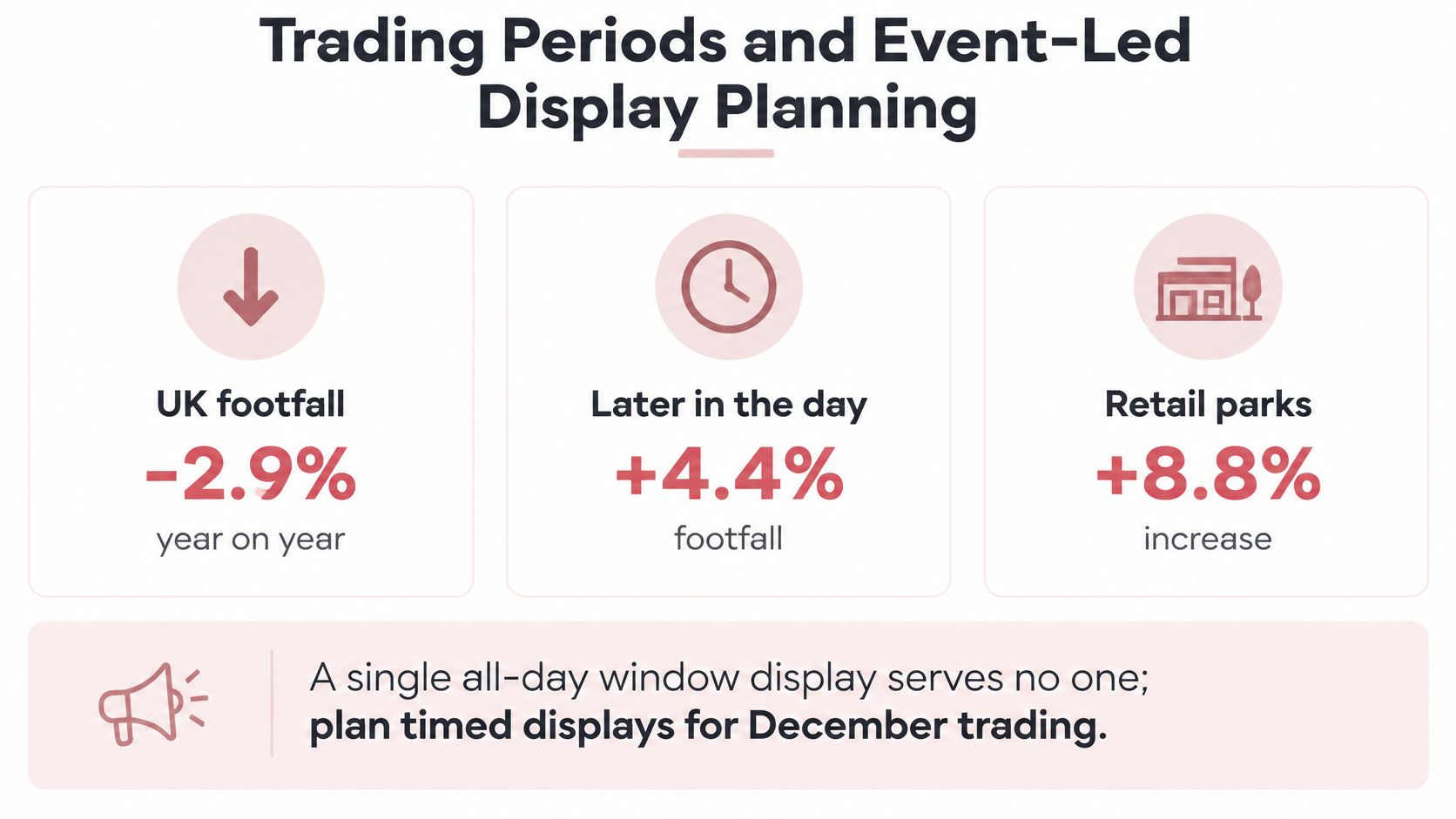
December UK footfall fell 2.9% year on year, yet footfall later in the day rose 4.4%, according to Tokio Marine HCC's UK retail sector report. Those are UK measures, not a timetable for every London street. Their useful implication is that an overall decline can conceal a valuable trading period.
The December contrast provides a reason to test timed display emphasis rather than assume the same presentation works equally well throughout the day.
Morning messages should survive a moving glance
Where observation confirms commuter traffic, prioritise immediate comprehension. Present a recognisable product, its price or a genuine offer, and a clear indication of where to find it. Don't make someone decode a seasonal concept before discovering what the shop sells.
A passing commuter and a destination shopper need different cues. The commuter needs a reason to interrupt a journey. The destination shopper needs confirmation that they've reached the right place and can find the item or service they intended to buy.
For customers who have already researched online, make the physical product recognisable. Match the displayed garment to its product name, colour description and relevant purchasing information. Avoid hiding the item behind props when the customer's main question is whether the fabric, fit or finish meets expectations.
A useful morning test is to walk past the frontage at a normal pace without stopping. Afterwards, write down the product and message you remember. If colleagues recall different propositions, simplify the composition before adding more signage.
Browsing periods need evidence customers can inspect
During periods when customers spend more time considering products, move the emphasis towards comparison and detail. Pair the dressed form with accessible stock, explain sizing clearly and make fabric or construction details available for inspection.
For example, a structured jacket displayed on a torso can establish its shape, while an adjacent rail provides sizes and colour alternatives. Keep the styling aspirational, but don't force customers to dismantle the presentation to investigate the merchandise.
Weekday, evening and weekend plans should follow observed shopping missions rather than calendar labels alone. A weekday lunchtime destination shopper may need speed; a weekend appointment customer may want detailed advice. Record those differences before deciding which message deserves the frontage.
These window display ideas can support the creative brief, but define the customer's task before choosing the theme.
Event traffic needs a separate operating plan
During the 21 September 2025 traffic-free This Is Oxford Street event, pedestrian footfall increased 45% versus the previous week; 67% of surveyed stores reported sales at or above a typical Sunday, but only 50% reported comparable or higher in-store footfall, according to the Greater London Authority's event findings.
Those measures describe different outcomes. They don't establish a shared conversion rate, and the survey results shouldn't be treated as proof that every retailer benefited equally.
More people outside the shop create an opportunity. They don't establish that the display persuaded more people to buy.
Prepare a campaign reset with distinct responsibilities:
- Before the event: Photograph the normal arrangement and prepare a promotional alternative. Confirm stock availability, fixture positions and who authorises the change.
- At opening: Install the event configuration using modular garment rails, body forms and appropriate promotional bins. Keep the main proposition visible from the approach.
- During trading: Assign someone to inspect entrance congestion, replenishment needs and queues. Remove an obstruction rather than asking customers to go around it.
- Afterwards: Restore the planned layout and record what moved, what sold out and what staff had to change unexpectedly.
Denser promotional presentation is an option, not a default. If extra merchandise makes the entrance harder to interpret, use fewer fixtures and replenish more frequently.
For a visual reference alongside the written installation plan, use the following video.
Measure the point where customers drop out
Use a simple spreadsheet with consistent counting periods. Record pedestrian counts, store entries, transactions and sales value separately.
- Entry rate: Store entries divided by passing pedestrians.
- Purchase conversion: Transactions divided by store entries.
- Sales per visitor: Sales value divided by store entries.
A stronger entry rate with weaker purchase conversion warrants investigation. Customers might be responding to the window but encountering unavailable sizes, confusing presentation or a proposition that changes inside. Those are hypotheses to check through stock records and staff observations, not conclusions the figures prove independently.
For the next event, confirm the display owner, reset instructions, replenishment stock, counting method and review meeting. Change one main display variable where practical, so the team can interpret the outcome without guessing which alteration mattered.
Accessibility Rules That Keep Displays Usable
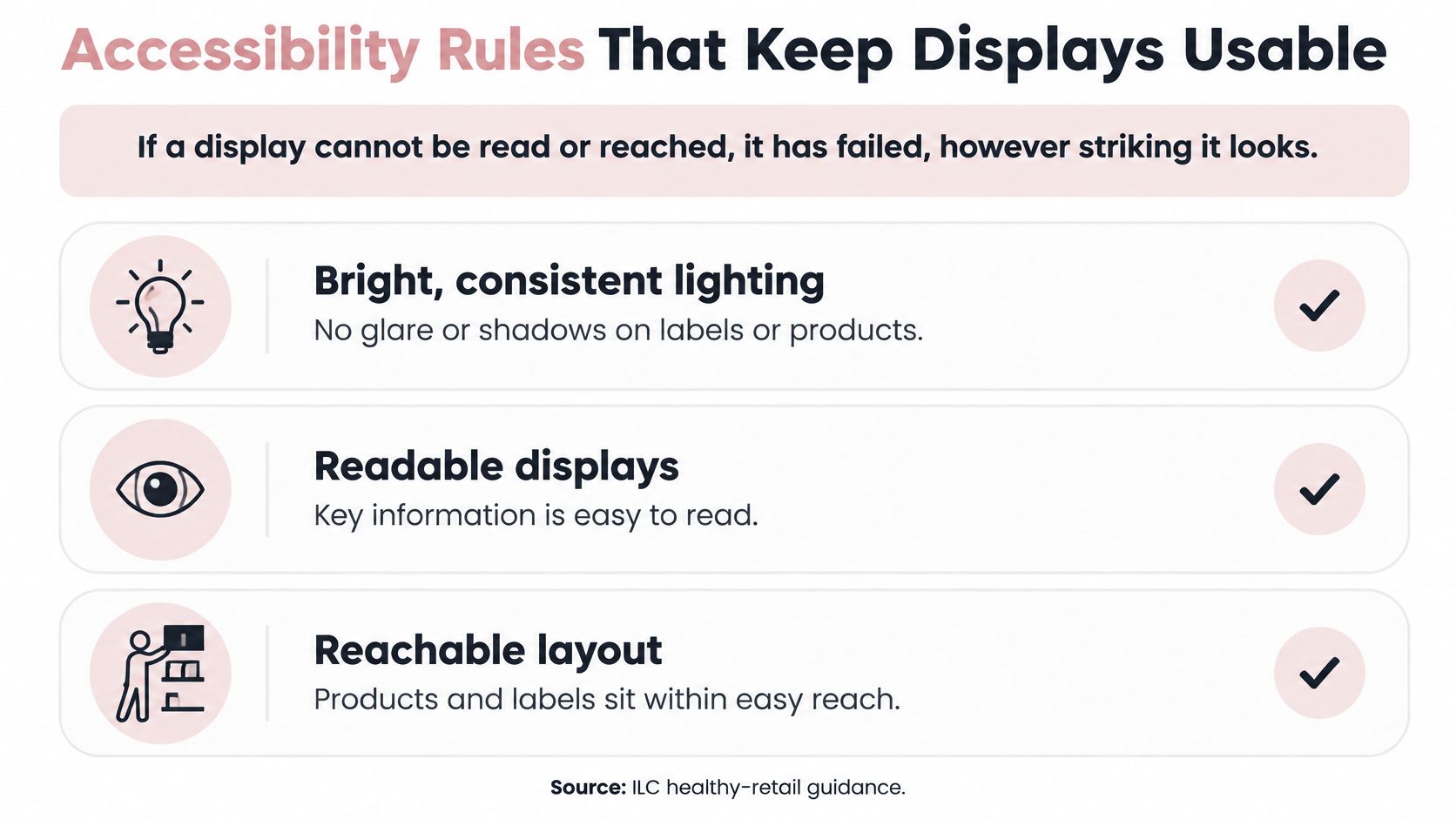
A display that can't be read or reached has failed, however striking it looks. Start with a three-variable audit: information visibility, lighting quality and physical access. Judge each from the customer's position, not from behind the fixture.
The ILC healthy-retail accessibility guidance recommends bright, consistent lighting without glare or shadows, clear signage, sans-serif type, strong contrast and a minimum 48-point font size for signage. Treat these as guidance benchmarks, not a complete statement of legal compliance.
The visual checklist summarises the relationship between readability and reachability.
Display accessibility checks for London stores
| Criterion | Benchmark | Test at each display |
|---|---|---|
| Lighting | Bright and consistent, without glare or shadows | Check reflections and silhouette shadows from normal approach distance |
| Signage type | Sans-serif, strong contrast and the minimum font size recommended in the cited guidance | Read the price and size from the normal viewing distance |
| Product visibility | Garments legible from a normal approach | Check the product and price without entering the fixture |
| Circulation | Unobstructed route to payment points and exits | Check the path width remains clear at each display |
| Sensory load | Avoid crowded or animated installations | Check for flicker, strong scent and noise at the display |
Run the audit from the approach
First, assess whether customers can identify the product and read its price without stepping into the fixture. Angle torso displays towards the approach and position information where the garment won't cover it. Inspect from seated as well as standing positions.
Next, check the lighting with the display fully dressed. A spotlight that looks effective on an empty form may cast a shadow across a label once a jacket is added. Adjust the fitting, label position or mannequin angle, then repeat the viewing test.
Finally, walk the route while another person browses the merchandise. An apparently clear aisle can become awkward when someone stops, reaches for stock or carries a shopping bag. Check the payment route and exit approach as carefully as the entrance.
Design constraint: If removing a fixture makes both the product and the route clearer, don't replace it merely to fill the space.
In compact premises, fixture density deserves particular scrutiny. Inspect animated screens, strong scents and competing sound as potential sensory obstacles, rather than assuming more stimulation improves the experience. Any pavement signage needs its own placement check; these A-frame board considerations can inform the display brief without replacing local permission checks.
Complete the walk from pavement to till with the shop operating, not just before opening. Record the obstruction, its owner and the change required, then verify the fix from the same customer position.
Professional Routes Into London Visual Merchandising
A useful London job search can include visual merchandiser, window dresser, display assistant, store designer and freelance stylist. Read the responsibilities rather than relying on the title: a role centred on maintaining shop-floor standards needs different portfolio evidence from one centred on concept design or installation.
Consider flagship retailers, department stores, fashion labels, shopfitters and independent shops as distinct target groups. Build the application around the work you want to perform, whether that's styling garments, planning customer routes or turning a drawing into a safe, maintainable installation.
Build skills around the whole assignment
Practise spatial planning, colour coordination, lighting assessment and interpretation of brand guidelines. Add practical fixture assembly, basic budgeting and the ability to explain a commercial measure. A sketch is more persuasive when you can also show how staff will replenish and maintain the finished arrangement.
Collaborative work should make each person's contribution clear.

Potential entry routes include:
- Store-based work: Seek opportunities to assist with dressing, replenishment and display maintenance alongside an existing retail role.
- Independent installations: Propose a tightly scoped window or pop-up assignment, with written responsibilities and permission to photograph the result.
- Structured learning: Compare visual merchandising training options by the practical work and feedback they include, not just the course title.
Show decisions rather than a gallery
For each portfolio project, include the brief, a sketch or floor plan, a photograph of the installation and an outcome where measurement was available. Identify your contribution and distinguish a commissioned project from a student exercise or speculative concept.
If sales information isn't available, don't invent a commercial result. Document an observable improvement instead, such as a resolved sightline problem, a completed accessibility check or a clearer replenishment procedure.
Include the trade-off you managed. Explain why you removed a prop, changed a light angle or selected a smaller form. A hiring manager can then assess your reasoning, not just your styling taste.
Lead the application with your strongest evidenced outcome. Follow it with the visual work that explains how you reached it.
Choose Your Next Step for London Displays
Choose a manageable assignment rather than commissioning a complete redesign. Write a short brief naming the store setting, intended shopper and purchasing task. Give the work an owner and a review date before moving anything.
Turn the brief into an operating decision
- Establish the starting position: Record the current commercial measure and photograph the display. Note stock availability, promotions and unusual trading conditions so the comparison has context.
- Specify the change: Agree the normal presentation, any timed adjustment and the event reset. Keep the instructions practical enough for another staff member to follow.
- Schedule the review: Compare equivalent trading periods and discuss the outcome with the people who worked the floor. Decide whether to retain, adapt or reverse the change.
A before-and-after comparison is useful, but it isn't proof of causation. Weather, stock, promotions and nearby activity can change the result. Keep a short change log so the team doesn't attribute every movement in sales to the display.
If you're considering external support, use these criteria for comparing visual merchandising companies to define deliverables, installation responsibilities and measurement expectations before agreeing the work.
For equipment, we supply white and black shopfitting garment rails, accessories and dump bins/baskets. In most cases, orders can be collected from our warehouse; contact our sales team on 01942 386640 or sales@displayguru.co.uk to discuss collection.
Choose one display to improve this month. Write down its starting measure, the change you'll make and the evidence you'll use to decide whether it worked.
Display Guru offers body forms, full mannequins, garment rails and display bins for practical retail presentations. Visit Display Guru to select fixtures that suit your London shop's layout, merchandise and reset plan, with the customer's route and purchasing task clearly defined before you order.