




Clothes Rail Shoe Rack: The Complete Buying Guide
You've measured the hallway twice, shifted the shoe pile three times, and still can't see how six coats, several pairs of shoes and a narrow doorway will coexist. A wardrobe feels too bulky, a plain clothes rail leaves footwear on the floor, and every product listing calls itself “space-saving” without showing whether the door will still open.
A clothes rail shoe rack can solve that problem, but only if you buy it as a room-layout decision, not as a feature comparison. Measure the doorway clearance, ceiling height, assembled depth and the weight of the garments first. Then judge the frame, shelf construction and load rating against the way you'll use it.
Why a Clothes Rail Shoe Rack Is Not Just a Wardrobe
A narrow hallway shows poor storage choices quickly. The door catches on coats, boots spill into the walking route, and a tall wardrobe takes up the floor area you meant to protect. In a rented flat, a fitted system may be impractical, while a freestanding unit can move between rooms as needs change.
A clothes rail shoe rack earns its space by handling two jobs in one vertical zone. The upper bar holds clothing and the lower structure stores footwear, but the frame must keep both loads stable without making the passage feel tighter. Treat it as a room-layout decision first. Features matter only after the unit fits the doorway clearance, ceiling height and weight profile of the room.
Shopfitter's rule: A unit that fits the product photograph but blocks the door is not space-saving storage.
Measure the route into the room before measuring the final position. Check the narrowest part of the doorway, the turn into the hall, and any stair or lift access. An assembled width may look manageable while a rigid frame still fails to pass through the entrance.
The three constraints that decide the purchase
Door clearance sets the usable depth and placement. A shoe shelf projecting into the walking line becomes a daily trip hazard, particularly when boots sit on its front edge. Account for the door leaf, handles and normal movement. Wall-to-wall width alone gives a false sense of fit.
Ceiling height determines whether a double-bar or tower-style design will work. A tall frame can provide more hanging space, yet it may feel cramped beneath a low ceiling and leave too little room to assemble the unit safely in place.
Garment weight matters more than hanger count. Heavy winter coats can weigh around 2kg each, so outerwear puts a different demand on the rail from light shirts. Even loading, a stiff rail and sound joints all affect whether the frame stays reliable. Display Sense's clothes rail guidance covers these practical considerations.
A conventional wardrobe encloses clothing and fixes the storage shape. An open hybrid unit is easier to inspect, move and reorganise, making it useful for renters, sewing rooms, pop-ups and homes handling seasonal changes. Retail layouts follow the same principle: retail display stands must support merchandise without taking circulation space away from customers.
Choose the unit by its effect on movement, not its advertised feature list. The right frame provides enough hanging capacity and usable shoe storage while leaving the doorway, route and surrounding floor clear. A combination that sags, tips or narrows the passage has failed, whatever its storage count.
What a Clothes Rail Shoe Rack Actually Is
A true clothes rail shoe rack is one integrated piece of furniture. Its frame carries a hanging bar at the top and a lower shelf, rack or basket system designed for footwear. That differs from parking a freestanding rail beside an unrelated shoe rack, where each item has its own footprint, centre of gravity and tendency to drift apart.
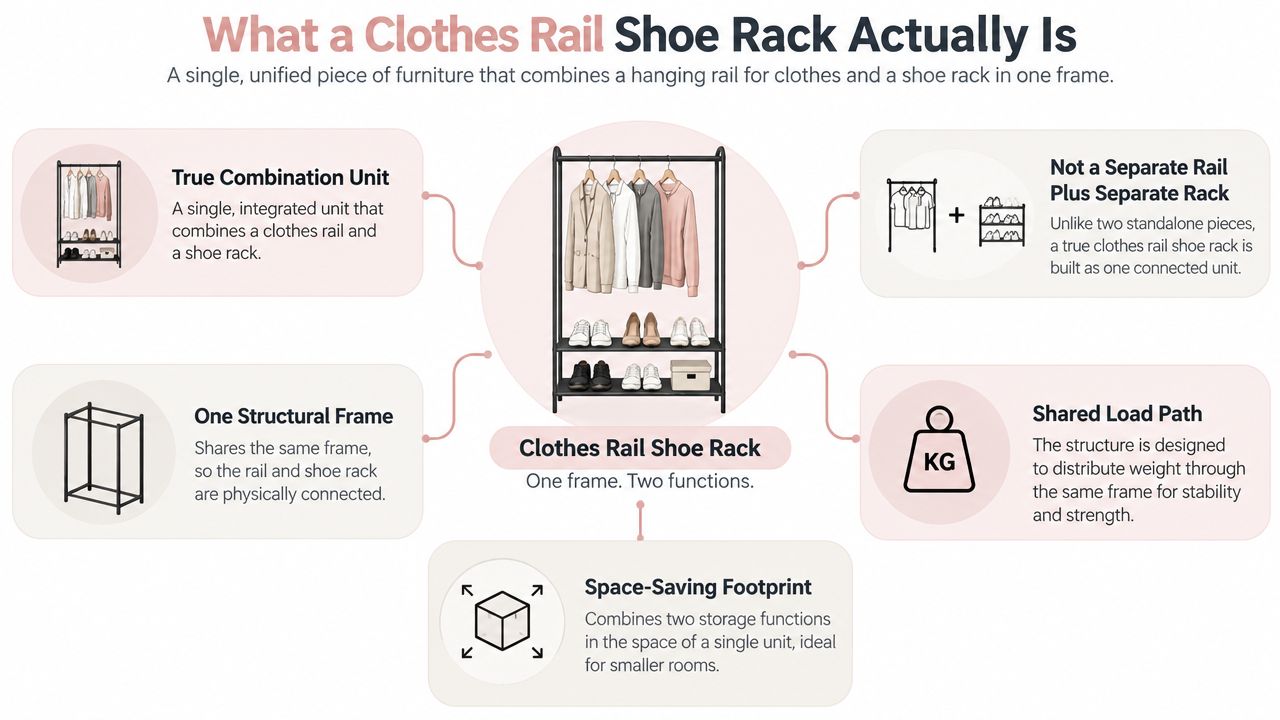
The useful mental model is a shared load path. Weight from coats travels through the hanging bar into the uprights and base, while shoes load the lower structure. A well-designed unit keeps those forces inside a braced frame. A loose pairing doesn't, and it often creates a crowded gap between the rail and rack that serves neither storage nor circulation.
Common configurations
A single-bar unit is the simplest option. It works well for a compact bedroom or entrance where you need everyday coats and a small footwear shelf, but it offers little flexibility if garments vary greatly in length.
A double-bar unit increases hanging capacity by using two levels or a front-and-back arrangement. It suits lighter garments and retail presentation, although it can become difficult to browse if long coats or bulky knitwear occupy both bars.
L-shaped corner versions use an awkward corner, but they demand careful checking of both wall lengths. The corner may be efficient on paper while the shoe shelves collide with skirting boards, radiators or the door swing.
Tower styles stack several shoe tiers beneath or beside the rail. They can organise more footwear vertically, but the lowest shelves may be uncomfortable to reach and the overall unit can become top-heavy unless the base is broad and the frame is secured.
A bottom shelf behaves differently from a mid-height tier. The bottom shelf is easy to load but can collect dirt and make boots protrude into the walkway. A raised tier keeps footwear more visible, yet it can reduce the clear space for longer garments above.
How to spot a loose pairing
Read the assembly instructions and the parts list before trusting the product title. If the listing shows two unrelated frames, separate fixing kits or different finishes, you're probably looking at a rail and rack sold together rather than an integrated unit.
The clothes rail range approach is useful as a comparison point because it encourages you to assess rails as structural products, not just decorative poles. Look for shared uprights, cross-bracing, a clearly stated shelf attachment and a single assembled footprint. Those details tell you more than a lifestyle photograph.
Load Capacity and Materials Explained
If a doorway barely clears the unit, ceiling height and room weight matter before any rail rating does. A clothes rail shoe rack must fit the route into the room, leave garments clear of the ceiling, and carry the combined load without twisting. Check those constraints before comparing finishes or shelf features.
A sound product page lists three separate load figures: the rail rating, the shoe-shelf rating and the total unit rating. One large headline number does not show how much weight the hanging bar or footwear shelf can safely support.
Commercial garment rails are often made from 32mm industrial-grade steel and designed for substantial, evenly spread loads. A rail that carries light clothing comfortably may perform very differently with winter coats. Coat weight, hanger spacing and where the load sits across the span all affect deflection.
A thin tube can cope with a respectable load over a short distance when the joints are braced properly. Across a longer span, it may sag, particularly when garments gather in the centre or at one end. Diameter helps, but joint design, upright stiffness, base width and bracing determine whether the frame stays rigid.
Material comparison
| Material | Typical rail load | Rust resistance | Best environment |
|---|---|---|---|
| Chrome-plated steel | Depends on tube and frame design | Moderate if the plating stays intact | Dry bedrooms, shops and changing areas |
| Powder-coated steel | Depends on tube and frame design | Good when the coating remains unchipped | Homes, boutiques and stockrooms |
| Stainless steel | Depends on tube and frame design | Strong resistance to damp conditions | Hallways with moisture, utility areas and commercial use |
| Aluminium | Depends on section and joint design | Naturally resistant to rust, but can flex more | Lightweight domestic applications |
Treat the table as a starting point, not a substitute for the manufacturer's rating. Chrome looks tidy, but scratches and damaged plating expose the steel underneath. Powder-coated steel is the sensible all-round choice for a dry home or shop. Stainless steel suits rooms where condensation is a regular problem.
The shelf is often the weak point
Wire mesh lets air through and helps grit fall away, but narrow heels can slip between the wires and soft soles may pick up marks. MDF or particleboard gives shoes a flatter surface, although its edges need sealing in damp rooms. A shelf that bows destabilises footwear and puts extra strain on the frame.
Use this heavy-duty clothing rack guidance to assess the rail, then inspect the shoe shelf separately. Check whether its rating applies across the full surface, whether the centre has support, and whether the total rating assumes evenly distributed weight. Those details reveal a weak clothes rail shoe rack faster than a large load figure.
Modular Systems Versus Fixed Units
The choice between modular and fixed construction comes down to whether the room is likely to change. A modular clothes rail shoe rack uses compatible uprights, crossbars, shelves and shoe tiers that can be moved or extended. A fixed unit arrives as one welded or pre-assembled frame, with the shoe storage locked at a set height.
| Factor | Modular system | Fixed unit |
|---|---|---|
| Moving home | Breaks down into manageable parts | May require more room and careful handling |
| Reconfiguration | Shelves and rails can change position | Layout stays as supplied |
| Appearance | Functional, system-led look | Cleaner, more uniform presentation |
| Expansion | Add compatible components | Replace the unit when capacity runs out |
| Installation | More joints to assemble and check | Fewer decisions after delivery |
| Best use | Renters, studios and changing stock needs | Permanent boutiques and consistent displays |
When modular earns its keep
Modular is the practical choice for a renter who expects the next room to be different. You can lower a hanging bar, remove a shoe tier or split the system into separate storage zones instead of abandoning the whole unit. It also makes sense for a studio flat where clothing volume changes with work, study or seasonal routines.
Transport is another advantage. A modular system commonly arrives flat-packed in several manageable packages, while a larger fixed frame may need more space for delivery and manoeuvring. The trade-off is assembly time and more joints that can loosen if you rush the build.
For entrepreneurs fitting out a flexible workspace, turnkey storage units for entrepreneurs offer useful context on how modular storage can support changing operational layouts. That doesn't make every modular rail suitable for garments, so still check the rail and shelf specifications.
When fixed construction wins
A fixed unit suits a boutique where presentation must stay consistent and staff need a dependable fixture. Welded frames usually remove some assembly variables, while a permanently positioned shoe shelf can create a cleaner visual line across a shop floor.
Don't assume fixed automatically means stronger. Inspect the welds, base geometry and stated rail rating. A poorly designed welded frame can still twist, while a properly braced modular system may be more stable in practice.
The integrated display system model is a useful way to think about fixed retail furniture. Choose it when consistency and visual order matter more than taking the frame apart. For a home that moves regularly, modular normally gives you the better long-term fit.
Assembly, Stability and Floor Protection
Most failures begin during installation. The frame feels slightly loose, the builder compensates by tightening one side harder than the other, and the result is a unit that rocks whenever a coat is removed. Correct assembly starts with an orderly setup, not with brute force.
Build from a level base
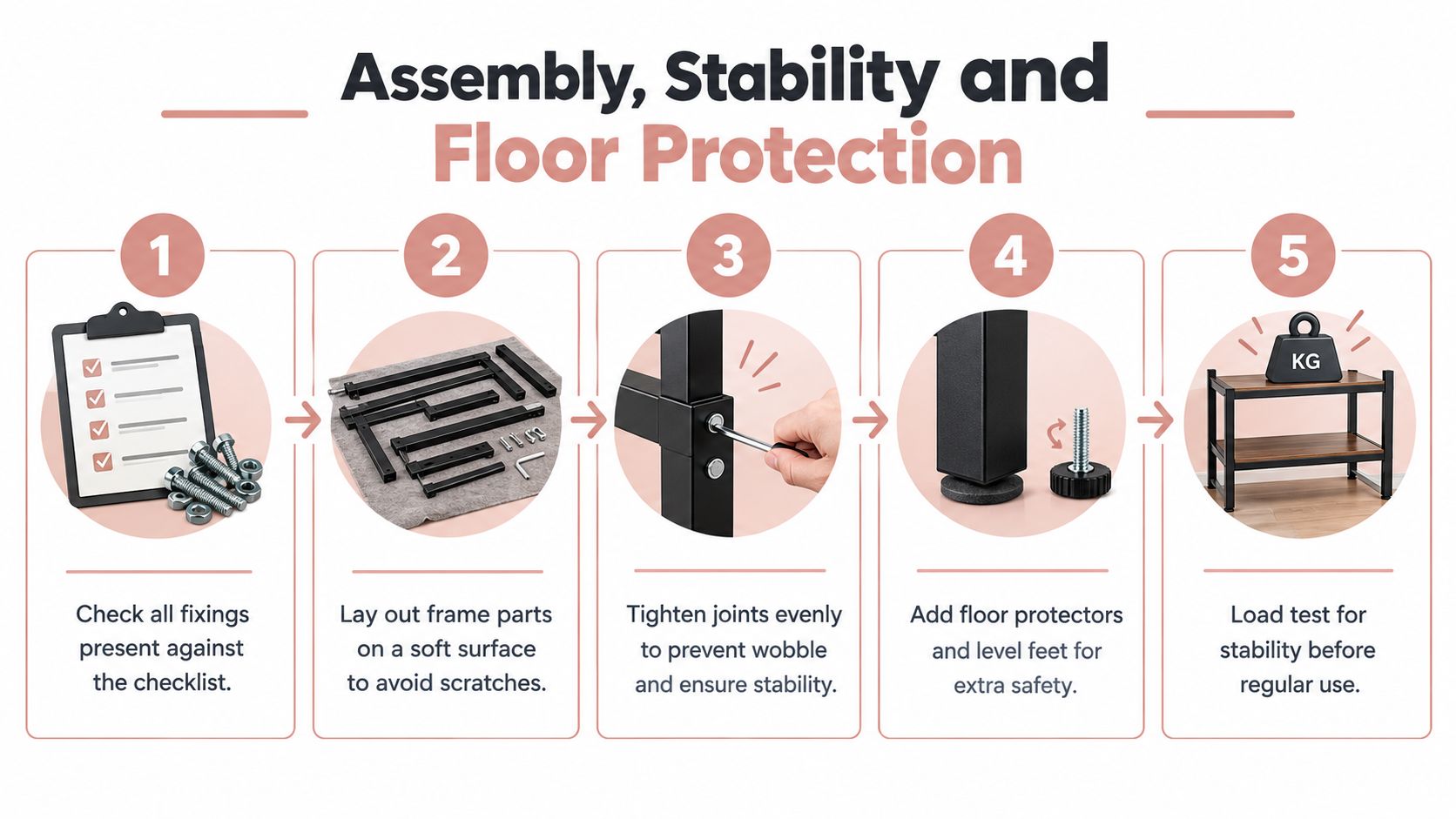
- Check every fixing. Lay out bolts, brackets, feet and caps before joining the frame. Confirm that the tube diameter matches the supplied brackets, because forcing a mismatched connection creates play at the joint.
- Protect the parts. Assemble on cardboard, a blanket or another soft surface. This prevents scratches and lets you see whether uprights and crossbars are sitting square.
- Level before final tightening. Join the base loosely, check it against the floor, then tighten opposing joints gradually. If you fully tighten one corner first, you can pull the frame out of square.
- Fit the shoe shelf early. The lower shelf establishes the frame's working geometry. Once it's level, set the hanging bar relative to that fixed datum rather than guessing the height from a leaning upright.
- Test progressively. Add a small, balanced load first. Open and close nearby doors, check for movement and listen for clicking or creaking before adding heavier garments.
Practical rule: Never test stability by loading one end first. A concentrated coat bundle can twist a frame before the total rating is reached.
Any clothes rail shoe rack over 120cm tall should be considered for wall fixing, particularly in a busy hallway or retail area. Use the supplied bracket and fix into a suitable stud or masonry. Plasterboard alone isn't an adequate fixing point for a tall, loaded frame.
For floors, felt pads suit temporary domestic placement, while hard nylon glides are better for heavy retail units on concrete. Keep steel feet away from untreated timber and inspect underneath after moving the unit. Bathrooms and unheated conservatories are poor environments for ordinary steel because condensation will shorten the life of exposed metal and unsealed boards.
Watch the installation sequence here before you start:
Matching the Right Unit to Your Space
The best unit depends on the room's bottleneck. In a small home, that bottleneck is usually movement. In a boutique, it's browsing access and load distribution. In a studio flat, it's the likelihood that the furniture will need to move before the storage wears out.
UK listings show why generic “space-saving” language isn't enough. Argos lists a model measuring 82cm wide and 44cm deep, while a Tesco all-in-one rail measures 120cm wide and 46.5cm deep. Another Tesco variant reaches 150cm wide and states a 100kg rail capacity. Argos's shoe storage listings provide a useful reminder to compare actual dimensions rather than relying on category labels.
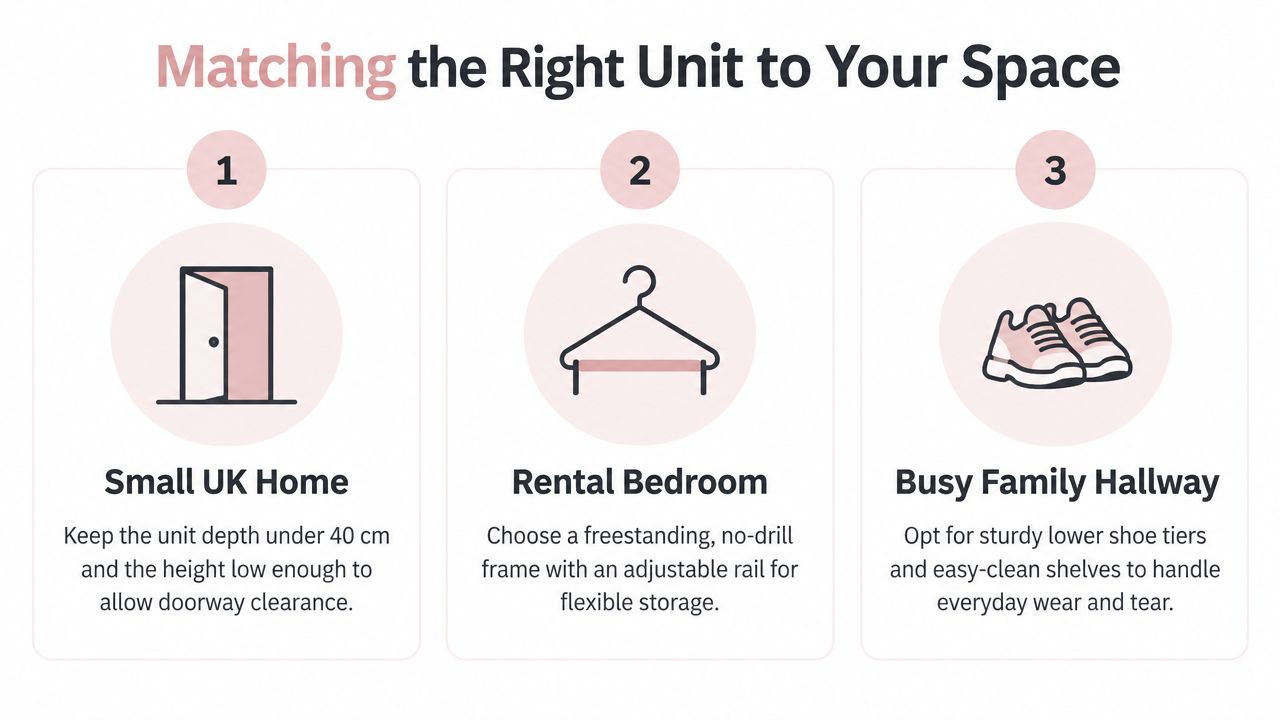
Small UK home
For a narrow hallway, prioritise the assembled depth and the door swing. Keep the unit's depth under 40cm where the layout allows, and choose a height under 180cm if that gives the room better visual and practical clearance. A single lower shoe shelf is usually preferable to several tiers that force footwear into the walking line.
Recommendation: Choose a compact single-bar frame with one stable base shelf, then confirm the full assembled dimensions and doorway route before ordering.
Boutique or pop-up
Retail units need browsing space, not maximum packing. A fixed frame in chrome or matte black can create a consistent shop-floor finish, while a double-tier shoe arrangement makes footwear part of the display rather than an afterthought.
Winter stock changes the calculation. Retail guidance places freestanding rails in the 2ft to 6ft range, with around 20 to 30 garments on a 2ft rail, 40 to 60 on a 4ft rail, and 60 to 80 on a 6ft rail. The same guidance gives roughly 25 to 30 shirts or blouses per metre, but only 10 to 15 coats per metre, because bulky garments need more space. Shopfitting Warehouse's rail capacity guide supports the practical rule: reduce density when stock gets heavier or bulkier.
Recommendation: Use a braced fixed unit with a clearly stated rail rating above 80kg, and load it by garment mass rather than hanger count.
Studio flat or shared rental
Here, modular construction normally wins. You can dismantle it during an end-of-tenancy move, adjust the hanging arrangement for a new room and remove shoe tiers that no longer suit the layout. Keep the frame freestanding only if it remains stable and the manufacturer permits that setup.
Families should also consider whether the shelves are easy to wipe and whether children can reach the footwear without pulling the frame forward. For broader organisation ideas, practical children's storage advice can help you plan access by age and room use.
Recommendation: Choose a modular, no-drill frame with adjustable storage, then secure it if its height and loading make that appropriate.
For retail footwear presentation, display shoe racks show why shelf angle, visibility and access can matter as much as raw capacity. A shoe rack that hides the product or forces customers to crouch too far down is poor merchandising, even if it stores plenty.
Your Pre-Purchase Checklist
Treat the product page like a specification sheet, not a sales pitch. The attractive finish matters, but it won't compensate for a frame that blocks the door, a shelf that bows or a rail that flexes under the coats you own.
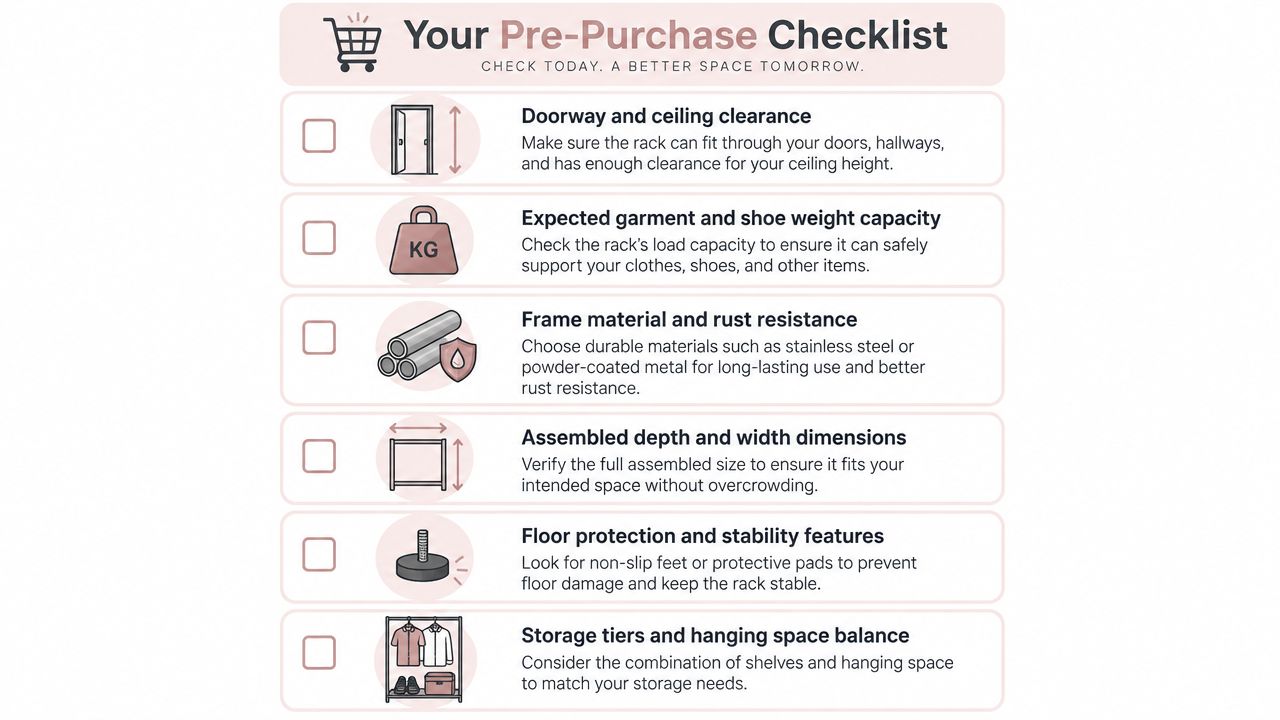
Use these questions before checkout:
- Will it pass through the entrance? Have you checked the narrowest doorway, hallway turn, stairs and lift route, not just the final wall?
- Will the doors still open fully? Have you allowed for handles, skirting boards, radiators and the front edge of the shoe shelf?
- Does the height suit the ceiling? Can you assemble and stand the frame upright without striking the ceiling or light fitting?
- What will you hang on it? Is the rating suitable for light shirts, dense knitwear, bags or damp winter coats?
- Are the ratings separated? Does the listing state rail, shelf and total unit capacities rather than one unexplained headline figure?
- What is the frame made from? Is it chrome-plated steel, powder-coated steel, stainless steel or aluminium, and does that suit the room's moisture level?
- Will the shelves tolerate real footwear? Can they handle boots, grit, wet soles and uneven loads without bowing or allowing shoes to fall through?
- How does it stay stable? Does it have a wide base, adjustable feet, cross-bracing or a wall-fixing bracket?
- What protects the floor? Are felt pads, nylon glides or level feet supplied, and can replacements be fitted?
- Can the system change with you? Will you move tiers or add components, or is the frame permanently fixed?
- What does the warranty cover? Does it include joints, welds, shelves and finish, rather than only manufacturing defects in a narrow component?
- Is the storage balance right? Are you buying enough hanging space with a usable shoe shelf, or paying for tiers that will obstruct the room?
The UK market shows strong demand for both sides of this hybrid category. Amazon UK shoppers searched for “clothes rail” 4.3 million times in the last 12 months, with estimated spend of £3.2 million and a 5.5% increase over 90 days in the cited analysis. The UK clothes rail market data also reports a September peak, when demand is 1.6 times the quietest month, an average listing price of £20.96, and estimated annual sales of 125,000 to 150,000 units.
Shoe storage is just as established. A cited 2026 market analysis estimates that dedicated shoe storage reaches 55% to 65% household penetration in the UK, with around 60% to 65% of sales used in entryways or foyers. It also estimates that the small shoe rack market was 80% to 90% import-dependent in 2024 to 2025, while value grew 4% to 6% annually between 2020 and 2025 and volume grew 2% to 4% annually. The UK tall shoe rack analysis reinforces the point: this is everyday home organisation, not a specialist oddity.
No single clothes rail shoe rack wins every trade-off. Compactness can reduce capacity, extra tiers can affect access, and a lighter frame may be easier to move but less forgiving under heavy coats. Measure the room first, calculate the load, and choose the simplest unit that meets both without relying on optimistic product photography.
Display Guru supplies garment rails, including heavy-duty and two-tier options, alongside tailor dummies, body forms and display equipment for homes, studios and retail environments. Compare the available rails and storage tools at Display Guru before choosing the frame that fits your space and working load.