

Choosing Your Perfect Female Full Body Mannequin
Think of choosing a female full-body mannequin as hiring a silent ambassador for your brand. It's a vital tool that goes far beyond simply displaying clothes; it ensures a garment fits perfectly, shapes how your customers see your collection, and ultimately helps drive sales.
For designers, retailers, and creative professionals, the right mannequin is an essential asset, not just another piece of equipment.
Your Guide To Selecting The Right Mannequin
This guide is here to cut through the confusion and break down the core factors you need to consider. The first step? Realising that there's no such thing as a one-size-fits-all solution. The perfect choice boils down entirely to what you need it to do.
For instance, a designer's studio absolutely needs a pin-friendly polystyrene form for draping and pattern making. In contrast, the workhorse of a busy retail floor is more likely to be a durable fibreglass model. Your specific needs will always point you toward the right balance of function and aesthetics.
Defining Your Primary Goal
Before you even start looking at materials or sizes, you need to get crystal clear on the primary role your mannequin will play. This one decision will shape every other choice you make.
- For Tailors and Designers: Here, the mannequin is a functional tool for bringing creations to life. Accurate measurements, pinnable surfaces, and adjustability are non-negotiable for proper garment construction.
- For Retail and Visual Merchandising: In this world, the mannequin is a sales assistant. Its job is to catch the customer's eye, showcase clothing in the best possible light, and embody the brand's identity through its pose and style.
Think of it like this: a chef needs a brutally efficient, sharp knife for prep work in the kitchen. A food stylist, however, needs a beautiful, photogenic knife for a photoshoot. Both are knives, but they’re optimised for very different jobs. Your female full-body mannequin serves an equally specialised role.
Matching the mannequin to its main function is the first and most crucial step towards getting professional results and making a smart investment that lasts. This guide will give you the clarity you need to navigate the options, ensuring you find the perfect partner for your creative or commercial work. You can also explore our detailed insights on choosing the right mannequins for shops to further refine your selection.
Decoding Mannequin Materials For Durability And Function
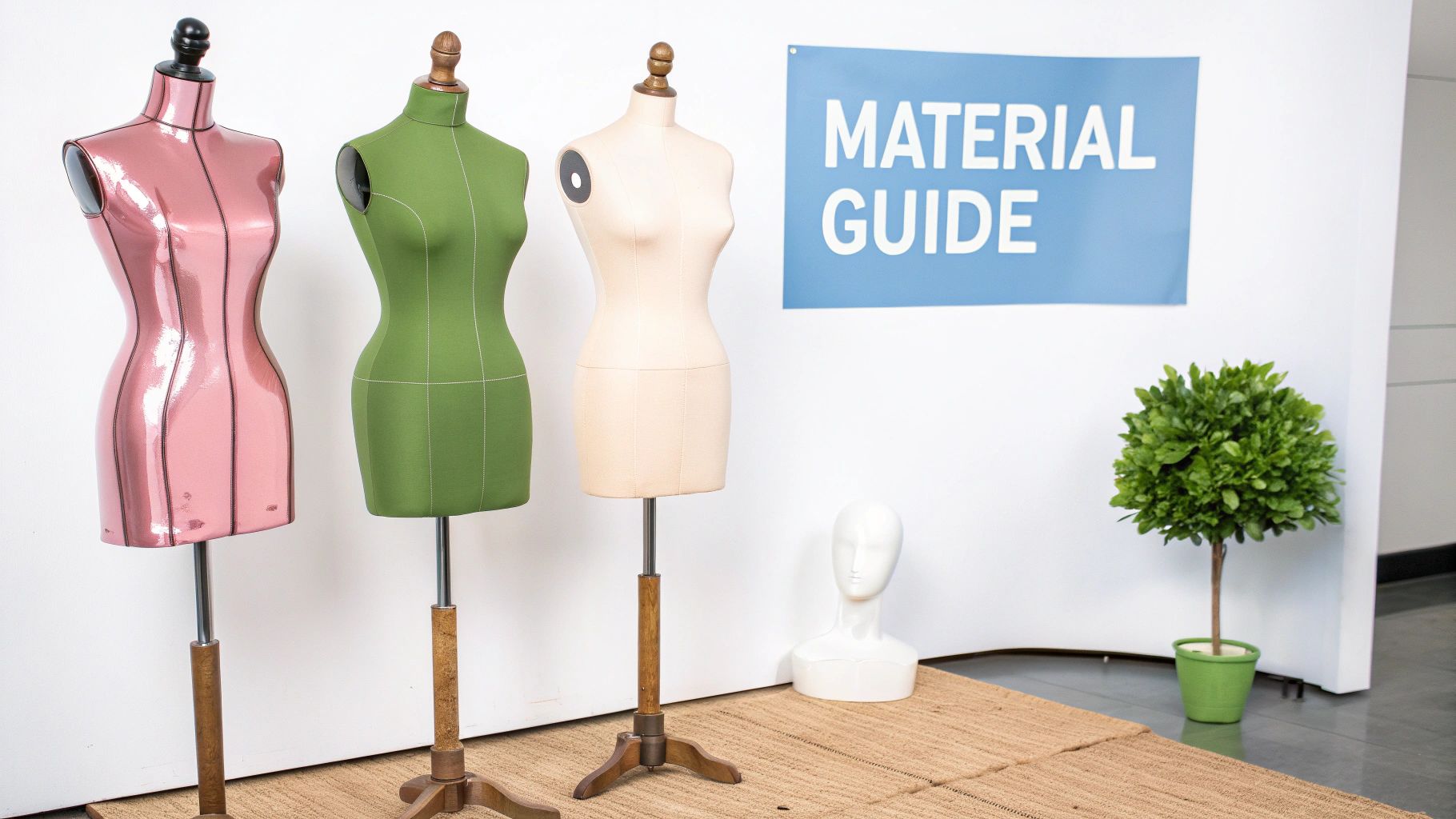
The material of your female full body mannequin is perhaps its most defining characteristic. It dictates just about everything, from its weight and durability to its entire purpose. It helps to think of it like the difference between a clay sculpting model and a finished bronze statue; one is meant for shaping and constant interaction, while the other is built for pure display and longevity.
Ultimately, choosing the right material isn't about finding the single "best" one. It’s about matching its properties to your specific workflow. Whether you're draping fabric in a quiet studio or catching the eye of shoppers on a bustling high street, the material is your true starting point.
Polystyrene: The Designer's Choice
For tailors, designers, and sewing enthusiasts, polystyrene is the undisputed champion. This lightweight yet dense foam is engineered from the ground up to be pin-friendly. You can stick pins directly into the body from any angle, making it an indispensable tool for draping, pattern-making, and fitting garments.
This ability to interact directly is what truly sets polystyrene apart. It becomes a genuine stand-in for the human form, allowing for precise tweaks and creative exploration. Its feather-light nature also means it’s a breeze to move around a studio, reposition, and work with from all sides.
Most polystyrene forms also come with a fabric cover, usually jersey or linen. This gives a gentle grip that stops fabric from slipping around, creating the perfect working surface for anyone who needs to physically handle garments on the form.
For designers, a polystyrene mannequin isn't just a display piece; it's an active participant in the creation process. Its pinnable surface transforms it from a passive model into a three-dimensional sketchbook where ideas take shape.
Fibreglass: The Retail Powerhouse
When you shift from a private studio to a public retail space, the demands on a mannequin change completely. This is where fibreglass and other tough plastics take centre stage. These materials are chosen for one main reason: their strength, longevity, and superior finish.
A fibreglass female full body mannequin is built to withstand the rigours of a busy shop floor. It shrugs off chips, scratches, and the general wear and tear from frequent dressing and customer traffic. That hard, non-pinnable surface makes them useless for tailoring, but absolutely perfect for display.
Visual appeal is everything in retail, and fibreglass offers a massive range of possibilities.
- Finishes: Models can be produced in matte, gloss, or even striking chrome finishes to match a brand's aesthetic.
- Realism: From hyper-realistic forms with detailed facial features and makeup to sleek, abstract shapes, fibreglass can be moulded into any style imaginable.
- Poses: The material's inherent strength allows for dynamic, creative poses that capture attention and tell a story.
These mannequins are designed to sell clothes through powerful visual merchandising. Their number one job is to look good and make the garments they wear look even better. While you can't stick pins in them, their durability ensures they remain a valuable asset for years. If you'd like to explore how to set them up effectively, you might find it useful to learn more about assembling a mannequin on a stand in our detailed guide.
Choosing between these core materials is the most critical decision you'll make after defining your mannequin's purpose. Polystyrene offers hands-on functionality for the creator, while fibreglass provides the visual punch and resilience needed for commerce. By understanding these fundamental differences, you can select a mannequin that not only meets your needs but becomes an invaluable tool for your craft or business.
Getting The Right Fit With Mannequin Sizes And Measurements
A mannequin is essentially a stand-in for a real person, so getting the size right is everything. Forget vague labels like "small" or "large" for a moment. The true story of a good fit is told in the numbers: the precise measurements of the bust, waist, and hips.
These three core measurements are the bedrock of garment construction and display. Whether you’re draping a one-of-a-kind wedding dress or setting up a new retail collection, a mannequin that truly reflects your target customer’s shape is non-negotiable. Without it, fabrics hang poorly, silhouettes are distorted, and the garment’s intended design is lost.
Looking Beyond The Label
We’ve all experienced it – a UK size 12 in one shop fits completely differently to a size 12 in another. The same is true for mannequins. A "size 10" from one manufacturer might have slightly different bust and hip dimensions than another, which is why you can't rely on the dress size alone.
Always go straight to the detailed measurement chart. This is where you’ll find the objective truth about the mannequin’s proportions.
A mannequin's size chart is its fingerprint. The "dress size" offers a general guide, but the specific bust, waist, and hip measurements in centimetres are what give the form its unique, undeniable identity.
This is why learning how to read mannequin measurements is such a crucial skill. It gives you the power to choose a form that lines up perfectly with your design specifications or your brand’s sizing block, ensuring consistency in every piece you create or display.
To give you a practical starting point, here's a look at some typical measurements for female mannequins based on standard UK dress sizes.
Typical UK Female Mannequin Size Guide
This table provides a reference for common UK dress sizes and their corresponding mannequin bust, waist, and hip measurements in centimetres. Use this as a starting point when selecting your mannequin.
| UK Dress Size | Bust (cm) | Waist (cm) | Hips (cm) |
|---|---|---|---|
| 6 | 81 | 62 | 86 |
| 8 | 84 | 65 | 89 |
| 10 | 88 | 69 | 93 |
| 12 | 93 | 74 | 98 |
| 14 | 98 | 79 | 103 |
| 16 | 104 | 85 | 109 |
| 18 | 110 | 91 | 115 |
| 20 | 116 | 97 | 121 |
Remember, this is a general guide. Always cross-reference with the specific manufacturer’s chart to ensure you get the exact fit you need.
The Power Of Adjustable Mannequins
For many professionals, especially tailors and designers who work with a wide range of clients, a single fixed-size mannequin just isn't practical. This is where adjustable mannequins come in. Think of them as a standard form that can grow or shrink in all the right places.
These models usually have a series of internal dials – often 10 or more – that let you independently expand or contract the bust, waist, and hip sections. This is a game-changer for:
- Bespoke Tailoring: You can dial in a client's exact measurements for a truly custom fit.
- Pattern Grading: It allows you to test how a garment fits across a small range of sizes without needing a room full of mannequins.
- Versatile Studios: One tool can be adapted for multiple projects and different body shapes.
While they can't mimic every single curve of the human body, their flexibility offers a level of precision that static forms simply can't.
Embracing Inclusive Sizing
The fashion industry is finally moving towards more realistic and inclusive body shapes, and mannequin design is following suit. The demand for petite and plus-size forms has shot up, empowering brands and designers to serve a much wider audience.
This isn't just about representation; it's a savvy business move. The UK market is heavily focused on women's apparel, and the drive for inclusive sizing has made the female full-body mannequin a dominant force. In fact, the women's category commands well over 50% of the UK market share, with the growing demand for plus-size figures being a significant contributor, as noted in market analysis from Fortune Business Insights.
By choosing a mannequin that genuinely reflects your target customer – whether they are petite, tall, or plus-size – you ensure your clothes are designed, fitted, and displayed on a form that speaks to them. That attention to detail builds trust and shows you understand their needs, leading to better-fitting garments and happier customers.
Choosing Stands And Mounts For Stability And Style
The stand is your mannequin’s anchor. It's the unsung hero that governs its stability, how easily it can be moved, and its overall visual impact. While the form itself naturally gets all the attention, the base is what turns it from a simple shape into a practical, workable tool.
Choosing the right one is a bit like framing a piece of art; it needs to be supportive and functional, but it also has to look the part. A good stand makes sure your full-body mannequin stays firmly upright, whether you’re draping heavy wool in a design studio or it’s standing proud in a busy retail space.
Classic Stability: The Tripod Stand
For most sewing rooms and design workshops, the classic tripod stand is the undisputed champion. Its three-legged design creates a wide, stable footprint that’s incredibly difficult to knock over—exactly what you need when you're pulling and pinning fabric with focused intensity. That reliable stability gives you the confidence to work without constantly worrying about the form wobbling.
You’ll typically find them made from wood or metal, so you can easily find one that matches the feel of your creative space. It’s a simple, functional design that has truly stood the test of time.
Modern Aesthetics: The Flat Metal Base
Step into the world of retail, and you'll see that the flat metal base reigns supreme. These stands favour clean lines and a minimalist feel, often featuring a sleek rectangular or circular plate in brushed steel, chrome, or a powder-coated finish. Their low profile is wonderfully discreet, ensuring all eyes are on the mannequin and the garments it’s showcasing.
This style is perfect for modern boutiques and polished window displays where every single element is part of a curated look. The sheer weight of the metal plate provides all the stability you need without the sprawling footprint of a tripod, keeping the overall aesthetic clean and uncluttered.
Think of the stand as part of your brand's story. A rustic wooden tripod might be perfect for a heritage brand that values craftsmanship. In contrast, a polished chrome base speaks the language of a high-fashion, contemporary label.
Functionality On The Move: Wheeled Bases
If your mannequins are constantly on the move, a wheeled base is an absolute game-changer. These stands, usually equipped with lockable castor wheels, let you reposition displays, shuffle forms around a bustling studio, or rearrange a shop floor without any back-breaking lifting. This kind of mobility is a massive advantage for visual merchandisers planning their next layout or for designers who need a flexible workspace.
The Mounting Point Matters: Calf Versus Foot Rods
That small point where the stand connects to the mannequin—the mount—has surprisingly big implications for styling. The two main options are a calf rod and a foot rod, and your choice will directly affect what your mannequin can wear.
- Calf Rod: This is by far the most common and versatile choice. A metal pole slides discreetly into the back of the mannequin's lower leg, leaving the feet completely free. This clever setup means you can display almost any type of footwear, from chunky trainers to delicate sandals.
- Foot Rod: This mount goes directly into the heel or sole of the mannequin's foot. While it offers rock-solid stability, it makes displaying any shoe with a closed heel impossible. It’s mainly reserved for specific poses or for showing off items like socks, hosiery, or open-toed shoes.
Ultimately, the decision comes down to one simple question: do you need to display shoes? For the vast majority of users, the sheer flexibility of the calf rod makes it the clear winner. If you'd like to explore this further, you can learn more about selecting the right stand for your mannequin in our specialised guide.
Matching Mannequin Features To Professional Needs
Choosing the right female full-body mannequin isn't about picking the prettiest one; it's about matching the tool to the trade. A master tailor and a high-street visual merchandiser might both use mannequins, but their needs couldn't be more different. One is looking for a functional partner for creating garments, while the other needs a silent salesperson to catch a customer's eye.
Thinking of it this way cuts through the noise. It’s like a chef choosing a knife—a heavy cleaver is essential for a butcher but utterly useless for finely slicing sashimi. Once you pinpoint the non-negotiable features for your work, you can invest in a mannequin that truly supports your professional goals.
The Tailor and Designer's Toolkit
When your job is to build a garment from scratch, the mannequin is your hands-on assistant. Here, pure function wins out over aesthetics every single time. The most crucial features are the ones that help you create, ensuring every pin and stitch is perfectly placed.
These are the features that really matter:
- Pin-Friendly Materials: A fully pinnable surface is non-negotiable. Polystyrene models are fantastic for this, as you can drape, adjust patterns, and fit fabric directly onto the form without causing any damage.
- Collapsible Shoulders: This is a brilliant bit of engineering. It allows the shoulder section to compress slightly, making it a breeze to get tight-fitting or delicate garments on and off without stretching them out of shape.
- Precise Adjustability: For anyone doing bespoke work, an adjustable dress form is a game-changer. Internal dials that alter the bust, waist, and hip measurements mean a single mannequin can be adapted for multiple clients. We dive deeper into this in our guide to the benefits of an adjustable dress mannequin.
For a tailor, the mannequin is a three-dimensional blueprint. Its value isn't in how it looks, but in how accurately it can be manipulated to reflect the human form, ensuring a perfect fit every time.
The Retail Merchandiser's Stage
In a retail setting, the focus shifts entirely from hands-on creation to visual persuasion. The mannequin’s job is to stop shoppers in their tracks, tell a compelling story, and make the clothes look absolutely irresistible. It's less of a tool and more of a performer.
In the UK’s competitive fashion scene, the right mannequin is a visual merchandiser’s best friend. The UK mannequin market was valued at USD 312.8 million in 2024 and is expected to soar to USD 1,132.6 million by 2035. This growth underscores just how much retailers rely on mannequins to create displays that pull customers in and drive sales.
One of the first practical decisions is how to mount the mannequin, which often comes down to footwear. This quick decision tree makes it simple.
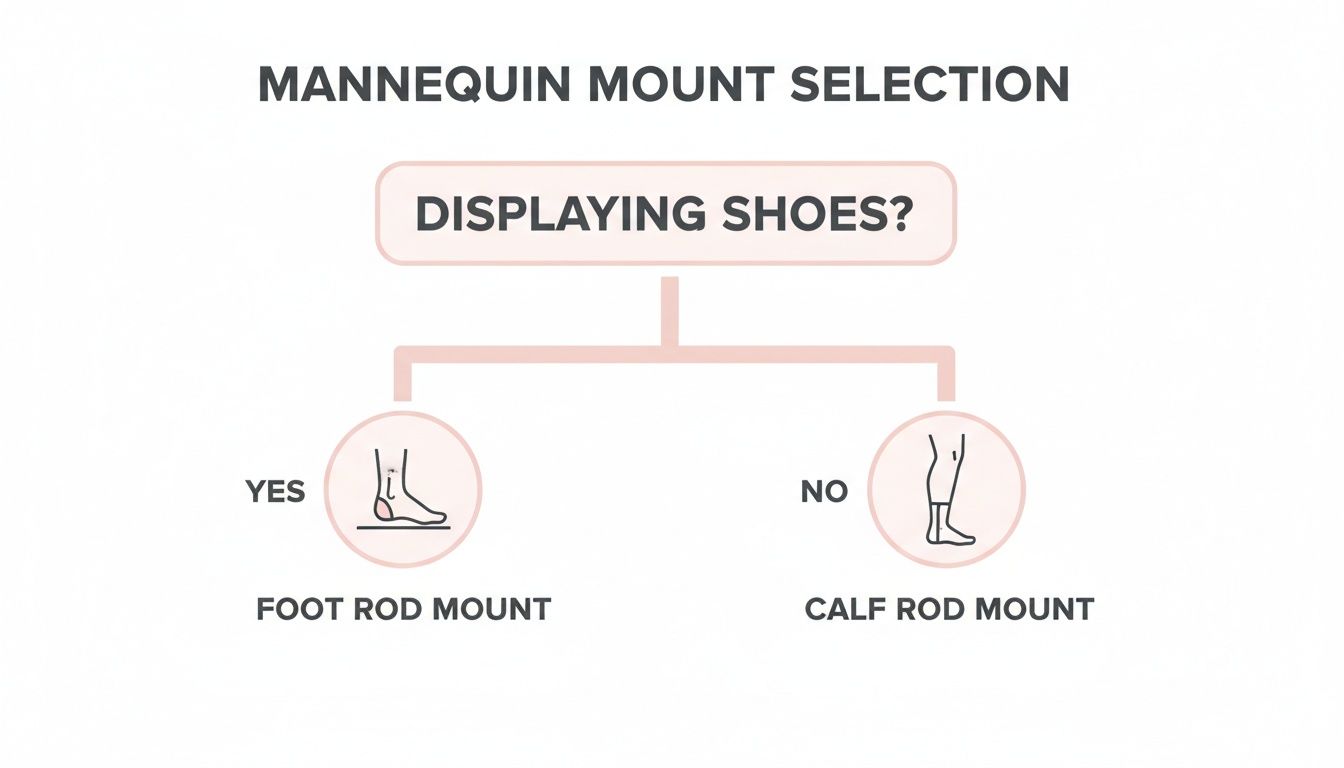
As you can see, the calf rod mount offers far more versatility, leaving the feet free for any style of shoe you want to feature in your display.
For retail success, you’ll want to focus on:
- Aesthetic Style: The style you choose—from realistic mannequins with detailed faces to abstract, egg-head forms—says a lot about your brand. A realistic form suits a classic brand, while an abstract one is perfect for a modern, edgy boutique.
- Durable Finishes: Shop floors see a lot of traffic. Mannequins made from fibreglass or tough plastic with chip-resistant finishes (like matte or gloss) are vital for keeping your displays looking sharp.
- Dynamic Poses: A static, straight-armed pose gets the job done, but it’s a bit lifeless. Dynamic poses—walking, leaning, or even interacting with other mannequins—create movement and a narrative that grabs attention and helps customers imagine themselves wearing the outfits.
Mannequin Features For Tailoring Versus Retail
To make the distinction crystal clear, let's break down how the priorities differ between a creative studio and a retail floor.
| Feature | Importance For Tailors & Designers | Importance For Retail & Merchandising |
|---|---|---|
| Pinnability | Essential. A fully pinnable surface is a must-have for draping, pattern making, and fitting garments directly on the form. | Low. Rarely needed. The primary goal is dressing the mannequin for display, not constructing clothing on it. |
| Adjustability | High. An adjustable form is incredibly valuable for custom work, allowing one mannequin to mimic various body shapes and sizes. | Low. Not a priority. Standard sample sizes are used, and the focus is on a consistent brand look rather than individual client measurements. |
| Collapsible Shoulders | Very High. Crucial for easily dressing the form with tight or delicate garments without causing damage or stretching. | Moderate. A "nice-to-have" feature that can speed up dressing changes, but not a necessity. |
| Aesthetic/Pose | Low. A basic, neutral pose is all that's needed. The form's purpose is functional, not to create a mood or story. | Essential. The pose, finish, and style are paramount. They must align with the brand's identity and create an engaging visual narrative to attract customers. |
| Durability & Finish | Moderate. Durability is important, but the surface finish is secondary to its pinnability. Scuffs are less of a concern. | Very High. Mannequins must withstand a high-traffic environment. A chip-resistant, high-quality finish is crucial for maintaining a polished brand image. |
Ultimately, whether you're a creator or a curator will guide your choice. By being clear on your professional context from the start, you can filter through the endless options and find a female full-body mannequin that’s perfectly suited to help you excel.
Caring For Your Mannequin To Maximise Its Lifespan
A quality female full-body mannequin is a real investment, one that should serve your brand or studio for years to come. Think of it like a trusted sewing machine; a bit of regular attention and care goes a long way.
With the right routine, you can easily sidestep the common pitfalls of scuffs, stubborn stains, and mechanical issues. Here’s how to keep your mannequin looking sharp and performing perfectly.
Cleaning Different Mannequin Materials
When it's time to clean a fibreglass form, treat it like you're washing a car’s paintwork. A damp microfibre cloth and a touch of mild detergent are all you need to gently wipe down the surface. Steer clear of harsh chemicals or abrasive sponges, as they’ll only dull the finish.
For polystyrene mannequins with fabric covers, the approach is different. Imagine you're brushing a favourite wool jumper; a soft brush will lift away lint and dust without snagging the jersey or linen. If you spot a stain, just dab it with a mild soap mixture and rinse carefully with a damp cloth.
Plastic or resin forms are the most straightforward. They just need a simple wash with warm, soapy water. The key is to dry them quickly afterwards to prevent water spots and keep the finish looking crisp.
Key Insight: According to industry best practices, regular, gentle cleaning can extend the life of any mannequin material by up to 30%.
| Material | Cleaning Agent | Cleaning Frequency |
|---|---|---|
| Fibreglass | Mild detergent and cloth | Weekly |
| Polystyrene | Soft brush and soap mix | Bi-weekly |
| Plastic | Warm soapy water | Monthly |
Assembly, Disassembly, And Storage
Proper handling during setup is your first line of defence against damage like bent rods or cracked joints. Treat assembly like building a puzzle—follow the steps precisely and don't force anything.
When it's time to pack it away, just reverse the process methodically to protect all the clips and adjustable parts.
Here’s a simple checklist for storage prep:
- Gently loosen any tension dials and clamps to avoid putting strain on internal springs.
- Remove stands or rods, then wrap each piece individually in a soft cloth or bubble wrap.
- Always store the torso upright in a dry, climate-controlled space to prevent it from warping.
This process is a bit like putting away a delicate musical instrument; you're just making sure every component stays safe until you need it next.
Creative Uses To Extend Value
A female full-body mannequin can be so much more than a silent partner on the shop floor or in your design studio. It can become the star of your product photography, giving you consistent angles and perfect posture every time. Clear, professional fitting images can seriously boost buyer confidence and help reduce returns when you're selling garments online.
You can also use your mannequin to create stunning seasonal and thematic displays that draw attention to your storefront or website.
- Adapt poses to match holidays or current trends.
- Layer clothing and accessories to offer styling inspiration.
- Incorporate props like scarves, hats, or bags for added context.
These simple tactics transform a static form into a dynamic and versatile marketing tool.
"Treat your mannequin as a professional partner and it will always be ready to perform flawlessly for you," says a specialist from Display Guru.
By committing just a few minutes each week to these practices, you'll keep your mannequin in pristine condition. The payoff is a durable, high-impact display that elevates every garment and maximises your return on investment.
Best Practices You Need To Know
- Regularly inspect the fittings on feet and stands to prevent wobbling or tilts.
- Keep mannequins away from direct sunlight or heat sources that can warp the materials over time.
- Clearly label storage boxes with the form’s size and material so you can find what you need quickly.
Frequently Asked Questions
When you're looking for the perfect mannequin, a few questions always pop up. It's a bit like casting a silent actor for your brand – you need the right fit for the role. Here are some quick answers to the questions we hear most often.
Can I Assemble My Mannequin by Myself?
Absolutely. Most mannequins are designed with solo assembly in mind. They come in a few key parts – torso, legs, arms, and the stand – which usually connect with simple twist-and-lock mechanisms. No toolbox required.
From opening the box to having your mannequin ready for its first outfit, you're typically looking at no more than 10-15 minutes. A good tip is to assemble it on a soft surface, like a rug, to prevent any accidental scuffs, especially if you're working with a fibreglass model.
What's the Real Difference Between Realistic and Abstract Mannequins?
Think of it as choosing between a character and a canvas. The style you pick completely changes the vibe of your display and how customers interact with the clothing.
-
Realistic Mannequins have defined facial features, and sometimes even makeup or wigs. They create a very human, relatable feel. This style is fantastic for classic brands because it helps customers easily imagine themselves in the clothes.
-
Abstract Mannequins, with their "egg-head" or simplified forms, are all about putting the fashion first. By removing facial details, they ensure 100% of the focus lands on the garment's cut, colour, and texture. This makes them a go-to for high-fashion boutiques and contemporary brands where the design is the star.
The choice really comes down to strategy. A realistic mannequin suggests, "This could be you." An abstract one declares, "Behold this design." Both are effective, but they speak to different merchandising philosophies.
How Do I Choose the Right Size for My Brand?
The key is to ignore generic dress sizes and get down to the numbers. The three measurements that truly matter are the bust, waist, and hips. Your aim is to find a mannequin that closely matches your brand’s fit model or the average measurements of your target customer.
Always dig into the product specifications for these exact dimensions. If your collection caters to a variety of body shapes, an adjustable mannequin is a brilliant investment. Its internal dials give you the freedom to showcase different sizes on a single form, ensuring every piece drapes just as you designed it to.
Ready to find the perfect silent partner for your designs or retail displays? Explore the extensive collection of professional-grade mannequins at Display Guru. From adjustable dress forms for precise tailoring to durable display models for busy shops, we have the tools you need to bring your vision to life. Find your ideal female full body mannequin today at https://www.displayguru.co.uk.