




Dump Bin Baskets Guide: Types, Placement and Security
A Tuesday morning delivery leaves six cartons of discounted knitwear and seasonal accessories sitting in the stockroom. Your main wall bays are already dressed for the new range, the promotional tables are full, and you need those lines shifting by midday without calling in joiners or turning the entrance into an obstacle course. Reaching for a floor-standing wire bin feels like the quickest fix, yet the wrong unit can cost you far more in rumpled stock, wasted replenishment hours, and walk-out theft than it ever earns back in extra sales.
Physical shops across Great Britain still command massive spending. Retail sales in Great Britain reached £517 billion in 2024, a 1.4% increase on 2023 according to the UK House of Commons Library. Trading conditions inside that market remain choppy, though, and online rivals keep raising the convenience bar. The Office for National Statistics November 2024 retail sales bulletin put non-store retailing at £64,417 million, while monthly non-food store volumes swung from a 3.0% drop in April 2024 to a 3.5% jump in May, their largest monthly rise since April 2021.
That kind of trading swing explains why experienced shopfitters treat dump bin baskets as active merchandising infrastructure rather than cheap bulk storage. Buying on capacity alone is a trap. Every basket on your floor sits at the centre of a commercial trade-off between impulse sales, staff labour, and shrinkage risk, and getting the specification right starts with matching the container to the exact stock you plan to sell.
What Dump Bin Baskets Are and Why Retailers Use Them
Watch any busy high-street shop on a Saturday afternoon and you'll spot the same scene. A shopper slows down beside a waist-high wire container filled with mixed socks and winter gloves, drops their shoulder bag onto their forearm, and rummages through the pile at their own pace. Nobody hovers over them, nothing looks too precious to touch, and two pairs end up in their hand before they even reach the main clothing rails.
In shopfitting terms, a dump bin basket is an open-top, floor-standing display container, typically built from powder-coated wire, moulded plastic, or timber, designed to hold loose or packaged merchandise for self-selection. Much like a market trader's wooden crate, it deliberately swaps regimented shelf order for visual abundance. Shoppers read that generous volume as value, which lowers hesitation and invites hands-on browsing.

Where Open Baskets Earn Their Keep
Open-top bins work hardest across five commercial categories: discount lines, short-run promotional offers, seasonal changeover stock, everyday household essentials, and low-ticket impulse buys. They sit at the opposite end of the display spectrum from structured counter organisers used for tasks like keeping reception desk cards organised, where neat alignment and single-item presentation matter most. On the sales floor, a bin succeeds precisely because it strips away formality and lets customers pick up goods without disturbing a manicured stack.
Recent UK trading numbers show why adaptable promotional zones matter so much for store managers. In the Office for National Statistics December 2024 retail sales bulletin, non-food store sales volumes (covering department, clothing, household, and other non-food retailers) increased by 1.1% compared with November, even as total Great Britain retail sales volumes fell 0.3% month on month. The same release noted that while all main retail sectors except food stores grew across 2024, non-food stores still sat below their 2022 level.
When demand shifts from one month to the next, fixed shelving locks your floor plan into yesterday's priorities. Movable bins let your team spin up a clearance corner, promote a wet-weather line, or rotate seasonal bundles in ten minutes alongside your broader retail display equipment.
A dump bin isn't a storage box you happen to leave on the shop floor. It's flexible merchandising infrastructure built for fast-changing assortments.
Dump Bin Basket Types Compared
Walking into a fixture catalogue without a clear job description usually leads managers to buy the biggest square wire cage on offer. That single mistake explains why half the promotional bins on the high street look half-empty, tangled, or awkward to shop by mid-afternoon. Each basket format solves a distinct floor problem and brings its own operational headache.
| Type | Best job | Stock it suits | Main watch-out |
|---|---|---|---|
| Open floor-standing basket | High-volume promotions and clearance | Low-value, fast-moving lines | Looks untidy when overfilled |
| Deep bin with dividers | Mixed sizes and small items | Socks, accessories, small homewares | Dividers reduce usable capacity |
| Tiered or angled basket | Eye-level browsing | Packaged goods with clear fronts | Costlier and heavier to move |
| Castor-mounted mobile basket | Repositioning for seasons or weekly campaigns | Changing promotional ranges | Castors wear on hard floors |
| Fixed-base or wall-anchored unit | Holding higher-risk stock under control | Items needing sightline and security | Less flexible for layout changes |
Reading the Trade-Offs Behind Each Design
An open floor-standing basket gives you maximum cubic capacity for the lowest purchase price, making it the default workhorse for fast-moving clearance stock. The catch is depth: once shoppers dig down looking for a colour or size, stacked goods collapse into a jumble that signals low quality unless staff tidy it regularly.
Adding internal grids turns that shell into a deep bin with dividers, which keeps small items like woolly hats, multipack socks, or kitchen gadgets separated by size or price point. Those wire partitions do eat into your usable internal volume, though, and awkward oversized packaging catches on the divider rims when customers pull items out.
A tiered or angled basket solves the visibility problem for boxed or header-carded lines by tipping the product face towards the shopper's eye line. Because each tier holds less stock than a deep single well, your team will refill it more often, and the heavier steel frame takes two people to shift during a floor reset. Where modular height matters more than bulk volume, wire stacking baskets often give better access to small packaged lines without swallowing aisle width.
Castor-mounted mobile baskets shine in stores that flip promotional zones every Monday morning or wheel stock out to the threshold during dry weather. Check the wheel specification before ordering, because soft rubber treads flat-spot under heavy loads and unbraked castors drift across tiled or polished concrete floors whenever a trolley clips the corner.
At the controlled end of the range, a fixed-base or wall-anchored unit removes the risk of a fixture being nudged out of staff view or tipped during busy weekend trading. You give up layout agility in return, so reserve anchored units for permanent promotional bays or stock lines that require steady supervision.
Matching the Basket to the Stock
Before you look at dimensions or finishes, settle one practical question: is this basket meant to clear bulk stock quickly, present a structured range, or hold items that need closer control? I always advise managers to match the fixture to the unit size and daily turnover of the merchandise, never to the largest capacity available in the brochure.
Run through three quick checks before shortlisting a model:
- Unit footprint and packaging rigidity: Soft textiles tolerate deeper wells, whereas cardboard boxes crush under their own weight after four or five layers.
- Expected refill rhythm: A giant basket holding slow-moving goods turns stale and dusty at the bottom, while a shallow angled tray holding fast-selling impulse snacks will run bare before lunch.
- Floor reset frequency: If your team moves promotional points every week, prioritise lockable twin-wheel castors and folding sides over welded static frames.
Choosing Size, Material and Specification
Once you know the basket style, the buying decision shifts to build quality, material recovery, and total cost of ownership. A flimsy welded mesh bin that buckles on its second campaign is poor value, even if the unit invoice looks attractive on day one.
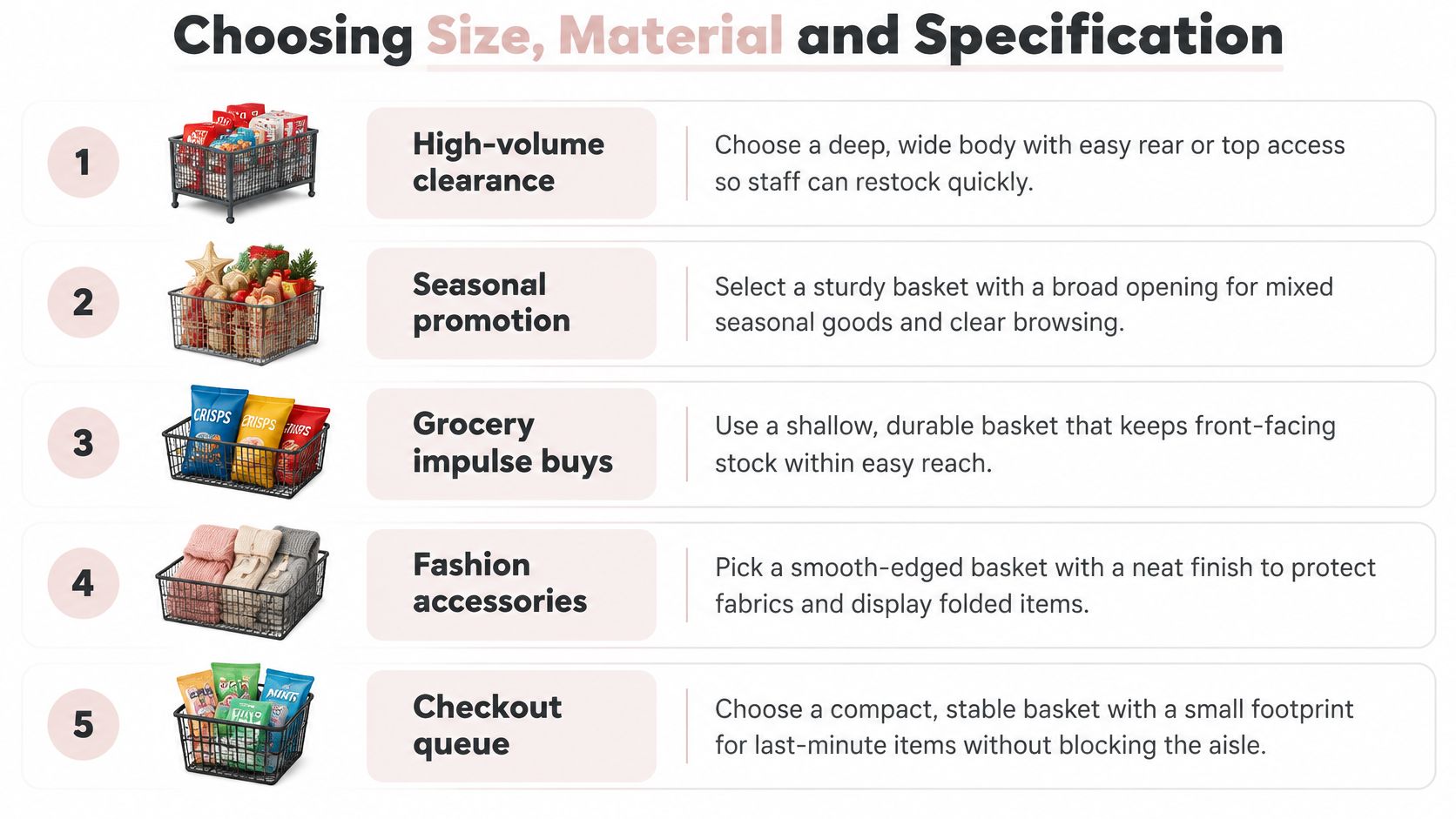
Start by linking your retail use case directly to the specification you put in front of your supplier.
| Retail case | Main priority | Specification to request |
|---|---|---|
| High-volume clearance | Capacity and quick refill | Deep, wide body with easy rear or top access |
| Seasonal promotion | Repositioning and storage | Lightweight, stackable or folding frame |
| Small high-value items | Visibility and control | Shallower depth, divided compartments, secure fixing |
| Fragile or easily crushed lines | Protection from damage | Shallow tray with a rigid or padded base |
| Long-term store fixture | Durability and repair | Replaceable panels, documented component weights, disassembly instructions |
Materials, coatings and end-of-life recovery
Most shopfitters choose between three core materials: powder-coated steel wire, injection-moulded plastic, and timber or laminated board. Powder-coated steel handles heavy loads and lets light pass through the sides so stock stays visible from across the aisle, though cheap paint chips when metal shopping baskets scrape the rim. Moulded plastic shrugs off damp mop water and works well for smooth-edged fashion accessories that snag on bare wire, while timber suits gift shops and delis but weighs more and absorbs knocks along the lower plinth.
Material choice also governs what happens when a fixture reaches the end of its service life or loses a promotional header panel. While reusable bins are display equipment rather than consumer packaging, the UK Statistics on Waste packaging recycling data for 2024 provides a clear picture of the recovery infrastructure your waste contractor works with: recycling rates stood at 84.1% for paper and cardboard, 78.7% for metal, 53.5% for plastic, and 51.7% for wood.
The practical takeaway isn't to abandon steel or plastic. It's to avoid glued composite fixtures where plastic trims, metal frames, and printed board panels are permanently bonded together. According to UK and Ireland retail findings cited in the same waste guidance, 86% of stores claimed to recycle more than three-quarters of temporary display equipment yet some couldn't explain how those figures were measured, and roughly 80% of collected recyclable display materials had to be exported for processing. A modular basket built with bolted fasteners, replaceable side panels, and separable metal, plastic, and board parts lasts longer on the shop floor and sorts cleanly when damaged pieces finally need replacing.
Your pre-order specification checklist
Even domestic storage advice, such as guides on involving kids in toy cleanup, rests on the same ergonomic principle you need on a retail floor: people reach into containers sized for the objects inside them, not bottomless pits where small items vanish. Translate that principle into seven concrete specifications before requesting a quote:
- Usable internal capacity: Ask for internal cubic measurements rather than outer frame dimensions, especially when drop-in base grids or castors add height.
- Internal depth against unit height: Keep well depth proportional so a shopper's hand reaches the bottom without elbowing the rim; adjustable false bottoms let you raise the base as stock sells down.
- Safe working load limit: Verify the static load rating in kilograms, particularly for dense household goods like tinned food, candles, or bottled toiletries.
- Empty fixture weight: Confirm whether one staff member can safely lift, fold, and store the empty frame during seasonal changeovers.
- Replaceable wear parts: Check if castors, base liners, header sign clips, and side panels can be bought individually rather than scrapping the whole bin.
- Fastener type and disassembly instructions: Request standard nuts, bolts, or clips that separate without specialist tools, paired with clear teardown notes.
- Documented component weights: Ask for a breakdown of metal, plastic, and board weights so your facilities team can log real disposal and recovery rates.
Procurement check: Before placing a repeat order, log three numbers from your last campaign in a simple spreadsheet: weeks deployed, damage incidents, and final disposal route.
If you're ordering fixtures in bulk or want to inspect logistics early, our estimated delivery date appears right on the Basket page once you choose your delivery area and shipping method. Heavy pallet orders are rescheduled directly with you if a delivery slot needs adjusting, and in most cases you can also collect orders from our warehouse at Butts Mill, Butt Street, Leigh, WN73AE between 9am and 5pm, Monday to Friday.
Placing Dump Bins for Footfall and Flow
A well-specified basket placed in a dead corner will gather dust while a smaller unit positioned at a natural pause point clears twice a day. Successful placement comes down to watching where shoppers naturally slow down, rather than cramming a bin into whatever gap happens to sit empty.

High-dwell zones that earn floor space
Four positions consistently outperform mid-aisle placements because customers are already braking or waiting there:
- Just past the entrance threshold: Avoid the very first stride inside the doorway, where shoppers adjust to store lighting and put umbrellas away. Set your promotional bin a couple of paces further in, angled slightly towards the main flow.
- Aisle ends and promotional cross-walks: End-cap sightlines pull attention down long runs of shelving, making a compact basket beside a gondola end effective for linked offers, such as dishcloths beside washing-up liquid.
- Checkout queues: Captive dwell time turns low-ticket add-ons into easy basket builders, provided the fixture stays compact enough not to trap customers mid-queue.
- Department transition points: Placing a basket where womenswear meets accessories, or where hardware meets gardening, catches shoppers mentally shifting gears between categories.
For wider floor planning around traffic patterns and fixture spacing, map your bin zones alongside retail store layout best practices so promotional displays reinforce your main walkways instead of fighting them.
Circulation, sightlines and safe loading
Every floor-standing fixture takes away walking width, so test clearance with a full shopping trolley or a pushchair before locking a position in. Never narrow a primary walkway into a single-file pinch point, never sit a bin across a fire exit route, and preserve generous turning space for wheelchair users at aisle junctions.
Till sightlines matter just as much as walkway width. Stand behind your main counter and check whether you can see the top rim of the basket and the floor around its base without leaning over displays. Tall promotional header boards look great from the front door, yet an oversized graphic panel can block your cashier's view of an entire corner bay.
Loading discipline keeps the display inviting once shoppers start browsing. Keep stock comfortably below the basket's safe working load limit and raise the adjustable base grid whenever product levels drop below halfway. Once items slump below waist height into a tangled pit, shoppers stop digging and start treating the line as damaged leftovers.
Moving the bin as the season turns
Picture a medium-sized clothing and homeware shop running a winter accessories push. In November, a wide waist-high basket of fleece-lined gloves sits just past the front entrance, catching cold shoppers stepping in off the high street. By the second week of January, footfall intent has shifted from full-price seasonal buying to bargain hunting, so the manager reduces the stock depth, raises the false bottom, and wheels a slimmer divided bin of the remaining pairs into the checkout queue as a clearance pick-up.
Place your dump bin where shoppers already pause, and move it the moment footfall behaviour shifts rather than waiting for a fixed quarterly reset.
Keeping Stock Safe Without Deterring Shoppers
Most fixture brochures sell dump bins on openness and volume, as if maximum accessibility always equals maximum profit. On today's UK high streets, that assumption breaks down quickly. An open, unattended bin packed with easy-to-pocket merchandise doesn't just invite browsing; it creates an effortless sweep-theft target and drains staff hours into constant floor checks.
The scale of retail loss makes security a core merchandising decision, not an afterthought. A UK Parliament committee report on retail crime noted that police recorded 509,556 shop-theft incidents in the year ending December 2025, while the British Retail Consortium logged 7.159 million theft and damage incidents during 2025 at an estimated cost of roughly £1.5 billion. Convenience retailers separately estimated 6.2 million theft incidents and £265 million spent on crime-prevention measures in 2025.
The cheapest, deepest open basket is rarely the most profitable fixture once you factor in stock loss and the staff time spent policing it.
A practical security decision framework
Before dropping any promotional line into a dump bin, weigh seven operational levers together rather than looking at unit price in isolation:
- Product value and resale appeal: Fast-moving, low-margin basics carry low theft incentive, whereas branded cosmetics, phone cables, razor blades, or small leather goods disappear fast from open floor displays.
- Basket height and depth: Deep opaque sides hide hands and open bags; open wire mesh with a shallower well keeps every reach visible from across the floor.
- Till and camera sightlines: Position higher-risk bins inside the natural gaze of checkout staff and directly beneath clear CCTV arcs, never tucked behind tall garment rails or structural pillars.
- Replenishment frequency: Stocking smaller quantities more often caps the value exposed at any single moment. A half-filled shallow tray refreshed twice a shift loses far less to a grab-and-run than a brimming deep bin filled once a week.
- Fixture anchoring: Lightweight empty-framed bins near an exit can be nudged out of camera range or knocked over as a distraction; anchor or weight permanent near-door units so they stay put.
- Internal division: Compartmentalised grids slow down bulk sweeping, because someone can't scoop twenty loose items into a bag with one arm motion.
- Visible floor presence: Staff tidying aisles and greeting shoppers deter opportunist theft far better than stern printed warnings.
Matching control to the line
Say you're running a weekend promotion across two accessory ranges: discounted cotton ankle socks and compact branded umbrellas. The socks stay in an open floor-standing wire basket in the main central walkway, where high volume drives quick self-selection and minor stock loss barely dents total margin. The umbrellas, carrying a higher unit cost and quick resale value, move into a shallow divided bin positioned right beside the till point, stocked with only six to eight pieces at a time.
If a promotional line carries high unit value and compact packaging, skip open bins altogether and house it inside locked display cabinets where staff can hand items over smoothly. Keep customer tone welcoming across every fixture: skip passive-aggressive signs warning thieves that cameras are watching, and train staff to offer relaxed eye contact and help rather than hovering awkwardly behind browsers. Weigh impulse upside against shrinkage exposure line by line, and never let a fixture's low purchase cost dictate where vulnerable stock sits.
Measuring Whether a Dump Bin Earns Its Floor Space
Shop managers love the energy a busy promotional bin brings to the floor, yet busy doesn't always mean profitable. British consumers do spend heavily on unplanned buys: retail insights published by Harrison Retail report around £21.7 billion a year in UK impulse spending, with UK grocery sales exceeding £12 billion in December 2024 and impulse purchases running 8% higher than during the rest of that year.
Those national totals show the size of the prize, but they don't guarantee that a specific wire basket in your store will create incremental demand. A poorly placed bin often just steals sales from your standard shelving twenty feet away while adding twenty minutes of tidying to every shift. The only reliable way to know whether a fixture pays its rent is to run a clean, controlled store test.
How to run a clean fixture trial
- Select two matched trading windows or comparable stores. Pair sites with similar footfall and shopper profiles, or compare two steady trading periods free of bank holidays or major weather shocks.
- Capture a clean baseline before moving anything. Run a baseline period, say four weeks, tracking store conversion, units per transaction, average basket value, and stock loss on the target SKU group.
- Install the dump bin basket and freeze every other variable. Place the new fixture in its chosen high-dwell spot without changing header signage elsewhere in the department.
- Hold pricing, promotions, and stock levels constant. If you cut the price by twenty percent on the day the bin goes out, you're testing a markdown, not the display fixture.
- Time staff replenishment and tidying. Give floor staff a quick tally sheet on the stockroom clipboard to record minutes spent refilling, straightening, and picking dropped items off the floor each day.
- Calculate net contribution margin per square metre-hour. Subtract replenishment labour, any clearance markdowns caused by crushed packaging, and recorded shrinkage from the gross margin generated during the trial, then divide by the floor footprint and trading hours.
Mistakes that skew fixture trials
The quickest way to fool yourself is to judge a dump bin purely by gross revenue per fixture. A basket parked beside the entrance might ring up impressive till receipts while total category sales stay flat because loyal shoppers grabbed their usual item earlier in their walk. Tracking overall category lift across the store separates genuine impulse volume from cannibalised shelf sales.
Ignoring hidden labour is the second trap. If an over-deep bin takes thirty minutes of refolding every afternoon to stop it looking like a jumble sale, your real margin evaporates fast. Likewise, changing promotional offers mid-trial or letting the basket sink into a collapsed heap ruins your comparison before you have usable numbers.
Stick to one hard decision rule: keep a dump bin on the sales floor only when net contribution margin rises after labour, markdowns, and shrinkage come off the top. For wider merchandising tests that pair fixture placement with pricing and presentation tweaks, look at practical ways to increase retail sales alongside your floor trials. Before you place your next fixture order, jot down three things on one page: the exact stock line, the retail use case, and the trial metrics you'll track, then match the specification to that plan.
When you're ready to put a clearer specification into practice, we supply retail dump bins and baskets alongside white and black shopfitting garment rails, body forms, and mannequins for working shops. Every order comes with free shipping, dedicated pre- and post-sales support via live chat and email, and convenient weekday collection from our Leigh warehouse if you prefer to pick fixtures up direct. Explore our full range of retail display fixtures at Display Guru.