

How to Increase Retail Sales: A Practical UK Guide
The shop feels busy, the team is working hard, and customers are still coming through the door. Yet the till total is slipping, online baskets aren't turning into orders, and you're considering another sale to get things moving.
Before cutting prices, find out where customers stop buying. How to increase retail sales is an operational question before it's a marketing question: the shop floor, the till and the online checkout need to work as one sales system.
Find the Lever Holding Your Sales Back
Falling takings don't necessarily mean you need more visitors. If footfall is steady, start with what happens after people arrive.
The basic equation is sales = visits × conversion rate × average transaction value. Units per transaction helps explain basket value, while repeat purchase rate tells you whether customers have a reason to come back.
Sales levers, the measure to track and the healthy sign
| Lever | Measure | Healthy sign | First test |
|---|---|---|---|
| Footfall or visits | Door counter or web sessions per week | Sustained stability or growth across comparable weeks | Refresh the window display on a fortnightly schedule |
| Conversion rate | Buyers as a share of visitors | Stable or rising month on month | Fix the single worst shelf or checkout step |
| Average transaction value | Sales divided by number of transactions | Rising without extra discounting | Bundle complementary products |
| Units per transaction | Items sold divided by number of transactions | Rising across comparable trading days | Add a relevant accessory prompt at the till |
| Repeat purchase rate | Share of an identifiable customer group returning within your chosen purchase window | Rising across comparable customer groups | Send a useful follow-up message after purchase |
These are directional checks, not universal benchmarks. A dressmaker buying a replacement form won't behave like a customer buying everyday consumables, so choose a repeat-purchase window that suits the category.
Separate the symptom from the cause
Say a clothing shop has steady footfall and transaction counts, but takings are down. Its receipts show that customers still buy the main garment but no longer add the coordinating accessory. That's a reason to inspect availability, product placement and staff recommendations before paying for more traffic.
Check the sales mix too. Lower basket value can reflect missing premium stock, heavier discounting or a shift towards cheaper products, rather than fewer items. Use our inventory management guidance to distinguish a selling problem from an availability problem.
Practical rule: Don't buy more attention until you know what happens to the attention you already receive.
Give each channel a clear job
The diagnosis must cover both physical and digital shopping. The ONS June 2026 retail sales bulletin puts online sales at 29.4% of Great Britain retail sales, the highest share since April 2021.
Use the website for searchable specifications, product comparisons and straightforward repeat orders. Use the shop for tactile assessment, trying products and advice. Offer collection where stock visibility and picking arrangements make it dependable, rather than adding it because competitors do.
Record when shoppers research online but buy in-store. Otherwise, you may cut useful product content because it doesn't appear to generate direct website orders.
Once you've identified the obstruction, Quikly's guide to increase retail sales with consumer psychology offers a useful way to think about purchase decisions. Apply those ideas to a diagnosed hesitation, not as a substitute for diagnosis.
Pull a baseline covering comparable trading weeks, separate the channels, and name the weakest lever before changing anything.
How to Run a Sales Routine Step by Step
A useful sales routine turns observations into assigned work. It shouldn't become a meeting where everyone reports that trade feels quiet and nobody changes anything.
Keep the sequence consistent, but choose the intervention from the figures. The ONS December 2025 retail sales bulletin reports that Great Britain's retail sales volumes rose 1.3% in 2025, following 0.2% growth in 2024. That market context matters, but it doesn't tell you which shelf, shift or checkout step needs attention.
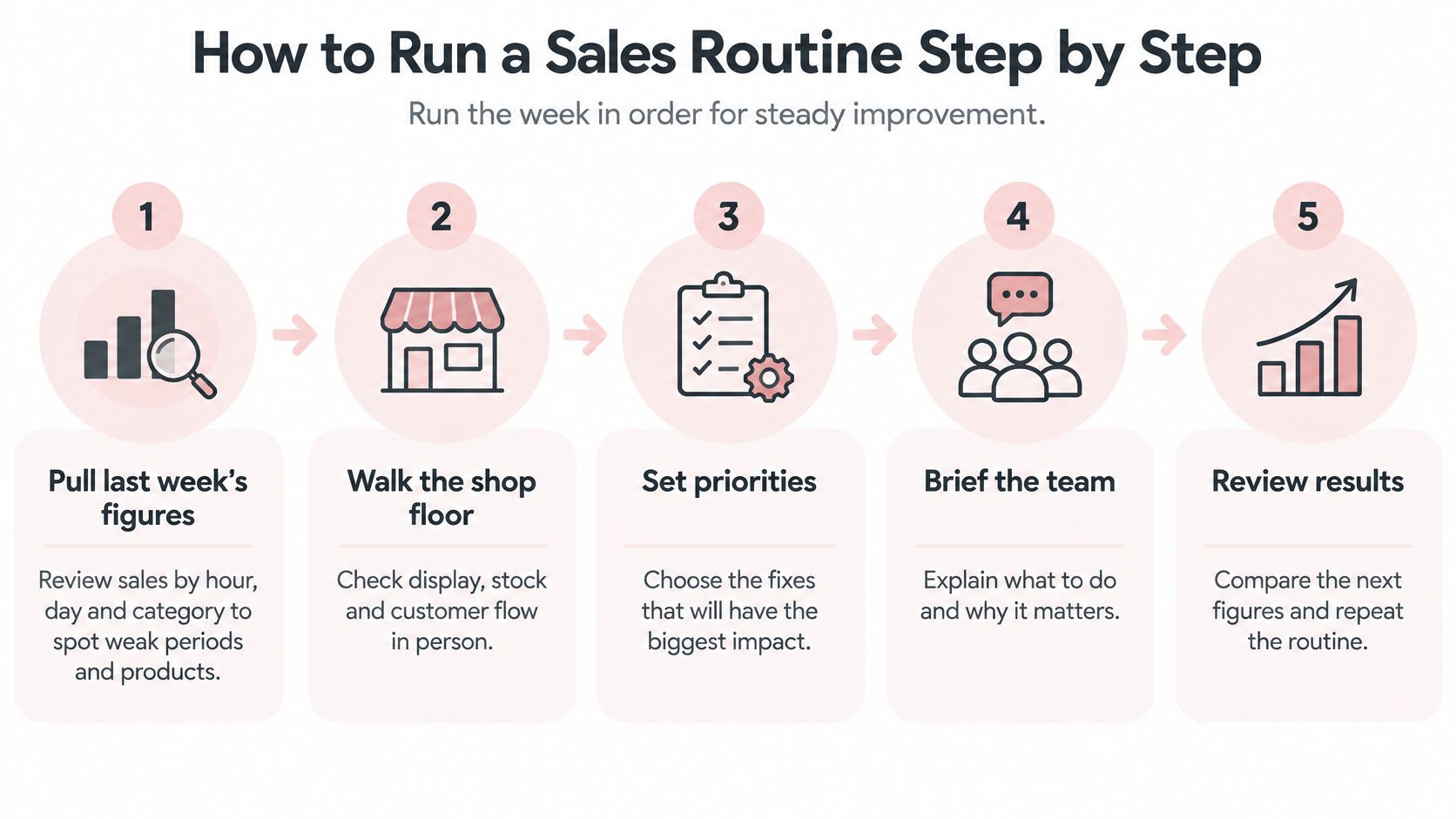
Run the week in order
- Pull last week's figures by hour, day and category. Look for periods where visitors aren't becoming buyers, or categories where transactions remain healthy but basket size weakens. Don't compare a promotional weekend with an ordinary weekday and call the difference an improvement.
- Walk the shop floor and online catalogue as a customer. Follow a specific task, such as finding a garment in the right size or ordering a compatible display accessory. Record blocked routes, missing prices, unavailable variants and unclear descriptions instead of making a vague list of things to tidy.
- Choose a hero product or practical bundle. Pick something that addresses the weakest lever, has enough stock and leaves acceptable profit after fulfilment. Choosing a favourite product without checking availability can turn a successful display into a string of disappointed enquiries.
- Reset its window and front-of-store presentation. Give the product a clear focal position, an understandable price and a reason to stop. Avoid rebuilding unrelated displays at the same time, because you won't know which change affected the result.
- Brief the team before the offer goes live. Explain who it's for, its main benefit and a useful question to ask the customer. Skipping this conversation leaves staff trying to interpret signage while serving, which invites inconsistent explanations.
- Check the corresponding product page and purchase route. Confirm that the item shown in-store matches its online description, available variants and current offer conditions. Don't send customers from a confident sales conversation to a page that leaves basic purchase questions unanswered.
- Review the result on Friday. Compare conversion, units per transaction and profit with the baseline, noting stock shortages, staffing changes or unusual local conditions. Keep useful changes, investigate ambiguous results and stop interventions that make selling harder.
Use this process flow as a visual reminder of the weekly rhythm.
Make ownership visible
Write the action, owner and review date in a shared spreadsheet or shop diary. A named supervisor should check completion, rather than assuming that mentioning a task in the huddle means it happened.
Keep separate notes for execution and results. If the display wasn't installed until late in the week, or the featured size sold out immediately, you've learned about execution, not necessarily customer demand.
Don't abandon a sensible change after an unusually quiet afternoon. Equally, don't keep a weak intervention because the team spent time creating it.
Good progress means the chosen lever improves without an unacceptable trade-off elsewhere. More add-ons aren't a win if queues lengthen, returns rise or staff steer customers away from better-suited products.
Store Layout and Display That Move Stock
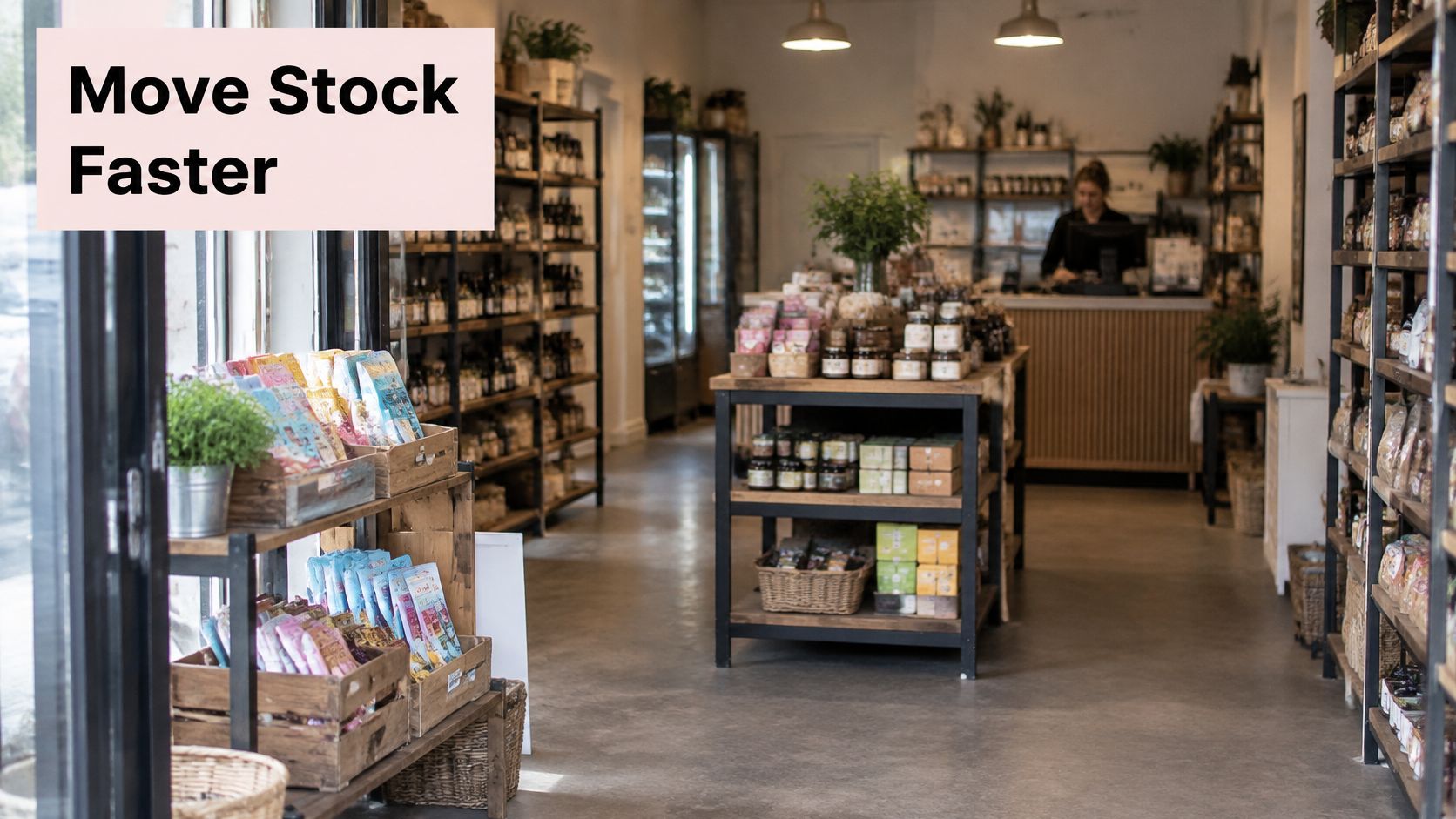
Walk into your shop without looking towards your favourite display. Notice what a customer can see: perhaps the back of a rail, a handwritten delivery notice or a crowded table with no obvious price.
Fix the journey in the order customers experience it. Buying attractive fixtures won't resolve an entrance that makes the shop difficult to understand.
The useful feature in an organised shop is the clear relationship between products, shelving and walking space.
Start with the entrance and main route
Leave customers room to enter, orient themselves and decide where to go. A dump bin can work for recognisable, easy-to-price products, while a rail suits garments customers need to browse. Neither belongs where it obstructs the doorway or hides the rest of the shop.
Make the main route pass stock that combines customer demand with worthwhile margin. Keep replenishment cartons, spare hangers and abandoned fitting-room returns out of that route.
Test accessibility in practice. Can customers pass comfortably, turn with a pushchair and reach the merchandise without moving another display? A route that looks generous on a floor plan may feel cramped once people stop to browse.
Use our retail store layout guidance to assess the whole journey rather than improving isolated corners.
Give customers a reason to continue
The back wall needs a clear destination: a complete outfit, a useful project grouping or a category customers actively seek. Don't put slow stock there just because you don't know where else to put it.
Group by customer use, not automatically by supplier. A garment, coordinating accessory and suitable care product can explain a purchase more clearly together than separated into unrelated bays.
- Show the finished result. Use a mannequin or body form to demonstrate proportion, layering and how a garment hangs.
- Answer the obvious question. Shelf-edge cards should make the price, variant and relevant compatibility easy to identify.
- Keep small add-ons relevant. Till-side accessories should complete the purchase, not create a cluttered obstacle to payment.
- Protect sightlines. Avoid tall fixtures that leave staff unable to see customers needing help.
A display earns its space by making buying easier, not by holding the largest possible quantity of stock.
Don't strip every spare item from the floor in pursuit of a showroom appearance. Customers still need confidence that the right size or colour is available, and staff need a workable replenishment process.
For a practical test, stand at the entrance and note the strongest line of sight. Put the product you want customers to consider there, keep its price unchanged, and track its sales alongside purchases of complementary items.
If the featured item improves but nearby products suffer equally, you may have moved demand around rather than increased it. Judge the category result, not just the display's headline product.
Promotions That Lift Revenue Without Eroding Margin
What must the promotion protect: margin on core lines, cash tied up in aged stock, or sales during a quiet period? Those are different jobs, and they shouldn't automatically receive the same percentage-off offer.
A discount gives away margin on purchases some customers would have made anyway. Define the commercial job before choosing the incentive.
Promotion types compared on margin, use and risk
| Promotion | Margin impact | Best used for | Main risk |
|---|---|---|---|
| Percentage discount | High direct cost | Clearing aged stock or a defined event | Customers learn to wait for discounts |
| Bundle | Medium cost when the saving is controlled | Raising units per transaction | Bundle must match what the customer actually needs |
| Gift with purchase | Medium cost, including handling | Seasonal peaks such as November and December | Gift sourcing and leftover stock cost more than expected |
| Free delivery threshold | Medium cost through shipping subsidy | Lifting online basket size | Threshold set too low erodes profit on small orders |
| Loyalty points | Low to medium cost, subject to reward design | Rewarding existing regulars | Slow payback and complexity deter staff and customers |
These cost descriptions are planning categories, not guaranteed outcomes. Calculate each offer using your product costs, reward terms and fulfilment requirements.
Choose value customers can use
Bundles work when the items solve a connected problem. A garment rail paired with compatible accessories makes sense; unrelated slow stock attached to a bestseller usually doesn't.
Use our cross-merchandising examples to identify combinations worth testing. First calculate the combined contribution, then decide whether the bundle needs a saving at all. Convenience and compatibility can be valuable without a deep price cut.
Seasonality deserves preparation. The ONS internet sales series shows online sales accounted for 32.4% of UK retail sales in November 2025, compared with 26.1% in May 2025. Arrange stock, gift availability, campaign content and clearance decisions before demand arrives.
Free-delivery thresholds need particular care with bulky or expensive-to-ship items. Model the basket contribution after carriage, packaging and handling rather than assuming a larger order is automatically more profitable.
Make rewards earn their administration
Loyalty points suit a genuine repeat-purchase pattern, not a business hoping software will create one. Staff must be able to explain the reward easily, and customers must understand when it becomes useful.
If that case exists, BonusQR's option to create QR-based customer rewards is worth considering alongside your till workflow. Decide the reward economics and redemption rules before choosing the technology.
Margin guardrail: Stop an offer when its incremental contribution falls below the floor you set before launch.
Judge promotions on gross profit, revenue per visitor and incremental orders. Include payment fees, fulfilment costs, redeemed rewards and returns when deciding whether the extra sales were worthwhile.
Compare against a suitable period without the offer, accounting for stock and seasonal differences. For your next campaign, choose a defined customer need and write down both the intended benefit and the condition that will make you stop.
Training Staff to Sell Advice, Not Just Stock
A customer asks which body form would suit a jersey garment. An assistant who immediately points towards the nearest model hasn't established whether the customer wants to fit, pin or display the piece.
The better response starts with the intended task and how the customer needs the garment to sit. Good retail advice reduces the risk of buying the wrong thing, rather than pushing the most expensive option.
Helpful selling begins with understanding the customer's practical requirements.

Coach habits customers can feel
- Ask an open question before presenting stock. Find out what the customer is trying to achieve, rather than making them choose between products before they understand the differences.
- Know the practical facts about bestsellers. Staff should explain intended use, size options and what makes an alternative more suitable, without improvising technical claims.
- Recommend a relevant complementary item. Explain the task it completes, then accept the customer's answer without turning the conversation into a sequence of pitches.
- Use the customer's own language. If they need easy movement between displays, explain handling and positioning rather than reciting unrelated features.
- Log unmet requests. Record missing sizes, unclear instructions and products customers expected to find, then review those notes with the person responsible for buying or merchandising.
These habits need practice, not just a laminated script. A script can help a new starter remember the conversation, but it shouldn't make every customer receive the same recommendation.
Train around decisions, not product recitals
Use a short daily product huddle to compare likely customer needs. Ask staff when they would recommend the item, when they wouldn't, and which detail they would verify before promising suitability.
Build role-play around genuine questions from the enquiry log. Give new starters a shadowing shift where they hear an experienced colleague explain trade-offs, including occasions when the cheaper product is the better choice.
Use the video as a discussion prompt, then practise the advice in your own product context.
Measure add-on rate, units per transaction and returns involving advised purchases. Don't reward basket growth alone, because staff may learn to recommend unnecessary extras or avoid customers with more complex questions.
Review the reason for returns as well as the count. A sizing misunderstanding calls for different coaching from an unwanted gift or a damaged delivery.
Before a shift, staff should be able to answer this checklist:
- Customer need. What task does today's featured product help with?
- Suitability. What must I ask before recommending it?
- Useful pairing. Which accessory completes that task?
- Limits. What shouldn't I promise without checking?
- Escalation. Who can resolve a question I can't answer?
The standard is straightforward: customers should leave knowing more than when they arrived, whether they buy immediately or not.
Fixing Online Checkout and Delivery Drop-Offs
More checkout features don't necessarily produce more orders. Account prompts, promotional boxes and extra payment messages can make a simple purchase feel like administration.
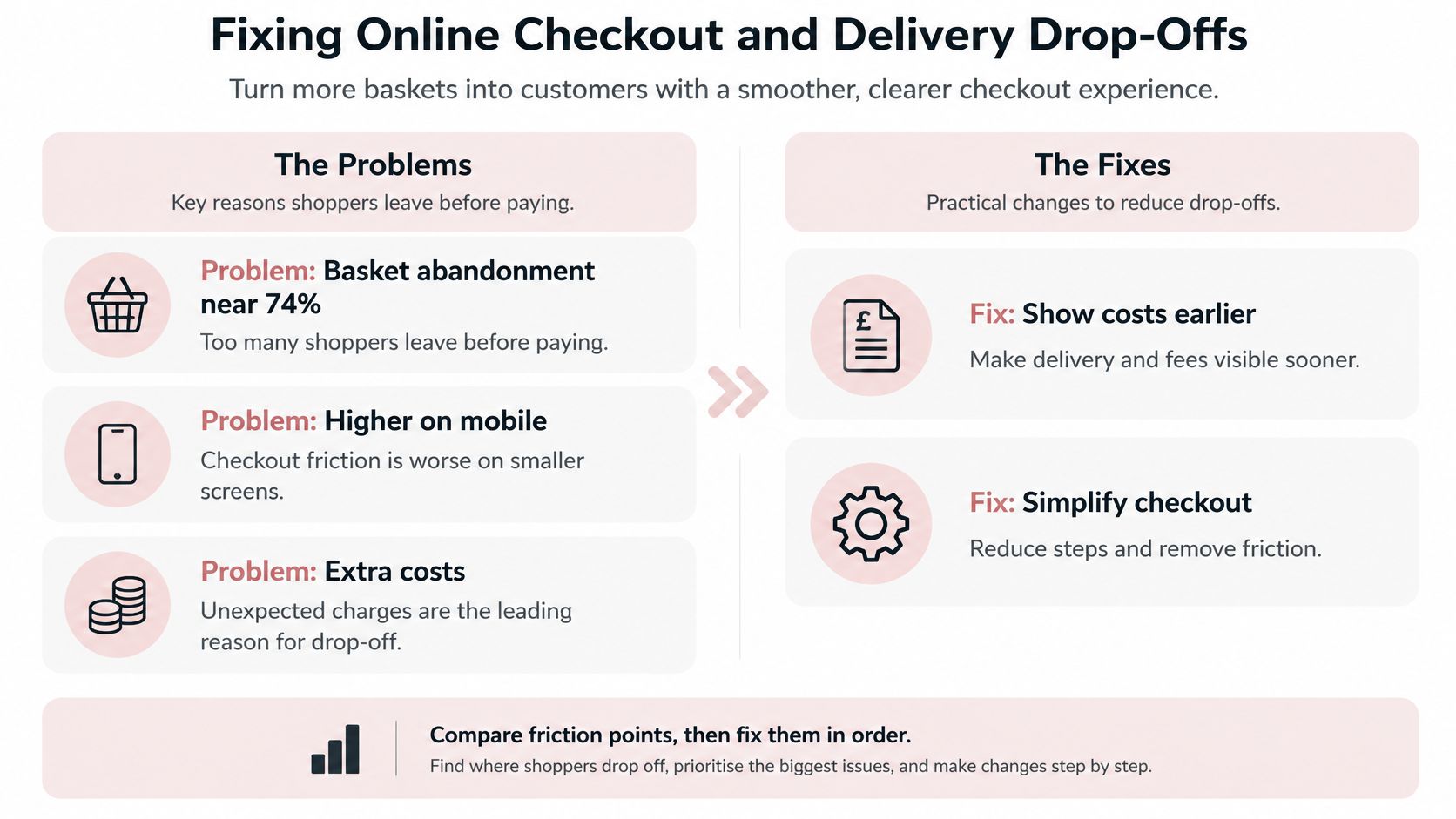
Start with the place customers leave, not a list of features competitors have added. The Grumspot ecommerce conversion guide reports UK basket abandonment of approximately 74%; its synthesis of 50 studies identifies extra costs as the leading abandonment reason, cited by 40% of shoppers.
Those are diagnostic signals, not a target your shop should accept. Your product mix, traffic quality and purchase cycle still matter.
Locate the largest loss
Build a funnel covering product views, add-to-basket actions, checkout starts and completed orders. Segment it by device, traffic source, new versus returning customers and product category.
Look for the largest mobile-versus-desktop gap, then inspect that journey on an actual phone. A checkout that works on an office monitor may be awkward with a mobile keyboard covering the delivery fields.
Checkout and delivery symptoms, causes and fixes
| Symptom | Likely cause | Fix |
|---|---|---|
| Customers abandon at the delivery charge | Costs revealed only at the final step | Show the total delivered price on the product page |
| Mobile abandonment far above desktop | Slow pages and long forms on small screens | Compress images and shorten forms |
| Customers leave at account creation | Forced sign-up before payment | Offer guest checkout as the default |
| Orders arrive late and complaints rise | Delivery promise is faster than operations can keep | Show dispatch time beside the price and set realistic dates |
| Repeat contacts about order status | No proactive updates after purchase | Send automatic status messages at dispatch and delivery |
Where the delivered price requires a postcode or selected configuration, provide the calculation route early. Don't display an apparently complete price that changes unexpectedly at payment.
This visual summarises the distinction between purchase friction and useful reassurance.
Make the delivery promise operationally true
Delivery isn't just a checkout label. The GFS guide to delivery-related abandonment reports that 22.3% of UK shoppers abandon checkout when the delivery experience fails to meet expectations, while 51% have abandoned because delivery charges didn't meet expectations.
Distinguish dispatch timing from arrival timing. Separate stocked products from made-to-order items, and make any mixed-basket implications clear before payment.
Send proactive messages when the order changes status. If something goes wrong, give the customer a useful next action rather than leaving them to interpret a tracking page.
Our live chat support guidance explains how timely assistance can address unresolved questions. Use those conversations to identify missing product information, not to compensate indefinitely for a confusing page.
Test the fix rather than the whole redesign
Choose a primary metric before launch, preferably revenue per visitor, and retain a contribution-margin check. A higher conversion rate can still produce a weaker commercial result if orders become smaller or costlier to fulfil.
Use a controlled comparison where traffic allows it. Run across complete trading cycles, include weekday and weekend demand, and don't declare success from a small cluster of orders.
- Do simplify the obstruction. Remove unnecessary fields or expose information customers need.
- Don't change unrelated elements. A new payment layout, delivery offer and product price launched together won't give you a clear diagnosis.
- Do check downstream effects. Faster checkout isn't an improvement if address errors and support contacts increase.
Fix the highest-impact symptom in the table first. Leave cosmetic changes until customers can complete the essential task confidently.
Start One Sales Test This Month
Choose the weakest lever, select a matching fix and assign an owner. Keep the intervention small enough that you can explain what changed without listing an entire shop refit.
A useful test connects an operational action with a customer decision. Moving coordinating accessories beside garments tests whether shoppers notice a useful pairing; changing the shop's colour scheme doesn't give you such a direct explanation.
Write a test you can judge
Use a simple test card in your spreadsheet or shop diary:
- Problem. Describe the observed behaviour, not an assumption about customer motivation.
- Baseline. Record the current measure from comparable trading periods.
- Change. Specify the display, staff prompt or checkout element being altered.
- Target. State the improvement that would make the work worthwhile.
- Owner. Name who will implement the change and maintain it.
- Review. Set the decision date and the conditions for keeping, adapting or stopping it.
I would use a month-long review window for a small operational test, while recognising that low transaction volumes may require longer before the result is persuasive. Keep prices unchanged if you're trying to understand presentation or advice, rather than price sensitivity.
Record the result weekly and note anything that could distort it: unavailable stock, reduced opening hours, a local event or a major change in traffic source. Don't remove inconvenient weeks from the record just because they weaken the story.
Protect the customer outcome
Pair the sales measure with a service check. Use our customer satisfaction metrics guidance to choose a relevant safeguard, such as complaints, returns or unresolved enquiries.
A stronger till total isn't sufficient if customers bought unsuitable products. Equally, a slower sale may be appropriate when advice prevents a costly mistake and builds confidence in a later purchase.
Before buying equipment for the test, establish the job it must perform, the space it will occupy and the products it must support. You can ask our online operators or use our Ask An Expert and Questions & Answers pages to clarify suitability before purchasing.
At the review date, make a decision. Keep a commercially useful improvement, adapt a promising change with an identifiable weakness, or drop an intervention that hasn't justified its cost and disruption.
Put the review in the diary now. Launching an idea is easy; comparing the outcome is what turns it into a better way of running the shop.
We supply body forms, full mannequins, garment rails, dump bins and baskets, furniture and other retail display products to help you put a focused merchandising test into practice. Visit Display Guru to explore suitable fixtures, or discuss your display requirements with our team on 01942 386640 or at sales@displayguru.co.uk before choosing.