



Double Garment Rack Guide for Shops and Studios
A second rail is sold as free capacity. It isn't. On a busy Saturday I've seen a double garment rack lean when a customer tugged a coat from the top bar, block the aisle with sleeves, and hide the sizes that sell. Height you aren't using looks like a bargain until the frame, the floor and the route around it have to carry the extra mass.
Treat the upper bar as extra risk and extra handling time. It becomes useful capacity only when someone can reach it, the load is honest, and a fire exit stays clear. Volatile clothing sales make that judgement sharper, not softer. A display locked to one collection fails the moment trading swings.
Why a Second Rail Is Not Free Capacity
The floor is full and the ceiling still has room. That is the moment a boutique, a market stall or a studio reaches for a taller rail. The popular claim is that a double garment rack doubles what one bar can hold. Reject that. A second bar adds hanging positions only if the frame, a sound floor and a workable aisle can take the extra weight, the longer reach and the denser stock.
Great Britain's clothing trade is why a fixed display keeps failing. The Office for National Statistics clothing-retail volume index, using 2015 as the reference year, rose from 74.4 in 2004 to 110.6 in 2019, about 48.7%. Clothing-retail sales value then fell 26.4% in 2020, before rebounds of 17.0% in 2021 and 20.5% in 2022. The same series shows a 6.6% value rise in 2023, a 2.5% decline in 2024 and a 3.3% increase in 2025.
What uneven trade asks of the rail
Those figures describe the retail climate. They don't count racks sold. They do show expansion, a sharp drop, then smaller swings rather than a steady line. A rail earns its place when it can do three jobs on one footprint.
- Raise capacity in a busy season without stealing another metre of floor.
- Split sizes, a new drop or clearance so each group stays readable.
- Re-merchandise quickly when sales move the other way and yesterday's hero line becomes dead stock.
Shop floor rule: if staff can't reach the top bar, customers brush hangers in the aisle, or one end is packed while the other is bare, you haven't doubled capacity. You've stacked a problem.
One double unit can be the right tool. Two single rails, set apart, are often better. That choice waits until load, access and fire risk all still work. Setup comes after the decision, not before it.
What a Double Garment Rack Actually Does
Picture a tall wardrobe turned inside out. A double garment rack is two hanging levels on one frame, not a shelf with clothes piled on it. Garments stay on hangers, stay visible and come off one at a time. That suits tailoring, fittings and visual merchandising far better than a drawer or a dump bin, where fabric is compressed and you hunt by feel.
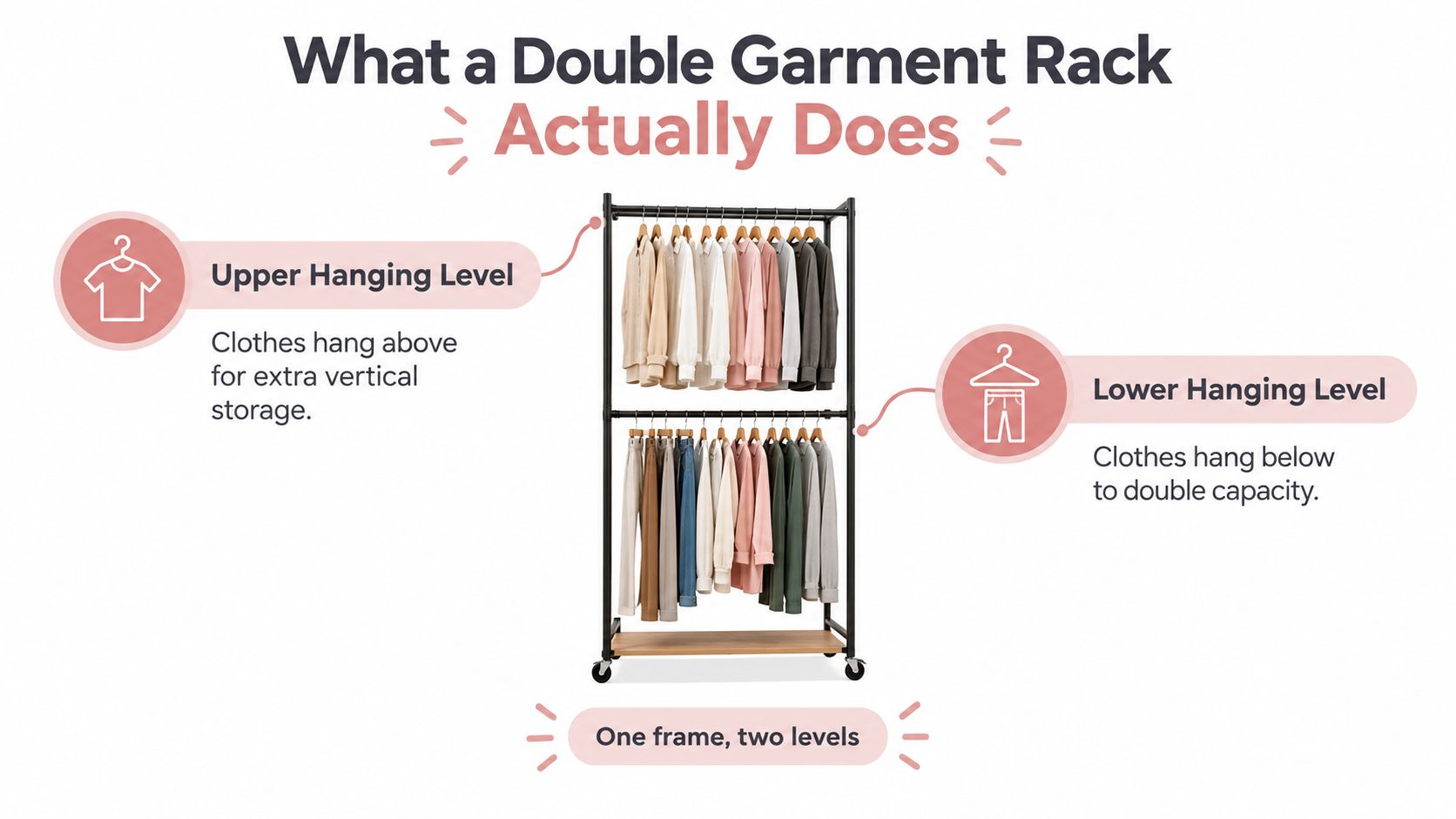
The parts are simple, and each one does a job.
- Upper and lower rails: the two bars that carry hangers.
- Uprights: the vertical members that set height and stiffness.
- Cross-bracing or welded joints: what stops the frame from racking sideways.
- Feet or a base: what spreads load onto the floor.
- Castors: only where the unit must move, and only if they lock.
The same problem at home
Shops aren't the only rooms that run out of wall. Hammonds' UK wardrobe research found the average UK adult owns 83 clothing items, while 84% of surveyed Britons keep garments they no longer wear or have never worn. The same research put unworn clothing at about £9.32 billion collectively, roughly £174 per person, with averages of about 16 pairs each of socks and underwear. Those are survey estimates, not a census of wardrobes.
Home sewing rooms, dressmakers and costume stores live with both active garments and pieces waiting for alteration, reuse, sale or archive. Two levels increase vertical capacity and keep clothes accessible in a way a crushed drawer can't. The upper rail also changes reach, sightlines and the centre of gravity. Count hangers only after you've checked who can use them. A portable clothing rack solves a different job: short-term movement, not a permanent second tier.
Where Double Racks Earn Their Place
Match the rack to the room, not the brochure photo. Four jobs show up again and again, and they don't want the same layout.
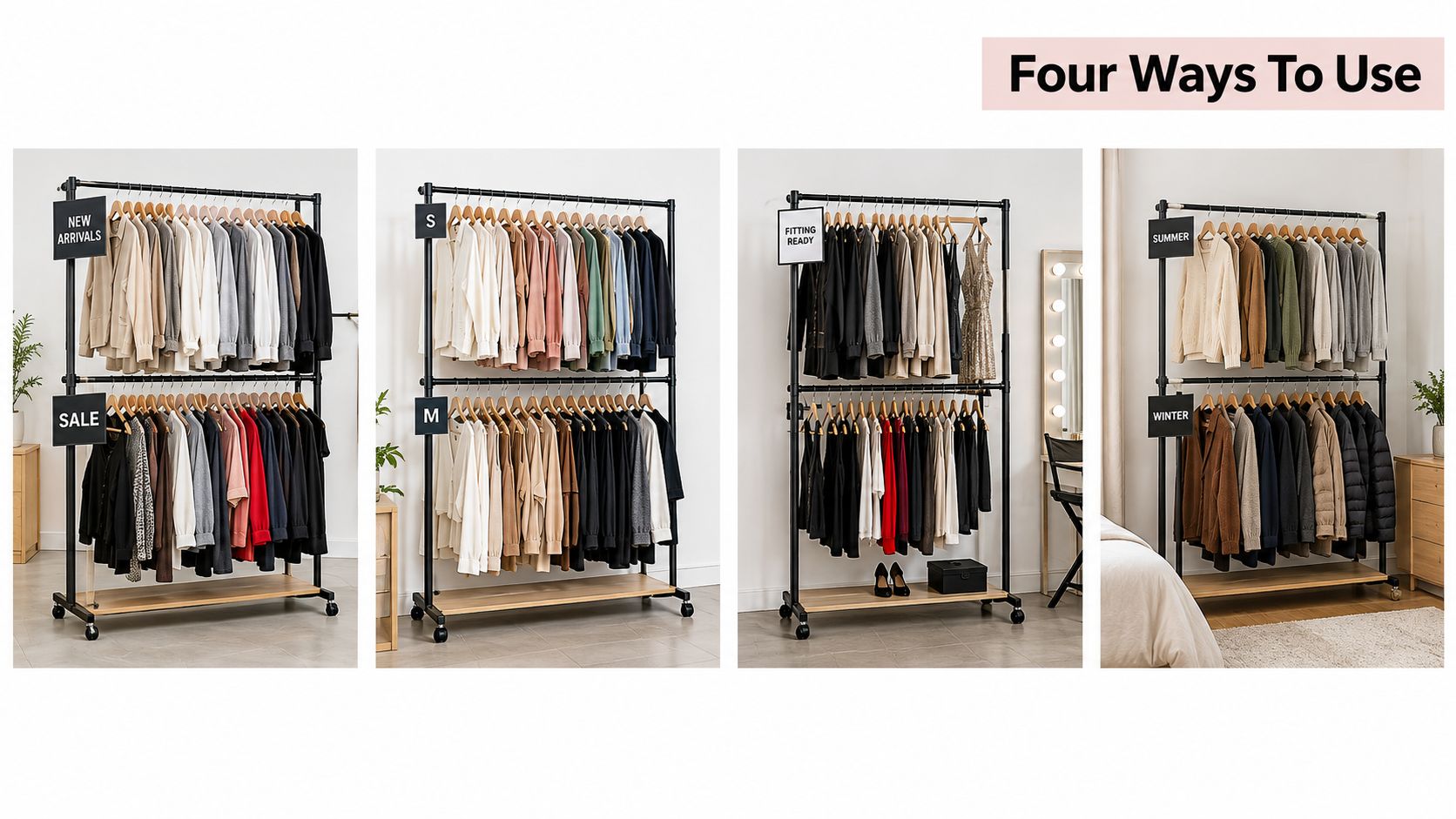
A retailer can put the new collection on one level and sale stock on the other, same footprint, two stories. That works when both ranges are short enough to reach and the aisle still reads as a path. A design studio or dressmaker can keep fittings above and works in progress below, so a client doesn't walk out in a half-pinned toile.
Stages that must not share a bar
Theatre and event teams are different again. Costumes have to move between rehearsal and show, often in a hurry, often in poor light. A costume rail that rolls, locks and stays readable beats a tall unit that hides act two under a crush of act one.
Home resellers are the audience most buying guides ignore. A 2025 UK household-storage survey of 2,000 consumers found 50.3% had bought storage products in the previous 12 months, 74.9% researched before buying and 66.2% named price as a driver. Clothing is the leading declutter category, cited by 47%, with an estimated 18.8 million households needing to declutter. The UK resale market is reported at £8 billion, growing at roughly 20% compound annual growth since 2019, and almost one in four UK fashion transactions now runs through second-hand channels.
That buyer is price-sensitive and workflow-hungry. They sort, steam, photograph, list and hold stock before dispatch. A second tier can shrink the floor area and still slow the work if photographed, listed, sold and waiting garments share one crowded rail.
Separate those stages by end of rail, a colour tab or a second unit. Two single racks beat one double garment rack when each category must stay at a comfortable height and nothing gets crushed between jobs.
If you can't name which end is "listed" and which end is "sold" without touching the clothes, the second tier is costing you time.
A short walk-through of a working rail helps more than another capacity claim.
Say yes to one double unit when categories can share a frame and both bars stay in reach. Say no when the room is a public route or the stock must stay in separate workflows. Split the job across two rails when search time matters more than saving half a metre.
Specs Materials and Working Load
Read the specification before you fall for the finish. Treat each hanging level as its own loaded member. An advertised total does not apply evenly to both bars, and it does not include the hangers you forgot to count.
The working-load check
Add the garments, the hangers and any side hooks or accessories on that rail. Compare the total with the manufacturer's stated limit for the rail, then with the limit for the whole frame. If either number is missing, the rack fails the shortlist. UK workplace guidance on shelves, racks and pallets expects storage equipment to be suitable for its purpose, stood on sound, level floors and labelled with the correct maximum loads. Heavier goods belong low or around waist height. Frequently handled pieces stay easy to reach.
Coated steel tube is the durable choice for a retail rail that gets knocked. A wide base, or locking castors if the unit must move, matters more than a colourway. White or black tube is a shop-scheme decision, not a strength decision. Loading one side, or only the upper rail, lifts the centre of gravity and increases the force that wants to tip the frame when someone pulls a sleeve.
A heavy-duty clothing rack is worth the label only when both bars and the frame are rated, and when you will respect those ratings.
| Check | What good looks like | Fail sign |
|---|---|---|
| Per-rail load | Each bar has its own stated limit, and your garment-plus-hanger total sits inside it | One headline capacity for the whole unit, no split |
| Frame capacity | Overall rating exceeds the sum of both working loads | Upper and lower totals already match the frame limit with nothing to spare |
| Base | Wide feet on a level floor, or a base that doesn't rock when you push a corner | Narrow footprint, wobble, or feet that sit on an uneven board |
| Movement | Fixed feet if it stays put; locking castors if it must roll, unloaded when you can | Wheels that spin free, or a habit of moving it fully loaded |
Strength is a pass or fail. Style and price come after the rack can carry what you intend to hang, on both levels, without a lean.
Inspect joints, castors, feet and welds for deformation before you trust a second season out of a second-hand frame. Where the unit is tall, narrow or rolled while loaded, lock the wheels and think about extra restraint. Storage has to be designed and installed for the load, then checked when you can see damage.
How to Choose Height Width and Format
Capacity maths doesn't pick the format. Reach and aisle width do. Set the upper bar to the shortest person who must use it without a step. If that person needs a stool for everyday stock, the top rail is archive, not a selling face. Set the width so a hanger pulled fully out still leaves a clear walk. Shoulders and coat hems steal more aisle than the tube diameter suggests.
Three formats, one rule
One double garment rack fits a tight footprint when the stock is mixed but still reachable, and when both levels tell the same story. Use it for one collection split by size, not for four workflows pretending to be organised.
Two single rails win when categories must stay apart, or when the room is narrow and a tall unit would tip or crowd the route. Each rail stays at a comfortable height. You spend a little more floor and you save the search.
A rail plus a dump bin or a mannequin is the right mix when some pieces should be folded or featured rather than hung. Coats and dresses want a bar. Knits and promoted looks often sell better off a form or in a bin, where a second hanging level would only hide them.
Display Guru is one UK catalogue of garment rails and display tools for tailors, retailers, costume teams and home studios, with durable white and black garment rails, free shipping on orders, and pre- and post-sales help by live chat and email. Treat it as a place to shortlist, not a reason to skip the load check. Confirm each product's stated capacity against the per-rail sum you already worked out. Pick locking wheels only if the rack will actually move. If it lives in one spot, feet are calmer.
Don't buy on a pictured width you haven't measured in your own aisle. The shortlist rule is simple. Height the shortest user can work, width the aisle can spare, format that keeps categories apart, and a stated capacity that survives the check above.
Setup Layout and Fire-Safe Merchandising
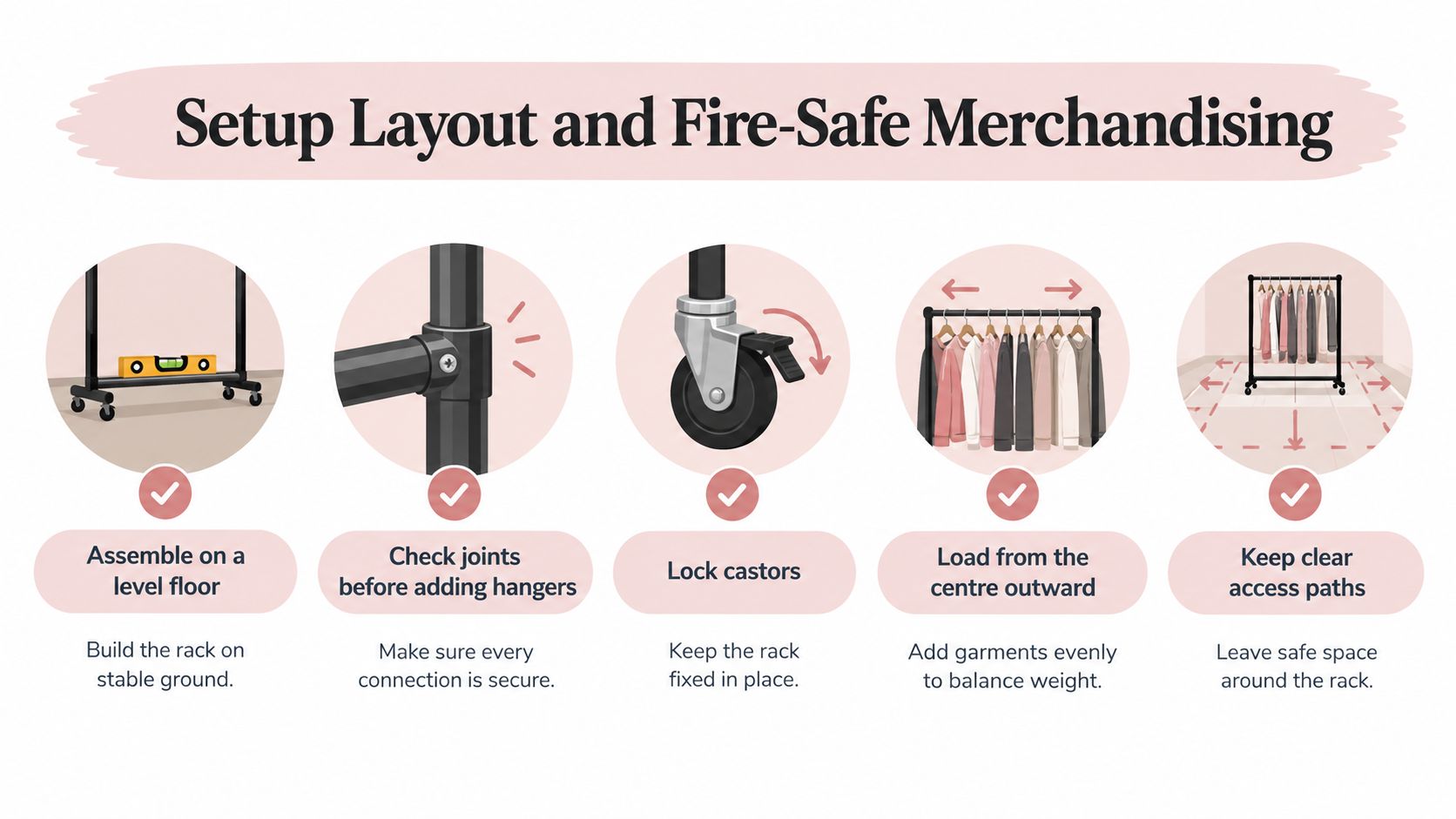
Place the rack only after it has passed on strength. The sequence is short, and skipping a step is how units tip.
- Assemble on a level floor, not on a rug edge or a sloping stall board.
- Check every joint before a single hanger goes on.
- Lock the castors, or seat the feet so the frame doesn't rock.
- Load from the centre outward, both levels, so one end doesn't become a lever.
- Keep heavier garments on the lower rail, near waist height.
Merchandise the upper tier as a second storey of the same range. Group by collection, size or colour. If the top bar is where awkward stock goes to be forgotten, you've built a hiding place.
Public rooms are not sewing rooms
A private sewing room can hold a dense rail against a wall. A shop, a market stall or a theatre foyer cannot. Fire-risk guidance warns that large quantities of clothing on vertical hangers can speed fire development. Keep displays away from heaters, light fittings, curtains and ceiling voids. Keep them out of corridors and foyers.
Doubling the hanging levels does not double safe capacity. The stock is denser, the unit is less stable, and a blocked route is worse than a smaller display. Split stock across smaller, separated rails when the escape path is tight. A retail store layout that protects the route beats any rail that saves floor space by standing in it.
Walk this list after you load, and again before you open.
- Tip risk: push a corner. The frame should not lift a foot.
- Locked wheels: every castor holds, or the feet sit flat.
- Clear routes: a person passes without turning sideways.
- Ignition sources: no heater, lamp or curtain against the hang.
- Crossbars: no bow, no cracked weld, no overloaded end.
If any line fails, unload before you trade. A double rack in a blocked exit is the wrong tool, full stop.
Keep the Rack Working Season After Season
The checks above are useless if you run them once. After a sale, a costume strike or a house move, look before you reload. Fixings loosen. Castors flatten and stop locking. Rails bow in the middle. Chipped coating snags fine fabric. Hangers left shoulder to shoulder crush garments and turn two levels into one overloaded bar with a neglected top.
A light reset, not a rebuild
Between collections, take ten minutes. Pull the hangers off the crowded end, put weight back to the centre, and clear whatever has crept into the aisle. Visual merchandisers and home dressmakers live with the same drift. The top rail fills with "later" and the bottom rail fills with what sold yesterday.
Protect what isn't on the floor. Garment rack covers earn their place in a dusty studio, a store between shows, or a spare room where unworn stock waits. A cover doesn't fix a bent rail. It stops dust and snags from adding to a frame you already decided was sound.
Then act on the shortlist you already made. Compare the white and black rails against the height, the width and the per-rail load. If a shop, studio or theatre layout still feels tight, ask by live chat or email before you order. Free shipping is a stated service on those orders, not a reason to take a rack the aisle can't hold.
Leave the rack full and the route around it empty. That is the only layout worth keeping into the next season.
Display Guru supplies garment rails, tailor dummies and display tools for shops, studios, costume teams and home sewing rooms, including double rails when a second level still passes on load, reach and fire safety. If you're choosing between one double garment rack and two single rails, start with the stated capacity and the aisle you have. Visit Display Guru and shortlist the rail that keeps stock visible without blocking the route.