



Display Stand for Shops: The Complete Buyer's Guide
You've probably got a box room, a back counter, or a half-finished floor plan and one question keeps coming back, what sort of display stand for shops earns its space? The wrong choice shows up fast. Garments slump, impulse items disappear into clutter, customers hesitate, and staff end up rearranging the same fixture all day.
In UK retail, that decision matters more than it looks. Retail directly employs around 3 million people and contributes about 5% of UK GDP according to the British Retail Consortium, which is why shop presentation tools are treated as operational kit, not decoration, in the display stand guide from Display Guru's retail display blog. A well-chosen stand helps turn footfall into sales, while a poor one wastes floor space, increases handling, and makes the shop harder to manage.
Why Display Stands Drive Retail Success
A new boutique owner once told me the shop felt busy but not productive. The stock was good, the lighting was decent, and yet people drifted past the window, stepped inside, and still left without buying much. The culprit wasn't the range, it was the display structure. Product was scattered across surfaces that didn't guide the eye, so the shop never gave customers a clear reason to stop, browse, and commit.
That's why a display stand for shops is a conversion tool first and a furnishing second. UK retail has long treated visual merchandising as measurable shop work, because the display stand sits right on the path between footfall and sales. The market context matters too, since retail's scale in the UK makes in-store presentation part of the business case rather than a styling choice, especially when every square metre has to work harder.
From self-service retail to guided browsing
The modern shop display stand grew up alongside self-service retail after the war, when British stores moved away from over-the-counter selling. Once shoppers had to find their way around the store on their own, freestanding fixtures, branded display units, and product presentation stands became the way to direct attention. That shift still shapes what works today. Seasonal lines, impulse buys, and category zoning all depend on fixtures that can guide customers without staff standing over every rail.
This is why display planning still starts with behaviour, not decoration. A stand has to support how people move, what they can see, and where they pause. In practice, that means the right fixture often does more than one job, it holds stock, creates a merchandising zone, and makes the shop look organised enough to trust.
For a practical shopfitting angle, Professional Window Cleaning shares a useful facility-management perspective that fits this same logic. Clean, orderly presentation helps a shop look managed, and that impression matters just as much as the fixture itself.
Practical rule: if a stand doesn't help customers find, compare, or reach product, it's using floor space without earning it.
Types of Display Stands and Their Best Applications
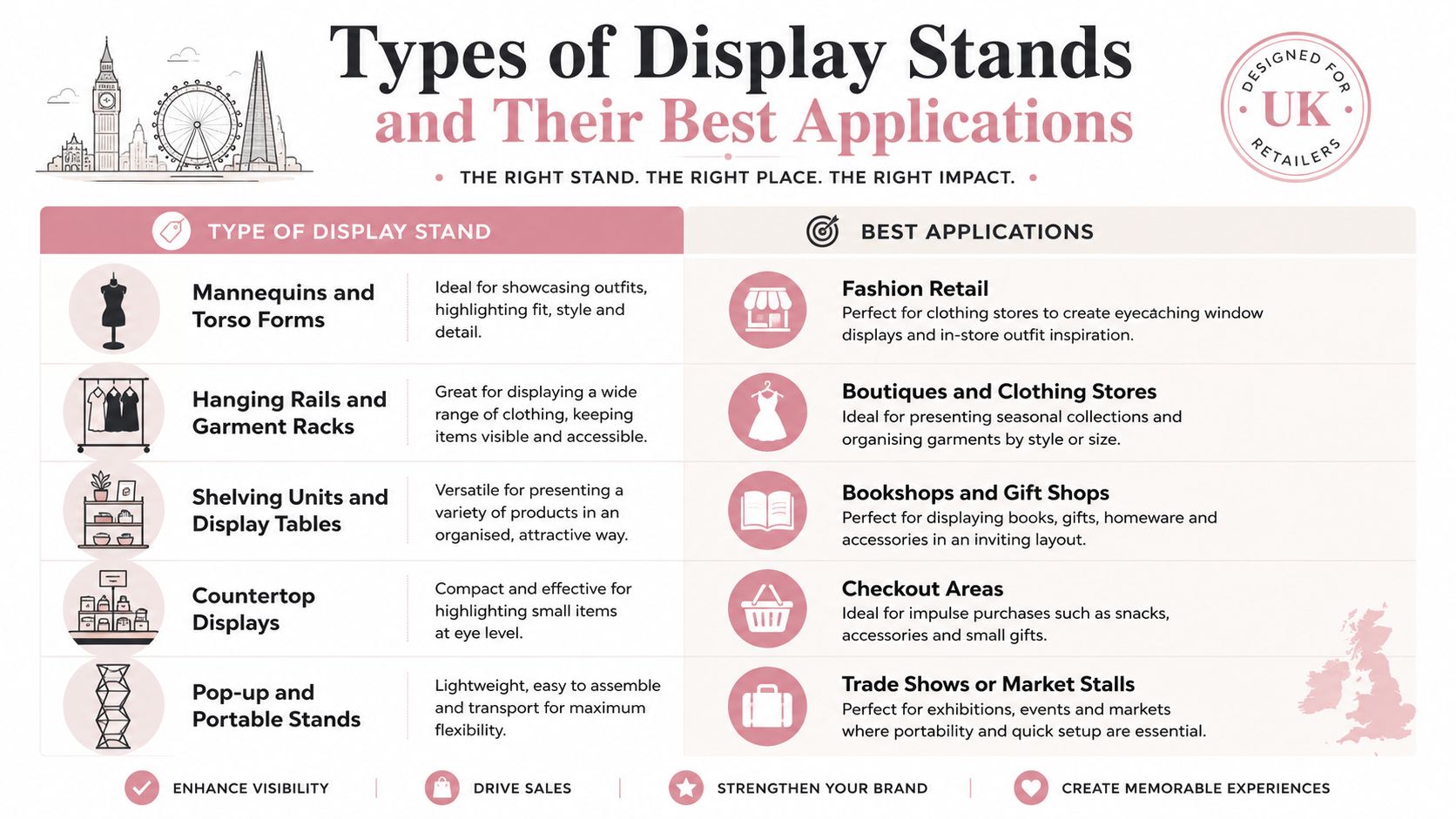
Different fixtures solve different problems, and mixing them up is where many shops waste money. A tailors' studio doesn't need the same stand logic as a gift shop, and a market stall needs a very different footprint from a fashion boutique. The quickest way to narrow the field is to match the fixture to the buying behaviour you want.
Fashion forms and garment presentation
Mannequins and torso forms work best when the clothing itself needs shaping. Full-body mannequins suit window displays and complete outfit stories, while adjustable dress forms are more useful for tailoring, alteration work, and fit development. Polystyrene torsos are pin-friendly, which is a real advantage for costume makers and dressmakers who need to mark, fit, and amend quickly. For clothing retailers, a display that keeps structure visible often sells the garment better than one that just hangs it flat, as noted in Display Guru's clothing display racks article.
Rails, racks, and compact merchandising
Garment rails and racks are the workhorses of day-to-day retail. Freestanding versions are good for flexible zoning, while wall-mounted options free up floor area and keep walkways open. They're useful for boutiques, tailoring rooms, and stock organisation where browseability matters. In a busy shop, a rail can also act as a sorting tool, separate sizes, new arrivals, or clearance stock without needing a full refit.
Dump bins, tables, and impulse zones
Dump bins make sense when speed matters more than perfect presentation. They're strong for seasonal promotions, last-chance items, and low-cost add-ons near the till or at a turning point in the store. They can be untidy if overfilled, so they work best when the product range is simple and replenishment is frequent.
Portable stands for flexible selling
Pop-up and portable stands suit market traders, costume teams, and anyone who changes location often. They're usually chosen for transport and quick assembly rather than premium appearance. A retailer should only buy one if the setup time, weight, and storage size fit the way the stand will be used.
Materials and Finishes That Stand Up to Daily Use
The material choice decides whether a fixture feels solid after six months or starts wobbling after six weeks. In a high-traffic shop, the stand has to survive contact, re-merchandising, cleaning, and the occasional bump from a basket or trolley. Appearance matters, but durability and service life matter more.
Start with the structural core
Steel bases and uprights make sense where the fixture needs to stay upright under frequent use. The technical buyer's guide notes that a 20 kg steel base with a 12" × 12" contact area exerts about 1.4 psi on carpet, while the same mass on a 24" × 24" base drops to about 0.35 psi, which is why footprint design matters so much for stability and floor protection, according to this buyer's guide on floor-standing display stand criteria. Commercial-grade uprights typically need 2.5–3.0 mm wall thickness, because thinner aluminium extrusions can visibly deflect at around 40 kg of load in the same guide.
Aluminium still has a place. It suits lighter fixtures, portable stands, and setups that get moved often. It won't usually feel as planted as steel, but it's easier to handle, which matters in event selling and fast-changing retail layouts.
Match the surface to the work
Polystyrene forms are practical for tailoring and costume work because they take pins well and keep garments in place during fitting. They're not the right answer for rough public handling, but they're efficient in a studio where accuracy matters.
Finish choice should follow the room rather than trends. Powder-coated white reads clean and neutral in most retail settings. Black can make products pop, especially under controlled lighting. Chrome can suit a fashion-forward interior, but it shows fingerprints and scuffs quickly. Natural wood softens the look of a space and works well where the stand needs to feel less commercial.
If you're comparing stands with display cases or protected merchandising, the article on acrylic display cabinets from Display Guru's blog is a sensible companion read because material choice and visibility usually get judged together.
Choose the material for the abuse it will take, not the look you want on day one.
Sizing and Ergonomic Placement for Maximum Impact
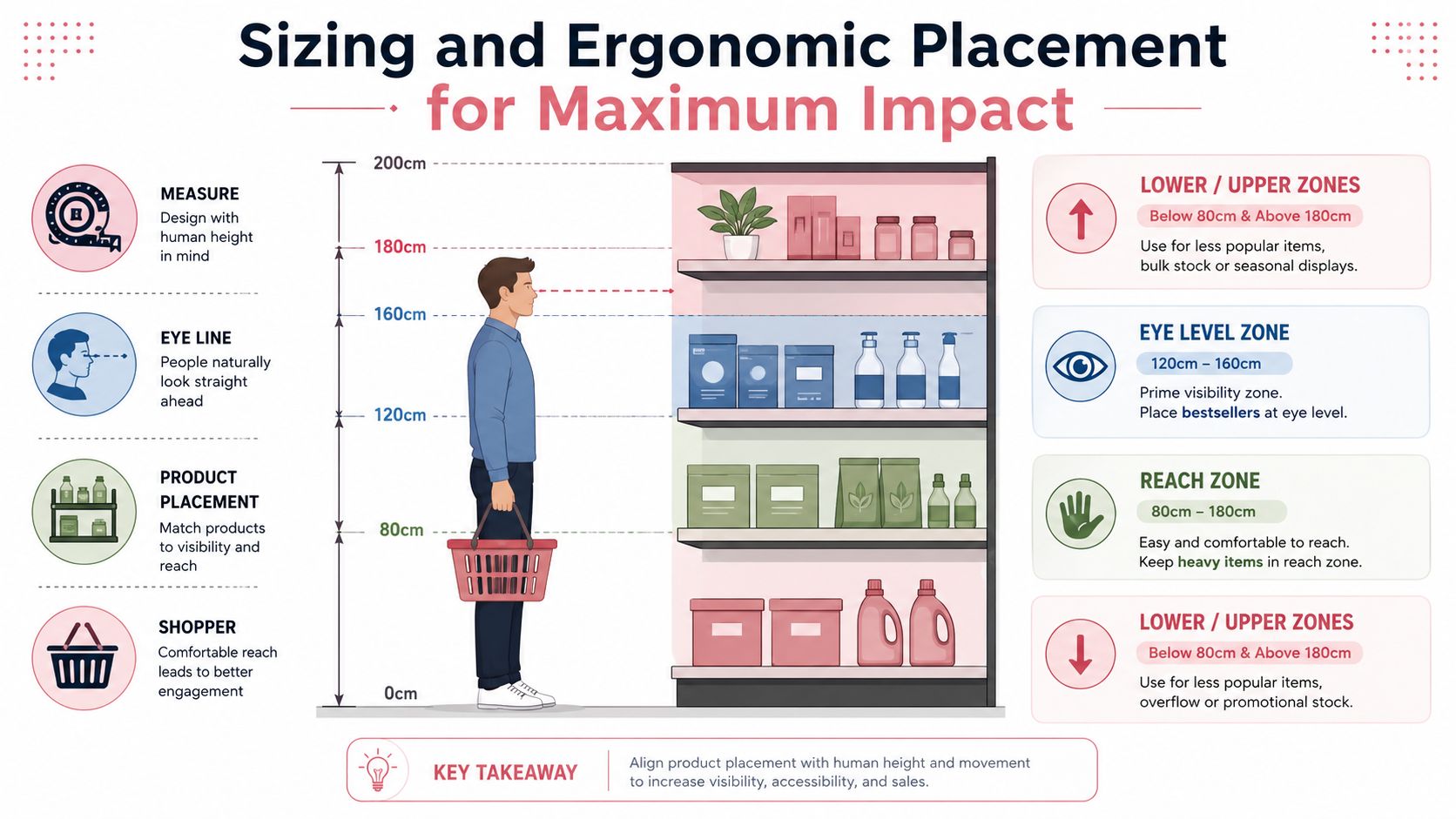
The best-looking stand can still underperform if it sits at the wrong height or crowds the wrong part of the shop. Product placement should follow how people stand, reach, and browse, not just where the fixture happens to fit. That's especially true in shops where a few inches can decide whether a product feels easy to pick up or awkward to handle.
Use the right viewing zones
A 2026 retail-display engineering guide recommends a primary display zone of 110–130 cm from the floor for standing adults, with a secondary zone at 75–90 cm and a lower accessibility zone at 45–60 cm for mixed-height shoppers and wheelchair users, according to this buying guide for display stands. In practice, that means your bestsellers, hero garments, or top-margin accessories should sit where most customers can see them without bending or stretching.
Heavy items belong in the more accessible mid-zone, not on top shelves where they're awkward to lift. Lighter, less urgent stock can use the upper or lower zones. That arrangement reduces strain and makes the display easier to shop, especially in stores where different ages and mobility levels share the same aisle.
Size the base as carefully as the top
Stability comes from footprint, not mass alone. A larger base lowers ground pressure and improves tip resistance, which matters in busy shops where customers brush past fixtures or lean in to look closely. If you're specifying a stand, check whether the supplier gives dynamic load capacity as well as a static maximum. Dynamic ratings are more useful because handling, vibration, and repeated adjustment all change how the fixture performs in real use.
The same 2026 guide also recommends stainless-steel fasteners and torque-controlled joints so pivots stay tight after repeated movement. That detail sounds small until a rail starts drifting, a shelf tilts, or a customer notices the wobble.
For layout planning, Display Guru's store layout guidance is worth using alongside measurements, because the stand only works when the surrounding path also works.
Balancing Theft Prevention, Accessibility, and Space Constraints
The awkward truth is that the most attractive display often isn't the best one for a small UK shop. A tall, open fixture invites browsing, but it also invites handling. A compact bin saves space, but it can choke the aisle if the room is tight. The right answer depends on how much risk, room, and customer movement you're managing.
Start with the shop's real pressure points
The British Retail Consortium reported customer theft was up to 20.4 million incidents in 2023/24, and the ONS reported the average independent retailer's sales area was 1,217 sq ft in 2024, with 44% of stores under 1,000 sq ft, according to Gadsby's retail display supply guidance. That mix changes the buying decision immediately. A fixture that looks elegant in a spacious showroom may create practical problems in a cramped high street unit.
If shrinkage risk is high, keep the highest-value items closer to staff sightlines and avoid overly open self-serve displays for small goods. If accessibility is the main concern, don't let merchandising overflow into the route customers need to turn, reverse, or pass each other comfortably. For a tighter-controlled option, locked display cabinets are worth considering when the product needs visibility but not unrestricted handling.
Compare the trade-offs before you buy
A display can be good at one job and poor at another. Open rails support browsing, but they increase touch points. Dump bins make sense for quick buys, but they can become clutter traps and are often weak on inclusive navigation if they sit too far into the walkway. Modular stands usually win in small shops because they let owners shift merchandising without tearing out fixtures.
If the stand makes staff supervise it constantly, it's probably too open for the product category.
Measure aisle widths, turning space, and staff access before you commit. A retailer should also think about how often the display will be rearranged. The more often you change ranges, the more valuable a lightweight, modular, or foldable stand becomes.
Installation and Maintenance Best Practices
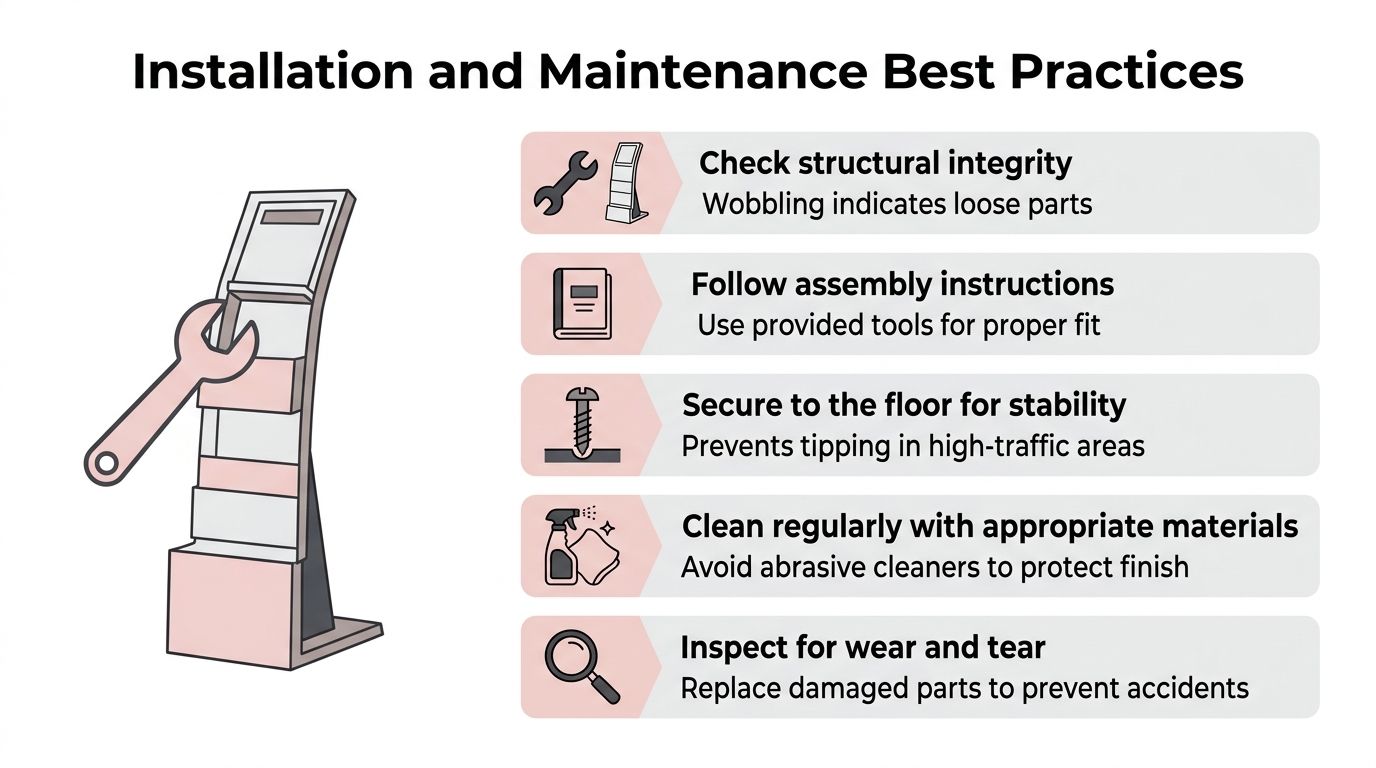
A good fixture can still fail if it's assembled loosely or left to wear unchecked. Most problems I see in shops are basic ones, a base that isn't level, a fastener that backs off, or a finish that gets damaged by the wrong cleaning product. These are maintenance issues, not design mysteries.
Assemble it like a working fixture, not furniture
Follow the supplied build order and use the right tools, especially on stands with adjustable uprights or rotating arms. Stainless-steel fasteners and torque-controlled joints help keep fittings tight after repeated adjustment cycles, which matters in shops that re-merchandise often. If the stand wobbles on day one, don't hope it settles. Re-check the joints, the floor contact, and the base alignment.
Surface protection should match the floor. Carpet can hide indentations at first, but the base still needs enough footprint to prevent sinking or lean. Hard floors need pads or feet that won't scratch, skip, or leave marks.
Keep the fixture presentable
For routine care, a practical cleaning schedule matters as much as the first install. The team at store cleaning for businesses covers commercial cleaning routines that suit the kind of finish maintenance retail fixtures need. Use gentle cloths on coated metals, avoid abrasive cleaners on powder coat or acrylic, and wipe fingerprints before they become part of the look.
Seasonal re-merchandising should happen with the same discipline. Reposition rails, rotate tables, and reset shelf heights in a way that keeps the display balanced. If parts are damaged, replace them quickly instead of tolerating the wobble or bend.
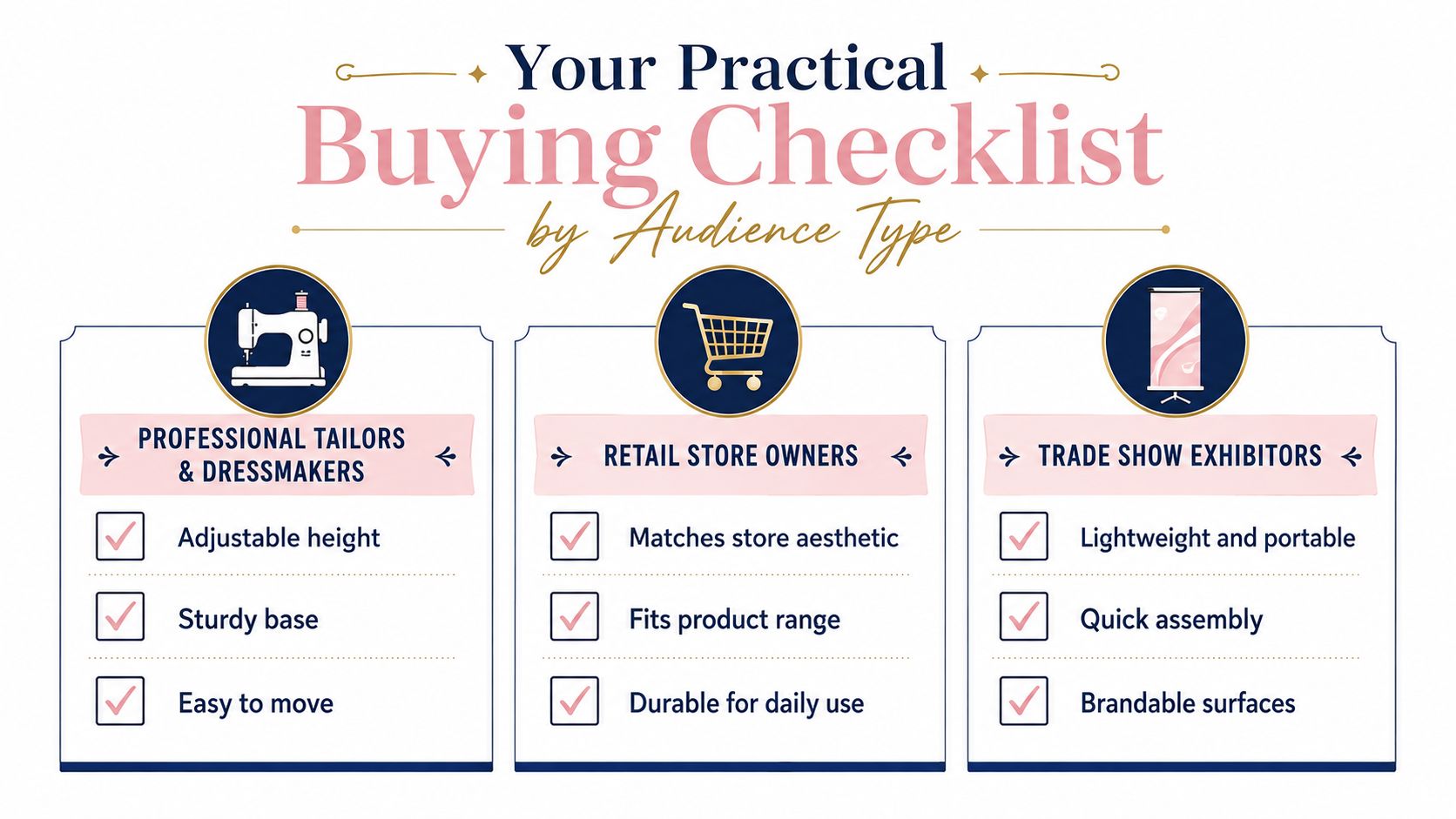
The fastest way to buy the wrong stand is to shop for a category instead of a use case. A tailoring studio, a retail floor, and a costume workshop all care about different things, even when they're looking at the same fixture. The checklist below keeps the decision practical.
Professional tailors and dressmakers
Adjustable forms matter more than decorative extras. A dressmaker needs a stand that holds fabric cleanly, allows repeated pinning, and won't tip when the garment shifts under pressure. Tripod bases are useful when access around the form matters, while round bases can feel neater in a compact studio.
Ask the supplier whether the form is pin-friendly, how the height adjusts, and how stable it is once the garment is fully loaded. Avoid stands that look elegant but flex under dressmaking use. That's false economy.
Retail store owners and visual merchandisers
Retail buyers should focus on range fit, daily durability, and how quickly the fixture can be changed around. Garment rails and modular systems are usually more useful than fixed pieces when stock changes by season. Dump bins can support promotions, but only if they don't block flow or make the shop look unkempt after a few hours of customer handling.
A display that matches the shop aesthetic is useful, but only after it passes the test of movement, stock turnover, and maintenance. If you can't reposition it without drama, it will slow the team down. If it can't take daily handling, it won't stay professional for long.
Costume designers and theatre teams
Frequent fittings and quick alterations put a different kind of strain on equipment. Costume teams need durable forms, easy height changes, and surfaces that can handle repeated pins, clips, and fabric adjustments. Stability matters more than visual polish, because the stand is a working tool rather than a front-of-house feature.
For poster and visual presentation work that shares some of the same display discipline, safe lighting for original posters is a useful parallel reference, especially where appearance and preservation both matter.
Home sewing enthusiasts and hobbyists
Budget still counts, but the cheapest option isn't always the usable one. Look for a form that adjusts easily, stores without taking over the room, and gives you enough control to test fit without constant readjustment. If the stand can't hold its position, you'll spend more time correcting it than using it.
Display Guru supplies tailor dummies, body forms, garment rails, and dump bins in a way that suits studios, retail floors, and home sewing rooms. If you're comparing fixtures for your own setup, visit Display Guru and shortlist the stands that match your space, your stock, and the way you work.