



What Is Tripod Stand? Parts, Uses and Buying Tips
A tripod stand is a freestanding support with three legs joined to a central pole or head, holding an object at a usable height. But if three legs make a stable base, why can a dress form still wobble when you pin a sleeve or pull on a jacket?
The answer lies in how the stand is assembled, where the weight sits and what's beneath its feet. For tailoring and visual merchandising, recognising those details matters more than choosing a stand that merely looks sturdy.
What a Tripod Stand Is and Why Three Legs Matter
A tripod stand supports an object independently, without needing a wall, table or overhead fixing. Here, the term means a freestanding dress-form or display stand, rather than a camera tripod, although both use the same underlying geometry.
Think of a three-legged stool beside a four-legged chair on an uneven floor. The chair may rock between its feet, while the stool's contact points define a single plane. That explains why a tripod can sit without rocking, but it doesn't mean the floor or supported object is level.
The principle has a long equipment-support history. The Science Museum Group's tripod collection records 124 tripod-related objects, including surveying tripods, photographic tripods and stands for other equipment.
Recognising a garment stand
In a sewing room, the supported object is usually a dress form, tailor's dummy or mannequin torso. The stand brings it to a useful position for arranging fabric, assessing a silhouette or presenting a finished garment.
Look for these features when browsing:
- A spread base: Separate legs extend outwards from the central assembly.
- A central shaft: This connects the base to the form and may include height adjustment.
- A top fitting: This connects the supported object to the shaft.
A round-base stand replaces the spread legs with a disc. The torso above it may look identical, so check the complete assembly rather than judging from a cropped product photograph.
Browsing rule: A tripod describes the base arrangement, not a guarantee of adjustable height, folding legs or compatibility with your existing form.
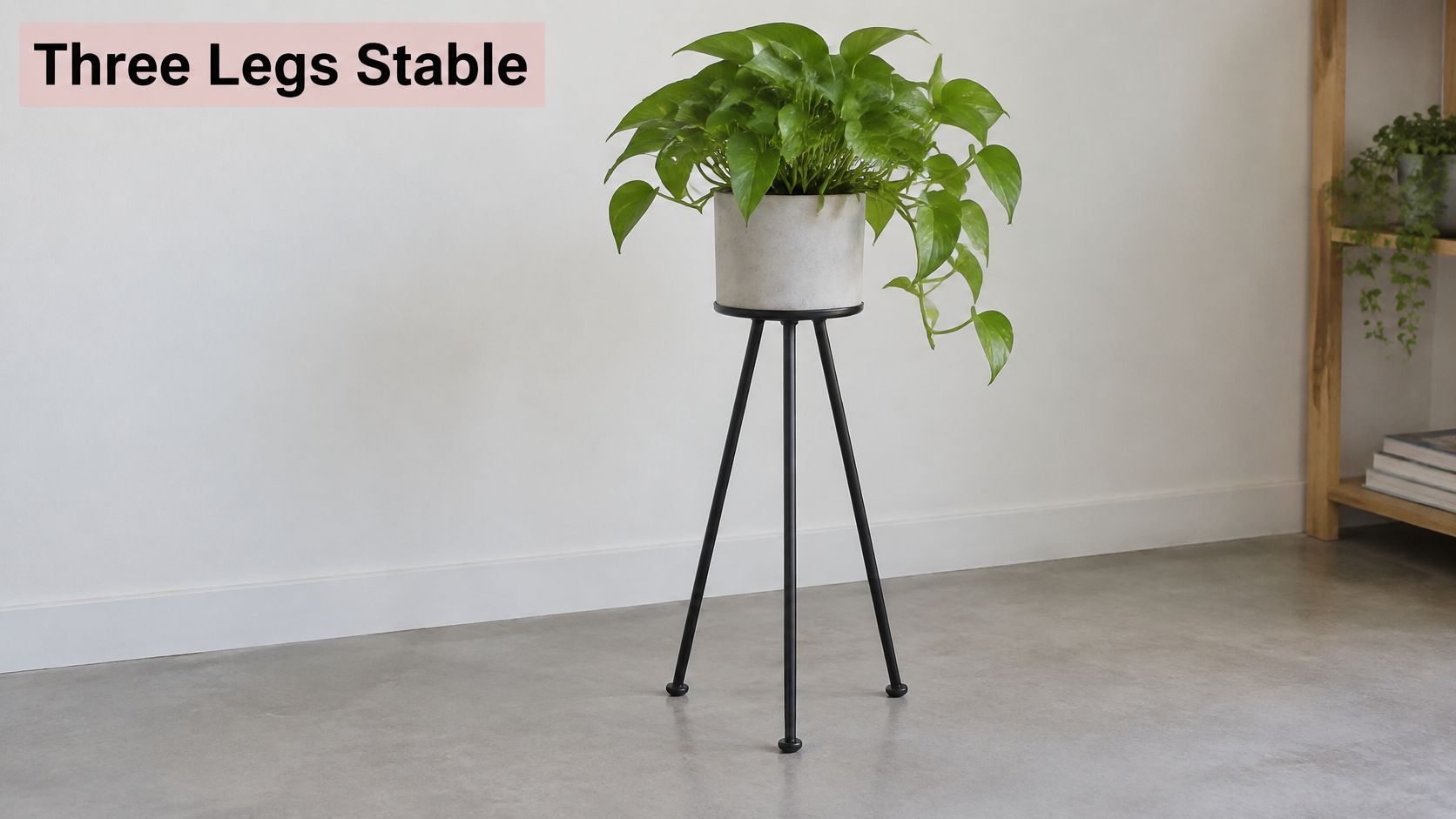
The plant stand pictured illustrates the broad shape. A garment stand needs a fitting designed for its particular torso, not merely a platform capable of holding something upright.
The Main Parts of a Tripod Stand
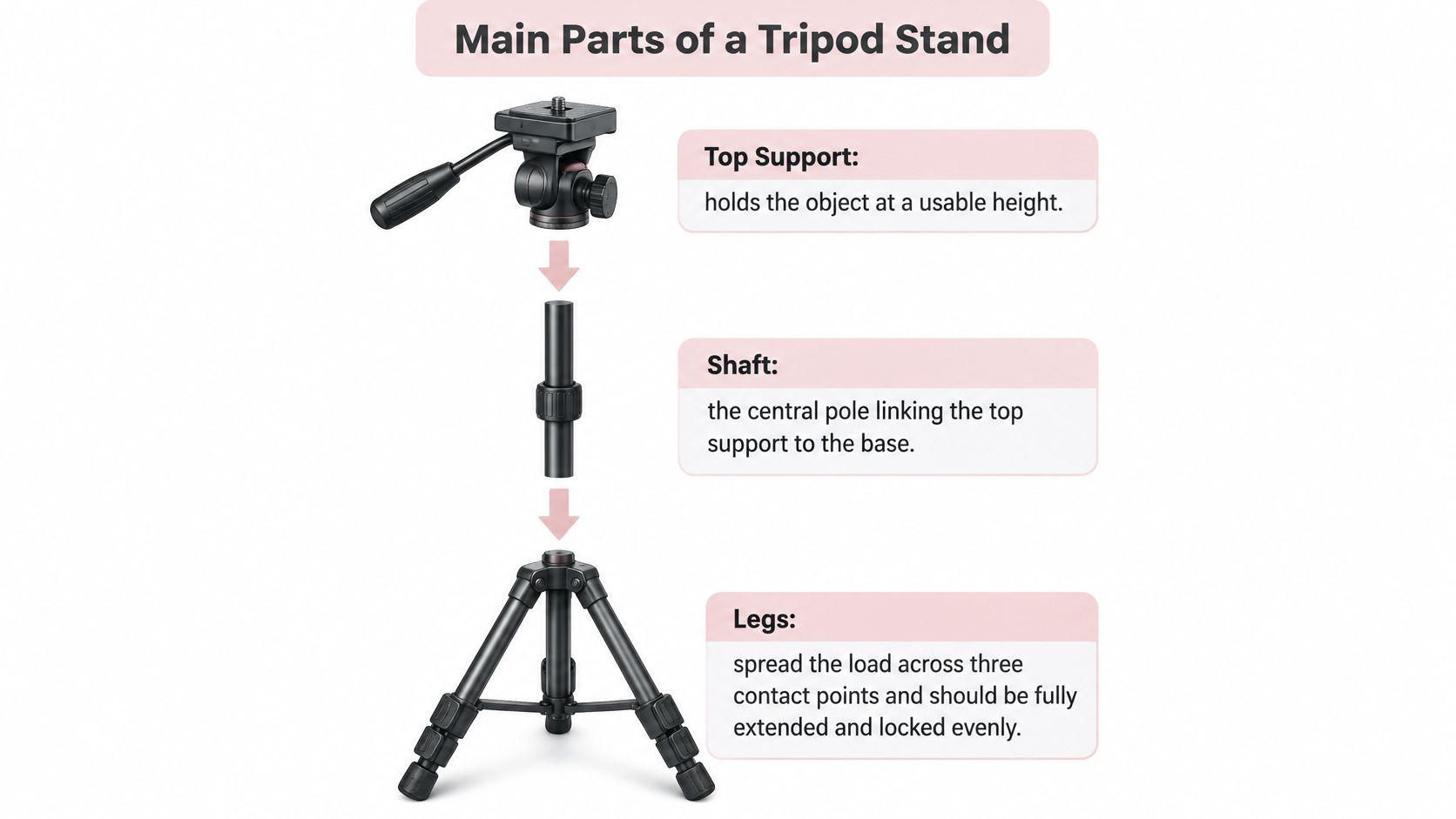
A tripod garment stand has a base, shaft and top support, with fittings that connect and secure them. Follow the assembly from the floor upwards to understand what each component does.
The legs spread the load across the floor. On an opening or folding design, extend them to their intended working position and engage any securing mechanism. Fixed wooden legs should sit firmly in their joints, without twisting or separating.
The central pole or shaft carries the form above the base. An adjustable shaft usually has a sliding section secured by a collar, screw or clamp. Support the torso while changing its height so it doesn't drop as you release the lock.
The diagram separates these main components.
Fittings that deserve a closer look
The height-adjustment lock must hold the selected position without slipping. Tighten it using the intended hand control; don't use pliers to force a reluctant knob, as this can damage the fitting.
At the top, distinguish the load-bearing support from the decorative finial. A thistle-style finial may finish or retain the top fitting, but it isn't automatically the part carrying the torso. Check the assembly instructions before lifting or turning the form by its decorative top.
Tripod stand parts, roles and checks
| Part | Role | What to Check |
|---|---|---|
| Legs | Spread the load across three contact points | Fully opened where adjustable, same intended length, no cracks |
| Central pole or shaft | Sets the working height | Straight, free of bends, sits square to the legs |
| Height-adjustment lock | Holds the chosen height | Tight and not slipping under load |
| Top support or head | Holds the form, base or mounted object | Secure, centred, no play |
| Finial | Decorative and, on some designs, holds the top fitting in place | Firmly seated, not loose |
| Feet | Grip the floor and resist sliding | Flat contact, no wear or missing caps where fitted |
Inspect the feet rather than assuming the visible legs tell the whole story. A loose cap, damaged underside or trapped piece of fabric can change how the stand contacts the floor.
When replacing dress-form legs, check their connection to the central assembly, not just their colour. The legs establish the base, the shaft positions the form and the top fitting secures it.
How a Tripod Stand Stays Upright and Its Load Limits
A stand tips when the combined weight of the stand and its mounted object moves beyond its supporting footprint. For a tripod, that footprint is the triangle between its feet. The University of Manchester's centre-of-mass teaching material explains the relationship between centre of mass, the supporting base and overturning.
In everyday terms, a tall form on a narrow base is easier to disturb than a lower assembly with a broader stance. Pulling a sleeve sideways applies force above the floor, and that force gains a mechanical advantage against the base.
Load capacity and resistance to tipping aren't the same thing. A pole may carry a torso's weight vertically while the complete stand remains vulnerable to sideways pressure. Joint strength, bending, leg strength and grip against the floor also matter.
Why a weight rating isn't enough
The ASTM static-loading test-method listing published by AFNOR concerns treestands and related equipment, not garment stands. It shouldn't be treated as a dress-form certification or used to assign an untested mannequin stand a capacity.
For garment work, use the manufacturer's stated working load and intended application. Don't borrow a rating from a similar-looking stand or assume a heavier base permits unlimited loading.
Floor conditions need equal attention. The Lifting Gear & Safety safe-use leaflet for shear legs, although written for lifting equipment, identifies relevant setup principles: firm support, properly spread legs, vertically aligned loads and avoidance of side loading. These principles help explain why a garment stand behaves differently on hard flooring and soft carpet.
A stand that holds an empty torso comfortably hasn't necessarily been shown suitable for a heavy costume or active fitting.
Check the complete working setup
- Confirm the full load. Include the torso, clothing and any attached accessories. If the intended load isn't stated, obtain confirmation before using the assembly for demanding work.
- Establish the footprint. Open adjustable legs fully, secure them as designed and centre the form over the base.
- Set a useful working height. Avoid unnecessary extension. Keep heavy components low where the design permits, and tighten the height locks.
- Check on the actual floor. With someone ready to steady the form, apply gentle hand pressure comparable to normal handling. Stop if a foot lifts, a joint shifts or the shaft slips. This is a practical check, not a certified load test.
- Recheck after moving or redressing. A trailing skirt, added coat or changed position can alter the setup before customer or public use.
For demanding applications, compare heavy-duty tripod stand considerations against the work you'll really perform. Don't compensate for instability with improvised weights hung from the torso.
Where Tripod Stands Are Used
A tripod-based form can support both garment construction and presentation, but the task determines how you use it. A tailor handling fabric needs something different from a retailer arranging a finished outfit.
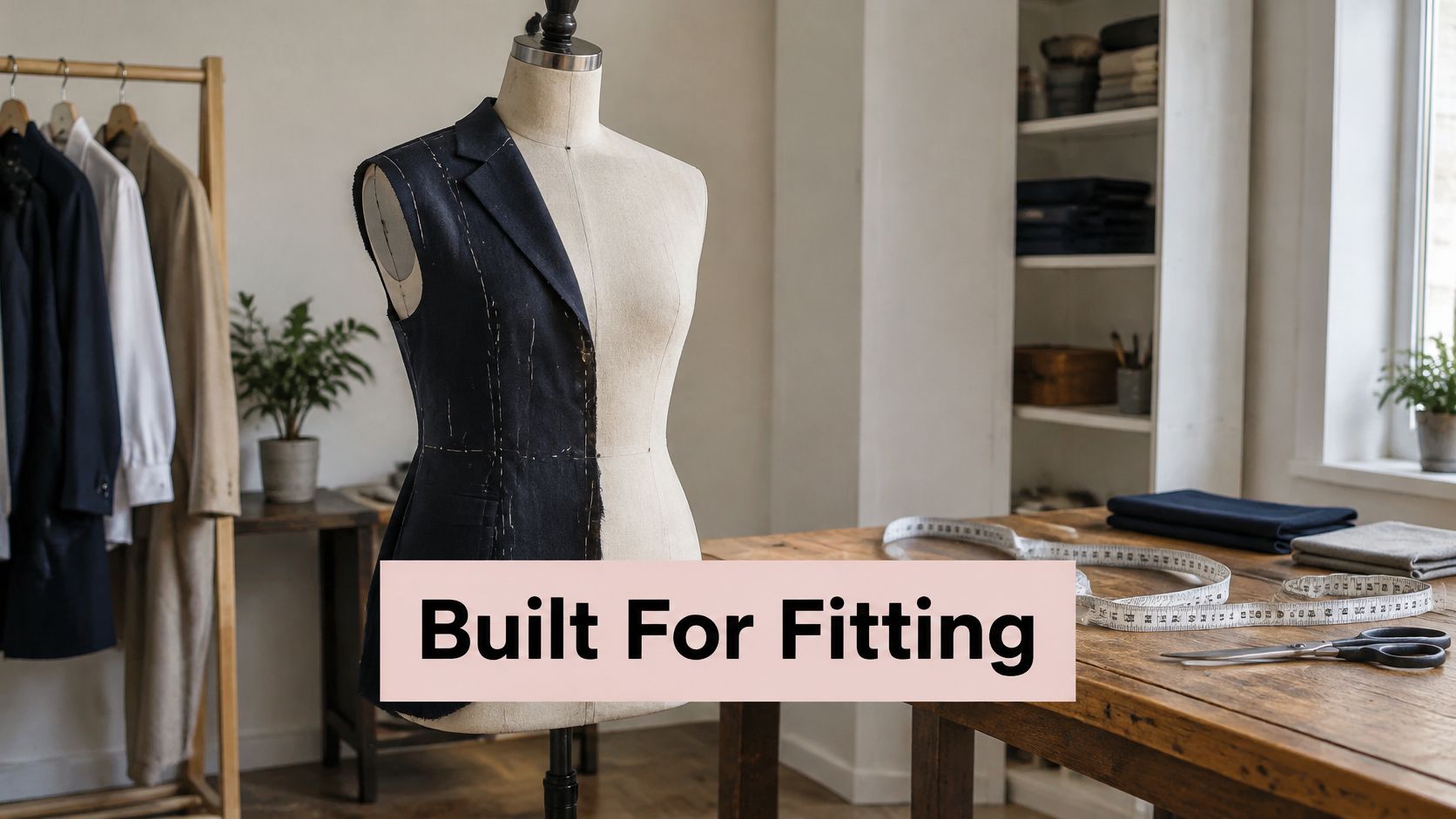
A typical tailoring setup keeps the garment accessible while work is in progress.
From fitting room to shop window
In tailoring and dressmaking, say you're setting a jacket sleeve. The form holds the shoulder and body in position while you assess the hang and place pins. The torso must be suitable for pinning; the stand alone doesn't make a display mannequin pin-friendly.
In retail, a mannequin on a stand can present a blouse, knitwear or coordinated outfit without a full-body mannequin. Check sightlines and keep the base clear of the customer route, especially where a long garment hides the feet.
For a practical visual reference alongside these examples, the video below is available to view.
Costume work and home sewing
A costume team might use a torso to arrange a waistcoat, coat and decorative layers between fittings. Keep loose ties and trailing fabric away from backstage walkways, and use a performer fitting to confirm movement and comfort.
At home, a form gives you somewhere to assess a dress or jacket without asking someone to hold it. Leave enough room to step back and view the garment, rather than squeezing the stand between a sewing chair and an ironing board.
Equipment-support history helps explain this versatility: the Science Museum Group catalogues a tripod for a large Daguerreotype camera made in 1839. Photography and garment display are different tasks, but both benefit from positioning an object independently.
Choose the assembly for its most demanding intended task, not just its easiest display arrangement.
Choosing Between a Tripod Stand and a Round Base
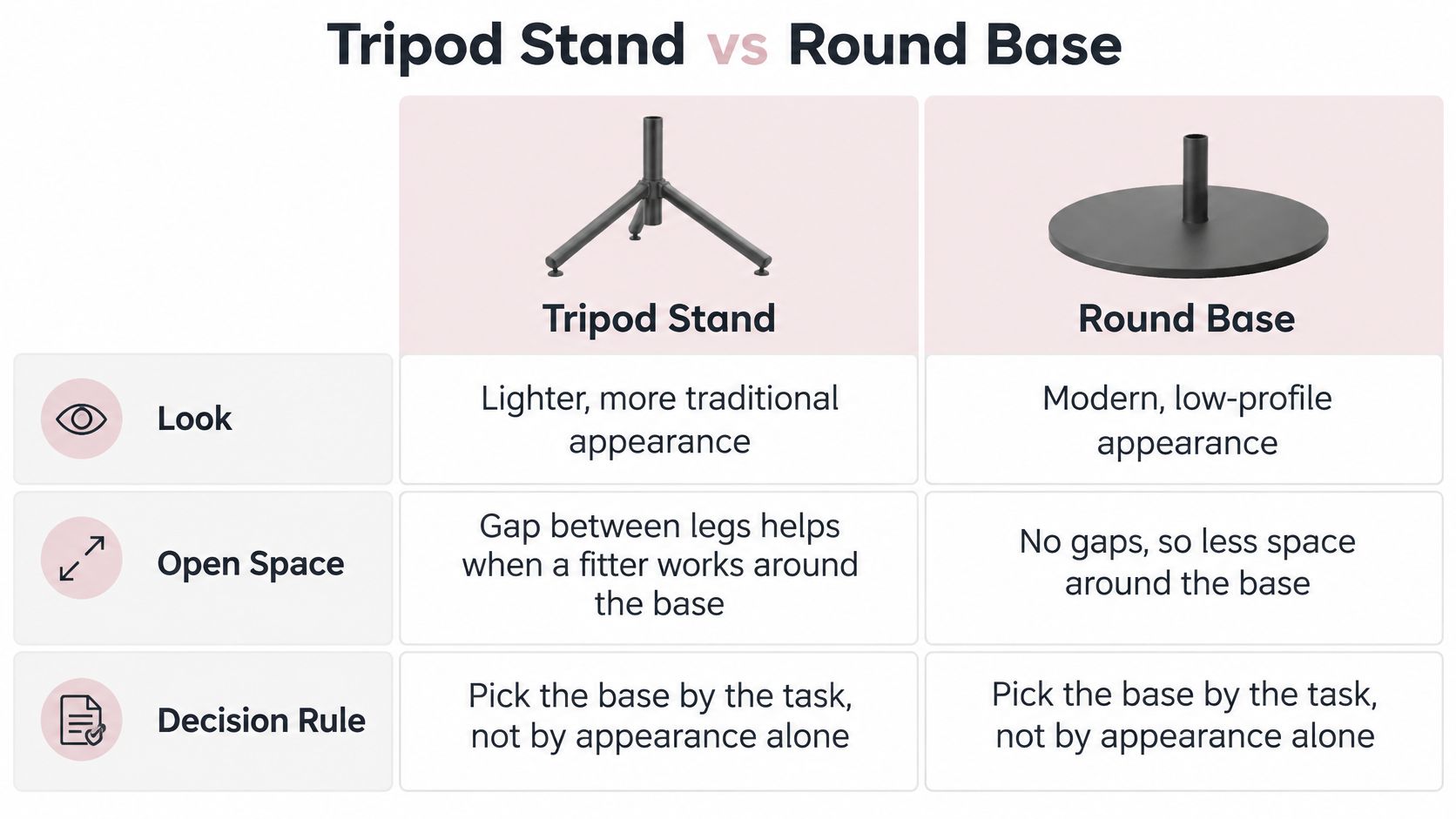
Choose the base by the task, not appearance alone. A traditional tripod may suit a fitting studio beautifully, while a round base may be easier to position beside a busy retail aisle.
Compare actual dimensions and construction. Not every tripod folds, not every round base is heavy, and neither shape guarantees stability without a suitable complete assembly.
Tripod stand and round base compared by task
| Factor | Tripod stand | Round base |
|---|---|---|
| Floor footprint | Three feet with open space between them | One compact, solid disc |
| Look and presentation | Lighter, more traditional appearance | Plain, solid appearance |
| Trip risk in aisles | Feet can catch passing feet | Can reduce projecting-foot hazards in tight spaces |
| Reaching around the form | Open between legs for pinning | Base may sit close to the hem |
| Moving and storing | Folding designs can be easier to store; fixed legs remain spread | Usually heavier to shift on weighted designs |
| Best fit | Fitting studios and visual display | High-traffic shops and narrow aisles |
The visual comparison highlights the difference in base arrangement.
Match the base to your daily work
For professional fitting and pinning, consider where your own feet go. Open gaps between tripod legs can give you convenient standing positions close to the form. However, a projecting leg may obstruct the position you prefer when marking a hem, so assess access all around the base.
For high-traffic retail display, a round-base stand may be the more practical choice. Its continuous outline is easier to keep within a defined display area. It still needs positioning away from walking routes; a low disc can also catch a shopper's foot.
For costume production, neither base wins on shape alone. A heavily layered costume needs an assembly with appropriate capacity, secure connections and sufficient stability during dressing. The practical question is whether the complete stand suits that costume and the handling involved.
Consider storage before buying
A folding tripod is useful only if its folding mechanism suits repeated assembly and you have somewhere to store the detached form. A fixed wooden tripod won't collapse merely because it has separate legs.
A round disc may occupy less uninterrupted floor space, but its weight and pole connection can make frequent moves awkward. Check whether you'll carry the stand assembled or separate it for storage.
Choose a tripod when its open layout improves your working access. Favour a round base when keeping projections contained matters more, then check the specific model rather than relying on the category.
Choose the Right Stand and Your Next Step
Write down your requirements before choosing a finish or placing an order. A useful buying checklist covers the complete working arrangement:
- Form and garment type: Identify the torso fitting and whether you'll display lightweight clothing, structured tailoring or layered costumes.
- Working height: Choose a position that lets you work comfortably without raising your shoulders or bending over the garment.
- Setting: Distinguish a fitting room from a shop floor, stage area or home studio.
- Floor surface: Assess the exact place where the stand will sit, including rugs, thresholds and uneven boards.
- Heaviest complete load: Include everything mounted on the stand, rather than the empty torso alone.
- Base type: Select the footprint that leaves practical working room and a clear pedestrian route.
Our female tailor's dummies at Display Guru are available with either a tripod stand or a round base stand, and we also sell replacement dummy parts. That lets you consider the form and base as separate requirements rather than replacing an entire setup automatically.
Before you order
Use the dress-form stand guide to help identify the assembly you need. Record the existing fitting dimensions if you're replacing a base, and check how the torso attaches.
Before ordering, check the stated working load against the full mounted assembly. Resolve any missing capacity or compatibility information before using the stand for fitting or public display.
Visit Display Guru to explore tailor's dummies with tripod or round-base options, along with replacement torsos, stands and covers. Choose the form and base for your working space, then confirm fitting compatibility and load suitability before ordering.