




Bodyform Pads with Wings: How to Choose and Use Them
It's late, the pack in your basket says "Ultra Normal+ Wings" and the one beside it says "Goodnight", and neither tells you whether it will still be in place at 3pm. You've probably already stood in a bathroom, folded a pad in half, and wondered why the wings that were supposed to stop leaks seemed to guide fluid sideways instead. Or you've bought a longer, thicker pad than you needed because a review promised it would never leak, then found it uncomfortable under jeans.
There's a smaller, calmer way to think about Bodyform pads with wings. The wings are a fitting and containment feature. They hold the pad still and guard the edges. They don't add absorbency, and they don't guarantee a leak-free day. Once you separate those two jobs, the buying decisions get simpler: you match the core to your flow, and you match the wings to your underwear.
What Bodyform Pads with Wings Are and How They Are Built
Imagine getting dressed for a long day and wanting the pad to stay centred while you walk, sit at a desk, take stairs and shift position. A Bodyform pad with wings is built for that problem. It is a sanitary pad with two flexible side flaps that fold around the edge of your underwear and stick underneath it. The wings work like small hinges that clamp the pad over the gusset, reducing sideways movement as the body changes position. Their job is fit and edge containment. They store no fluid, and the same pad without wings holds exactly the same volume.
That distinction matters most to people who cannot change as often as they would like. Bodyform reports it has donated more than 9 million menstrual products in the UK since March 2017, and it has committed to distributing 100,000 Ultra Normal+ Wings pads every month through In Kind Direct, a charity network connected with around 5,000 organisations across the UK, as set out in Bodyform's period poverty programme. Access to a change matters, but wings only help by keeping the pad in position. Fluid still needs somewhere to go, and the absorbent core still has a limit.
Inside the pad, layer by layer
A winged pad works like a layered drainage system rather than one absorbent sheet. Research on pad construction identifies six functional components, detailed in this Cranfield University study on absorbent hygiene products. Reading from the skin outwards:
- Topsheet. Takes fluid through quickly and feels relatively dry against the skin, so the surface does not stay wet after a gush.
- Acquisition and distribution layer. Spreads fluid across the core instead of letting it pool in one spot, buying time before the centre saturates.
- Absorbent core. Usually cellulosic fibres such as rayon, viscose or cotton. This layer holds the volume that absorbency wording describes.
- Backsheet. The liquid-resistant barrier underneath the core that helps stop fluid reaching clothes.
- Release paper and adhesive. Keep the pad attached to underwear until the backing is peeled off and pressed into place.
- Wings. Extend the backsheet and adhesive around the edge of the underwear, limiting lateral movement and lowering the chance that fluid bypasses the pad when you move.
The same study notes that plastics such as polyethylene frequently sit alongside cellulosic absorbent fibres. That makes material construction part of the disposal question as well as the comfort question. Pack wording about materials and disposal deserves the same careful reading as absorbency wording, because one describes what the pad is made from and the other describes how much fluid the core is designed for.
Two checks before you buy
Most winged-pad problems trace back to fit, and both checks are visible before you unwrap anything. Think of the pad as a small floor mat: even the best mat leaks at the edge if it bunches, shifts or lifts.
Does the wing adhesive stay bonded? Press a wing onto your forearm or a clean fabric scrap, flex it a few times, and see whether it lifts. Adhesive that releases under movement lets the wing drift, and a drifted wing becomes a side-leak path even when the core is nowhere near full.
Is the wing continuous with the backsheet? Fold the pad in half and look at the join. If the wing feels like a thin paper flap bonded onto the side rather than an extension of the same material, weak attachment can open a gap at exactly the point where fluid leaves.
Practical rule: when a pad leaks at the edge, treat it as a fitting problem before you blame your flow. Wings stabilise a pad. They don't absorb.
Three questions run through most of the confusion around Bodyform pads with wings: which format matches your heaviest hour, how you seat the wings so they hold, and what a leak is telling you.
Choosing the Right Winged Pad for Your Flow
| Situation | Winged format to consider | Change guidance |
|---|---|---|
| Light or normal days | Daytime winged pad, standard absorbency | Change as the pack directs and whenever it feels wet |
| Moderate daytime flow | Daytime winged pad, higher absorbency | Check every few hours and change when saturated |
| Heavier flow or sleeping | Overnight winged pad with a longer length | Change on waking or as the pack directs |
| Very heavy flow | Maxi or ultra-long winged pad | Change as needed; seek advice if flooding persists |
| Limited access to changing facilities | Winged pad with a spare in a small pouch | Plan changes around access; keep a spare on hand |
Read the table as a starting point and adjust from experience. The logic is straightforward. A standard daytime pad with wings suits a light day because there's little fluid to contain and the wings keep the pad flat under everyday clothing. A higher absorbency daytime pad gives you a wider window before the core fills, which is what you want on a moderate day with a long stretch between bathrooms.
Longer overnight formats move the protection further back and forward along the gusset. That length, not the wings, is what covers you lying down, because fluid travels along the pad rather than straight down. A maxi or ultra-long winged pad does the same job for a very heavy flow, with more core to fill before anything reaches the edge.
Then there's the situation that gets the least attention in product copy. If you can't reliably reach a bathroom, the value of a winged pad with a spare in a small pouch isn't comfort, it's having a plan. Wings that hold the pad in place are also the wings that make a discreet change quicker.
Three details to check on any pack
- Absorbency level. This describes the core only. Step up one level when a pad is saturated before the change interval the pack suggests.
- Length. Daytime and overnight formats differ in how far the pad extends, so compare the pad itself, not the front of the pack.
- Product line. Check that the wings belong to the same line as the pad. Bodyform sells variants such as Cour V Ultra Normal and Ultra Normal+ Wings, and those names identify different products rather than a complete range.
Marketing language won't resolve this for you. Bodyform's own pages for formats such as Ultra sanitary towels Goodnight Wings promote claims like "up to 100% leak-free", yet the copy doesn't state the test conditions, the maximum fluid volume, the recommended change interval, or how protection shifts with body position and flow intensity. Review pages add anecdotes rather than standardised testing, and a high star rating can hide a predictable side-leak for a particular body shape or movement pattern.
Fit your plan to your heaviest hour, not your average one. If your flow changes day to day and you can't predict which days will be heavy, record what to log when cycles vary so a pattern shows up over two or three cycles. For the light days in between, panty liners for light days cover you at lower cost than sizing every pad up.
Build your routine around the heaviest day of the cycle, then let the lighter days use the simpler format.
How to Fit Winged Pads Step by Step
A wing works like the hem of a well-fitted garment: it wraps the edge and holds everything in place. Seated flat against the underside of your underwear, it forms a small barrier that catches fluid heading sideways. Seated badly, it becomes the very gap a leak escapes through. The six steps below exist to make the first version happen.
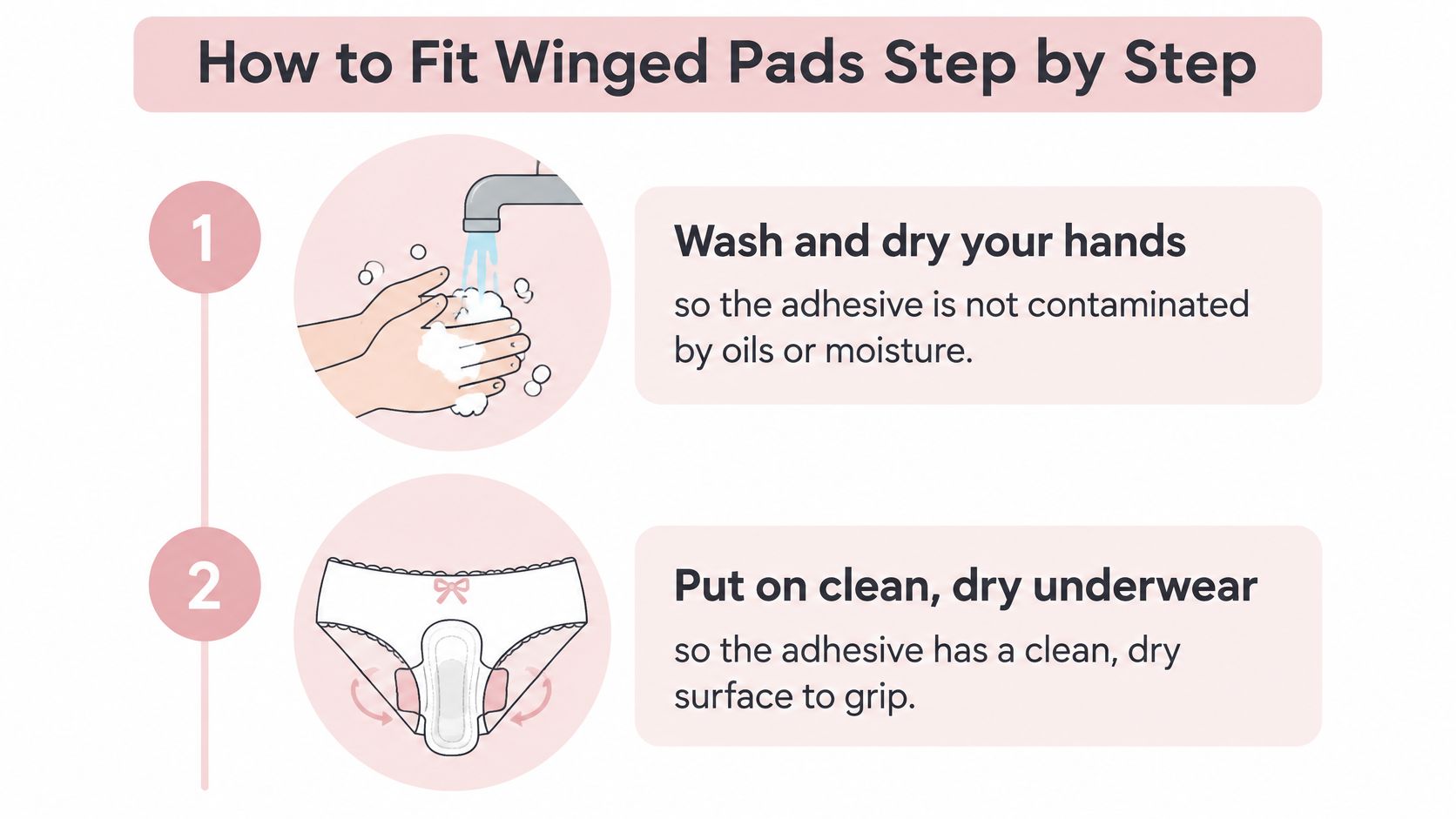
- Wash and dry your hands. Oils and moisture on your fingers degrade the adhesive before it ever touches fabric, which is why a pad that felt secure in the bathroom can shift an hour later.
- Put on clean, dry underwear that fits snugly. Loose fabric lets the wings lift away from the edge, and a lifted wing is an open gap. Save the looser pairs for liner days.
- Peel the release paper only when you're ready to place the pad. Leave the wing tabs covered until the pad is positioned. Adhesive exposed to air and fingertips loses grip, and it rarely bonds as well on a second attempt.
- Centre the pad over the gusset. The gusset is the panel between the legs of the underwear. An off-centre pad shifts the leak path to one edge, leaving the wing on the wrong side guarding nothing.
- Fold each wing around the edge and press for a few seconds. Run a finger along the full wing so it lies flat. A crease creates a channel that fluid can follow straight out.
- Sit, stand and walk before you trust it. Movement is the test. If the pad stays put through all three, the fitting is sound.
Removing the pad follows the same logic in reverse. Peel the wings off the underwear first instead of dragging the pad forward, fold it with the wings together so the wet surfaces face inwards, and wrap it in its wrapper or a disposal bag.
If a wing's adhesive leaves your skin sore where it has rubbed, the guidance behind dressing advice from Courier Pharmacy applies to skin contact generally: adhesives bond best on clean, dry, uncreased skin, and skin that's already irritated needs a barrier rather than another layer of the same adhesive.
Here's the fitting method in motion, including how the wings should sit around the gusset.
A good fit has three signatures. The pad feels flat under your hand rather than bulky or twisted. The wings stay bonded after you've walked around. And there's no pulling or bunching at the leg edge, which is the sensation that usually arrives just before a side leak.
Why Winged Pads Leak and How to Stop It
A headline like "heavy flow" tells you very little, because absorbency claims and protection aren't the same measurement. A technical specification used for sanitary pads delivers fluid to the centre at 15 ml per minute and checks whether liquid appears at the bottom or sides, and it specifies roughly 15 to 20 ml absorbency for the product category it tests, as described in this sanitary pad technical specification. The same specification recommends comparing equivalent market sizes or testing through an ISO/IEC 17025-accredited laboratory.
That matters because total capacity doesn't predict protection on its own. Acquisition speed, how fluid distributes across the core, compression under your body weight, and the integrity of the leak-proof layer all decide whether liquid escapes before the core is saturated. When you look at test data, ask whether the figure is total capacity or retained capacity under pressure, and don't compare regular, maxi and overnight formats without controlling for pad dimensions.
Wings should be assessed separately for attachment strength and edge containment. They stabilise and guard. They don't meaningfully increase how much the core can store.
| Symptom | Likely cause | Fix |
|---|---|---|
| Leakage at the join between pad and wings | Wings not pressed onto underwear, or worn adhesive | Re-seat the wings, press firmly and check the underwear fits closely |
| Side leaks while walking | Pad sitting off-centre over the gusset | Re-centre the pad and fold both wings evenly |
| Pad slipping or shifting | Underwear too loose or wings not fully adhered | Switch to snug underwear and smooth the wings flat |
| Leaks after several hours | Core saturated before the change interval | Change on the pack's schedule or move up one absorbency level |
| Persistent flooding | Flow beyond what the pad can contain | Seek advice from a GP or pharmacist |
The most common leak is a fit leak
Leakage at the point where the main pad meets the wings is the failure that product summaries skip past, and it's rarely about the core being full. The central absorbent area can be working perfectly while fluid travels sideways along the pad surface and out through a wing that never bonded or has lifted under movement.
Check the wing before you change anything else. Press it back down against the underwear edge, smooth it flat, and see whether the underwear itself is close-fitting enough to keep the wing in contact. If the pad has drifted forward or back, recentre it over the gusset. When the wings are seated and the leak still happens at the same point each time, the format is wrong for your anatomy or your movement pattern rather than your technique.
Saturating the core before the expected change interval is a different signal. That one calls for the next absorbency level up, or a longer format at night, not more adhesive.
Persistent flooding that goes through a pad every hour for several hours, or bleeding you'd describe as very heavy, is worth raising with a GP or pharmacist rather than solving with a different product.
What Winged Pads Cost Over a Cycle
Pack price hides the number you need. What a cycle costs is the price per pad multiplied by the number of pads you use, and that second figure varies far more than the first. Sainsbury's listed Bodyform Cour V Ultra Normal sanitary towels with wings, 12-pack, at £1.75, which is 15p per pad, according to the Sainsbury's period care range. Treat 15p as a simple reference point. It works like a ruler: once you know the unit cost, you can measure different usage patterns without guessing from the pack.
| Pads used per day | Pads per 28 days | Approximate cost per 28 days at 15p a pad |
|---|---|---|
| 4 | 112 pads | £16.80 |
| 6 | 168 pads | £25.20 |
| 8 | 224 pads | £33.60 |
The table gives you the comparison. Four pads a day across 28 days means 112 pads, so 112 x 15p brings the cycle to £16.80. Six pads a day means 168 pads, or £25.20. Eight pads a day means 224 pads, or £33.60. The jump looks larger than the pack price because the daily change habit repeats across the whole cycle.
The trade-off sits in which pad you use for which change. Reaching for an ultra-long night pad at every change pushes you toward the heaviest usage row and buys cost, bulk and waste you may not need. Wings help hold the pad in place and reduce side leakage, but they do not turn one pad into a higher-absorbency pad. A mixed plan, with a higher absorbency daytime pad on your heavy days and a standard winged pad on lighter ones, keeps the daily number lower while still meeting your flow.
Price is only part of the practical picture. An ActionAid UK poll found that 11% of women and people who menstruate had struggled to afford period products for themselves or a dependent during the previous year, as reported in ActionAid UK's period poverty poll. Affordability and access overlap. Free products aren't consistently available, safe disposal is often awkward, and asking for support carries stigma, particularly in temporary accommodation, schools, workplaces and shared housing.
Practical measures help more than they sound. A small pouch with one pad and one disposal bag covers an unexpected change without a trip to the shops. A zip pouch in a shared bag keeps the whole thing discreet. The habit is small, but it protects both your budget and your day.
Set Up Your Pad Plan for the Next Cycle
- Track your heaviest and lightest days across one cycle. The gap between them is what your plan has to handle, and it's usually wider than you'd guess.
- Match a winged format to each end of that range, using the format table earlier in this guide as the starting point.
- Buy a mixed pack for the heavy days, and check the cost per pad before you compare the pack price.
- Fit each pad using the steps above, then note any leak alongside the time it happened and its likely cause from the symptom table.
- Keep a spare pad and a disposal bag in your bag or at work, so an unplanned change doesn't become an unplanned purchase.
- Review after two cycles. If you leak at the same point every time, change the size or the fit rather than only the brand.
If any symptom in the leak table matches persistent flooding or very heavy bleeding, the next step is a conversation with a GP or pharmacist, not a larger pack.
If you sew, study fashion or dress a shop window, you'll recognise the same problem this guide keeps returning to: nothing sits right unless the form underneath is accurate. Display Guru supplies pin-friendly polystyrene tailors' dummies and body forms in sizes from a UK 6/8 through 18/20, along with garment rails and dump bins, so you can check how a piece of clothing hangs before you commit to the final fit. Browse the full range at Display Guru and get the fit right at the stage where it's easy to change.