



Double Clothes Rails: The Essential Guide to Space-Saving Solutions
At its heart, a double clothes rail is a wonderfully simple concept: it’s a storage rack built to give you twice the hanging space without taking up any extra room on the floor. With two parallel or tiered bars, it offers an instant, practical solution for anyone grappling with a crowded stockroom, a busy studio, or a bustling retail floor.
Why Double Clothes Rails Are a Game Changer for Your Space
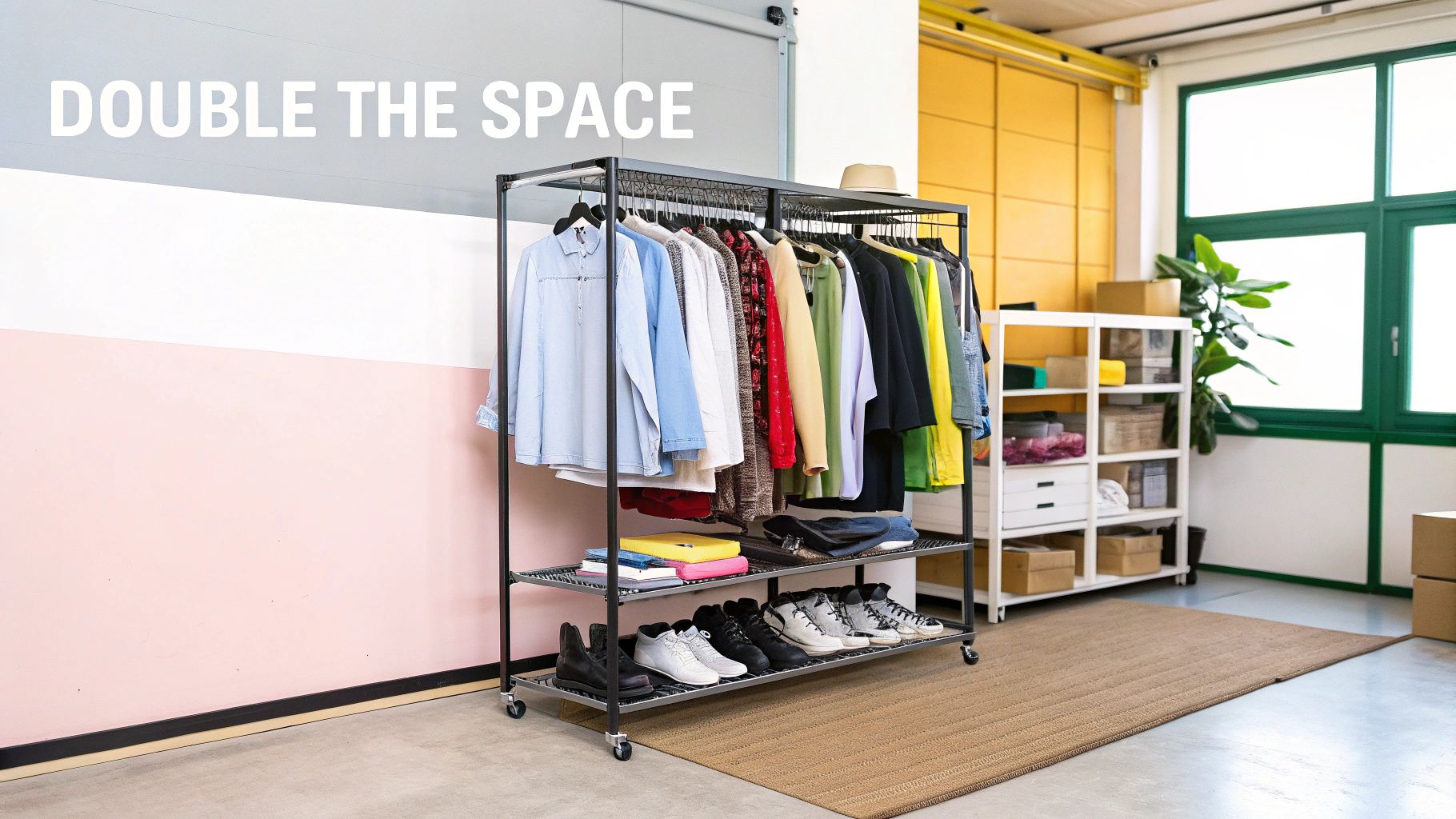
Picture a chaotic stockroom or a cramped design studio where every square inch is gold. For many professionals, the daily battle to manage inventory, juggle client projects, or organise costumes is all too real. This is where the humble double clothes rail transforms from a simple piece of storage into a genuinely strategic business tool.
Its most significant advantage is brilliantly straightforward: it doubles your hanging capacity on the exact same footprint. This one feature can bring immediate order to chaos, making it an indispensable piece of kit for anyone who works with garments.
Maximising Your Vertical Real Estate
The real magic of a double clothes rail lies in how cleverly it uses vertical space. Rather than letting your stock sprawl horizontally across several single rails, you start building upwards. This is an absolute lifesaver in places where floor space is at a premium, like a small boutique shop or a compact home studio.
This vertical-first approach delivers a few immediate wins:
- Space Efficiency: You suddenly free up valuable floor area for customer footfall, dedicated fitting rooms, or essential workstations.
- Smarter Organisation: Separating different garment types becomes a breeze. You could hang shirts and jackets on the top rail, with trousers or skirts neatly arranged below.
- Better Accessibility: When items are clearly divided and visible, finding exactly what you need is much faster, which is a huge boost to your workflow.
A Tool for Productivity and Presentation
For any professional, the right rail isn't just an expense; it's an investment in productivity. A disorganised space means time wasted hunting for items, the risk of stock getting damaged, and a generally frustrating environment to work in. Double clothes rails tackle these issues head-on. If you're looking for more ways to get the most from your setup, you can find great inspiration in different clothes rail storage ideas.
By creating a structured system for hanging clothes, these rails help professionals streamline their day-to-day work. For a retailer, that means quicker stocktakes. For a tailor, it means faster access to a client’s project.
In the end, this simple upgrade supports a more efficient way of working. It helps retailers, designers, and creative teams solve their most pressing storage and display problems, proving that sometimes the right equipment really does make all the difference.
Getting to Know the Double Clothes Rail
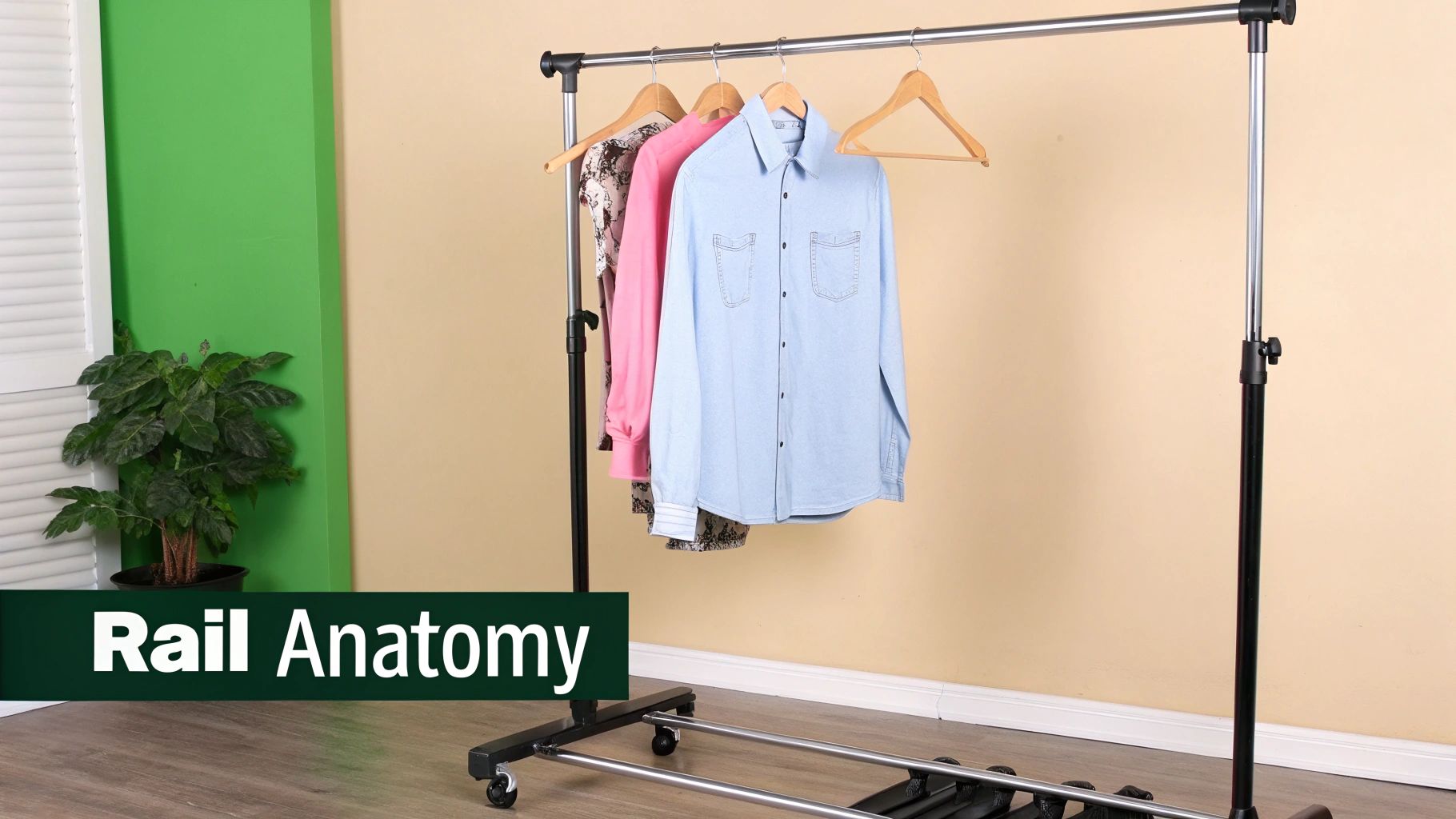
Before you can pick the right double clothes rail, it pays to know what makes a great one tick. It’s not just a single piece of equipment; it's a system of parts all working together. Once you understand the anatomy of a good rail, you can spot quality and make a choice that will stand up to years of professional use.
We'll look at everything from tiered rails that create stunning high-low visual displays to fully adjustable models that give you complete control. Getting to grips with these details is the key to finding a rail that truly fits the demands of your workspace.
The Foundation: The Base Frame
The stability of any clothes rail begins and ends with its base. Think of it as the foundation of a house—if it's weak or poorly designed, the whole structure becomes a liability. In the professional world, you'll mainly come across two designs.
- H-Frame Base: This is the workhorse. A classic rectangular shape with four solid points of contact on the floor, the H-frame offers incredible stability. It's the perfect choice for static displays or any situation where you don't need to move the rail around constantly.
- Z-Frame Base: This clever design is a real space-saver. The 'Z' shape allows you to nest multiple rails together when they’re not in use, which is a massive bonus for busy stockrooms. If you're an event company or a theatre needing to store a fleet of rails compactly, this is the one for you.
Ultimately, the choice comes down to your daily workflow. H-frames offer unwavering support, while Z-frames bring brilliant, space-saving convenience to the table.
The Backbone: Vertical Uprights and Steel Gauge
Moving up from the base, the vertical uprights are the pillars that bear the entire weight of your stock. Their strength is non-negotiable, especially if you’re hanging heavy garments like winter coats or leather jackets. That strength comes down to one thing: the steel gauge.
Steel gauge is a simple idea that works in reverse: the lower the gauge number, the thicker and stronger the steel. A proper heavy-duty rail might use 16-gauge steel, whereas a flimsy domestic one could be made from a much thinner 22-gauge. It’s like comparing the foundations of a skyscraper to those of a garden shed—both do a job, but only one is built for serious, heavy-duty work.
A professional-grade double clothes rail must be built from low-gauge steel to stop it from bowing or buckling under pressure. This single detail is often the most critical factor in its long-term performance and safety.
Mobility and Control: Industrial-Grade Castors
What really separates a good rail from a great one is how easily it moves. For any professional setting, industrial-grade castors (the wheels) are an absolute must. They let you glide a fully loaded rack across a shop floor or stockroom smoothly and safely.
You'll want to look for castors made from durable materials like rubber or polyurethane, as these won't scratch your floors and can handle minor bumps without a fuss. For safety, it’s vital that at least two of the four wheels have locking brakes. This is a non-negotiable feature that stops a heavy, loaded rail from rolling away on its own, especially on slightly uneven surfaces.
The way we shop has made these features more important than ever. In the UK, sales of double-tier garment rails shot up by 42% between 2021 and 2023 as retailers looked for smart, space-efficient solutions for compact high-street shops and the boom in e-commerce. You can find more insights on why heavy-duty clothes rails are necessary over on theshopfittingshop.co.uk.
By understanding these core components—the base, the uprights, and the castors—you’re now ready to select a double clothes rail that isn't just a purchase, but a lasting asset for your business.
Choosing the Right Material for Maximum Durability
When you're investing in a double clothes rail, the material it's made from is everything. It’s what separates a reliable workhorse from a wobbly disaster waiting to happen. Think of it like choosing tyres for a lorry; you wouldn't fit it with bicycle wheels and expect it to handle a heavy load. This choice directly affects how much weight your rail can safely hold and how it copes with the daily grind of a professional setting.
The key is to match the rail's construction to what you'll actually be using it for. The needs of a bridal boutique with heavy, delicate gowns are a world away from a pop-up shop selling lightweight t-shirts. Let’s get into the materials that really stand up to the job.
Heavy-Duty Steel: The Professional Standard
For any serious commercial use, there’s really only one contender: heavy-duty steel. It’s the backbone of the industry for a reason. Its incredible strength means it can support a huge amount of weight without buckling or bending, which is a non-negotiable for busy stockrooms, retail floors, or theatre wardrobes. We're not talking about the flimsy tubing you find in high street flat-pack furniture; this is industrial-grade steel built for the long haul.
But raw strength is only half the story. The finish is what protects the steel and keeps it looking smart. The two best options you'll come across are chrome plating and powder coating.
- Chrome-Plated Steel: This is the classic choice, giving the rail a bright, polished, and professional look that fits seamlessly into most retail environments. More than just looks, the chrome provides a tough, slick surface that’s highly resistant to scratches, scuffs, and rust. It’s built to withstand the constant clatter of hangers.
- Powder-Coated Steel: This modern finish is created by electrostatically applying a dry powder that's then baked on. The result is a thick, durable coating that's even tougher than traditional paint. It’s exceptionally good at resisting chips and corrosion, and it often comes in different colours – black is a very popular choice for creating a sharp, contemporary vibe.
For nearly any professional job, a steel frame with one of these finishes is the only way to go. It’s a choice for reliability.
What Does "Load Capacity" Really Mean?
You’ll see the term "load capacity" thrown around a lot, but what does a figure like 100kg actually look like in your stockroom? It's easy to dismiss these numbers, but they translate directly into operational peace of mind.
A high load capacity means you can fill the rail with your heaviest stock without a second thought. For anyone who depends on their equipment day in, day out, knowing what different materials can handle is crucial. If you want to dive deeper into this, our guide on selecting a clothes rail heavy duty model is a great resource.
A heavy-duty steel double clothes rail rated for 150kg isn’t just a statistic. It’s the ability to confidently hang around 60 heavy winter coats or well over 200 t-shirts without worrying about stability or safety.
Putting it into practice is what matters. A cheap domestic rail might only be rated for 20kg, which would struggle to hold ten winter jackets before it starts to sag. The golden rule is to always pick a capacity that gives you plenty of breathing room above your heaviest expected load.
Material and Load Capacity Comparison for Double Clothes Rails
To make your decision a bit easier, it helps to see the main options side-by-side. The table below outlines the key differences in common materials, helping you match their strengths to your specific professional needs.
| Material Type | Typical Load Capacity | Best For | Pros | Cons |
|---|---|---|---|---|
| Chrome-Plated Steel | 100kg - 150kg | Retail floors, showrooms, design studios, and busy stockrooms. | Extremely durable, scratch-resistant, professional appearance, resists corrosion. | Can be heavier, higher initial investment. |
| Powder-Coated Steel | 100kg - 150kg | Warehouses, theatrical wardrobes, stockrooms, modern retail spaces. | Very resistant to chipping and rust, available in multiple colours, tough finish. | A deep scratch can expose the steel underneath, potentially leading to rust if not treated. |
At the end of the day, choosing the right material for your double clothes rails is an investment in your own efficiency, safety, and sanity. Opting for a quality steel construction with a durable finish isn't just buying a product; it’s getting a reliable tool that’s built to perform under pressure.
Strategic Space Planning for Your New Rails
We’ve all been there. You find the perfect piece of equipment, get it back to your space, and… it doesn’t fit. It’s a frustrating and completely avoidable problem, especially with something as functional as a double clothes rail. Proper planning isn't just about measuring the floor; it’s about visualising how the rail will actually work in your environment, whether that’s a bustling shop floor, a tight stockroom, or a home studio.
A little forethought ensures your new rail becomes an asset, not an obstacle. A well-placed rail can transform your workflow, but a poorly planned one will just get in the way. Let's walk through how to get it right from the start.
Measure Your Space with Purpose
Before you even start looking at rails, grab a tape measure. You need to think about the rail's total operational area, not just the spot where it will stand.
Here are the key measurements to nail down:
- Footprint (Width and Depth): Measure the floor space you’ve allocated. Don't forget to check the base dimensions on the product specs—some frames, like Z-rails, have a different footprint than the hanging space above.
- Vertical Clearance (Height): This one is vital for double rails. Measure from the floor to the lowest point on your ceiling, like a light fitting or sprinkler. This ensures you have enough room to use an adjustable rail at its maximum height.
- Aisle Width (Movement Space): This is the measurement people forget most often. You need enough room for customers or staff to move around the rail, browse clothes, and manoeuvre trolleys or other equipment without creating a bottleneck.
In a commercial setting, you should aim for a minimum aisle width of 90cm (about 3 feet) to ensure accessibility and a smooth flow of traffic. Even in smaller spaces, make sure there’s enough room to walk past a fully loaded rail without brushing against it.
Plan for Garment Types and Workflow
With your measurements in hand, it’s time to think about what you’ll actually be hanging on the rail. The type of clothing directly impacts the vertical space you need between the two rails and from the bottom rail to the floor.
A tiered setup is often the most efficient way to use a double rail. For example, you might have one rail dedicated to longer items like coats and dresses, with a double rail next to it for shorter items. If you need to mix garments on a single unit, an adjustable model is your best friend.
Here’s a quick checklist to help you plan your layout:
- Long Garments: Do you stock full-length dresses or long coats? Make sure at least one rail gives you enough drop (usually 160-180cm) to keep them from dragging on the floor.
- Tiered Items: A double rail is perfect for tops, shirts, and folded trousers. Plan for about 100cm of height for each tier to give the garments enough breathing room.
- Workflow Path: Think about the rail's journey. Where does it need to go? Map its route from the delivery area to the stockroom and out to the shop floor, making sure it can get through doorways and around corners easily.
Of course, the material of the rail itself plays a huge part in how it performs and looks within your space.
This simple graphic breaks down the two most popular materials used in professional-grade rails.
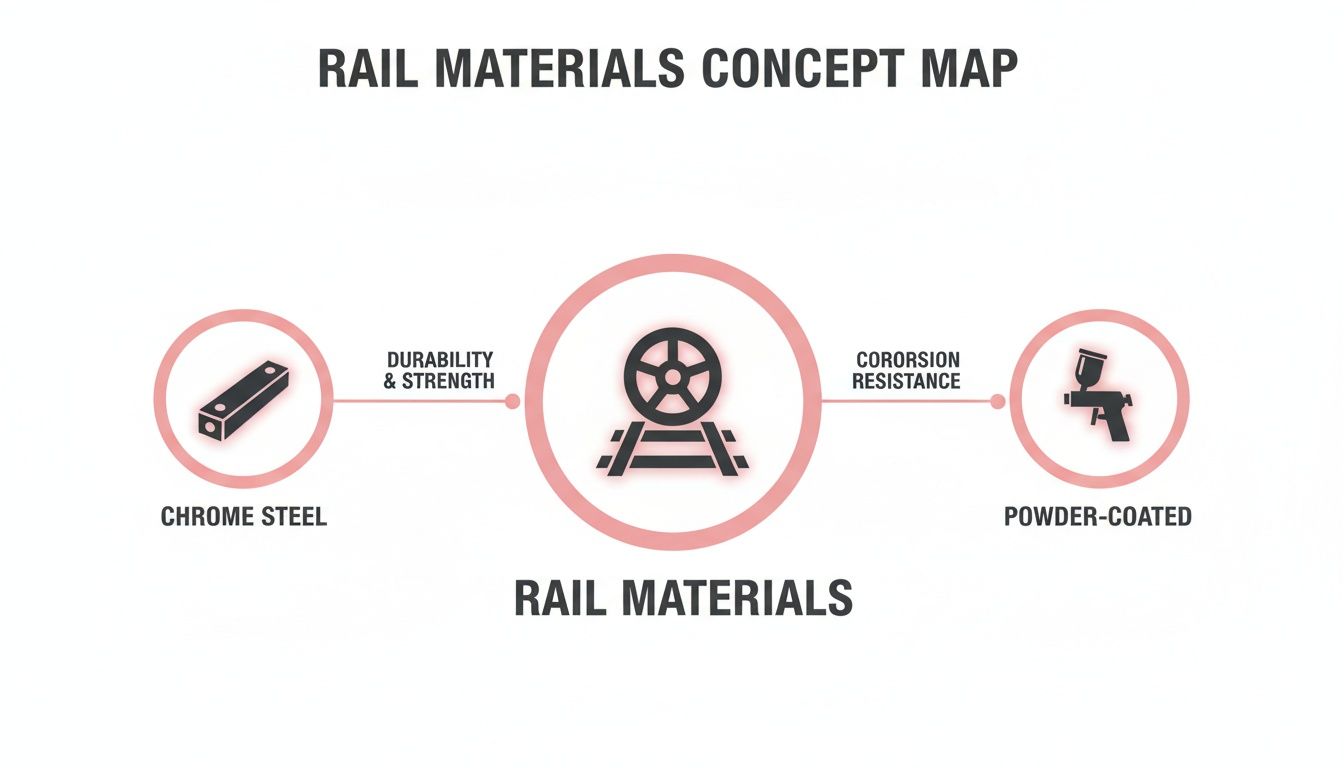 Ultimately, choosing between chrome and powder-coated steel is about balancing long-term durability with the aesthetic you're trying to create.
By taking a few moments to think through these steps, you can be confident that your new double clothes rails will work for you, not against you. And if floor space is your biggest challenge, remember that freestanding units aren't your only option. To explore alternatives, check out our guide on wall mounted clothes rail systems.
Custom Solutions for Retailers, Tailors, and Studios
A double clothes rail is so much more than just a place to hang clothes; it’s a workhorse that can solve real-world problems on a busy shop floor, in a meticulous tailor’s workshop, or behind the scenes in a theatre. Its real value comes to life when you put it to work in these demanding environments.
Forget just hanging more garments. We’re talking about building a system that boosts efficiency, sharpens your presentation, and tames the chaos of day-to-day operations. Let's break down how different professionals can get the most out of these incredibly useful pieces of kit.
For the Retailer: Dynamic Merchandising and Stock Control
In retail, looks are everything. A double clothes rail gives you a brilliant canvas for creative merchandising that tells a story and guides the customer’s eye. Using a tiered setup, you can create high-low displays that are far more engaging than a flat line of hangers. Imagine placing blouses on the top rail with perfectly coordinated trousers or skirts hanging just below—you're not just selling clothes, you're selling an outfit.
This vertical approach isn't just about looking good; it's smart business. Double clothes rails have become a cornerstone of UK retail, and the numbers back it up. A recent report shows these designs make up 38% of UK commercial purchases, with the market itself growing at an 8.5% CAGR. It’s no surprise when you hear that visual merchandisers across the country favour double-tier rails for their capacity, with some city trials reporting a 30% uplift in sales per square foot.
And what about the stockroom? These rails are an organiser's dream. They allow you to pack your backstock in neatly, separating everything by size, colour, or collection. This means your team can find what a customer needs or restock the floor in a fraction of the time. Our guide on retail display stands has even more ideas for creating displays that pop.
For the Tailor and Designer: Organising by Project Stage
If you’re a tailor or designer, you know how quickly a studio can descend into chaos with projects at different stages. A double clothes rail offers a deceptively simple way to manage that workflow, creating a clear visual divide between jobs and preventing mix-ups.
Think of it as a mobile production line:
- Top Rail: This is for finished client garments, ready and waiting for collection. Keeping them up high keeps them pristine and safely away from works-in-progress.
- Bottom Rail: This is your 'in-tray'. You can use simple dividers to separate projects for different clients or to mark items as 'awaiting fitting' or 'alterations needed'.
Suddenly, you have an intuitive system. A quick glance tells you exactly what needs your attention and what's ready to go. Because the rail is on wheels, you can move an entire client's project from the cutting table to the sewing machine and on to the finishing area without ever taking a single piece off its hanger.
A well-organised double rail system transforms a chaotic workspace into a streamlined operation. It cuts down the time spent searching for items and minimises the risk of mixing up client orders—a lifesaver in the world of bespoke.
For Theatrical and Wardrobe Departments: Character-Driven Organisation
In the world of theatre and film, everything comes down to speed and accuracy. Wardrobe departments are juggling hundreds of costume pieces, and a quick change during a live show can happen in the blink of an eye. Double clothes rails are the key to managing that organised chaos backstage.
The best approach? Organise by character. Assign each character a section of a rail, with their complete outfits hung together. The two-tier design is perfect for this—a jacket, shirt, and waistcoat can hang on top, with the matching trousers on the bottom. You can even hang hats or bags from the rail ends. Of course, for any business, getting those items delivered efficiently is just as important. Services like Same Day Clothes Delivery Melbourne show how crucial logistics can be for local boutiques and studios.
By setting up rails for specific scenes or acts, wardrobe managers can prepare for quick changes with military precision. A fully loaded rail can be wheeled into the wings moments before it’s needed, ensuring every piece of a costume is exactly where it needs to be. That’s a level of organisation you just can’t achieve with single rails, and it shows how the right equipment is fundamental to a flawless production.
Getting Set Up and Keeping It That Way
You’ve chosen a quality double clothes rail, and now it's time to make sure it works hard for you for years to come. A little attention during setup and some simple, regular checks will keep it strong, stable, and looking professional. Think of it like any other essential tool in your kit – a quick once-over now prevents major headaches later.
This isn't just about protecting the rail itself; it's about safeguarding the valuable garments you hang on it. Follow these best practices, and your rail will remain a safe, effective, and reliable part of your workspace.
A No-Fuss Assembly Guide
Putting together a heavy-duty double rail is usually a breeze, but a few insider tips can make it even smoother and help you sidestep common frustrations. Before you do anything, lay out all the parts and give them a quick check against the instructions.
- Start from the Ground Up: Always attach the castors to the base frame first. It’s far easier to do this while the base is lying flat on the floor. Use the spanner they provide and make sure they're properly tight.
- Raise the Uprights: Next, slot the two vertical posts into the base. Most professional rails use a simple push-fit or a spring-loaded button that clicks satisfyingly into place.
- Slot in the Rails: Add the lower rail first, especially if it's adjustable. Once that’s set to the height you need, fit the top rail. Double-check that any locking pins or mechanisms are fully engaged.
Once it's all together, give the frame a firm but gentle shake. A properly assembled rail should feel rock-solid, with no wobble or sway.
Long-Term Care and Staying Safe
Good maintenance is all about forming simple habits. A few minutes spent on regular checks will keep your double rails in prime condition, ensuring they roll smoothly and stand safely.
The golden rule of safety is simple: always load heavier items on the bottom rail. This simple action lowers the rail's centre of gravity, making it dramatically more stable and far less likely to tip over.
Here are a few essential habits to get into:
- Weekly Fixing Check: Take a moment to glance over all the connection points, screws, and locking pins to confirm they’re still tight.
- Regular Rail Wipe-Down: Use a soft, damp cloth to wipe down the rails. This removes any dust or grime that could easily transfer onto pristine fabrics.
- Castor Care: Threads, hair, and general floor debris love to get tangled in the wheels. A quick clean-out keeps them rolling smoothly and prevents frustrating jams.
The growing use of double clothes rails in the UK speaks volumes about their utility. The garment rail storage sector has blossomed into a £570 million market in Europe, and in the UK, double-tier models now have a 45% penetration in demanding sectors like hospitality. Retailers who use models with high-quality castors have even reported a 22% faster stock rotation, which is a clear win for operational efficiency.
Finally, always respect the weight limit provided by the manufacturer. Overloading is the single quickest way to cause permanent damage and create a serious safety risk. When you need to move a fully loaded rail, push it slowly and with care, especially when navigating corners or doorways. For more ideas on organising your space, check out our article on clothes rail and brackets.
Frequently Asked Questions
Even after you've done your research, a few practical questions always pop up just before you commit. We get it. Investing in new kit is a big decision, so let's tackle the most common queries we hear about double clothes rails. Think of this as the final check to make sure you're getting exactly what you need.
What Is the Maximum Weight a Heavy Duty Double Clothes Rail Can Hold?
You can expect a well-built, heavy-duty double rail made from industrial-grade steel to handle a substantial load, typically between 100kg and 150kg. Of course, always double-check the manufacturer's specific rating.
To put that into perspective, that's more than enough to hold a full rail of heavy winter coats, leather jackets, or a dense collection of suits without breaking a sweat. Just remember to spread the weight evenly across both rails to keep it stable.
Can I Adjust the Height of Both Rails Independently?
This is a classic "it depends on the model" situation, and it's a crucial detail to watch for. Many professional rails offer height adjustment, but independent control for each rail is a premium feature.
Some designs have a fixed top rail and an adjustable bottom one, while others allow both to move freely. If your displays change often, look for a model that gives you the exact flexibility you need.
A popular retail trick is to use a fixed top rail for a consistent visual line and an adjustable lower rail. This lets you adapt to different garment lengths—like swapping long coats for shorter jackets—as the seasons change.
Are the Wheels Suitable for All Floor Types and Can They Be Locked?
Absolutely. Professional rails are built for the real world, so they come fitted with durable castors that glide smoothly over most commercial flooring, from polished concrete and wood to low-pile carpet.
For safety, any decent model will have locking brakes on at least two of the wheels. This is a non-negotiable feature in a busy shop or a bustling backstage area, as it stops the rail from rolling away at the worst possible moment.
How Do I Prevent a Fully Loaded Double Clothes Rail from Tipping Over?
It all comes down to smart loading and basic physics. To keep the rail grounded, always follow these simple rules:
- Load from the bottom up. Place your heaviest items on the lower rail first. This creates a low centre of gravity, making the whole unit much more stable.
- Distribute weight evenly. Don't pile all your heavy stock on one end. Spread the load along the full length of each rail and balance it between the top and bottom.
- Check your foundations. Make sure the rail is on a level floor, and once it’s where you want it, always engage the wheel locks.
For a complete range of professional-grade garment rails, mannequins, and retail display solutions, explore the collection at Display Guru. Find the perfect tools to organise your space and showcase your work at https://www.displayguru.co.uk.